eBook - ePub
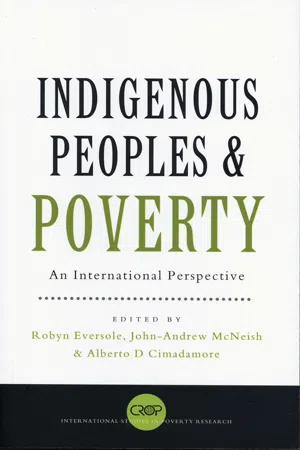
Indigenous Peoples and Poverty
An International Perspective
- English
- ePUB (mobile friendly)
- Available on iOS & Android
eBook - ePub
Indigenous Peoples and Poverty
An International Perspective
About this book
This book brings together two of today's leading concerns in development policy - the urgent need to prioritize poverty reduction and the particular circumstances of indigenous peoples in both developing and industrialized countries. The contributors analyse patterns of indigenous disadvantage worldwide, the centrality of the right to self-determination, and indigenous people's own diverse perspectives on development. Several fundamental and difficult questions are explored, including the right balance to be struck between autonomy and participation, and the tension between a new wave of assimilationism in the guise of 'pro-poor' and 'inclusionary' development policies and the fact that such policies may in fact provide new spaces for indigenous peoples to advance their demands. In this regard, one overall conclusion that emerges is that both differences and commonalities must be recognised in any realistic study of indigenous poverty.
Information
1 | Introduction: indigenous peoples and poverty
JOHN-ANDREW MCNEISH AND ROBYN EVERSOLE
Why write about indigenous peoples and poverty?
In recent years poverty has moved to the centre of international development policy. ‘Development’ itself has failed to provide answers to human suffering and disadvantage, or to fulfil its broad promise to make poor people better off, eventually. Gone are the days of easy assumptions that industrial development, or technological progress, or cooperative economic activity, or enterprise development will automatically mend what is lacking when people are poor. Now the focus is upon that lack itself – defining it, measuring it, and sometimes even venturing to ask directly: What can actually be done about poverty?
Encouragingly, there appears to be a growing international consensus that poverty – and doing something about poverty – is the key development issue (Maxwell 2003). The UNDP has placed the eradication of poverty at the top of its list of Millennium Development Goals (MDGs). Concurrently, the World Bank has published the Voices of the Poor report and hosts the online site Poverty Net. More importantly, the Bank and the International Monetary Fund have made the national production of Poverty Reduction Strategy Papers (PRSPs) a condition of debt relief. The chorus of voices worldwide giving attention to poverty suggests that there is a real will to do something about it. Yet this rhetoric can easily lead on to dangerous ground. Suddenly, it seems, poverty is a concrete thing that can be identified, measured and fought. And the poor too easily become a category of people, homogenous in their poverty, awaiting outsiders’ efforts to assist them.
Who are ‘the poor’ anyway? Indicators and methods for measuring poverty attempt to offer an answer – to assess who is ‘in’ and who is ‘out’ of this particular group. There is of course no such group. Being ‘poor’ is simply a conceptual category, a category one may place oneself in, or be placed in by others: one’s neighbours, one’s government, or people on the other side of the world. Someone may end up in this category, poor, for extremely diverse and shifting reasons, in an enormous variety of contexts, based on vastly different experiences and indicators: from the inability to pay the rent, to the impossibility of sponsoring a village festival, to the inaccessibility of schools for one’s children. Given the huge variety of experiences the term encompasses, how can we even begin to talk about poverty?
Yet talking about poverty is useful, because these conversations call attention to patterns, and in doing so, they offer a lens for analysis. Where is poverty – however defined – always more prevalent? In what kinds of situations, in what places, in what roles, are people around the world most likely to be poor? Clearly, there are patterns. Once a pattern is recognized, it is possible to analyse it: to follow it back to source, to understand why that pattern exists. If there is observable disadvantage for a group of people, there are sure to be reasons behind it. Unearthing the reasons – discovering what creates a situation of disadvantage – is a solid first step towards understanding what can be done to reduce or eliminate poverty.
This book acknowledges and explores one key pattern of poverty: the fact that around the world, in vastly different cultures and settings, indigenous peoples are nearly always disadvantaged relative to their non-indigenous counterparts. Their material standard of living is lower; their risk of disease and early death is higher. Their educational opportunities are more limited, their political participation and voice more constrained, and the lifestyles and livelihoods they would choose are very often out of reach.
The United Nations estimates that there are at least 300 million people in the world who are indigenous – belonging to 5,000 indigenous groups in more than seventy countries (UN 2002). Not all the people in all these indigenous groups are poor. Many are not. But in country after country, region after region, the pattern repeats itself: people who are indigenous are much more likely to be poor than their non-indigenous counterparts. There is, in the terminology of Psacharopoulos and Patrinos (1994), a ‘cost’ to being indigenous. These authors’ attempt to quantify disadvantage in Latin American countries showed how being indigenous regularly correlated to being below the poverty line, having less schooling and lower earnings. In Peru, for instance, they found that indigenous peoples were one and a half times as likely to be below the economic poverty line as non-indigenous Peruvians. And indigenous Peruvians were almost three times as likely to be extremely poor. In Guatemala, 38 per cent of all households were extremely poor – but the figure was 61 per cent for indigenous households (ibid.: xviii).
In an international consultation in 1999, the Director-General of the World Health Organization made the following observations about the status of indigenous peoples around the world:
Life expectancy at birth is 10 to 20 years less for indigenous peoples than for the rest of the population. Infant mortality is 1.5 to 3 times greater than the national average. Malnutrition and communicable diseases, such as malaria, yellow fever, dengue, cholera and tuberculosis, continue to affect a large proportion of the indigenous peoples around the world … Indigenous peoples are over-represented among the world’s poor. This does not mean only that they have low incomes … indigenous people are less likely to live in safe or adequate housing, more likely to be denied access to safe water and sanitation, more likely to be malnourished … (Brundtland 1999)
In most countries, indigenous peoples have less access to education than other groups, and they are often subjected to curricula designed for other cultural groups which ignore their own history, knowledge and values. Indigenous peoples also tend to have less access to national health systems and appropriate medical care, and may suffer nutritional problems when denied access to their traditional lands. Overall, according to a statement from the United Nations Working Group on Indigenous Populations, ‘indigenous peoples worldwide continue by and large to be disadvantaged in every area of life’ (Daes 2000). Martínez Cobo, in an earlier study of discrimination against indigenous peoples, reached a very similar conclusion: indigenous peoples were ‘at the bottom of the socio-economic scale. They did not have the same opportunity for employment and the same access as other groups to public services and/or protection in the fields of health, living conditions, culture, religion and the administration of justice. They could not participate meaningfully in political life’ (Martínez Cobo 1986, quoted in Daes 2000).
While data on indigenous disadvantage are available from some countries (though often not using definitions or formats that are comparable across countries), there is a general lack of reliable national-level data on indigenous peoples in many parts of the world; also, the accuracy of such data is sometimes disputed between government authorities and indigenous groups (PFII 2003). In many countries, reliable data with which to compare poverty indicators by ethnicity at the national level are simply not available (see, e.g., Plant 2002: 31; Damman this volume). Even in Australia, a committee headed by the prime minister recently concluded that ‘the Australian Government lacks any meaningful data about Indigenous people, making it impossible to tell whether conditions are getting better or worse’ (ABC 2003). Nevertheless, it is clear that ‘in all major practical areas, Indigenous Australians are worse off than non-Indigenous Australians’ (ibid.; cf. USDS 2002).
From wealthy countries to poor countries, from East to West, patterns of indigenous disadvantage persist. In India, for instance, about 8 per cent of citizens belong to scheduled tribes – and 80 per cent of these live below the poverty level (USDS 2002). Nor does the situation for indigenous peoples necessarily improve when they form the majority of national populations. In Bolivia, for instance, where indigenous peoples comprise over half the national population, and indigenous languages are now recognized as official national languages, we still find that between two-thirds and three-quarters of indigenous Bolivians are poor – they are much more likely to be poor than non-indigenous Bolivians (Psacharopoulos and Patrinos 1994: xviii, xix).
Reports from the various meetings of the United Nations Working Group on Indigenous Populations (WGIP) highlight that, for specific countries and areas, there are clear cases of indigenous peoples’ disadvantage relative to non-indigenous people – including direct violations of human rights. Note, for instance, the following excerpts:
A number of indigenous participants from, among other places, Australia, Canada, Guatemala, Cameroon, the Philippines and the United States of America reported that their Governments had failed to protect the rights of indigenous peoples and that human rights violations were taking place. They claimed that Governments and, in particular, military authorities were violating international human rights standards, inter alia through summary and arbitrary arrests and killings, use of violence, forced displacement of indigenous peoples and confiscation or denial of access to their communal and individual property.
A number of indigenous observers from, among other places, Bangladesh, Ecuador, Indonesia, Nepal, New Zealand, Peru and the Russian Federation stressed the importance of the recognition of their right to land and control over natural resources. In this regard, activities of certain TNCs [transnational corporations] were considered detrimental to indigenous peoples.
The issue of institutionalized discrimination against indigenous peoples was also seen as a reality in many countries. In this regard, references were made to the problems associated with administration of justice, including arbitrary detention, and access to social security and health care, including HIV/AIDS treatment for indigenous peoples. (UNHCR 2003: 7)
In many different parts of the world, across many different cultures, a pattern emerges in people’s varied experiences of poverty. It is only one among many, but it may explain something very important. A clear pattern links indigenous peoples and poverty. What does this mean? Exploring this pattern, analysing it, can take us beyond facile assumptions about poverty and how to fight it. By asking the question Why are indigenous peoples, despite all their diversity of cultures and contexts, disproportionately affected by poverty? we begin a discussion that can illuminate the reasons for this pattern, and can then find strategies to address them.
Defining indigenous peoples
In the mid-1980s, the United Nations Sub-Commission on the Prevention of Discrimination and the Protection of Minorities commissioned a study into discrimination against indigenous peoples. The resulting five-volume report (1986) uses the following definition of indigenous peoples:
Indigenous communities, peoples and nations are those which, having a historical continuity with pre-invasion and pre-colonial societies that developed on their territories, consider themselves distinct from other sectors of the society now prevailing in those territories, or parts of them. They form at present non-dominant sectors of society and are determined to preserve, develop and transmit to future generations their ancestral territories, and their ethnic identity, as the basis of their continued existence as peoples, in accordance with their own cultural patterns, social institutions and legal systems. (Martínez Cobo 1986)
This definition was accepted by an international gathering of indigenous peoples in July 1996; nevertheless, defining indigenous peoples is still problematic (WGIP 1996). Given the great diversity of the world’s indigenous peoples, trying to include them all under a single definition is difficult, and any definition often contested. Even the process of establishing any definition at all of who is and who is not indigenous can itself be offensive to those tired of being defined and categorized by outsiders. Self-identification, many say, is at the heart of indigenous identity. In the United Nations Working Group meetings on the Draft Declaration on the Rights of Indigenous Peoples, the following concerns were expressed:
In a statement on behalf of all the indigenous organizations participating, it was maintained that a definition of indigenous peoples was unnecessary and that to deny indigenous peoples the right to define themselves was to delimit their right of self-determination. It was claimed that the right of self-determination required that indigenous peoples define themselves without outside interference. They reiterated, together with several Governments, the need for a declaration with universal application. (CHR 1996: 7)
Definitions by their nature draw rigid lines, while identity can be more fluid – both for groups, and for the individuals who comprise them. Many people would prefer not to define indigenous peoples at all.
Yet while formal definitions may be problematic, the term does acknowledge clear commonalities of experience amongst diverse peoples – commonalities that have stimulated the formation of international organizations, alliances and working groups, and which require at least a name. The umbrella term indigenous peoples, as indicated by the definition above, highlights the important common characteristics that these many diverse peoples share: being original inhabitants of a land later colonized by others, and forming distinct, non-dominant sectors of society, with unique ethnic identities and cultural systems. Other commonalities, hinted at in the Martínez Cobo definition, include strong ties to land and territory; experiences or threats of dispossession from their ancestral territory; the experience of living under outside, culturally foreign governance and institutional structures; and the threat of assimilation into dominant sectors of society and loss of distinctive identity. The identifier indigenous peoples flags these kinds of basic similarities in peoples’ histories and current identities.
Such peoples include the Aborigines or First Nations of Australia, New Zealand and North America; the hill tribes, ethnic minorities, ethnic nationalities, original inhabitants, scheduled tribes and other indigenous groups of Asia and the subcontinent; the indigenous campesinos (‘peasants’) or indios (‘Indians’) of Latin America; the indigenous peoples of Russia an...
Table of contents
- Cover
- Title Page
- Copyright
- Contents
- List of tables and maps
- 1 Introduction: indigenous peoples and poverty
- One | Indigenous poverty
- Two | Indigenous peoples in nation-states: rights, citizenship and self-determination
- Three | Indigenous peoples’ perspectives on development
- About the contributors
- Index
Trusted by 375,005 students
Access to over 1.5 million titles for a fair monthly price.
Study more efficiently using our study tools.
Frequently asked questions
Yes, you can cancel anytime from the Subscription tab in your account settings on the Perlego website. Your subscription will stay active until the end of your current billing period. Learn how to cancel your subscription
No, books cannot be downloaded as external files, such as PDFs, for use outside of Perlego. However, you can download books within the Perlego app for offline reading on mobile or tablet. Learn how to download books offline
Perlego offers two plans: Essential and Complete
- Essential is ideal for learners and professionals who enjoy exploring a wide range of subjects. Access the Essential Library with 800,000+ trusted titles and best-sellers across business, personal growth, and the humanities. Includes unlimited reading time and Standard Read Aloud voice.
- Complete: Perfect for advanced learners and researchers needing full, unrestricted access. Unlock 1.5M+ books across hundreds of subjects, including academic and specialized titles. The Complete Plan also includes advanced features like Premium Read Aloud and Research Assistant.
We are an online textbook subscription service, where you can get access to an entire online library for less than the price of a single book per month. With over 1.5 million books across 990+ topics, we’ve got you covered! Learn about our mission
Look out for the read-aloud symbol on your next book to see if you can listen to it. The read-aloud tool reads text aloud for you, highlighting the text as it is being read. You can pause it, speed it up and slow it down. Learn more about Read Aloud
Yes! You can use the Perlego app on both iOS and Android devices to read anytime, anywhere — even offline. Perfect for commutes or when you’re on the go.
Please note we cannot support devices running on iOS 13 and Android 7 or earlier. Learn more about using the app
Please note we cannot support devices running on iOS 13 and Android 7 or earlier. Learn more about using the app
Yes, you can access Indigenous Peoples and Poverty by Robyn Eversole, John-Andrew McNeish, Alberto D. Cimadamore, Robyn Eversole,John-Andrew McNeish,Alberto D. Cimadamore in PDF and/or ePUB format, as well as other popular books in Social Sciences & Sociology. We have over 1.5 million books available in our catalogue for you to explore.