'A fireball of terse information.'
Oliver Stone
'A remarkable collection. Blum concentrates on matters of great current significance, and does not pull his punches. They land, backed with evidence and acute analysis.'
Noam Chomsky
For over sixty-five years, the United States war machine has been on automatic pilot. Since World War II we have been conditioned to believe that America's motives in 'exporting' democracy are honorable, even noble.
In this startling and provocative book, William Blum, a leading dissident chronicler of US foreign policy and the author of controversial bestseller Rogue State, argues that nothing could be further from the truth.
Moreover, unless this fallacy is unlearned, and until people understand fully the worldwide suffering American policy has caused, we will never be able to stop the monster.
eBook - ePub
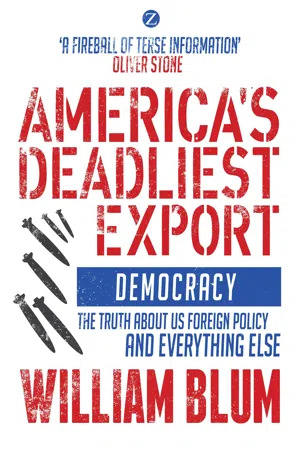
America's Deadliest Export
Democracy – The Truth about US Foreign Policy and Everything Else
- English
- ePUB (mobile friendly)
- Available on iOS & Android
eBook - ePub
America's Deadliest Export
Democracy – The Truth about US Foreign Policy and Everything Else
About this book
Information
1
US FOREIGN POLICY VS THE WORLD
Mit der dummheit kämpfen Götter selbst vergebens.
(‘With stupidity, even the gods struggle in vain.’)
(‘With stupidity, even the gods struggle in vain.’)
Friedrich Schiller (1759–1805)
I’m often told by readers of their encounters with Americans who support the outrages of US foreign policy no matter what facts are presented to them, no matter what arguments are made, no matter how much the government’s statements are shown to be false. My advice is to forget such people. They would support the outrages even if the government came to their home, seized their firstborn, and hauled them away screaming, so long as the government assured them it was essential to fighting terrorism (or communism), and threw in a little paean to democracy, freedom, and God. My rough guess is that these people constitute no more than 15 percent of the American population. I suggest that we concentrate on the rest, who are reachable.
Inasmuch as I cannot see violent revolution succeeding in the United States (something deep inside tells me that we couldn’t quite match the government’s firepower, not to mention its viciousness), I can offer no solution to stopping the imperial beast other than: educate yourself and as many others as you can, increasing the number of those in the opposition until it reaches a critical mass, at which point… I can’t predict the form the explosion will take or what might be the trigger.
As to the education, I like to emphasize certain points that try to deal with the underlying intellectual misconceptions and emotional ‘hang-ups’ I think Americans have which stand in the way of their seeing through the propaganda. Briefly, here are some of the main points (explained in more detail in later chapters):
1. Far and away the most important lesson to impart to the American mind and soul: regardless of our lifetime of education to the contrary, US foreign policy does not ‘mean well.’ The facts presented in this book should leave no doubt of that thesis, but the progressive political activist must be conscious of it at all times. I like to ask the American True Believers: what would the United States have to do in its foreign policy to cause you to stop supporting it?
2. The United States is not concerned with this thing called ‘democracy’, no matter how many times every American president uses the word each time he opens his mouth. As noted in the Introduction, since 1945 the US has attempted to overthrow more than fifty governments, most of which were democratically elected, and grossly interfered in democratic elections in at least thirty countries. The question is: what do American leaders mean by ‘democracy’? The last thing they have in mind is any kind of economic democracy – the closing of the gap between the desperate poor and those for whom too much is not enough. The first thing they have in mind is making sure the target country has the political, financial, and legal mechanisms in place to make it hospitable to corporate globalization.
3. Anti-American terrorists are not motivated by hatred or envy of freedom or democracy, or by American wealth, secular government, or culture, as we’ve been told many times. They are motivated by decades of awful things done to their homelands by US foreign policy. It works the same way all over the world. In the period of the 1950s to the 1980s in Latin America, in response to a long string of harmful American policies, there were countless acts of terrorism against US diplomatic and military targets as well as the offices of US corporations. The US bombing, invasion, occupation, and torture in Iraq, Afghanistan, and elsewhere in recent years have created thousands of new anti-American terrorists. We’ll be hearing from them for a very long time.
4. The United States is not actually against terrorism per se, only those terrorists who are not allies of the empire. There is a lengthy and infamous history of Washington’s support for numerous anti-Castro terrorists, even when their terrorist acts were committed in the United States. At this moment, Luis Posada Carriles remains protected by the US government, though he masterminded the blowing up of a Cuban airplane that killed 73 people. He’s but one of hundreds of anti-Castro terrorists who’ve been given haven in the United States over the years. The United States has also provided close support to terrorists, or fought on the same side as Islamic jihadists, in Kosovo, Bosnia, Iran, Libya, and Syria, including those with known connections to al-Qaeda, to further foreign policy goals more important than fighting terrorism.
5. Iraq was not any kind of a threat to the United States. Of the never-ending lies concerning Iraq, this is the most insidious, the necessary foundation for all the other lies.
6. There was never any such animal as the International Communist Conspiracy. There were, as there still are, people living in misery, rising up in protest against their condition, against an oppressive government, a government usually supported by the United States.
That oh-so-precious world where words have no meaning
In December 1989, two days after bombing and invading the defenseless population of Panama, killing as many as a few thousand totally innocent people, guilty of no harm to any American, President George H.W. Bush declared that his ‘heart goes out to the families of those who have died in Panama.’1 When a reporter asked him, ‘Was it really worth it to send people to their death for this? To get [Panamanian leader Manuel] Noriega?’ Bush replied: ‘Every human life is precious, and yet I have to answer, yes, it has been worth it.’2
A year later, preparing for his next worthwhile mass murder, the first US invasion of Iraq, Bush Sr. said: ‘People say to me: “How many lives? How many lives can you expend?” Each one is precious.’3
At the end of 2006, with Bush’s son now president, White House spokesman Scott Stanzel, commenting about American deaths reaching 3,000 in the second Iraq War, said that Bush ‘believes that every life is precious and grieves for each one that is lost.’4 In February 2008, with American deaths about to reach 4,000, and Iraqi deaths as many as a million or more, George W. Bush asserted:
When we lift our hearts to God, we’re all equal in his sight. We’re all equally precious. … In prayer we grow in mercy and compassion. … When we answer God’s call to love a neighbor as ourselves, we enter into a deeper friendship with our fellow man.5
Inspired by such noble – dare I say precious? – talk from its leaders, the American military machine likes to hire like-minded warriors. Here is Erik Prince, founder of the military contractor Blackwater, whose employees in Iraq killed people like others flick away a mosquito, in testimony before Congress: ‘Every life, whether American or Iraqi, is precious.’6
While his killing of thousands of Iraqis was proceeding merrily along in 2003, the second President George Bush was moved to say: ‘We believe in the value and dignity of every human life.’7
Both father and son are on record expressing their deep concern for God and prayer both before and during their mass slaughters. ‘I trust God speaks through me,’ said Bush the younger in 2004. ‘Without that, I couldn’t do my job.’8
After his devastation of Iraq and its people, Bush the elder said: ‘I think that, like a lot of others who had positions of responsibility in sending someone else’s kids to war, we realize that in prayer what mattered is how it might have seemed to God.’9
God, one can surmise, might have asked George Bush, father and son, about the kids of Iraq. And the adults. And, in a testy, rather ungodlike manner, might have snapped: ‘So stop wasting all the precious lives already!’
In the now-famous exchange on television in 1996 between Madeleine Albright and reporter Lesley Stahl, the latter was speaking of US sanctions against Iraq, and asked the then-US ambassador to the UN, and Secretary of State-to-be: ‘We have heard that a half million children have died. I mean, that’s more children than died in Hiroshima. And… and you know, is the price worth it?’
Albright replied: ‘I think this is a very hard choice, but the price… we think the price is worth it.’10
Ten years later, Condoleezza Rice, continuing the fine tradition of female Secretaries of State and the equally noble heritage of the Bush family, declared that the current horror in Iraq was ‘worth the investment’ in American lives and dollars.11
The worldwide eternal belief that American foreign policy has a good side that can be appealed to
On April 6, 2011, in the midst of NATO/US bombing of his country, Libyan leader Muammar Gaddafi wrote a letter to President Barack Obama in which he said:
We have been hurt more morally than physically because of what had happened against us in both deeds and words by you. Despite all this you will always remain our son whatever happened … Our dear son, Excellency, Baraka Hussein Abu Oubama, your intervention in the name of the U.S.A. is a must, so that Nato would withdraw finally from the Libyan affair.12
Gaddafi’s hope that writing to Obama could move the American president to put an end to the bombing of Libya turned out, as we know, to be unrealistic.
Before the American invasion in March 2003, Iraq tried to negotiate a peace deal with the United States. Iraqi officials, including the chief of the Iraqi Intelligence Service, wanted Washington to know that Iraq no longer had weapons of mass destruction and offered to allow American troops and experts to conduct a search; they also offered full support for any US plan in the Arab–Israeli peace process, and to hand over a man accused of being involved in the World Trade Center bombing in 1993. If this is about oil, they added, they would also talk about US oil concessions.13 Washington’s reply was its ‘Shock and Awe’ bombing.
In 2002, before the coup in Venezuela that briefly ousted President Hugo Chávez, some of the plotters went to Washington to get a green light from the Bush administration. Chávez learned of this visit and was so distressed by it that he sent officials from his government to plead his own case in Washington. The success of this endeavor can be judged by the fact that the coup took place very shortly thereafter.14
In 1994, it was reported that the spokesperson of the Zapatista rebels in Mexico, Subcomandante Marcos, said that ‘he expects the United States to support the Zapatistas once US intelligence agencies are convinced the movement is not influenced by Cubans or Russians.’ ‘Finally,’ Marcos said, ‘they are going to conclude that this is a Mexican problem, with just and true causes.’15 Yet for many years, before and after these remarks, the United States provided the Mexican military with all the tools and training needed to crush the Zapatistas.
Maurice Bishop of Grenada in 1983, Cheddi Jagan of British Guiana in 1961, the Guatemalan foreign minister in 1954, all made their appeals to Washington to be left in peace.16 The governments of all three countries were overthrown by the United States.
In 1945 and 1946, Vietnamese leader Ho Chi Minh, a genuine admirer of America and the Declaration of Independence, wrote at least eight letters to President Harry Truman and the State Department asking for America’s help in winning Vietnamese independence from the French. He wrote that world peace was being endangered by French efforts to reconquer Indochina and he requested that ‘the four powers’ (US, USSR, China, and Great Britain) intervene in order to mediate a fair settlement and bring the Indochinese issue before the United Nations.17 Ho Chi Minh received no reply. He was, after all, some kind of communist.
The myth of the good war
The reason so many Americans support US war crimes is that they’re convinced that no matter how bad things may look, the government means well. And one of the foundation stones for this edifice of patriotic faith is the Second World War, a historical saga that all Americans are taught about from childhood on. We all know what its real name is: ‘The Good War.’
Which leads me to recommend a book, The Myth of the Good War, by Jacques Pauwels, published in 2002. It’s very well done, well argued and documented, an easy read. I particularly like the sections dealing with the closing months of the European campaign, during which the United States and Great Britain contemplated stabbing their Soviet ally in the back with maneuvers like a separate peace with Germany, using German troops to fight the Russians, and sabotaging legal attempts by various Communist parties and other elements of the European left to share in (highly earned) political power after the war; the most dramatic example of this being the US taking the side of the Greek neo-fascists against the Greek left, who had fought the Nazis courageously. Stalin learned enough about these schemes to at least partially explain his postwar suspicious manner toward his ‘allies.’ In the West we called it ‘paranoia.’18
The enduring mystique of the Marshall Plan
Amidst all the political upheavals in North Africa and the Middle East in 2011 the name ‘Marshall Plan’ kept being repeated by political figures and media around the world as the key to rebuilding the economies of those societies to complement the supposed political advances. But caveat emptor; let the buyer beware.
During my years of writing and speaking about the harm and injustice inflicted upon the world by unending United States interven...
Table of contents
- Cover
- About this Book
- About the Author
- Title
- Copyright
- Contents
- Preface to the 2014 edition
- Introduction
- 1 US foreign policy vs the world
- 2 Terrorism
- 3 Iraq
- 4 Afghanistan
- 5 Iran
- 6 George W. Bush
- 7 Condoleezza Rice
- 8 Human rights, civil liberties, and torture
- 9 WikiLeaks
- 10 Conspiracies
- 11 Yugoslavia
- 12 Libya
- 13 Latin America
- 14 Cuba
- 15 The Cold War and anti-communism
- 16 The 1960s
- 17 Ideology and society
- 18 Our precious environment
- 19 The problem with capitalism
- 20 The media
- 21 Barack Obama
- 22 Patriotism
- 23 Dissent and resistance in America
- 24 Religion
- 25 Laughing despite the empire
- 26 But what can we do?
- Notes
- Index
Trusted by 375,005 students
Access to over 1.5 million titles for a fair monthly price.
Study more efficiently using our study tools.
Frequently asked questions
Yes, you can cancel anytime from the Subscription tab in your account settings on the Perlego website. Your subscription will stay active until the end of your current billing period. Learn how to cancel your subscription
No, books cannot be downloaded as external files, such as PDFs, for use outside of Perlego. However, you can download books within the Perlego app for offline reading on mobile or tablet. Learn how to download books offline
We are an online textbook subscription service, where you can get access to an entire online library for less than the price of a single book per month. With over 1.5 million books across 990+ topics, we’ve got you covered! Learn about our mission
Look out for the read-aloud symbol on your next book to see if you can listen to it. The read-aloud tool reads text aloud for you, highlighting the text as it is being read. You can pause it, speed it up and slow it down. Learn more about Read Aloud
Yes! You can use the Perlego app on both iOS and Android devices to read anytime, anywhere — even offline. Perfect for commutes or when you’re on the go.
Please note we cannot support devices running on iOS 13 and Android 7 or earlier. Learn more about using the app
Please note we cannot support devices running on iOS 13 and Android 7 or earlier. Learn more about using the app
Yes, you can access America's Deadliest Export by William Blum in PDF and/or ePUB format, as well as other popular books in Politics & International Relations & Diplomacy & Treaties. We have over 1.5 million books available in our catalogue for you to explore.