In 2009, after decades of conflict, the Sri Lankan government proclaimed the decisive defeat of the Liberation Tamil Tigers of Elam. Subsequently, the state proved resistant to attempts by the UN and other international bodies to promote post-war reconciliation or reform.
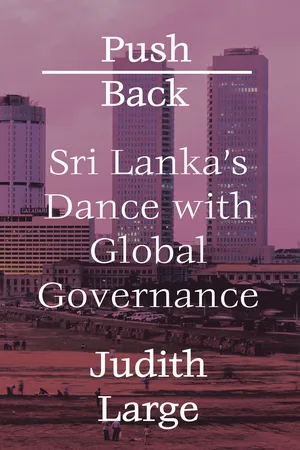
In this incisive new work, Judith Large investigates the ways in which the Rajapaksa government was able to subvert international diplomatic efforts, as well as exploring the wider context of rising Sinhalese nationalism, the attendant growth of discrimination against minorities, and efforts by both the diaspora and citizens within Sri Lanka to work towards a positive peace.
Push Back is vital reading not only for those interested in Sri Lanka, but also for those concerned about the wider implications of the conflict for human rights, peace-making, and geopolitics.
- English
- ePUB (mobile friendly)
- Available on iOS & Android
eBook - ePub
About this book
Trusted by 375,005 students
Access to over 1.5 million titles for a fair monthly price.
Study more efficiently using our study tools.
Information
CHAPTER 1
War’s end and competing models for recovery
Peace without unity, unity without reconciliation, and reconciliation without accountability. (Paikiasothy Saravanamuttu)
The way the war ended cast a legacy on its aftermath, and two models of recovery were advocated by those in power as a means to peace: namely, the Singapore model of economic development to make Sri Lanka the Wonder of Asia, and notions of reconciliation, as defined in government circles. The residual dilemma was the clash between these dominant approaches and the actual underlying causes of the war.
War to peace transitions may be understood through the prisms of resistance, accountability and that elusive term ‘governance’. Resistance because civil war and its ending entail the reconfiguration of power relations and friction among and between societal actors; accountability because a population and its leaders need to come to terms in some way with the effects of violence and construct a viable narrative on which to begin again; and ‘governance’ in the sense of levels of norms and mechanisms to enable the renewed functioning of a given society. The Liberation Tigers of Tamil Eelam fought for over three decades in Sri Lanka, a bitter armed struggle in which ceasefires failed to hold and a degree of territorial control was achieved and then lost. This civil war arose from historical grievances over language rights, issues of land, higher education, employment and the socio-political status of the minority Tamil community.
War’s end
In the aftershock of the military defeat of the LTTE in May 2009, a mixture of euphoria, anxiety and profound uncertainty seemed to grip the capital Colombo. The city was a grey and concrete labyrinth of military fortification: watchtowers, roadblocks, checkpoints, razor wire, enforced curfew and armed patrols. International media had reported for months about the northern assault: a frantic situation in the Vanni including entrapment and deprivation and attacks on thousands of civilians. In February, an interview with Defence Secretary Gotabaya Rajapaksa1 aired on BBC appeared to condone attacks on hospitals if they were outside the official no-fire zone (Crawford 2009). Satellite imagery abounded of the full pincer effect of the assault, as well as rumours of additional satellite imagery held by US intelligence. What had been fever-pitch activity in embassy and mission corridors to find a ceasefire or halt to hostilities gave way to diplomatic numbness, while citizens were encouraged to celebrate a final victory over terrorism.2
For over a quarter of a century, the veracity of the Tamil–Sinhala conflict had attracted considerable international attention and intervention attempts, from the Government of India (at considerable cost, with the related assassination of Rajiv Ghandi) to numerous relief and development NGOs dedicated to peace making, a process of Norwegian-brokered talks and the international donor community backing economic incentive packages, particularly in the wake of the 2004 tsunami. As the Petrie report would later observe, the UN’s political engagement in Sri Lanka during the period from 2007 to the end of the conflict in May 2009 was consistently secondary to the efforts of other external actors (UN 2012). These included countries in the region, primarily India and China. Norway sponsored the Ceasefire Agreement, with the EU, Japan and the US joining a Co-Chair Group of States to coordinate financial contributions to Sri Lanka in support of the peace process. The UN was not invited to be a member of the Co-Chair Group.
The final determined government offensive of the war was launched in late 2008. International agencies were forced by official directive to relocate from the Vanni in September 2008, a time when hundreds of thousands were being displaced within this increasingly dangerous conflict zone (IDMC 2009). By January 2009, an editorial in The Economist was asking ‘Where have all the people gone?’ in reference to the deserted streets and destroyed buildings in Kilinochchi, once the showcase de facto capital city of the declared Tamil Eelam (The Economist 2009). The LTTE had lost the city, with thousands of families displaced into the district around Mullaitivu. A final offensive was under way under the rubric of counter-terrorism with a rejection of perceived half-way measures and compromise as per the Norwegian brokered (aborted) peace initiative. There was a total rejection of calls for a ceasefire as the final battle loomed in 2009. Rajapaksa was quoted as saying: ‘They are trying to preach to us about civilians. I tell them to go and see what they are doing in Iraq and Afghanistan’ (Revise 2009). It was widely reported that a quarter of a million civilians were trapped in a shrinking area of land, caught in the crossfire and suffering casualties as well. Rumours flew of a massacre of people who were not themselves combatants and had no exit possibility, later confirmed in the wake of the final battle (Weiss 2012).3
In fact, Norwegian facilitation (Sorbo et al. 2011) had been accepted and tried not long after the advent of the US-led narrative on ‘the war on terror’, described in detail by Kleinfeld in 2003. Kleinfeld documents how both the People’s Alliance Government and the Tamil Tigers of Tamil Eelam used the ‘9/11’ lexicon ‘associated with the U.S. attacks and early global response to brand their adversary as terrorist, to recode political and conflict narratives in September eleventh terms, and to indicate the appropriate scale and scope of the war’ (Kleinfeld 2003). The future Defence Secretary Gotabaya Rajapaksa, a US citizen, was living in California at the time of the Bush administration measures that echoed ‘with us or against us’ as an uncompromising stance (Montlake 2009). His official governmental website invoked geo-political analogies when referring to subsequent United Nations Human Rights Council (UNHRC) war crimes investigations, stating that the:
Sri Lankan government should closely study the Iraq case. It should be a priority. The Iraq case presents an excellent opportunity to highlight the double standards adopted by those threatening to haul Sri Lanka up before an international war crimes tribunal on the basis that the local process lacked credibility. (MoD Sri Lanka 2014)
It was Gotabaya who warned ambassadors, news agencies and international NGOs of dire consequences if they were ‘partisan’ in their concern for the LTTE or made comments in support of their cause during the military ground offensive. As he singled out BBC journalists and the Swiss and German ambassadors for particular criticism, a joint statement was issued by five leading Sri Lankan bishops calling on both sides at war in the Vanni to keep civilians safe from the line of fire and calling on the government to invite the International Committee of the Red Cross (ICRC), the United Nations High Commissioner for Refugees (UNHCR) and independent Tamil leaders to monitor and manage relief in the war zone.4 When the President met with Manmohan Singh in New Delhi in November 2008, the Indian Premier also called for restraint and presented a copy of a unanimous resolution passed by the Tamil Nadu state legislative assembly that called for an immediate ceasefire and resumption of negotiations (transCurrents 2008; Kelegama 2013).
Just seven years earlier it had been suggested that Sri Lanka had come ‘to serve as a laboratory and showcase for liberal peacebuilding’ (Höglund and Orjuela 2012: 94) when the country embarked on a path of third party facilitation to resolve the long-standing conflict with the LTTE. Now the picture changed to one of triumphant military victory, as video footage released on 18 May 2009 showed the bloodied body of the LTTE leader, Velupillai Prabhakaran, after a violent all-out attack by the Sri Lankan military under the presidency of Mahinda Rajapaksa (Saddlesmania 2009). Public statements from Colombo rejected notions from Western governments at the time that clemency should have been shown; moreover, civilian deaths were denied and Western interference decried, as a ‘Look East’ policy was revived with pride and defiance. According to UN documentation, approximately 40,000 civilians had been killed in the first five months of 2009, with an estimated 300,000 displaced in the Northern Province (UN 2011a). Most internally displaced persons (IDPs) were held at the Manik Farm, the government IDP centre located between Vavuniya and Mannar districts. It was not long before ‘credible allegations’ associated with the final stages of the war surfaced in a way that would only loom and grow for the next five years. The Panel of Experts mandated by the Secretary-General reported that ‘between September 2008 and 19 May 2009, the Sri Lanka Army advanced its military campaign into the Vanni using large-scale and widespread shelling, causing large numbers of civilian deaths. This campaign constituted persecution of the population of the Vanni’ (UN 2011b). This was in stark contrast to the government’s framing of operations as a humanitarian rescue operation. Sri Lanka is party to the 1949 Geneva Conventions (but not to additional protocols) and saw accession to the International Covenant on Civil and Political Rights (ICCPR) in 1997. But Mahinda R...
Table of contents
- Cover
- About the book
- About the author
- Title page
- Copyright
- Contents
- Acknowledgements
- Abbreviations
- Timeline of Sri Lankan history
- Foreword
- Map of Sri Lanka
- Introduction
- 1. War’s end and competing models for recovery
- 2. Executive presidency and the unitary state
- 3. Non-interference Sri Lankan style
- 4. The outsiders
- 5. Majoritarianism or divide and rule
- 6. Home-grown solutions and the quest for accountability
- 7. Small state in a large system
- Notes
- Bibliography
- Index
Frequently asked questions
Yes, you can cancel anytime from the Subscription tab in your account settings on the Perlego website. Your subscription will stay active until the end of your current billing period. Learn how to cancel your subscription
No, books cannot be downloaded as external files, such as PDFs, for use outside of Perlego. However, you can download books within the Perlego app for offline reading on mobile or tablet. Learn how to download books offline
Perlego offers two plans: Essential and Complete
- Essential is ideal for learners and professionals who enjoy exploring a wide range of subjects. Access the Essential Library with 800,000+ trusted titles and best-sellers across business, personal growth, and the humanities. Includes unlimited reading time and Standard Read Aloud voice.
- Complete: Perfect for advanced learners and researchers needing full, unrestricted access. Unlock 1.5M+ books across hundreds of subjects, including academic and specialized titles. The Complete Plan also includes advanced features like Premium Read Aloud and Research Assistant.
We are an online textbook subscription service, where you can get access to an entire online library for less than the price of a single book per month. With over 1.5 million books across 990+ topics, we’ve got you covered! Learn about our mission
Look out for the read-aloud symbol on your next book to see if you can listen to it. The read-aloud tool reads text aloud for you, highlighting the text as it is being read. You can pause it, speed it up and slow it down. Learn more about Read Aloud
Yes! You can use the Perlego app on both iOS and Android devices to read anytime, anywhere — even offline. Perfect for commutes or when you’re on the go.
Please note we cannot support devices running on iOS 13 and Android 7 or earlier. Learn more about using the app
Please note we cannot support devices running on iOS 13 and Android 7 or earlier. Learn more about using the app
Yes, you can access Push Back by Judith Large in PDF and/or ePUB format, as well as other popular books in Politics & International Relations & Higher Education. We have over 1.5 million books available in our catalogue for you to explore.