Energy justice is one of the most critical, and yet least developed, concepts associated with sustainability. Much has been written about the sustainability of low-carbon energy systems and policies - with an emphasis on environmental, economic and geopolitical issues. However, less attention has been directed at the social and equity implications of these dynamic relations between energy and low-carbon objectives - the complexity of injustice associated with whole energy systems (from extractive industries, through to consumption and waste) that transcend national boundaries and the social, political-economic and material processes driving the experience of energy injustice and vulnerability.
Drawing on a substantial body of original research from an international collaboration of experts this unique collection addresses energy poverty, just innovation, aesthetic justice and the justice implications of low-carbon energy systems and technologies. The book offers new thinking on how interactions between climate change, energy policy, and equity and social justice can be understood and develops a critical agenda for energy justice research.
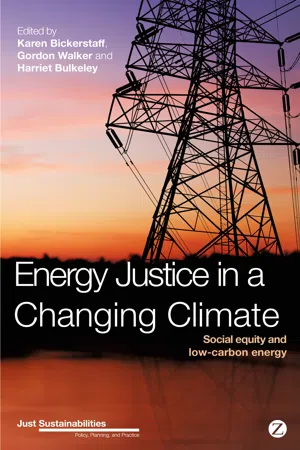
eBook - ePub
Energy Justice in a Changing Climate
Social Equity and Low-Carbon Energy
- English
- ePUB (mobile friendly)
- Available on iOS & Android
eBook - ePub
Energy Justice in a Changing Climate
Social Equity and Low-Carbon Energy
1 | Household energy vulnerability as ‘assemblage’
ROSIE DAY AND GORDON WALKER
Introduction
In the profile of current energy justice concerns, those focused on households’ access to sufficient and affordable energy are perhaps the most well established. In both developed and developing world contexts the well-being that energy services – such as heat, light and mobility – can bring to people’s lives has provided the basis for assertions of energy-related rights and for political mobilization against the inequalities in energy access that are implicated in patterns of ill-health, mortality and diminished life-chances (AGECC 2010; Boardman 2010; Wilkinson et al. 2007; Wright 2004). In the UK, for example, and as discussed in the introductory chapter, the language of fuel poverty has provided a powerful framing for recognizing problems of access to affordable energy and for a range of policy interventions intended to address these (Walker and Day 2012; Hills 2012). Such policy, research and political mobilization is less advanced in other European countries, and elsewhere across the developed world, but is emerging and gradually revealing the prevalence, depth and characteristics of household energy problems in different settings (e.g. Healy 2003; Brunner et al. 2012; Buzar 2007; O’Sullivan et al. 2011; Simshauser et al. 2011; Tirado Herrero and Ürge-Vorsatz 2012).
Partly because research and policy attention has emerged in a quite differentiated manner, different languages have been employed to characterize the problem that is at issue, including those of fuel poverty, energy poverty, energy insecurity, energy deprivation and energy precariousness. To some extent these different terms reflect the underlying understanding or framing of the problem. Fuel poverty, for example, is strongly rooted in the UK experience and its primary focus is on affordable warmth; energy poverty tends to be used in relation to access and affordability problems in the developing world which can take on a quite different character; while energy insecurity can imply a concern primarily with the provisioning and price stability of energy supplies to the household. In this chapter we work with the term ‘energy vulnerability’ with the intention of following a broad and open framing that does not imply a particular emphasis or understanding of cause and effect. As we explain further below, energy vulnerability is a term that for us better captures the variability of circumstances and processes through which problems of access to sufficient and affordable energy are manifest, and one that has the potential to work across many different national and regional settings.
Having proposed this open terminology, we then seek in this chapter to develop a more theoretically informed account than is typical of work in this field. The bulk of existing research is applied and problem oriented, drawing on different disciplinary traditions, but not engaging very substantially with social or critical theory. There are some exceptions. For example, Buzar (2007: 1908) examines household energy deprivation as an ‘innately relational phenomenon’, drawing together a range of theory on infrastructure, poverty and everyday life to inform his analysis of the ‘socio-spatial arrangements’ of energy poverty in post-socialist Europe. Powells (2009) uses actor network theory and notions of entanglement and overflow to examine the complex interactions between fuel poverty and energy efficiency policy in the UK. Harrison and Popke (2011), in a rare examination of ‘energy poverty’ (their term) in the USA, use the notion of ‘assemblage’ as a way of setting up and analysing their empirical account of rural household energy problems in North Carolina.
Each of these applications of theoretical ideas has connections with the approach we explore in this chapter, but it is the innovative use of assemblage thinking by Harrison and Popke which we particularly seek to take forward. They argue that ‘energy poverty’ can be seen as ‘a particular kind of techno-social assemblage, made up of an array of networked actors and materialities’ and that ‘a focus on the networked nature of energy poverty … can help to highlight its historical foundations and multidimensional character’ (ibid.: 950). They go some way to substantiate these claims through their empirical work, but, we would argue, take up only some of the potential of ‘assemblage thinking’. In particular they do not go as far as they might to draw out the ways in which assemblage embodies particular understandings of agency, emergence and dynamics. Our specific aim is therefore to explore the value of assemblage thinking to the analysis of energy vulnerability, considering both what it can bring to understanding the basis, formation and dynamics of energy vulnerability, and also what it can less satisfactorily account for.
Before moving on to examine the origin of assemblage as a concept and the core ideas it encompasses, we need to say more about how we understand energy vulnerability. Energy vulnerability is for us a situation in which a person or household is unable to achieve sufficient access to affordable and reliable energy services, and as a consequence is in danger of harm to health and/or well-being. This open definition makes no specific judgement about which energy services are significant, what constitutes sufficient access, how harm may be involved or how substantial that harm needs to be. The notion of vulnerability also conveys a sense of potentiality or precariousness rather than necessarily a situation of demonstrable and existing harm. We understand energy vulnerability as having a number of general characteristics:
• First, as much of the existing literature emphasizes, it is multidimensional in character and produced through the coming together of social, technological and natural processes.
• Secondly, the exact nature of this coming together for any particular person or household is locally contingent. Hence energy vulnerability is variable in its production and character over space and time.
• Third, energy vulnerability as experienced exhibits different temporal qualities, sometimes constant and unyielding, sometimes far more dynamic and shifting in cyclical or more unpredictable patterns.
In the following discussion these three key characteristics will be reflected on in the light of assemblage theory, drawing on illustrative cases taken from the review work and extended discussions and interactions within the InCluESEV project. In this respect we draw on varied cases and settings from across Europe and North America (which reflects the scope of work in the project), given, as noted earlier, that we are seeking to provide an analytical framework that is open to the international and regional variability of energy vulnerability experiences. We do not in this chapter extend to specific consideration of energy vulnerability in other parts of the world, but suggest in the concluding discussion that an assemblage framework might be readily applicable to a wider global geography of household energy contexts.
Understanding assemblage
The concept of ‘assemblage’ as it is used by social scientists is normally attributed in its origins to the work of Deleuze and Guattari, and their notion of ‘agencement’, which came to be translated as ‘assemblage’ (Deleuze and Guattari 1987). While some working with assemblage have attempted to follow Deleuze and Guattari closely, other distinctive versions of the approach have also developed (e.g. De Landa 2006). Also closely related but with distinctive elements is the ‘assembling of associations’ that is central to Actor Network Theory (Latour 2005; Law 1992; Whatmore 1999).
All of these approaches at their basis view the happening world as coalescing into assemblages, or networks, of heterogeneous entities (sometimes referred to as actants), which include humans, non-human and abstract things. Entities form an assemblage in that they have some kind of relation with each other, such that a kind of collective whole can be discerned. A whole assemblage should be more than the sum of its parts: it is not just a collection of stuff, but a functioning collective, at least for a time. The assemblage, though, need not be self-aware or intentionally formed by any of its members – its function and effect are always emergent and contingent. Although some assemblages may be designed, many are not, and even those that start with a template acquire their own momentum and configuration as they proceed.
The emphasis on the heterogeneity of the constituent entities of assemblages is essential. If we were to take a simple non-energy example and consider a (specific) school classroom as an assemblage, a very simple analysis might reveal it to contain children, a teacher, furniture, building infrastructure involving various material parts, books, clothing, computers and their software, educational theories, curriculum policies, routines, rules, religious beliefs, clocks, artworks, even a cold virus moving from child to child. These and potentially many other entities all shape the ‘happening’ of that specific classroom.
Viewing things in this way has the effect of decentring the human as the subject. As discussed later, this is an important shift which some social scientists dislike, but which has proved appealing for others, especially geographers, who are centrally concerned with the material world with which humans interact. A core intention for many using assemblage thinking is to make visible the way that non-human (including non-living) entities have a strong role in how situations play out – that is, they are not just props to human endeavours but they assert themselves in significant ways (see especially Bennet 2004, 2010; Callon 1986; Latour 2005).
Another feature of the heterogeneity is that assemblages can also blur spatial and temporal distinctions, bringing together entities that are near with those that are far (Anderson and McFarlane 2011) and entities with different temporal rhythms (Allen 2011). Thus the classroom example is able to include national government educational policy originating in a capital city and with a lifespan of a few years, alongside the daily rhythm of lesson timings, slowly evolving cultural practices and the rapidly changing weather. The existence of an assemblage needn’t be in fully concrete or locational terms, but is rather through its working relations and bonds of influence.
Human and non-human entities can of course be involved in many assemblages at once, so defining an assemblage is not a way of separating or bracketing off parts of the world. Assemblages do not always present themselves neatly. Rather, it is the job of analysis to identify and describe them. Deciding what is and isn’t an assemblage, where one begins and ends, is therefore an interpretation to be offered and, potentially, contested. This work of identifying and naming an assemblage and its constituents can imply a rather descriptive orientation, and indeed, this is often a criticism of such approaches. Some uses of an assemblage approach do stay in the realms of the more descriptive, and can be productive in doing so. Those drawing on Deleuze and Guattari in particular, though, are often more keen to emphasize the processual aspects of assemblages forming, unforming and reforming, such that the ‘time-space of assemblage is imagined as inherently unstable and infused with movement and change’ (Markus and Saka 2006: 102).
Because assemblages are characterized as impermanent, unpredictable and in flux, there are always possibilities for alternatives, and this is also an important aspect of the assemblage approach. Rather than describing just what is, the approach is also concerned with fostering imaginative conceptualizations of what may be, of how the world could be reassembled in different configurations and what difference that might make. However, its essential world view of messiness and contingency would militate against precise predictions of outcomes.
Assemblage has been worked with across diverse disciplinary literatures, usually more as an approach, or an orientation, than as the basis of a coherent theory. It is also applied in fairly diverse ways, which is variously regarded as both an advantage and a weakness (see, e.g., Marcus and Saka 2006; Anderson and McFarlane 2011; McFarlane 2011b; Brenner et al. 2011). To give some examples of the varied phenomena that might be conceived as assemblages, the concept has been applied to, among other things, political support movements (Davies 2012), rock climbing (Barratt 2012), flooding (Walker et al. 2011), environmental justice controversies (Bickerstaff and Agyeman 2009) and church buildings (Edensor 2011).
The approach does attract criticism, including over questions of agency and how assemblages come to be (discussed later), and issues around how the boundaries of assemblages are delimited (Allen 2011). Probably the most trenchant criticism is the perceived blindness of assemblage thinking to the structures and uneven power relations within which actants in an assemblage operate. There is thus an inability fully to explain or understand inequality (Brenner et al. 2011; Madden 2010), including how best to overcome it. However, although some believe that assemblage approaches do signify a full alternative to, and potential replacement of, more structural approaches in critical social and political science (Farías 2009), others advocate the combination of an assemblage perspective with other analytical approaches such as political economy or feminism for a fuller analysis and augmented explanatory power (McFarlane 2011b; Rankin 2011; see also Castree 2002). We will return to these questions later in our discussion.
Assemblage and energy vulnerability
Having introduced the concept of assemblage, its underpinnings and the ways of thinking that it draws on and promotes, we can now turn to applying these ideas to energy vulnerability. As noted in the introduction, the use of an assemblage approach has been mooted in this context before (Harrison and Popke 2011), but the ways in which it can inform and illuminate our understanding and conceptualization of energy vulnerability have not been fully explored. To take this agenda forward, we suggest that there are six fundamental features of assemblage thinking which can provide for a distinctive and productive analysis of the basis, formation and dynamics of energy vulnerability. In working through these we will consider the concept of assemblage in more depth, and draw on examples of varied forms of energy vulnerability.
1 Networks of entities Assemblage thinking conceives situations (or phenomena more generally) as being constituted by a network or configuration of human, non-human, material and abstract entities in some kind of relations with each other (as noted earlier, a relational ontology it shares with other theoretical traditions). As already discussed, some who use it particularly value the visibility and status that it gives to material, non-human entities, such as buildings and urban infrastructures, in human lives (Bennet 2004, 2010). For example, McFarlane (2011a), drawing particularly on his own work on informal settlements in Mumbai, argues that attention has to be given to how material environments are both constituted by poverty, and part of the experience of poverty – as well as sometimes having a role in resistance strategies. Others have also seen value in how assemblage brings status and agency to nature in relational networks, from the molecular scale through to forces of earthquakes and global climatic change (Hinchliffe 2007; Clark 2011).
If we consider this open understanding of networks and entities with respect to energy vulnerability, we can see immediate resonances with the heterogeneity of entities that come together to create energy vulnerability. This dimension of assemblage thinking is what Harrison and Popke (2011: 959) emphasize most strongly in their ‘open and relational account’ of ‘energy poverty as a geographical assemblage of networked materialities’. An energy-vulnerable household contains people by definition. It also involves a material infrastructure with many constituent parts – a building, a heating system, a supply line perhaps, the fuel itself; cooking and lighting devices, other appliances, insulation. The characteristics and condition of these material components are vital to the constitution of energy vulnerability, albeit in hugely diverse ways. How efficient are they? How old are they? How big are they in relation to the spaces and needs they service? Are they even there at all?1
So we can see the importance of both the human and material elements – energy vulnerability would not exist without both. Non-human nature in the form of the outdoor climate, involved processes of air movement, temperature, humidity and their relation to the indoors are also essentially implicated, particularly in relation to demands on heating or cooling systems and temperature-related threats to health. We can also add ...
Table of contents
- Cover
- About the Editors
- Title
- Copyright
- Contents
- Figure and tables
- Acknowledgements
- Introduction: making sense of energy justice
- 1 Household energy vulnerability as ‘assemblage’
- 2 Precarious domesticities: energy vulnerability among urban young adults
- 3 Energy justice in sustainability transitions research
- 4 Energy justice and the low-carbon transition: assessing low-carbon community programmes in the UK
- 5 Energy justice and climate change: reflections from a Joseph Rowntree Foundation research programme
- 6 Equity across borders: a whole-systems approach to micro-generation
- 7 Fair distribution of power-generating capacity: justice, microgrids and utilizing the common pool of renewable energy
- 8 Framing energy justice in the UK: the nuclear case
- 9 Justice in energy system transitions: the case of carbon capture and storage
- About the contributors
- Notes
- Bibliography
- Index
Trusted by 375,005 students
Access to over 1.5 million titles for a fair monthly price.
Study more efficiently using our study tools.
Frequently asked questions
Yes, you can cancel anytime from the Subscription tab in your account settings on the Perlego website. Your subscription will stay active until the end of your current billing period. Learn how to cancel your subscription
No, books cannot be downloaded as external files, such as PDFs, for use outside of Perlego. However, you can download books within the Perlego app for offline reading on mobile or tablet. Learn how to download books offline
Perlego offers two plans: Essential and Complete
- Essential is ideal for learners and professionals who enjoy exploring a wide range of subjects. Access the Essential Library with 800,000+ trusted titles and best-sellers across business, personal growth, and the humanities. Includes unlimited reading time and Standard Read Aloud voice.
- Complete: Perfect for advanced learners and researchers needing full, unrestricted access. Unlock 1.5M+ books across hundreds of subjects, including academic and specialized titles. The Complete Plan also includes advanced features like Premium Read Aloud and Research Assistant.
We are an online textbook subscription service, where you can get access to an entire online library for less than the price of a single book per month. With over 1.5 million books across 990+ topics, we’ve got you covered! Learn about our mission
Look out for the read-aloud symbol on your next book to see if you can listen to it. The read-aloud tool reads text aloud for you, highlighting the text as it is being read. You can pause it, speed it up and slow it down. Learn more about Read Aloud
Yes! You can use the Perlego app on both iOS and Android devices to read anytime, anywhere — even offline. Perfect for commutes or when you’re on the go.
Please note we cannot support devices running on iOS 13 and Android 7 or earlier. Learn more about using the app
Please note we cannot support devices running on iOS 13 and Android 7 or earlier. Learn more about using the app
Yes, you can access Energy Justice in a Changing Climate by Karen Bickerstaff, Gordon Walker, Harriet Bulkeley, Karen Bickerstaff,Gordon Walker,Harriet Bulkeley in PDF and/or ePUB format, as well as other popular books in Economics & Sustainable Development. We have over 1.5 million books available in our catalogue for you to explore.