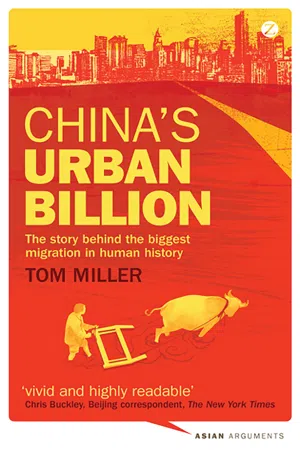
By 2030, China's cities will be home to 1 billion people - one in every eight people on earth. What kind of lives will China's urban billion lead? And what will China's cities be like?
Over the past thirty years, China's urban population expanded by 500 million people, and is on track to swell by a further 300 million by 2030. Hundreds of millions of these new urban residents are rural migrants, who lead second-class lives without access to urban benefits. Even those lucky citizens who live in modern tower blocks must put up with clogged roads, polluted skies and cityscapes of unremitting ugliness. The rapid expansion of urban China is astonishing, but new policies are urgently needed to create healthier cities.
Combining on-the-ground reportage and up-to-date research, this pivotal book explains why China has failed to reap many of the economic and social benefits of urbanization, and suggests how these problems can be resolved. If its leaders get urbanization right, China will surpass the United States and cement its position as the world's largest economy. But if they get it wrong, China could spend the next twenty years languishing in middle-income torpor, its cities pockmarked by giant slums.
- English
- ePUB (mobile friendly)
- Available on iOS & Android
eBook - ePub
About this book
Information
1
By the Sweat of Their Brows: The People Who Built Urban China
For a week or two in late winter or early spring, depending on when the lunar New Year falls, China’s cities shut down. Construction halts, shops and restaurants close, and factory gates are bolted. Most urbanites barely notice the millions of rural migrants who live among them until they disappear for the holiday. But without the floating population of migrant workers, who flock to the cities from villages across the country, modern China would not exist. It is no exaggeration to say that these men and women, many barely out of school, power China’s urban economy.
Chen Fangyan, who sells fruit on the streets of Beijing, is a typical migrant. Chen’s parents moved to Beijing from their village in Henan province in the early 1990s, leaving their young daughter at home in the village. Like tens of millions of left-behind children in China, Chen only saw her parents during the holiday at Chinese New Year. ‘I minded a little bit each time my parents returned to the city, but not much,’ she says, matter-of-factly. ‘After all, there’s nothing we could do about it – they had to earn a living.’ In 2004, as soon as she finished school, Chen followed her parents to the capital. Now, after eight years in Beijing, she could almost pass for a city girl. But Chen’s dyed-brown, semi-frizzed thatch of hair marks her as an outsider: the shaggy-dog look is not popular among fashionable locals.
Chen and her husband share a single room in a squat brick house in northeast Beijing. They live in what is colloquially known as a ‘village in the city’ – one of an estimated 600 former rural communities in the capital that have been swallowed up by urban sprawl. Only a decade ago, the village was home to farmers growing vegetables. Then the city government bought up the fields for development, compensating villagers with a lump sum and a city hukou, giving them the right to live in the city on a legally permanent basis. Villagers used the cash to buy modern flats, and rented out their old homes to migrant workers. Today the bustling streets ring with the dialects of Henan and Anhui, two of the biggest providers of migrant labour in Beijing. A whiff of fetid water hangs over the village, which is dirty, crowded and rundown. But birds sing in the trees, children scamper freely, and the atmosphere is friendly. Nearly 3 million of Beijing’s estimated 7 million migrant workers live in urban villages like this.
The village’s brick houses are divided into cramped rooms that migrant families rent for around US$80 per month. Chen’s 15-square-metre home contains a television, rice cooker and washing machine – exactly what you would find in any modestly prosperous rural home. An urban addition is a cheap computer, which Chen uses to search the Internet for a second-hand fridge. There are few other luxuries: an old iron bedstead is covered in dirty blankets, washing hangs from a wire strung across the room, and electric cables sprout from the wall. A single hot pipe runs from a coal heater, but the room is freezing in winter. Boxes of fruit are stacked against the wall.
Every night at 2 a.m. Chen’s husband drives his minivan to a large food wholesale market on the other side of Beijing. Then he drives back and sleeps for an hour or two before setting out for work. Chen stands on the street beside her fruit-laden tricycle for ten hours every day of the week. Many migrant workers have tougher jobs, but Chen is frequently accosted by city patrol units (chengguan) – thugs who clear the streets of vagrants and peddlers, confiscating produce and meting out fines with fists. The fruit business did well in 2010, bringing in nearly US$8,000. But Chen and her husband struggled with rising prices in 2011 as food inflation surged by more than 10 per cent. ‘The wholesale costs were really high, but people didn’t want to buy expensive fruit,’ Chen sighs. ‘We save almost all the money we make, but every day there’s pressure to make ends meet. You can see it on my husband’s face – he’s always tired and stressed.’
Like many people from the countryside, Chen and her husband ignored China’s one-child rule. They have two boys. Looking after children in the city, where migrant children struggle to find places in state schools, is tough. Chen’s younger son boards at a nursery school for migrant children on the outskirts of Beijing, and only comes home at weekends. ‘We’re too busy working to look after him every day,’ Chen says. Her elder son returned to rural Henan to attend primary school, where he can study for free, and her younger son will follow soon. They will stay in the family homestead with their grandfather, who used to live in Beijing but had to leave after contracting tuberculosis. As a migrant worker without access to subsidized health care, he could not afford the cost of treatment in the city.
For migrant workers like Chen, life in China’s cities is hard and unfair, and often cold and uncomfortable. Most have no social security, and the feared city patrols may stop them from earning a living. Chen has little contact with local Beijingers, except when they buy a bag of apples or a box of strawberries. This is typical: migrant workers live isolated lives, ghettoized both socially and physically. Yet Chen and her husband, like most young migrants in China’s cities, are determined not to go back to rural Henan. They will stay in the city permanently, Chen says, and wait for their sons to join them. ‘Locals look down on us because we’re poor,’ she says. ‘But we’ll never go back to work the land – we have two children to support!’

China’s great migration from farm to city is only thirty years old. For most of Mao Zedong’s rule, freedom of movement between the countryside and the cities was tightly controlled. The Communist Party’s revolutionary credentials supposedly lay in the countryside, but its goal was urban industrialization. Protecting the productivity of China’s cities, which were viewed primarily as centres of heavy industry, meant limiting inflows of farmers. In the early years of Communist rule there was, in fact, extensive rural-to-urban migration. But that stopped in 1958 with the introduction of the household registration system. The hukou system proved a useful tool of social control, but it was originally designed to prevent rural migration to the cities. Farmers had to stay on the farm to produce food to feed urban workers, not move to the cities to gobble it up.
In the 1980s, as Beijing began to loosen its economic and social grip, rural workers were encouraged to ‘leave the land but not the villages, enter the factories but not the cities’. The success of township and village enterprises, owned and run by rural collectives, spawned a policy of small-town development. Nationally, the government advocated ‘controlling the big cities, moderating the development of medium-sized cities, and encouraging the growth of small cities’. Yet it made an exception in the southern coastal ports of Shenzhen, Zhuhai, Shantou and Xiamen, where the opening of experimental ‘special economic zones’ began to attract the first trickle of rural migrants into China’s cities. By the end of the 1980s, as factories mushroomed along the southeast coast, the number of rural migrants heading for the cities had deepened into a steady stream.
In the early 1990s, migrant flows accelerated again. Global manufacturers moved into China and set up factories all along the coast. Migrant workers were cheap, and jobs were plentiful. Young farmers flocked from their villages to assemble widgets in export-processing factories, to wait tables in new restaurants, and to lug bricks around building sites. Officially, China stuck to its policy of restricting the growth of large cities, even as tens of millions of migrant workers voted with their feet and moved to the swelling coastal metropolises. In the late 1990s, in a foretaste of what would occur in 2008, the Asian financial crisis struck, the economy faltered and exports slumped. As state enterprises began to lay off millions of urban workers, new job opportunities for rural migrants dwindled.
In the early years of the new century the economy recovered, exports boomed and China’s urban property market exploded. As the demand for labour grew, the stream of rural migrants swelled into a flood, leaving the cities awash with new residents. During the first decade of the new century, nearly 100 million new rural migrants flocked to China’s cities to find work, and urban policy finally shifted to recognize the reality on the ground. The 11th Five Year Plan (2006–10) advocated ‘balanced development’ of cities, regardless of size. The 12th Five Year Plan (2011–15) went further, explicitly promoting the growth of metropolitan regions and urban clusters of large cities orbited by smaller satellites. Current leaders are enthusiastically pro-urban: there is a consensus that developing prosperous cities is the key to fostering greater domestic demand.
After thirty years of expansion, China’s migrant labour flows have become so large that they are almost impossible to count. China’s urban population data are more accurate. They tell us that the number of people resident for six months or more in China’s cities grew by more than 200 million in the first decade of the century, the equivalent of adding the population of Australia every year. Nearly half of this increase came from rural-to-urban migration. Today, surveys indicate that around 160 million rural migrants work in cities far from home, more than the population of Russia. A further 60 million migrants have left their villages to live in local towns and cities, while another 35 million semi-migrants work at non-agricultural jobs during the day, returning home to their villages only to sleep. According to a government forecast, a further 250 million rural residents will migrate to cities by 2030, accounting for more than two-thirds of the projected increase in China’s urban population. The remainder will come from natural population growth and from the reclassification of rural residents as urban.
Rural migrants can be divided into two broad categories. The first are traditional migrant workers – the so-called ‘floating population’ (liudong renkou) of rural muscle who move to the city on a supposedly temporary basis. This includes about 220 million migrant workers who live away from their villages. The second category includes the growing millions of farmers who agree, or are forced, to give up their homesteads and land in exchange for a new urban life. This type of migrant is likely to become more common as local governments push through land reforms and attempt to speed up urbanization.
A third, fuzzier category is formed by rural residents who find themselves reclassified as urban citizens. These people can become ‘urban’ overnight, as rural–urban boundaries are adjusted. Some continue to live much as before, but others have to move out of their rural homes when their village is swallowed by the encroaching city. They may then move into urban apartments in a different part of the city, effectively becoming local migrants themselves. In recent years, rising compensation for requisitioned land on the urban fringe has allowed a growing band of lucky former farmers to grow rich – much to the irritation of grumbling local urbanites. Reclassified urbanites were a big part of the urbanization story over the past fifteen years, but tighter limits on requisitioning farmland for urban development mean they should have a smaller role to play in future.
Around one-third of China’s migrants currently cross provincial borders in search of work. Most come from inland China and travel east to the prosperous cities along or near the coast. In the export processing centres of Guangdong, the so-called workshop of the world, migrant workers have long outnumbered local residents. The couple of dozen towns that comprise Dongguan, probably the single biggest magnet for migrant workers nationwide, are dominated by factories and dormitories. Two-thirds of migrant workers are employed in coastal provinces. The 2010 census found that Guangdong remains a popular destination, sucking in nearly one in three migrants who cross provincial borders. Yet more migrants now find work in the greater Yangtze River Delta region around Shanghai, where there are more jobs and wages are often higher. A far smaller, but still significant, stream of migrant workers head north to Beijing and Tianjin.
The overwhelming majority of migrant workers who cross provincial borders come from just six provinces: Anhui, Guizhou, Henan, Hubei, Hunan and Sichuan. As long as wages are higher on the coast, poorer provinces in the interior will remain net exporters of labour. Take Sichuan, where more than 20 million rural folk have left their villages in search of more lucrative employment. Half of these migrants work in local cities, with up to 2 million gathering in Chengdu alone. But most of the rest work on the east coast, mainly in the Yangtze and Pearl River Deltas. ‘If all the migrant workers came home, we wouldn’t have enough jobs for them,’ says Professor Guo Xiaoming of the Sichuan Academy of Social Sciences in Chengdu.
But migrant flows are beginning to shift. Two-thirds of all migrant workers who travel beyond local towns and cities now find jobs in their home province, and rapidly growing inland cities like Chengdu are attracting far more migrant labour than they did a decade ago. The development of other big inland cities such as Chongqing, Wuhan, Xi’an and Zhengzhou means that many migrant workers now have the opportunity to find work nearer home. In 2011, for the first time, more migrant workers in Henan found jobs within the province than outside it. Migrant flows to inland cities will grow, too, as local farmers swap their land for urban hukou. Chongqing, for example, plans to move 7 million farmers into towns and cities between 2012 and 2020 in exchange for urban housing and social welfare. The big cities on the east coast are still growing quickly, but the urbanization process over the next two decades will be much more evenly balanced between the coast and the interior.
There is one important caveat to this analysis: migrant flows are not set in stone. China’s migrant workers are among the most flexible in the world and will quickly move to wherever the work is – but migrants will go nowhere if there are no jobs for them. When export factories in the Pearl River Delta began to shed workers in late 2008 after the onset of the global financial crisis, millions of migrant workers headed home early for Chinese New Year. An estimated 23 million failed to return, either sitting out the downturn on the farm or picking up jobs closer to home, often on infrastructure projects created by China’s massive economic stimulus programme. This reversed the steady stream of migrant labour from west to east, which had continued unabated for nearly three decades. In 2009, the number of migrants who left their home area to work in coastal cities dropped by 9 per cent to 91 million, while those in central and western provinces jumped 35 per cent, to 54 million.
This is a cautionary lesson for bullish China watchers who believe that mass migration will underpin economic growth for the next twenty or more years. The fact that China is still far less urbanized than most developed countries does not guarantee that China will catch up. Urbanization will underpin economic growth for many years to come if China’s economy continues to create enough jobs to absorb millions of extra workers. For the moment, many export businesses in the Pearl River Delta complain that there are not enough migrants to fill factory floors. But if a global economic crash destroyed China’s export machine, for example, then the greatest human migration in history could falter – or even go into reverse.
Migrant workers are known colloquially as the ‘floating population’ because they drift from place to place without putting down urban roots. These people are among the most enterprising of China’s vast, rural-born populace, but they must battle against institutional barriers designed to prevent them from becoming permanent urban citizens. Under China’s household registration system, most city governments only provide public welfare and social security to residents with a local urban residence permit, the hukou. Few migrant workers enjoy subsidized local health care and most pay for their children’s schooling. If they lose their job, they will probably receive no unemployment benefit and may have to return to the countryside.
The older generation of rural migrants – defined as those born before 1980 – are guest workers in their own country. They live in China’s cities temporarily, and plan to return home when they grow old. The majority of these workers regard themselves as rural and have little or no desire to change their rural status. But this traditional pattern of migration is changing. Surveys show that the majority of the new generation of migrant workers – those born after 1980 – have no intention of returning to the penury of rural life. They are significantly better educated than their parents and usually adapt far more quickly to urban ways. They hope to become fully fledged urban citizens and enjoy a modern consumer lifestyle. Many of them have never tilled a field in their lives. Yet, thanks to China’s discriminatory household registration system, these urban wannabes find themselves shut out of urban society.
In 2009, the National Bureau of Statistics (NBS) surveyed 68,000 rural households across thirty-one provinces and a further 6,000 ‘new generation’ migrants in ten provinces. The surveys showed that migrant workers are getting younger: 60 per cent of those who found work far from home were born in the 1980s or 1990s. A full half of the rural-registered population aged under 30 worked in towns and cities. On average, the new generation of migrants left home aged 20, falling to just 17 for those born in the 1990s. They are the first generation to be ‘non-agricultural’: 90 per cent did not spend a single day in the fields. By comparison, some 30 per cent of older generation migrant workers did some agricultural work, such as collecting in the harvest, during the previous year. This is significant: the fact that the vast majority of young migrant workers do not understand farming means they are far less likely than their parents to return to the countryside.
Nearly half of all young migrants work in manufacturing, particularly in coa...
Table of contents
- Cover
- Asian Arguments
- About the Author
- Title
- Copyright
- Contents
- Acknowledgements
- Map of China
- Introduction The Biggest Migration in Human History
- 1 By the Sweat of Their Brows: The People Who Built Urban China
- 2 Passport to Purgatory: Fixing the Hukou System
- 3 Farm versus Factory: The Battle over Land
- 4 The Construction Orgy: Paving the Fields
- 5 Ghost Towns in the Desert: How China Builds Its Cities
- 6 A Billion Wallets: What China’s New Urbanites Will and Won’t Buy
- Conclusion Civilizing the Cities
- Bibliography
- Index
Trusted by 375,005 students
Access to over 1.5 million titles for a fair monthly price.
Study more efficiently using our study tools.
Frequently asked questions
Yes, you can cancel anytime from the Subscription tab in your account settings on the Perlego website. Your subscription will stay active until the end of your current billing period. Learn how to cancel your subscription
No, books cannot be downloaded as external files, such as PDFs, for use outside of Perlego. However, you can download books within the Perlego app for offline reading on mobile or tablet. Learn how to download books offline
Perlego offers two plans: Essential and Complete
- Essential is ideal for learners and professionals who enjoy exploring a wide range of subjects. Access the Essential Library with 800,000+ trusted titles and best-sellers across business, personal growth, and the humanities. Includes unlimited reading time and Standard Read Aloud voice.
- Complete: Perfect for advanced learners and researchers needing full, unrestricted access. Unlock 1.5M+ books across hundreds of subjects, including academic and specialized titles. The Complete Plan also includes advanced features like Premium Read Aloud and Research Assistant.
We are an online textbook subscription service, where you can get access to an entire online library for less than the price of a single book per month. With over 1.5 million books across 990+ topics, we’ve got you covered! Learn about our mission
Look out for the read-aloud symbol on your next book to see if you can listen to it. The read-aloud tool reads text aloud for you, highlighting the text as it is being read. You can pause it, speed it up and slow it down. Learn more about Read Aloud
Yes! You can use the Perlego app on both iOS and Android devices to read anytime, anywhere — even offline. Perfect for commutes or when you’re on the go.
Please note we cannot support devices running on iOS 13 and Android 7 or earlier. Learn more about using the app
Please note we cannot support devices running on iOS 13 and Android 7 or earlier. Learn more about using the app
Yes, you can access China's Urban Billion by Tom Miller in PDF and/or ePUB format, as well as other popular books in Scienze sociali & Sociologia urbana. We have over 1.5 million books available in our catalogue for you to explore.