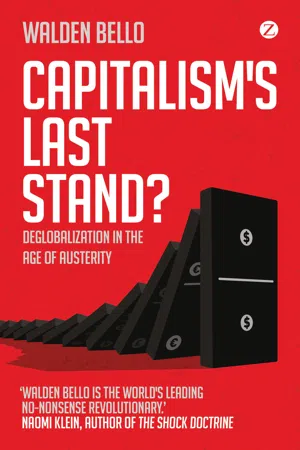
'Walden Bello is the world's leading no-nonsense revolutionary.' - Naomi Klein, author of The Shock Doctrine
In this eye-opening and often scathing book, Walden Bello provides a forensic dissection of contemporary capitalism's multiple crises. Trenchant but constructive, Bello's analysis of the collapse of the global real economy, covering such issues as the Wall Street meltdown, the disintegration of the Greek economy, and the rise of China, emphasizes the ever more pressing need to engage in a radical process of deglobalization towards a decentralized, pluralistic world system. Only then will we be able to construct a fairer and more equitable society.
A stirring call to arms for all those interested in global economic justice.
- English
- ePUB (mobile friendly)
- Available on iOS & Android
eBook - ePub
About this book
Information
PART I
THE DESTRUCTIVE DYNAMICS OF FINANCE CAPITAL
CHAPTER 1
WHY AND HOW FINANCE BECAME DOMINANT
A primer on Wall Street meltdown
Written shortly after the Wall Street collapse in September 2008, this essay sought to capture the impact of the event on the American middle class while providing a primer on the causes and dynamics of the financial crisis. The central concept here is ‘overproduction.’ Rooted in the inherent tendency to create productive capacity that outstrips demand, capital’s effort to surmount the crisis of overproduction is one of the central engines of globalization and financialization, which triggered the financial crisis. Deglobalization is thus, at bottom, a response to the crisis of capitalism.1
Flying into New York Tuesday, I had the same feeling I had when I arrived in Beirut two years ago, at the height of the Israeli bombing of that city — that of entering a war zone.
The immigration agent, upon learning I taught political economy, commented, ‘Well, I guess you folks will now be revising all those textbooks?’
The bus driver welcomed passengers with the words, ‘New York is still here, ladies and gentlemen, but Wall Street has disappeared, like the Twin Towers.’
Even the usually cheerful TV morning shows felt obligated to begin with the bad news, with one host attributing the bleak events to ‘the fat cats of Wall Street who turned into pigs.’
This city is shell-shocked, and most people still have to digest the momentous events of the past two weeks:
• a trillion dollars’ worth of capital going up in smoke in Wall Street’s steep plunge of 778 points on Black Monday II, September 29, as investors reacted in panic to the US House of Representatives’ rejection of President George W. Bush’s gargantuan $700 billion bailout of financial institutions on the verge of bankruptcy;
• the collapse of one of the Street’s most prominent investment banks, Lehman Brothers, followed by the largest bank failure in US history, that of Washington Mutual, the country’s largest savings and loan institution;
• Wall Street’s effective nationalization, with the Federal Reserve and the Department of Treasury making all the major strategic decisions in the financial sector and, with the rescue of the American International Group (AIG), the amazing fact that the US government now runs the world’s biggest insurance company.
Over $5 trillion in total market capitalization has been wiped out since October of last year, with over a trillion of this accounted for by the unraveling of Wall Street’s financial titans.
The usual explanations no longer suffice. Extraordinary events demand extraordinary explanations. But first…
Is the worst over?
No, if anything is clear from the contradictory moves of the last week — allowing Lehman Brothers and Washington Mutual to collapse while taking AIG over and engineering Bank of America’s takeover of Merrill Lynch — there is no strategy to deal with the crisis, just tactical responses, like the fire department’s response to a conflagration.
The proposed $700 billion buyout of banks’ bad mortgaged-backed securities is not a strategy but mainly a desperate effort to shore up confidence in the system, to prevent the erosion of trust in the banks and other financial institutions and avoid a massive bank run such as the one that triggered the Great Depression of 1929.
Did greed cause the collapse of global capitalism’s nerve center?
Good old-fashioned greed played a part. This is what Klaus Schwab, the organizer of the World Economic Forum, the yearly global elite jamboree in the Swiss Alps, meant when he told his clientele in Davos earlier this year: ‘We have to pay for the sins of the past.’2
Was this a case of Wall Street outsmarting itself?
Definitely. Financial speculators outsmarted themselves by creating more and more complex financial contracts like derivatives that would securitize and make money from all forms of risk — including exotic futures instruments such as ‘credit default swaps’ that enable investors to bet on the odds that the banks’ own corporate borrowers would not be able to pay their debts! This is the unregulated multi-trillion-dollar trade that brought AIG down.
On December 17, 2005, when International Financing Review (IFR) announced its 2005 Annual Awards — one of the securities industry’s most prestigious awards — it had this to say:
[Lehman Brothers] not only maintained its overall market presence, but also led the charge into the preferred space by … developing new products and tailoring transactions to fit borrowers’ needs. … Lehman Brothers is the most innovative in the preferred space, just doing things you won’t see elsewhere.3
No comment.
Was it lack of regulation?
Yes — everyone acknowledges by now that Wall Street’s capacity to innovate and turn out more and more sophisticated financial instruments had run far ahead of government’s regulatory capability, not because government was not capable of regulating but because the dominant neoliberal, laissez-faire attitude prevented government from devising effective mechanisms with which to regulate. The massive trading in derivatives helped precipitate this crisis, and the US Congress paved the way when it passed a law in 2000 excluding derivatives from being regulated by the Securities Exchange Commission.
But isn’t something more happening, something systemic?
Well, George Soros, who saw this coming, says what we are going through is the crisis of the ‘gigantic circulatory system’ of a ‘global capitalist system that is … coming apart at the seams.’4
To elaborate on the arch-speculator’s insight, what we are seeing is the intensification of one of the central crises or contradictions of global capitalism, which is the crisis of overproduction, also known as overaccumulation or overcapacity.
This is the tendency for capitalism to build up tremendous productive capacity that outruns the population’s capacity to consume, owing to social inequalities that limit popular purchasing power. Profitability is thus eroded.
But what does the crisis of overproduction have to do with recent events?
Plenty. But to understand the connections, we must go back in time to the so-called Golden Age of Contemporary Capitalism, the period from 1945 to 1975.
This was a period of rapid growth both in the center economies and in the underdeveloped economies — one that was partly triggered by the massive reconstruction of Europe and East Asia after the devastation of the Second World War, and partly by the new socioeconomic arrangements that were institutionalized under the new Keynesian state. Among the latter, key were strong state controls over market activity, aggressive use of fiscal and monetary policy to minimize inflation and recession, and a regime of relatively high wages to stimulate and maintain demand.
So what went wrong?
Well, this period of high growth came to an end in the mid-1970s, when the center economies were seized by stagflation, meaning the coexistence of low growth with high inflation, which was not supposed to happen under neoclassical economics.
Stagflation, however, was but a symptom of a deeper cause: the reconstruction of Germany and Japan and the rapid growth of industrializing economies like Brazil, Taiwan, and South Korea added tremendous new productive capacity and increased global competition, while social inequalities within countries and between countries worldwide limited the growth of purchasing power and demand, thus eroding profitability. This was aggravated by the massive oil price rises of the 1970s.
How did capitalism try to solve the crisis of overproduction?
Capital tried three escape routes from the conundrum of overproduction: neoliberal restructuring, globalization, and financialization.
What was neoliberal restructuring all about?
Neoliberal restructuring took the form of Reaganism and Thatcherism in the North and structural adjustment in the South. The aim was to invigorate capital accumulation, and this was to be done by (1) removing state constraints on the growth, use, and flow of capital and wealth, and (2) redistributing income from the poor and middle classes to the rich on the theory that the rich would then be motivated to invest and reignite economic growth.
The problem with this formula was that in redistributing income to the rich, they were gutting the incomes of the poor and middle classes, thus restricting demand, while not necessarily inducing the rich to invest more in production. In fact, what the rich did was to channel a large part of their redistributed wealth to speculation.
The truth is neoliberal restructuring, which was generalized in the North and South during the 1980s and 1990s, had a poor record in terms of growth: global growth averaged 1.1 percent in the 1990s and 1.4 percent in the 1980s, whereas it averaged 3.5 percent in the 1960s and 2.4 percent in the 1970s, when state interventionist policies were dominant. Neoliberal restructuring could not shake off stagnation.
How was globalization a response to the crisis?
The second escape route global capital took to counter stagnation was ‘extensive accumulation’ or globalization, or the rapid integration of semi-capitalist, non-capitalist, or pre-capitalist areas into the global market economy. Rosa Luxemburg, the famous German revolutionary economist, saw this long ago as necessary to shore up the rate of profit in the metropolitan economies. How? By gaining access to cheap labor; by gaining new, albeit limited, markets; by gaining new sources of cheap agricultural and raw material products; and by bringing into being new areas for investment in infrastructure. Integration is accomplished via trade liberalization, removing barriers to the mobility of global capital, and abolishing barriers to foreign investment.
China is, of course, the most prominent case of a non-capitalist area to be integrated into the global capitalist economy over the past twenty-five years.
To counter their declining profits, a sizable number of the Fortune 500 corporations have moved a significant part of their operations to China to take advantage of the so-called ‘China Price’ — the cost advantage deriving from China’s seemingly inexhaustible cheap labor. By the middle of the first decade of the twenty-first century, roughly 40–50 percent of the profits of US corporations were derived from their operations and sales abroad, especially in China.
Why didn’t globalization surmount the crisis?
The problem with this escape route from stagnation is that it exacerbates the problem of overproduction because it adds to productive capacity. A tremendous amount of manufacturing capacity has been added in China over the past twenty-five years, and this has had a depressing effect on prices and profits. Not surprisingly, by around 1997 the profits of US corporations stopped growing. According to another index, devised by economist Philip O’Hara, the profit rate of the Fortune 500 went from 7.15 in 1960–69 to 5.30 in 1980–90 to 4.02 in 1990–99 to 3.30 in 2000–02.5
What about financialization?
Given the limited gains in countering the depressive impact of overproduction via neoliberal restructuring and globalization, the third escape route became very critical for maintaining and raising profitability: financialization.
In the ideal world of neoclassical economics, the financial system is the mechanism by which the savers or those with surplus funds are joined with the entrepreneurs who have need of their funds to invest in production. In the real world of late capitalism, with investment in industry and agriculture yielding low profits owing to overcapacity, large amounts of surplus funds are circulating and being invested and reinvested in the financial sector — that is, the financial sector is turning in on itself.
The result is an increased bifurcation between a hyperactive financial economy and a stagnant real economy. As one financial executive notes, ‘There has been an increasing disconnection between the real and financial economies in the last few years. The real economy has grown … but nothing like that of the financial economy — until it imploded.’6
What this observer does not tell us is that the disconnect between the real and the financial economy is not accidental — that the financial economy imploded precisely to make up for the stagnation owing to overproduction of the real economy.
What were the problems with financialization?
The problem with investing in financial sector operations is that it is tantamount to squeezing value out of already created value. It may create profit, yes, but it does not create new value — only industry, agriculture, trade, and services create new value.
Because profit is not based on value that is created, investment operations become very volatile, and prices of stocks, bonds, and other forms of investment can depart very radically from their real value — for instance, the stock of Internet startups that keep on rising, driven mainly by upwardly spiraling financial valuations, and that then crash.
Profits then depend on taking advantage of upward price departures from the value of commodities, and then selling before reality enforces a ‘correction’ — that is, a crash back to real values.
The radical rise of prices of an asset far beyond real values is what is called the formation of a bubble.
Why is financialization so volatile?
Profitability being dependent on speculative coups, it is not surprising that the fina...
Table of contents
- Cover
- About the Author
- Title
- Dedication
- Copyright
- Contents
- Introduction Globalization’s Debacle: Crisis and Opportunity
- Part I: The Destructive Dynamics of Finance Capital
- Part II: Globalization in Crisis
- Part III: Competing Alternatives
- Conclusion Deglobalization: An Idea Whose Time Has Come?
- Notes
- Index
Trusted by 375,005 students
Access to over 1.5 million titles for a fair monthly price.
Study more efficiently using our study tools.
Frequently asked questions
Yes, you can cancel anytime from the Subscription tab in your account settings on the Perlego website. Your subscription will stay active until the end of your current billing period. Learn how to cancel your subscription
No, books cannot be downloaded as external files, such as PDFs, for use outside of Perlego. However, you can download books within the Perlego app for offline reading on mobile or tablet. Learn how to download books offline
Perlego offers two plans: Essential and Complete
- Essential is ideal for learners and professionals who enjoy exploring a wide range of subjects. Access the Essential Library with 800,000+ trusted titles and best-sellers across business, personal growth, and the humanities. Includes unlimited reading time and Standard Read Aloud voice.
- Complete: Perfect for advanced learners and researchers needing full, unrestricted access. Unlock 1.5M+ books across hundreds of subjects, including academic and specialized titles. The Complete Plan also includes advanced features like Premium Read Aloud and Research Assistant.
We are an online textbook subscription service, where you can get access to an entire online library for less than the price of a single book per month. With over 1.5 million books across 990+ topics, we’ve got you covered! Learn about our mission
Look out for the read-aloud symbol on your next book to see if you can listen to it. The read-aloud tool reads text aloud for you, highlighting the text as it is being read. You can pause it, speed it up and slow it down. Learn more about Read Aloud
Yes! You can use the Perlego app on both iOS and Android devices to read anytime, anywhere — even offline. Perfect for commutes or when you’re on the go.
Please note we cannot support devices running on iOS 13 and Android 7 or earlier. Learn more about using the app
Please note we cannot support devices running on iOS 13 and Android 7 or earlier. Learn more about using the app
Yes, you can access Capitalism's Last Stand? by Walden Bello in PDF and/or ePUB format, as well as other popular books in Politics & International Relations & Globalisation. We have over 1.5 million books available in our catalogue for you to explore.