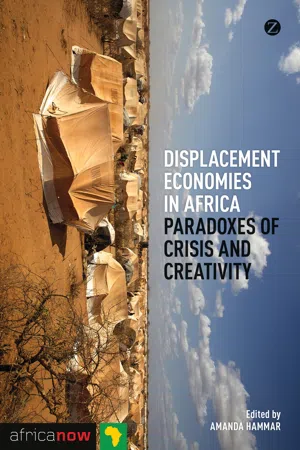
Large-scale displacement - whether caused by war, state-related political or development projects, different forms of political violence, structural crisis, or even natural disasters - evokes many stereotyped assumptions about those forcibly displaced or emplaced. At the same time there is a problematic lack of attention paid to the diversity of actors, strategies and practices that reshape the world in the face (and chronic aftermath) of dramatic moments of violent dislocation. In this highly original volume, based on empirical case studies from across sub-Saharan Africa, the authors reveal the paradoxical effects, both intended and unexpected, that displacement produces, and that manifest themselves in displacement economies.
An important contribution to a topic of growing scholarly and policy interest.
- English
- ePUB (mobile friendly)
- Available on iOS & Android
eBook - ePub
PART I
Economies of rupture and repositioning
2 | Securing livelihoods: economic practice in the Darfur–Chad borderlands
Andrea Behrends1
Introduction
When I returned to the Darfur border in 2007, I found Hashaba, the Chadian village in which I had lived six years before, emptied of nearly all its inhabitants. A few old people had remained there. They lived off wild berries that they found in the bush. ‘In normal times, this is children’s food,’ one old man told me, ‘and they eat it when they play in the bush. Now we don’t have anything else.’ I knew the old man whom they called Daldoum from my previous visits, although I hardly recognized him this time as the active and vivid man he used to be. He was very skinny and his clothes were dirty and torn.
He and his wife Mariam had come to Hashaba from a Sudanese village eight years before, escaping the violence that was spreading on the other side of the border. Now the violence had arrived in Chad, but they did not want to leave this place, where distant relatives had given them somewhere to stay and a piece of land to cultivate. Daldoum had been the chief of the Sudanese refugees in the village of Hashaba. A year ago, he said, all the others had left for Adré, with its approximately 13,000 inhabitants the largest town in the region, and the last border post on the way to Darfur in Sudan. The same had happened in the villages around Hashaba, with more than ten thousand people having moved to the outskirts of Adré to live there in shacks built from straw, only after some time to be replaced by more permanent houses constructed with wood, mud bricks and straw. They had all felt threatened by the violence that had spread from across the border. Had they stayed, they feared that the rebels and the militias would have destroyed everything and killed them. And indeed, at the time of my visit in 2007, the militias did come to the village almost every day. Daldoum said that they would sit under the village’s largest tree and throw stones at them, yelling, ‘We will kill you and take your land!’, but then they would leave them alone. Daldoum and the others are few and old and have nothing to lose, since all houses and fields around them have long been dismantled by their former owners or destroyed by the militias.
Their daughter Ashta is among those who had left for Adré. She lives in the outskirts of town in Hille Djidíde, which means New Town. There, she built a hut for herself and the children. She earned a bit of money by working on other people’s fields and by helping out in the production of mud bricks, carrying them to and from the ovens in which they are burnt.2 That way she has managed to survive and even buy her twenty-year-old son a horse carriage. He now earns a bit of money himself, carrying people and market goods; and he shares his income with his mother and his young wife. Ashta says that by leaving her parents in the village, they could keep the land while she and the children are gone. By her doing so, she hoped, the land could not be lost or given to someone else. She went to see her parents from time to time, walking on foot the eight kilometres of sandy tracks, to bring them food and to help farming around their house. In 2011, when I last visited Ashta and her parents, she still lived in Hille Djidíde and her parents were still in the village. One year later, in 2012, international aid agencies replaced her makeshift home with a house built of solid bricks. But other villagers had started to return temporarily to the village and to farm the land around their former houses.
Particularly notable among people farming in Hashaba are those who now live in one of the twelve refugee camps that the United Nations High Commissioner for Refugees (UNHCR) had built in 2003. There, they have no access to farming land, and they come to the village and stay during the farming season. In fact I found one of the villages close to Hashaba full of people – but hardly any of them were the village’s former inhabitants: ‘These are the refugees from the Farchana refugee camp,’ Daldoum told me. ‘They live and work on the land that others have left behind, and then they return to the camps after their harvests.’3 As he has remained in Hashaba village, Daldoum was now in a position to distribute land, since he and his wife had been there to guard it while the others were gone.
To maintain access to and ownership of land is at the foreground of economic planning and practice during their sustained displacement for Daldoum and his daughter Ashta. Similarly, access to farmland, even if only temporary, has been critical for those refugees who came from farming communities in Sudan and now live in one of the refugee camps. For many, it is a means to partly regain autonomy and to escape the dependence on aid and provisions within the camp. For Daldoum and Ashta, it is a strategy to secure (future) livelihoods throughout turbulent times. Securing livelihoods serves as my basic definition for their economic practice during their sustained displacement. It denotes those processes by which people make use of or translate into their respective contexts internationally devised aid infrastructures in order to produce security. This notion follows Thomas Eriksen’s (2010) understanding of ‘human security’. He starts from the assumption that it takes ‘hard work’ to ‘create secure lives in a complex and turbulent world’ (ibid.: 5). He maintains that the term ‘human security’ may be vague and wide ranging, but that it does allow for an orientation along the lines of social cohesion, integration, stability and collective identity. By asking what renders people secure and what insecure, it is possible to study the patterns and regularities of their actions on various levels of interaction.4
Focusing on economic practices to secure livelihoods also links up with the intention of building a better future as a strongly compelling factor for those dealing with an uncertain and disrupted present. Daldoum and his daughter Ashta provide one example of such rigorous future orientation. By physically remaining in a potentially mortal war zone, the old man not only stubbornly resists the constant threats of expulsion and death and the seemingly more secure situation within a refugee camp. He also foresees a way of ensuring that his family can regain the land, and with the land the livelihoods they had to leave behind owing to the war. He does so with the help of his daughter, who – although distantly relocated – risks regularly walking the 16 kilometres from Adré to the village and back in rebel and militia territory to support her parents by bringing them occasional provisions of food and other necessities, such as blankets, pots or soap. To Daldoum and Ashta, risk is a necessary factor in securing their livelihood during wartimes.
In this contribution I compare different situations in which people try to find and, if possible, remain in a condition of security in moments of insecurity and disruption. Here, the relational concept of displacement economies, laid out in the introduction to this volume by Amanda Hammar, perfectly fits the way different actors engage in historically entangled boundary crossing. Furthermore, it speaks to the creative mixing of economic survival strategies that I encountered in the Darfur–Chad borderlands. Indeed, one essential element of Ashta’s and Daldoum’s activities is firmly economic: their daily focus is on the necessity of getting at least a minimum (cash) income to be able to buy food to feed their family or for medical help, transport or other needs. Ashta and Daldoum do so by building upon the knowledge of their neighbours and other villagers in dealing with a crisis, which nonetheless also means having to put up with remaining risks and dangers. Others rely on systems of survival created through foreign interpretations of the crisis situation, as in the case of international models of emergency assistance and development aid. International models might provide for higher security from violence, for instance in the guarded surroundings of a refugee camp. But they also bear the risk of disconnecting people from local opportunities to access land and, thus, from the opportunity to build up an independent future security that comes close to what they had to leave behind in the war.5
To compare different situations, I refer to constraints and possibilities for economic strategies within four distinct yet interconnected socio-spatial sites that are part of what constitutes the broader displacement context of this borderland region: 1) the village of Hashaba, where Daldoum and his daughter have lived and from which most people have fled; 2) the town of Adré, where internally displaced people live largely without assistance from international aid agencies; 3) Abéché, the major city in eastern Chad with a current population of about 200,000 and the initial aid hub for the large number of aid organizations operating in the region; and 4) the refugee camp of Farchana, one of twelve such camps, in each of which between 20,000 and over 40,000 refugees currently live. The latter are assisted by international organizations like the United Nations High Commissioner for Refugees (UNHCR) or the World Food Programme (WFP), plus a large number of governmental and non-governmental organizations which take up different tasks within the camp. By comparing these sites and their actors, this chapter aims to show that the options open to each group are not unlimited: they are spatially and historically bound by the particularities of the respective contexts the actors find themselves in. The question guiding the presentation below of the region’s background is therefore: how did the events of rebellion and counter-insurgency in the Darfur–Chad border region affect the specific economies of actors in these different contexts? And how does living in one of the four displacement sites I describe shape the definition of livelihood security? In all four sites, not only the present but also relevant past events, political loyalties and personal experiences will enter the analysis.
‘Displacement economy’ as a socio-spatial analytical frame
Apart from the example of Daldoum and his daughter Ashta, who are associated, respectively, with two of the above-mentioned sites – namely the village of Hashaba and the group of internally displaced people living in Adré – I introduce below two more individuals who act as case examples to illustrate the third and fourth sites. The third example is that of Cheikh Moussa, a Sudanese refugee who moved from a border village close to Hashaba to the Farchana refugee camp. He receives aid from international programmes and is confronted with constraints to his mobility, since he still does not consider returning to Sudan a safe option. The fourth example is that of Brahim, who grew up in Adré. Today he lives in the vicinity of the Farchana refugee camp, where he works for an international NGO. He and his relatives profited financially from the international presence that followed the war along the international border with Sudan. Brahim and his family represent a group of better-off inhabitants of Abéché and Adré who, historically, held a privileged position in the region. They are among those who have remained more or less neutral and thus little affected by the conflicts in Darfur and across the border in Chad. I will argue that in all four cases, different but historically contingent practices to generate livelihood security under conditions of war and displacement prove to be successful. The question, then, will be to see which specific factors become important in such situations of war and displacement, and in which ways do the actors in all four sites relate to these factors differently in the process of producing livelihood security.
To compare and analyse strategies to secure livelihoods, I draw on this volume’s key notion of ‘displacement economy’ primarily with regard to its socio-spatial qualities – that is, as the larger space in which economically oriented interaction takes place. In my reading, the ‘displacement economies’ concept reflects a particular focus on what could more generally be termed ‘arena’. In Anselm Strauss’s (1978) understanding of an arena, individual actors compose ‘social worlds’, but they are committed to participating in a broader arena. Within the arena, ‘they commonly act as representatives of their social worlds, performing their collective identities’ (Klapp 1972, cited in Clarke and Star 2008: 120). The complexity and flexibility of entangled histories, actors and sites which figure prominently in Hammar’s definition of ‘displacement economies’ also echo in Clarke and Star’s (2008) expansion on Strauss’s original definition of an arena. They explain that an arena could, in fact, be understood as encompassing a multitude of social worlds, criss-crossed with ‘conflicts, different sorts of careers, viewpoints, funding sources, and so on’ (ibid.: 113). Using this framework opens up perspectives on ‘situatedness and contingency, history and fluidity, commitment and change’ (ibid.) within particular situations.
With this more general approach to arenas in mind, I adhere to the concept of a ‘displacement economy’ in relation to the overall space in which actors within and across each of the four sites interact. I abstain, however, from delineating fixed territories and boundaries as I consider the four sites to be both wider than and at the same time inclusive of particular places. For this study, I will refer to the conflict and displacement zone of the Darfur–Chad borderlands as a set of interconnected, flexible and varying sites that make up an encompassing displacement economy. This context includes different (collective) actors and institutions that apply particular strategies of survival. I refer to their strategic actions as a set of partly standar...
Table of contents
- Cover
- About the Editor
- Title
- Copyright
- Contents
- Figure and tables
- Introduction
- Part I: Economies of rupture and repositioning
- Part II: Reshaping economic sectors, markets and investment
- Part III: Confinement and economies of loss and hope
- About the contriburors
- Index
Trusted by 375,005 students
Access to over 1.5 million titles for a fair monthly price.
Study more efficiently using our study tools.
Frequently asked questions
Yes, you can cancel anytime from the Subscription tab in your account settings on the Perlego website. Your subscription will stay active until the end of your current billing period. Learn how to cancel your subscription
No, books cannot be downloaded as external files, such as PDFs, for use outside of Perlego. However, you can download books within the Perlego app for offline reading on mobile or tablet. Learn how to download books offline
Perlego offers two plans: Essential and Complete
- Essential is ideal for learners and professionals who enjoy exploring a wide range of subjects. Access the Essential Library with 800,000+ trusted titles and best-sellers across business, personal growth, and the humanities. Includes unlimited reading time and Standard Read Aloud voice.
- Complete: Perfect for advanced learners and researchers needing full, unrestricted access. Unlock 1.5M+ books across hundreds of subjects, including academic and specialized titles. The Complete Plan also includes advanced features like Premium Read Aloud and Research Assistant.
We are an online textbook subscription service, where you can get access to an entire online library for less than the price of a single book per month. With over 1.5 million books across 990+ topics, we’ve got you covered! Learn about our mission
Look out for the read-aloud symbol on your next book to see if you can listen to it. The read-aloud tool reads text aloud for you, highlighting the text as it is being read. You can pause it, speed it up and slow it down. Learn more about Read Aloud
Yes! You can use the Perlego app on both iOS and Android devices to read anytime, anywhere — even offline. Perfect for commutes or when you’re on the go.
Please note we cannot support devices running on iOS 13 and Android 7 or earlier. Learn more about using the app
Please note we cannot support devices running on iOS 13 and Android 7 or earlier. Learn more about using the app
Yes, you can access Displacement Economies in Africa by Amanda Hammar in PDF and/or ePUB format, as well as other popular books in Economics & Development Economics. We have over 1.5 million books available in our catalogue for you to explore.