Economic Policy and Human Rights presents a powerful critique of three decades of neoliberal economic policies, assessed from the perspective of human rights norms. In doing so, it brings together two areas of thought and action that have hitherto been separate: progressive economics concerned with promoting economic justice and human development; and human rights analysis and advocacy.
Focussing on in-depth comparative case studies of the USA and Mexico and looking at issues such as public expenditure, taxation and international trade, the book shows that heterodox economic analysis benefits greatly from a deeper understanding of a human rights framework. This is something progressive economists have often been skeptical of, regarding it as too deeply entrenched in 'Western' norms, discourses and agendas. Such a categorical rejection is unwarranted. Instead, human rights norms can provide an invaluable ethical and accountability framework, challenging a narrow focus on efficiency and growth.
A vital book for anyone interested in human rights and harnessing economics to create a better world.
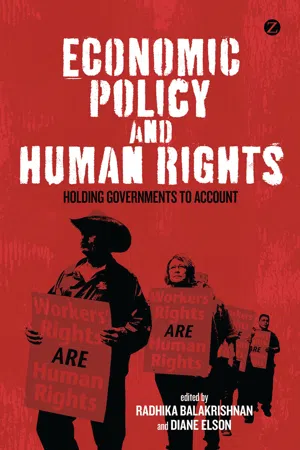
eBook - ePub
Economic Policy and Human Rights
Holding Governments to Account
- English
- ePUB (mobile friendly)
- Available on iOS & Android
eBook - ePub
Economic Policy and Human Rights
Holding Governments to Account
About this book
Trusted by 375,005 students
Access to over 1.5 million titles for a fair monthly price.
Study more efficiently using our study tools.
Information
1 | FISCAL AND MONETARY POLICY AND THE RIGHT TO WORK: MEXICO1
Kristina Pirker and Sarah Gammage
Introduction
Fiscal and monetary policy have implications for the realization of many human rights, and are particularly important for those that are related to paid employment. Here we examine fiscal and monetary policy with respect to the obligations to fulfil the right to work and to just and favourable conditions of work. The Universal Declaration of Human Rights (Article 23) and the International Covenant on Economic, Social and Cultural Rights (ICESCR) (Articles 6 and 7) oblige governments to create the conditions required to generate full and productive employment with fair wages that secure decent living conditions. The Mexican government ratified the ICESCR in 1981. Social rights have a long-standing legal basis in Mexico, having been included in the 1917 Constitution, which included the Right to Work as well as the Right to Earn a Minimally Remunerative Salary (Article 123). Mexican fiscal and monetary policy in the last thirty years or so is discussed in light of the human rights principles of progressive realization and non-retrogression; and transparency, accountability and participation.
Conduct of fiscal policy
Progressive realization and non-retrogression The ICESCR requires government to take steps ‘with a view to achieving progressively’ the full realization of the rights it specifies. The Committee on Economic, Social and Cultural Rights has clarified that, in general, states should not introduce ‘retrogressive’ measures that set back the realization of rights. If such retrogressive measures are deliberate, then the state has to show that they have been ‘introduced after consideration of all alternatives and are fully justifiable by reference to totality of rights provided for in the Covenant and in context of the full use of the maximum of available resources’. How far has the conduct of fiscal policy complied with these principles?
During the ‘stabilizing development’ period (1958–70) and the ‘debt expansion and crisis’ period (1971–82), fiscal policy played an active role in promoting growth and employment creation. This focus changed, however, after the debt crisis in 1982. Under the administration of Miguel de la Madrid (1982–88), stabilization and structural adjustment programmes were introduced, and the reduction of the federal government budget deficit became a paramount objective, taking precedence over promotion of growth and employment creation. Under the administrations of Carlos Salinas (1988–94) and Ernesto Zedillo (1994–2000), these policies have continued. Macroeconomic policy has prioritized the reduction of the role of the state in the economy, trade and financial liberalization, and labour market flexibility. The administrations of Vicente Fox (2000–06) and now Felipe Calderón (2006–12) have largely followed the course laid out by their predecessors; and the commitment to a balanced budget has been enacted in law.
The Federal Budget Law (2006) established a balanced budget as the guiding principle for fiscal policy: only under extraordinary economic and social conditions can the government incur a budget deficit, and the Federal Government must justify this before the Congress, explaining how it plans to return to a balanced budget (LFPRH, Article 17). Moreover, the Ruling of the Federal Law of Budget and Treasury Responsibility is even more specific by establishing in Article 11, ‘The budget deficit should be equal to zero. Under exceptional circumstances a budget deficit different from zero can be anticipated; up to 0.5 percentage points of the estimated GDP ...’2
Mainstream economists argue that maintaining a balanced budget will secure lower inflation, and stable access to international capital markets; as Ocampo notes, they believe this will promote dynamic and sustainable economic growth; and consequently ensure the generation of employment (Ocampo 2005: 13). However, the requirement for a balanced budget reduces the ability of a government to take counter-cyclical action in times of economic downturn. Despite their commitment to fiscal discipline, many OECD countries continue to maintain a budget deficit: for example, in 2005, prior to the financial crisis, the USA had a budget deficit of 4.7 per cent of GDP, Germany one of 3.3 per cent, Italy 4.2 per cent and Hungary 6.1 per cent (OECD 2006: 58). Ha-Joon Chang and Ilene Grabel, after an extensive evaluation of international experiences, recommend that well-designed and strategic public expenditure programmes in developing countries should not be cut as a result of an ‘obsession’ with not incurring a fiscal deficit (Chang and Grabel 2004).
Chile provides an interesting example of a fiscal balance commitment that focuses on the medium term instead of the short term and that therefore can be used to implement counter-cyclical fiscal policy. Since 2001, Chile’s fiscal policy has embraced a commitment to a central government ‘structural balance’. Unlike the ‘effective balance’, which reports the current fiscal position, this balance reflects the medium-term fiscal outlook. Maintaining a structural balance involves estimating the fiscal revenue that would be obtained net of the impact of the economic cycle, and spending only the amount that would be compatible with this level of income. In practice, this means saving revenue during economic upturns and spending the revenues during downturns. Mexico could draw on such an example to pursue counter-cyclical fiscal policy.

1.1 Public sector revenue and expenditure (1980–2009)
Source: Own calculations using data from the Centre for the Study of Public Finance from the Chamber of Deputies (CEFP) with data from the Federal Treasury Accounts, 1980–2006, www.cefp.gob.mx/intr/bancosdeinformacion/historicas/gasto_publico/A13.xls (accessed March 2008); data 2007–09: SHCP, Estadísticas oportunas de las finanzas públicas, 2010, www.apartados.hacienda.gob.mx/estadisticas_oportunas/esp/index.html (accessed July 2010).
As illustrated in Figure 1.1, since the late 1980s the budget deficit has been eliminated by reducing public expenditure rather than by raising tax revenue.3 Two considerable declines in the level of public revenue are worth mentioning, the first between 1992 and 1993 when total public revenue declined 3.1 percentage points from 26.7 per cent of GDP to 23.1 per cent. The second important fall can be seen from 1997 to 1998 – in response to the falling oil prices – with a decline of 2.8 percentage points from 21.2 to 20.4 per cent of GDP. The recovery in public sector revenue that can be seen over the last ten years is owing primarily to the strong price of oil and not to any improvement in tax revenue generation.
The current budget balance and the primary budget balance are shown in Figure 1.2.
The difference between the primary balance4 and the current budget balance is largely accounted for by interest payments and amortization of government debt. Figure 1.2 illustrates two important points. First, the budget deficit in the period under study was primarily the result of the debt service obligations of the various governments. As can be seen, the financial crisis of 1982 prompted an immediate and sudden increase in the public deficit5 – which demonstrated the impossible task that the administration of Miguel de la Madrid faced servicing the public debt in response to the increase in international interest rates. In order to meet these commitments in a timely manner, the resources dedicated to public investment and social development were drastically reduced, even though in this period total public expenditure reached historic levels, rising to 42 per cent of GDP in 1982. Thanks to the international debt renegotiation in 1988 and 1989, these payments were reduced, which permitted the recovery of social expenditure. A balanced budget was achieved in 2006 and 2007, with a surplus in the primary balance (approximately 2 per cent of GDP) dedicated to meet the financial obligations, which means that this amount of government revenues was being transferred to holders of government debt – both within Mexico and abroad. The impact of the 2008 global financial crisis resulted in a decline in economic growth from 3.2 per cent in 2007 to 1.3 per cent in 2008 and –6.7 per cent in 2009. Not surprisingly, revenue also fell, by 6.5 per cent in 2009 (CEPAL 2010). There was an increase in the deficit associated with the primary balance (–0.1 per cent of GDP) and in the overall budgetary balance (–2.3 per cent of GDP) in 2009. Congress authorized a temporary departure from a balanced budget because the circumstances were considered exceptional.

1.2 The public sector budget balances (1980–2009)
Source: Own calculations using data from the Centre for the Study of Public Finance from the Chamber of Deputies (CEFP) with data from the Federal Treasury Accounts, 1980–2006, www.cefp.gob.mx/intr/bancosdeinformacion/historicas/gasto_publico/A13.xls (accessed March 2008); data 2007–09: SHCP, Estadísticas oportunas de las finanzas públicas, 2010, www.apartados.hacienda.gob.mx/estadisticas_oportunas/esp/index.html (accessed July 2010).
One critical problem with Mexican public finances is the weight of financial sector liabilities in the Financing Requirements of the Public Sector (FRSP). In Figure 1.3, we can see the evolution of the FRSP and public sector expenditures from 1990 to March 2008. While public sector expenditure demonstrates few sudden increases or decreases, the historic balance declined in the early 1990s and then grew considerably from 1993 to 1995. This increase can be attributed to the fiscal cost of the 1994 banking bailout, as a result of which the Mexican government absorbed the obligations of bankrupt banks, which have cost around 6 per cent of GDP since 2006, calculated as part of the liabilities of the Institute for the Protection of Bank Savings (IPAB).6 Marcos Chávez concludes that with respect to the FRSP:

1.3 Financial Requirements of the Public Sector (FRPS) (1990–2008)
Note: Public expenditure for 2007 and 2008 refers to the approved budget
Source: Own estimates based on SHCP, Report on the Economic Situation, Public Finances and Public Debt, First Trimester, 2008, www.shcp.gob.mx (accessed June 2008); from the database of the Centre for the Study of Public Finance from the Chamber of Deputies (CEFP), www.cefp.gob.mx/intr/bancosdeinformacion/historicas/gasto_publico/A53.xls (accessed March 2008).
These [obligations] are of such a magnitude that they ...
Table of contents
- Cover
- About the editors
- Title page
- Copyright page
- Contents
- Figures, tables and box
- Abbreviations
- Acknowledgements
- Introduction: economic policies and human rights obligations
- 1 Fiscal and monetary policy and the right to work: Mexico
- 2 Human rights dimensions of fiscal and monetary policies: United States
- 3 Human rights and public expenditure in Mexico
- 4 Human rights and public expenditure in the USA
- 5 Taxation and economic and social rights in Mexico
- 6 Taxation and economic and social rights in the USA
- 7 Trade policy and human rights: Mexico
- 8 Trade policy and human rights obligations of the USA: NAFTA
- 9 Regulation: pension reform and human rights in Mexico
- 10 Regulation: pension reform and human rights in the USA
- About the contributors
- Index
Frequently asked questions
Yes, you can cancel anytime from the Subscription tab in your account settings on the Perlego website. Your subscription will stay active until the end of your current billing period. Learn how to cancel your subscription
No, books cannot be downloaded as external files, such as PDFs, for use outside of Perlego. However, you can download books within the Perlego app for offline reading on mobile or tablet. Learn how to download books offline
Perlego offers two plans: Essential and Complete
- Essential is ideal for learners and professionals who enjoy exploring a wide range of subjects. Access the Essential Library with 800,000+ trusted titles and best-sellers across business, personal growth, and the humanities. Includes unlimited reading time and Standard Read Aloud voice.
- Complete: Perfect for advanced learners and researchers needing full, unrestricted access. Unlock 1.5M+ books across hundreds of subjects, including academic and specialized titles. The Complete Plan also includes advanced features like Premium Read Aloud and Research Assistant.
We are an online textbook subscription service, where you can get access to an entire online library for less than the price of a single book per month. With over 1.5 million books across 990+ topics, we’ve got you covered! Learn about our mission
Look out for the read-aloud symbol on your next book to see if you can listen to it. The read-aloud tool reads text aloud for you, highlighting the text as it is being read. You can pause it, speed it up and slow it down. Learn more about Read Aloud
Yes! You can use the Perlego app on both iOS and Android devices to read anytime, anywhere — even offline. Perfect for commutes or when you’re on the go.
Please note we cannot support devices running on iOS 13 and Android 7 or earlier. Learn more about using the app
Please note we cannot support devices running on iOS 13 and Android 7 or earlier. Learn more about using the app
Yes, you can access Economic Policy and Human Rights by Radhika Balakrishnan, Diane Elson, Radhika Balakrishnan,Diane Elson in PDF and/or ePUB format, as well as other popular books in Economía & Macroeconomía. We have over 1.5 million books available in our catalogue for you to explore.