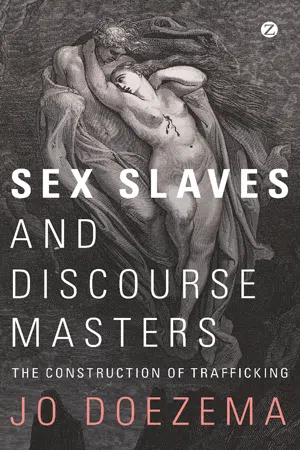
Why is the international community so concerned with the fate of prostitutes abroad? And why does the story of trafficking sound so familiar? In this pioneering new book, Jo Doezema argues that the current concern with trafficking in women is a modern manifestation of the myth of white slavery.
Combining historical analysis with contemporary investigation, this book sheds light on the current preoccupations with trafficking in women. It examines in detail sex worker reactions to the myth of trafficking, questions the current feminist preoccupation with the 'suffering female body' and argues that feminism needs to move towards the creation of new myths.
The analysis in this book is controversial but crucial, an alternative to the current panic discourses around trafficking in women. An essential read for anyone who is concerned with the increased movement of women internationally and the attempts of international and national governments to regulate this flow.
- English
- ePUB (mobile friendly)
- Available on iOS & Android
eBook - ePub
About this book
Information
1 White slavery and trafficking as political myth
I don’t know anything about the so-called white slave trade, for the simple reason that no such thing exists … it was left for the enlightened twentieth century to create the Great American Myth. ‘White slavery is abroad in our land! Our daughters are being trapped and violated and held prisoners and sold for fabulous sums (a flattering unction, this) and no woman is safe … the belief in this myth has become a fixed delusion in the minds of many otherwise sane persons. – Madeleine, an early twentieth-century prostitute and madam (quoted in Connelly 1980: 132)
The parallels between the manipulation and misrepresentation of statistics in the campaigns against white slavery and in today’s anti-trafficking campaigns are easy to draw. However, to see all white slavery campaigners, and, by analogy, all anti-trafficking campaigners, as deliberately exaggerating to achieve political goals is to impute an undeserved cynicism. With the exception of newspapers eager to increase circulation through sensationalism, or perhaps politicians ready to hop on a bandwagon for political gain, we cannot assume that most of these dedicated campaigners, then and now, were/are deliberately spreading falsehoods. While exaggeration may at times be a political strategy, the depth of commitment among today’s campaigners and their historical counterparts attests to their belief in the existence of trafficking/white slavery on a vast scale. Why did so many people believe in white slavery? And if records of the time show so little evidence, how are we to account for white slavery’s political potency?
Similar questions might be asked of today’s trafficking narratives. In this chapter, I draw on some of the theoretical resources that may be useful to make sense of the phenomena of white slavery and trafficking. Drawing on the work of historians of the white slavery era, and particularly that of Grittner (1990), I suggest that the concept of myth offers a useful starting point for an analysis of trafficking. It can move us beyond an empirical focus to an examination of why and how certain groups in society, including feminists, are so invested in the myth. If, as Grittner argues, white slavery was a cultural myth with repressive consequences for women, especially prostitutes, and subaltern men, what are the implications of this for the current campaign against ‘trafficking in women’? This chapter argues that an understanding of the ways in which myth is informed by ideology can help us understand not only the reasons for the appearance of the white slave in history, but also the reappearance of her mythical successor, the trafficking victim.
Myth and ideology
Current accounts of ‘trafficking in women’ vie with ‘white slavery’ stories in their use of sensational descriptions and emotive language, though the ‘victims’ are no longer white, western European or American women, but women from the Third World or the former Eastern bloc.
Trafficking Cinderella features gut wrenching testimonies of broken dreams, withered illusions, rape and humiliation from six Eastern European girls sold as prostitutes throughout the world. This film was made on behalf of all these lost girls; confused by the crumbling post-communist reality they became an easy prey for pimps, procurers and sex-traffickers.1
Think of it. You’re a young girl brought from Burma, you have been kidnapped or bought. You’re terrified … if you haven’t already been raped along the way (or sometimes even if you have) you’re immediately brought to the ‘Room of the Unveiling of the Virgin’. There you are raped continuously – until you can no longer pass for a virgin. Then you are put to work. (Mirkenson 1994: 1)
It is possible to see in these stories the reworking of several of the motifs identified in the Introduction: innocence; youth and virginity; deception and violence. Looking at Grittner’s use of the notion of ‘cultural myth’ can begin to provide some first clues towards an explanation for the similarity in white slavery and trafficking narratives. According to Grittner, a myth does not simply imply something that is ‘false’; rather, it is a collective belief that simplifies reality. Grittner explains his conception of myth as follows:
As an uncritically accepted collective belief, a myth can help explain the world and justify social institutions and actions … When it is repeated in similar form from generation to generation, a myth discloses a moral content, carrying its own meaning, secreting its own values. The power of myth lies in the totality of explanation. Rough edges of experience can be rounded off. Looked at structurally, a cultural myth is a discourse, ‘a set of narrative formulas that acquire through specifiable historical action a significant ideological charge’. (Grittner 1990: 7, quoting Slotkin 1985)
In this conception, myth is seen as more than a simple distortion or misrepresentation of facts. Slotkin’s (1985) definition points to the ways in which myth is connected to ideology. This broad notion of myth – as a narrative or story which carries ideological overtones – moves us beyond a search for the simple factuality of white slavery and trafficking narratives. Flood’s 1996 study of political myth argues that an understanding of ideology is essential to understanding how myth functions in the political process.2 Flood defines political myth as ‘an ideologically marked narrative which purports to give a true account of a set of past, present, or predicted political events and which is accepted as valid in its essentials by a social group’ (1996: 44). Flood’s comprehensive review of theorists of political myth demonstrates the ways in which different conceptions of ideology in turn influence how theorists conceptualize myth. One of the most famous examples of this is Sorel’s idea of the syndicalist general strike as a utopian social myth which embodies in its totality the idea of socialism:
The question whether the general strike is a partial reality, or only a product of popular imagination, is of little importance. All that it is necessary to know is, whether the general strike contains everything that the Socialist doctrine expects of the revolutionary proletariat … general strike … is … the myth in which Socialism is wholly comprised, i.e. a body of images capable of evoking instinctively all the sentiments which correspond to the different manifestations of the war undertaken by Socialism against modern society. (Sorel 1908 [1999]: 5, emphasis added)
Contemporary theorists of myth, as examined below, have retained these ideas of political myth as images or stories that are able to promote a collective response, the notion of myth as a reflection of how society should be. These theorists view myth as the expression of ideology. However, to define myth in terms of its relationship to ideology begs the question of what exactly ‘ideology’ is.
DO WE NEED IDEOLOGY?
The notion of ideology is anything but uncontested: Eagleton (1991) lists sixteen ways in which ‘ideology’ might be approached. Thus it comes as no surprise that distinctions between myth and ideology often blur in studies of political myth. For example, Tom Brass’s (2000) study of the ‘agrarian myth’ of peasant societies both equates myth with ideology – ‘the agrarian myth is an essentialist ideology’ (p. 11) – and argues that the agrarian myth ‘by itself’ is powerless: only ‘deployed as part of wider ideological struggle is it capable of exercising a political impact’ (p. 313). Eagleton states that the relationship between myth and ideology is not clear, and indeed, he himself is not clear, arguing both that the concept of myth is more and that it is less inclusive than ideology. For the purposes of this study, I wish to avoid an overly schematic and ahistorical search for ‘ideal types’. The concept of ideology is important for the study of the myth of white slavery/trafficking for the light it can shed on important questions relating to the origin, validity, function and power of the myth, rather than as an abstract theoretical construct. I will thus leave fluid the boundaries between myth and ideology, as well as definitions of them. As Eagleton says:
the term ‘ideology’ has a whole range of useful meanings … to try to compress this wealth of meaning into a single comprehensive definition would thus be unhelpful even if it were possible. The word ‘ideology’, one might say, is a text, woven of a whole tissue of different conceptual strands … it is probably more important to access what is valuable or can be discarded … than to merge them forcibly into some Grand Global Theory. (1991: 1)
Nevertheless, it is helpful to review some of the most prevalent conceptions of ideology in order to determine just what is ‘valuable’ and what can be ‘discarded’ for the purposes of this study.
Though the term ‘ideology’ is still very much in use in everyday speech, it has gone rather out of fashion in academia, replaced by the more capacious ‘discourse’. Ideology’s traditional concern with ‘truth’ and distortion seems decidedly old-fashioned when faced with the body blow dealt to notions of ahistorical, transcendental ‘truth’ by post-modernism. And if ideology is out of fashion, myth is the academic equivalent of love-beads and peace-sign necklaces. Myth was a central concept in the work of the standard-bearers of high structuralism, theorists such as Barthes and Lévi-Strauss, but like ‘ideology’ was outshone by the ‘discourse’ and ‘deconstruction’ of the hot young designers of post-structuralist haute couture.
Terry Eagleton, in his 1991 book Ideology: An Introduction, argues that the academic and progressive-left abandonment of ‘ideology’ for ‘discourse’ ended up throwing out the baby with the bathwater. For Eagleton, the diffuseness of power as diagnosed by Foucault’s (1975 [1991]) ‘disciplinary mechanisms’ leaves us with no centre to fix our analysis upon. This centre can be found, he suggests, in the notion of ‘ideology’. This view is linked to his condemnation of what he views as the relativism of post-modernism. For Eagleton (2003), the notion of a superior, or even an ‘absolute’ truth is not an anathema but the cornerstone of ethical political and cultural life. Eagleton argues that focusing on ‘ideology’ can help bring questions of truth to the forefront, banishing the spectre of the post-modern scenario of a bunch of commensurate truths.
Ernesto Laclau (1997) looks for the ‘resurrection’ of ideology in a different area. Rather than arguing against the post-modern attack on truth, Laclau pushes the post-modern case against ideology to the point that it collapses under its own inherent contradictions.3 At this point of collapse, ideology emerges transfigured (if marked by the resurrection). Thus we see that the lack of a centre identified by Eagleton as a reason to reclaim ideology from the morass of post-modern relativism is for Laclau the cornerstone upon which ideology is resurrected, ‘a starting point for a possible re-emergence of a notion of ideology which is not marred by the stumbling blocks of an essentialist theorisation’ (p. 300). Rather than distort an original truth, the function of ideology, according to Laclau, is in giving the illusion that this truth ever existed. Ideological distortion exists even in the absence of an original truth to distort.
Laclau achieves his resurrection with Althusser playing Lazarus. Dead and staying dead are Althusser’s notions of the strict separation between science and ideology. Alive again and rolling away the stone from the tomb are Althusser’s ideas about the indispensability of ideology, ideology as a ‘necessary illusion’, and in particular the idea of interpellation – of a necessary misrecognition in the constitution of the individual subject. Althusser, in his essay ‘Ideology and Ideological State Apparatuses’ (1971 [2001]), stated that: ‘Ideology represents the imaginary relationship of individuals to their real conditions of existence’ (p. 109). This misrecognition takes place through ‘interpellation’, in which individuals are turned into ideological subjects.4 Laclau retains Althusser’s idea of ideology as a necessary illusion, but moves the grounds of illusion from the individual to the very idea of society itself. If for Althusser it is the subject that is interpellated through ideology, for Laclau it is society – the community as a whole.
Laclau turns Eagleton’s argument on its head: it is because there is no centre, no ultimate truth, that ideology is necessary. Ideology is thus also, of course, impossible, for no distortion can occur without something that is undistorted to begin with. This impossible ‘constituent distortion’ of ideology is a necessary condition of society, making society the ‘impossible and necessary object’. The dialectics between the antimonies of impossibility and necessity is the process of ideology.
Laclau gives the following example of how ideology works:
Let us suppose that at some point, in a Third World country, nationalisation of the basic industries is proposed as an economic panacea. Now this just a technical way of running the economy and if it remains so it will never become an ideology. How does the transformation into the latter take place? Only if the particularity of the economic measure starts incarnating something more and different from itself: for instance, the emancipation from foreign domination, the elimination of capitalist waste, the possibility of social justice for excluded population, etc. In sum: the possibility of constituting the community as a coherent whole. That impossible object – the fullness of the community – appears here as depending on a particular set of transformations at the economic level. This is the ideological effect strictu sensu: the belief that there is a particular social arrangement which can bring about the closure and transparency of the community. (1997: 303)
Ideology and trafficking
The value of Eagleton’s arguments for this study lies first of all in the refocusing on truth, on questions of epistemology. In the study of white slavery as myth, we return time and time again to the question of truth. The word ‘myth’ connotes falsehood, and this is how the myth of white slavery has largely been understood by historians. To deal with the questions regarding the falsehood of myth means that we also need to deal with its postulated opposite. As reviewed below, attempts to distinguish the truth about white slavery from the myth preoccupy historians. Similarly, research on trafficking today is dominated by empirical studies. The questions policy makers and NGOs want answered is how many women are being trafficked? From where? I hope to show that these questions cannot be answered by a straightforward review of empirical evidence; that the problem is not one of inadequate definitions or statistical shortcomings (as has most often been argued), but a matter of differing ideologies.
Second, ideology as theorized by Laclau inspires a focus on community and conflict. Ideology effectively captures the idea of political struggle, of winners and losers, of strategies and compromise, of power given and taken: it foregrounds conflict in a way that the rather bloodless ‘discourse’ does not.5 This is important for trafficking, as meanings about what trafficking is have been the site of major political conflicts between feminists, sex workers and states. Chapters 4 and 5 concentrate on this political struggle, showing how different groups have wielded their ideologies in the international policy arena in the discussions around the 2000 Trafficking Protocol. Combined with Laclau’s (1990) own earlier theorizations about the role of myth in society, examined in Chapter 3, analysis of these discussions enables us to begin to answer the question of why the myth of trafficking is powerful again at this point in history.
Ideology, truth and power
These aspects of ideology – epistemology and political struggle – w...
Table of contents
- Cover
- About the Author
- Title
- Copyright
- Contents
- Acknowledgements
- List of Acronyms
- Introduction: Positioning trafficking in women
- 1 White slavery and trafficking as political myth
- 2 The construction of innocence and the spectre of chaos
- 3 Metaphorical innocence: white slavery in America
- 4 ‘Prevent, protect and punish’
- 5 Now you see her, now you don’t: consent, sex workers and the Human Rights Caucus
- 6 Towards a reinscription of myth
- Notes
- Primary Sources
- Works Cited
- Index
Trusted by 375,005 students
Access to over 1.5 million titles for a fair monthly price.
Study more efficiently using our study tools.
Frequently asked questions
Yes, you can cancel anytime from the Subscription tab in your account settings on the Perlego website. Your subscription will stay active until the end of your current billing period. Learn how to cancel your subscription
No, books cannot be downloaded as external files, such as PDFs, for use outside of Perlego. However, you can download books within the Perlego app for offline reading on mobile or tablet. Learn how to download books offline
Perlego offers two plans: Essential and Complete
- Essential is ideal for learners and professionals who enjoy exploring a wide range of subjects. Access the Essential Library with 800,000+ trusted titles and best-sellers across business, personal growth, and the humanities. Includes unlimited reading time and Standard Read Aloud voice.
- Complete: Perfect for advanced learners and researchers needing full, unrestricted access. Unlock 1.5M+ books across hundreds of subjects, including academic and specialized titles. The Complete Plan also includes advanced features like Premium Read Aloud and Research Assistant.
We are an online textbook subscription service, where you can get access to an entire online library for less than the price of a single book per month. With over 1.5 million books across 990+ topics, we’ve got you covered! Learn about our mission
Look out for the read-aloud symbol on your next book to see if you can listen to it. The read-aloud tool reads text aloud for you, highlighting the text as it is being read. You can pause it, speed it up and slow it down. Learn more about Read Aloud
Yes! You can use the Perlego app on both iOS and Android devices to read anytime, anywhere — even offline. Perfect for commutes or when you’re on the go.
Please note we cannot support devices running on iOS 13 and Android 7 or earlier. Learn more about using the app
Please note we cannot support devices running on iOS 13 and Android 7 or earlier. Learn more about using the app
Yes, you can access Sex Slaves and Discourse Masters by Doctor Jo Doezema in PDF and/or ePUB format, as well as other popular books in Social Sciences & Gender Studies. We have over 1.5 million books available in our catalogue for you to explore.