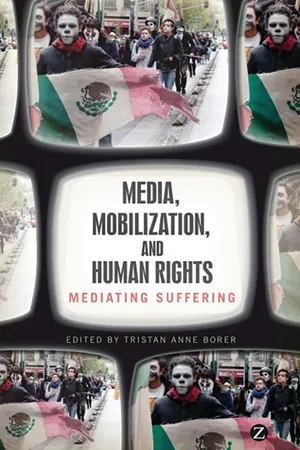
What impact do mass media portrayals of atrocities have on activism? Why do these news stories sometimes mobilize people, while at other times they are met with indifference? Do different forms of media have greater or lesser impacts on mobilization? These are just some of the questions addressed in Media, Mobilization, and Human Rights, which investigates the assumption that exposure to human rights violations in countries far away causes people to respond with activism.
Turning a critical eye on existing scholarship, which argues either that viewing and reading about violence can serve as a force for good (through increased activism) or as a source of evil (by objectifying and exploiting the victims of violence), the authors argue that reality is far more complex, and that there is nothing inherently positive or negative about exposure to the suffering of others. In exploring this, the book offers an array of case studies: from human rights reporting in Mexican newspapers to the impact of media imagery on humanitarian intervention in Somalia; from the influence of celebrity activism to the growing role of social media.
By examining a variety of media forms, from television and radio to social networking, the interdisciplinary set of authors present radical new ways of thinking about the intersection of media portrayals of human suffering and activist responses to them.
- English
- ePUB (mobile friendly)
- Available on iOS & Android
eBook - ePub
About this book
Information
1 | Humanitarian intervention in the 1990s: cultural remembrance and the reading of Somalia as Vietnam
DAVID KIERAN
On 24 March 1999, President Bill Clinton told Americans that the United States had begun bombing Kosovo. ‘Ending this tragedy is a moral imperative,’ he argued. ‘It is also important to America’s national interest’ (Clinton 1999, 451). Clinton’s determination came after months of contentious debate over whether a potential US intervention in the former Yugoslav republic constituted a national interest, could be militarily successful, or was worth the risk to American lives. For Clinton, clearly, it did, it could, and it was. His opponents, meanwhile, identified a different moral imperative: protecting US troops from dying in unnecessary wars for unachievable goals (Boot 2002, 327–8). ‘America risks a debacle,’ commentator Pat Buchanan opined, portending that ‘US troops may have to go marching into the Big Muddy’ while superciliously complaining that ‘such are the fruits of Utopian crusades for global democracy’ (Buchanan 1999, A21). This anxiety about what endangered troops could accomplish, Buchanan makes clear, was rooted in remembrance of the original ‘Big Muddy’ – Vietnam.
Clinton’s speech and Buchanan’s rejoinder are reminders that between the end of the Cold War and 11 September 2001 a central debate in US foreign policy was not whether the nation could win a long-term ideological struggle but whether it was morally and politically obligated to intervene in humanitarian crises. ‘Clinton-era liberals,’ Peter Beinart (2010, 277) writes, ‘were more confident than their Cold War predecessors that human rights were achievable everywhere, soon. And militarily, they were more confident that America could defend those rights at the point of a gun.’ Four years earlier, in 1995, Clinton had made similar claims before sending troops to Bosnia. But both speeches echoed Clinton’s predecessor, who in 1992 told Americans that meeting the nation’s interests and obligations required sending troops to end a famine on the Horn of Africa, a deployment that ended with perhaps one of the most infamous US military disasters of the post-Vietnam era, the 3 October 1993 raid in which eighteen American soldiers died and Somalis mutilated American bodies in the streets. Within days, newspapers around the country and politicians from both parties were referencing Vietnam. In the Chicago Tribune, the Vietnam-veteran father of one of the soldiers killed in Somalia wondered: ‘What are we doing there? This is how we got into Vietnam, isn’t it?’ (McWhirter 1993, 10). Two days later, Anna Quindlen (1993, A14) marveled: ‘We were as naïve about Aidid as we were about his ancestor, Ho Chi Minh. We learned a quarter-century ago that people can be inspired to fight tooth and nail for the sovereignty of their own small country, where they know the turf and we do not.’ ‘Just as we were flummoxed’ in Vietnam, she concluded, ‘we are flummoxed by how to be humanitarian in tanks.’
Such comparisons continued as Americans contemplated deployments to Bosnia in 1995 and Kosovo in 1999. Although interventionists argued that the nation had become unnecessarily gun-shy and could define a workable strategy for humanitarian missions, realists and isolationists insisted that Somalia made evident their folly (Shattuck 2003, 25–6; Boot 2002, 323–4; Power 2007, 261 and 283). Instead, they demanded adherence to the Powell Doctrine, the strict criteria for military action that Colin Powell and Caspar Weinberger had outlined in the 1980s to address what conservatives believed had been the root causes of the defeat in Vietnam and that envisioned ‘an all-or-nothing approach to warfare, with the ideal war being one in which the US wins with overwhelming force, suffers few casualties, and leaves immediately’ (Boot 2002, 323 and 319; Power 2007, 261–2; Shattuck 2003, 123).
But as Quindlen demonstrates, the doctrine was invoked somewhat differently than it had been a few years earlier. When Bush declared that the Gulf War ‘[would] not be another Vietnam,’ he promised troops ‘the support they need to get the job done, get it done quickly, and with as little loss of life as possible’ (Bush 1992a, 61).1 Emphasizing former Secretary of Defense Caspar Weinberger’s dictum that if the US does commit troops, ‘we should do so wholeheartedly, and with the clear intention of winning,’ he continued earlier remembrances of Vietnam as a mismanaged, unsupported war (Boot 2002, 319). In only two of the eight speeches in which Bush dismissed the Vietnam analogy did he construe it as an error of intervention rather than prosecution (Bush 1992b, 72; Bush 1992c, 379).
For Quindlen, however, Vietnam was not a war the United States could have won: it had been ‘flummoxed.’ For her and others, the doctrine’s other demands – that there be a compelling ‘national interest,’ that ‘the commitment of US forces to combat should be a last resort’ and, most importantly, that ‘the relationship between ends and means “must be continually reassessed and adjusted if necessary”’ – were more central (Boot 2002, 319). In shifting attention from fighting wars effectively to arguing that there were wars that the United States could fight but should not, the significance of Vietnam changed, too. No longer a noble cause poorly managed, it became the wrong war fought for the wrong reasons, and that remembrance, persistently linked to Somalia, informed opposition to humanitarian interventions.
This chapter examines how Americans’ remembrance of Vietnam during the 1990s shaped the emerging legacy of the 1993 Somalia intervention and defined its significance within debates about US commitments to humanitarian intervention. I am hardly the first to note the persistent comparisons of such missions to Vietnam throughout the 1990s (Power 2007, 284; Shattuck 2003, 163 and 198). I am interested, however, in how the precise contours of Americans’ remembrance of Vietnam at this moment contributed to critical conversations about and representations of humanitarian intervention.
My use of the word ‘remembrance’ embraces Jay Winter’s (2006, 5) conception of ‘what groups of people try to do when they act in public to conjure up the past.’ Moreover, as Marita Sturken (1998, 9) argues, the process of remembering engages ‘questions of political intent’ and reveals ‘the stakes held by individuals and institutions in attributing meaning to the past.’ Put another way, as Fitzhugh Brundage (2000, 11) contends: ‘The depth and tenacity of a historical memory within a society may serve as one measure of who exerts social power there.’ Remembrance is thus politically significant; Americans’ remembrance of Vietnam and their remembrance of Somalia in similar terms contributed significantly to the dominance of a discourse opposed to humanitarian intervention.
Brundage (ibid., 5) also points out that ‘in order for a historical narrative to acquire cultural authority, it must appear believable to its audience.’ Building on this premise, my project moves beyond simply tracing references to Vietnam in media coverage, editorials, and congressional debates about humanitarian intervention during the 1990s. I am interested, rather, in examining how such claims and the political positions that they undergirded became interpreted and reinterpreted. I thus interrogate the popular literature of the Somalia intervention, arguing that during a decade in which Americans routinely encountered opposition to human rights wars that persistently yoked Somalia and Vietnam together – as well-intentioned interventions marred by unrealizable goals and which had unnecessarily killed US troops – they also read important and bestselling popular texts about both the Vietnam War and the Somalia intervention, and that the popular literature about Somalia appropriated and redeployed the tropes and dominant discourses of the Vietnam texts that had preceded it a few years earlier. In so doing, these texts portrayed Somalia as precisely replicating the American soldiers’ experiences and American leaders’ errors during Vietnam’s early years, thereby contributing to, buttressing, and legitimizing a discourse evident in both the media and political rhetoric that aligned Somalia with Vietnam to oppose US military commitments to humanitarian efforts. Because popular texts insistently portrayed the Somalia mission by mobilizing language and literary tropes nearly identical to those that dominated equally popular and roughly contemporaneous accounts of the Vietnam War, the frequent critique that humanitarian interventions might become ‘another Vietnam’ became, in Brundage’s word, ‘believable.’
I develop this argument in three parts, moving chronologically through the 1990s and early 2000s. I begin by analyzing a shift in the remembrance of Vietnam in popular literature during the early and mid-1990s. Concurrent with the evolving emphasis on the Powell Doctrine that I highlighted above was the increasing articulation of Vietnam as having been a strategic error from the outset. In 1992, retired Lieutenant General Harold Moore and journalist Joseph Galloway published We Were Soldiers Once … and Young: Ia Drang – The Battle That Changed the War in Vietnam, which described American soldiers’ first major clash with the North Vietnamese army. The book became a New York Times bestseller. Two years later, in the bestselling In Retrospect: The Tragedies and Lessons of Vietnam, former Secretary of Defense Robert McNamara famously admitted that intervening in Vietnam had been an error. Invoking, combining and also revising existing discourses of Vietnam memory – the celebration of the soldier and the vilification of his enemy, which were central to early and mid-1980s representations of Vietnam, and images of the soldiers’ suffering familiar from the texts of the late 1980s – as well as representations of the 1991 Gulf War, these texts present American soldiers as consummate professionals while explicitly criticizing a misguided policy that led to an unnecessary, unwinnable war.2 Particularly significant to this discourse is Moore and Galloway’s multivalent deployment of the bodies of US soldiers, which simultaneously confirms American tenacity, Vietnamese brutality, and American suffering, and each text’s explicit condemnation of policymakers who knowingly pursued a doomed war.
As readers were encountering Moore and Galloway’s and McNamara’s accounts of Vietnam, politicians and pundits were invoking that war as they condemned the 1993 Somalia intervention and warned against peacekeeping deployments to the former Yugoslavia in 1995 and 1999. The chapter’s second section examines those debates, arguing that although realist politicians certainly opposed humanitarian missions on the grounds that they were outside US national interests, they also insistently emphasized the dangers that such missions posed to US troops by invoking Vietnam in language consistent with popular culture representations and declared Somalia a replication of Vietnam’s errors.
I last analyze the popular culture of the Somalia intervention. At the end of a decade awash with critiques of humanitarian intervention that relied upon the rhetorical yoking together of Somalia and Vietnam, Americans began reading popular accounts of that intervention, particularly Mark Bowden’s Black Hawk Down: A Story of Modern War, a book for which one editorialist suggested an important audience: ‘Before Americans go [to Kosovo], the Clinton White House ought to talk to Mark Bowden’ (Pinkerton 1999, A15). Another reviewer made a similar point and a significant comparison, writing that the text ‘recalls the epic Vietnam narrative We Were Soldiers Once … and Young.’ before suggesting that ‘[Bowden’s] book may join [Moore and Galloway’s] as required reading for military officers. For the rest of us, hungering to understand the world of one superpower and the forces swirling around it, it might also be required’ (Moniz 1999, 20).
Black Hawk Down and several memoirs that followed – Mike Durant’s In the Company of Heroes, Martin Stanton’s Somalia on Five Dollars a Day, and Dan Schilling and Matt Eversmann’s The Battle of Mogadishu – did more, however, than simply compare the two conflicts. Rather, they contributed to the realist critiques that posited humanitarian interventions as like Vietnam by explicitly representing Somalia as Vietnam.
These texts explicitly appropriate and redeploy the discourses and tropes through which Moore and Galloway and McNamara portrayed Vietnam and with which American readers were already familiar, reaching identical conclusions, often in nearly identical language. Like the contemporary Vietnam literature, the Somalia texts describe exceptional soldiers sent to fight sadistic enemies in an unnecessary, inappropriate war. In both, the wounded American body is similarly an unstable signifier simultaneously enabling the soldier’s valorization and the mission’s condemnation, and policymakers likewise receive explicit condemnation for pursuing well-intentioned but misguided interventions that tragically lead to American deaths. Through this appropriation and redeployment, these texts cautioned against humanitarian intervention by casting the Somalia intervention as repeating Vietnam’s errors and suffering. In so doing, they contributed to, amplified, and legitimated realist assertions that the United States should adhere to the Powell Doctrine by eschewing military commitments to humanitarian crises.
‘We were wrong, terribly wrong’: Vietnam in the 1990s
When Robert McNamara’s In Retrospect appeared in April 1996, reviews of the war’s planning and prosecution were scathing.3 The planners had been ‘bumblers of the worst sort,’ one editorialist fumed, men ‘contemptuous and ignorant of the land and people they sought to save, preoccupied in the most irrational of ways with global games, using the cloak of national security to mask a paucity of logical thought’ (Scheer 1995, 7b). Another (Kaplan 1995, B11) suggested that they ‘seem never to have stopped to ask themselves whether these evaluations might be flawed,’ and a St. Louis Post-Dispatch editorial (19 April 1995, 6b) fumed that they ‘were unable to understand that no compelling national interest was at stake.’ Eighteen months after the Somalia debacle, these reviews in fact critiqued McNamara’s admissions that the United States had been ‘terribly wrong’ in Vietnam (McNamara and VanDeMark 1996). In Retrospect, along with Moore and Galloway’s We Were Soldiers Once, revised the dominant remembrance of Vietnam, celebrating tactical success while emphatically condemning the intervention as an unnecessary and avoidable failure of political vision.
This remembrance, constructed both in these popular texts and in the political discourse of those opposed to humanitarian interventions, recalled and revised earlier memorial discourses. Popular culture of the early 1980s presented idealized soldiers fighting a savagely inhumane enemy and a dysfunctional bureaucracy that, famously, refused to let them win (Jeffords 1989, 8–12; Studlar and Desser 1997, 101–12). In contrast, later texts such as Platoon and The Things They Carried construed the war as a theater for redemptive narratives in which the victimized soldiers endure in an incomprehensible setting (Aufderheide 1990, 84; Sturken 1998, 101-10; Klien 2005, 429; Haines 1997, 94–6; Kaplan 1993, 46; Robinson 1999, 258–9). These texts, Aufderheide (1990, 87) has argued, ‘show boldly that we … don’t know why we were in Vietnam and are no longer afraid to admit it. Nor are we interested in finding out, in a political sense.’
The Vietnam literature of the 1990s built upon, but significantly adapted, these discourses as well as the discourse that dominated the 1991 Gulf War, which celebrated the Powell Doctrine and prized soldiers for their ‘education, training … willingness to subordinate themselves to the country’s good, and the absolute nature of their commitment’ (Kendrick 1994, 71). As In Retrospect’s reviews reveal, Vietnam in the 1990s was no longer Bush’s or Reagan’s Vietnam, yet neither was it Oliver Stone’s. A war fought by men ‘preoccupied … with global games’ was not one that could have been won had bureaucrats not hamstrung soldiers, nor was it one about which political questions were inconsequential. In the 1990s, Vietnam became a failed war not because of policymakers’ reluctance, but because of their exuberance.
This remembrance combined elements of those earlier memorial discourses, matching portrayals of soldiers who were simultaneously the exceptionally competent, dedicated, and moral figures of the early 1980s and the Gulf War and the vulnerable victims of the intervening years, while recasting Vietnamese enemies as uncomplicated, bestial villains, and policymakers as problematic not for their timidity but for their eagerness in pursuing a war that was, from the outset, a strategic mistake.
‘Those who survived would never forget the savagery...
Table of contents
- Cover
- Title
- Copyright
- Contents
- Acknowledgments
- Introduction
- 1 Humanitarian intervention in the 1990s: cultural remembrance and the reading of Somalia as Vietnam
- 2 Framing a rights ethos: artistic media and the dream of a culture without borders
- 3 How editors choose which human rights news to cover: a case study of Mexican newspapers
- 4 Framing strategies for economic and social rights in the United States
- 5 ‘Fresh, wet tears’: shock media and human rights awareness campaigns
- 6 Celebrity diplomats as mobilizers? Celebrities and activism in a hypermediated time
- 7 Amplifying individual impact: social media’s emerging role in activism
- 8 The spectacle of suffering and humanitarian intervention in Somalia
- About the editor
- About the contributors
- Notes
- References
- Index
Trusted by 375,005 students
Access to over 1.5 million titles for a fair monthly price.
Study more efficiently using our study tools.
Frequently asked questions
Yes, you can cancel anytime from the Subscription tab in your account settings on the Perlego website. Your subscription will stay active until the end of your current billing period. Learn how to cancel your subscription
No, books cannot be downloaded as external files, such as PDFs, for use outside of Perlego. However, you can download books within the Perlego app for offline reading on mobile or tablet. Learn how to download books offline
Perlego offers two plans: Essential and Complete
- Essential is ideal for learners and professionals who enjoy exploring a wide range of subjects. Access the Essential Library with 800,000+ trusted titles and best-sellers across business, personal growth, and the humanities. Includes unlimited reading time and Standard Read Aloud voice.
- Complete: Perfect for advanced learners and researchers needing full, unrestricted access. Unlock 1.5M+ books across hundreds of subjects, including academic and specialized titles. The Complete Plan also includes advanced features like Premium Read Aloud and Research Assistant.
We are an online textbook subscription service, where you can get access to an entire online library for less than the price of a single book per month. With over 1.5 million books across 990+ topics, we’ve got you covered! Learn about our mission
Look out for the read-aloud symbol on your next book to see if you can listen to it. The read-aloud tool reads text aloud for you, highlighting the text as it is being read. You can pause it, speed it up and slow it down. Learn more about Read Aloud
Yes! You can use the Perlego app on both iOS and Android devices to read anytime, anywhere — even offline. Perfect for commutes or when you’re on the go.
Please note we cannot support devices running on iOS 13 and Android 7 or earlier. Learn more about using the app
Please note we cannot support devices running on iOS 13 and Android 7 or earlier. Learn more about using the app
Yes, you can access Media, Mobilization, and Human Rights by Tristan Anne Borer in PDF and/or ePUB format, as well as other popular books in Social Sciences & Media Studies. We have over 1.5 million books available in our catalogue for you to explore.