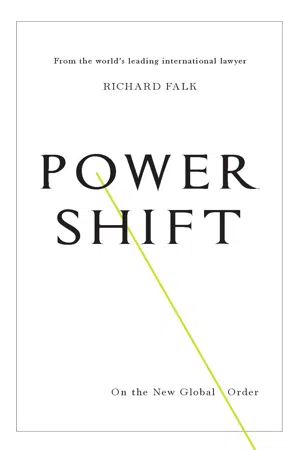
This book depicts the challenges associated with the emergence of a new global order in which patterns of conflict and the role of traditional military power are in the process of radical flux.
Our ideas about global order have yet to catch up with these new behavioral trends, including the rise of non-state transnational political actors in the context of neoliberal globalization. In this historical setting the modern territorial sovereign state is confronted by multiple challenges ranging from climate change to mass migration to transnational political extremism.
The existing global order seems currently overwhelmed by these challenges, resulting in widespread stress and chaos that is transforming global security in ways that endanger democratic governance. The future will be determined by whether the peoples of the world make their weight felt in support of sustainable global justice and overcome the impact of oppressive and exploitative patterns of corporate and state behavior. It is this problematic set of circumstances that Power Shift addresses.
- English
- ePUB (mobile friendly)
- Available on iOS & Android
eBook - ePub
About this book
Information
1
TOWARD A NEW GEOPOLITICS
Let me begin this commentary on a new geopolitics by making two more or less irreverent remarks about how best to think about this dialogic approach to political transformation. To begin with, I would encourage a greater emphasis on what I would call to the vertical dimensions of dialogue. Let me try to clarify this observation. It is, of course, important to have eminent people drawn from different civilizational and religious orientations speaking to one another in civil tones. But part of the ethos of humane dialogue at this time in world history is to realize that all voices are relevant and deserving of recognition. In this spirit, it may be especially important to arrange for the participation in the future of those who are habitually excluded from such interaction. We need to listen carefully to youth, to oppressed peoples, and to women, that is, to those whose voices are typically not heard at all at high-profile gatherings, and if represented at all, then only nominally. I believe that a proper vertically conceived dialogic process would certainly include representatives of indigenous and minority peoples whose ancient wisdom is urgently needed by the world at this ecologically and normatively troubled time. And all of us must learn to listen in ways that are not characteristic of the manner in which the elites of the Western world are accustomed to heed the complaints and concerns of those who have been marginalized and oppressed. As the wave of migrants from the killing fields of the contemporary world suggests, the response of Western publics is increasingly exhibited by barbed wire, police brutality, and mob xenophobia.
The second irreverent suggestion that I would make underscores the importance – because of the urgency of some of the challenges facing humanity – that one move toward a politics of dialogue. It is not enough, it seems to me, to talk to one another. One has to imagine political projects that can move dialogic reflections on what needs to be done into the life world of change and struggle. I wish to critique the old geopolitics which is based on the primacy of hard power, essentially conceived of as military power and its accompanying diplomatic clout, as the essential agent of historical change in the affairs of sovereign states. It seems appropriate at this stage of history to contrast this old geopolitics with an emerging but yet not emergent new geopolitics that relies on soft power and grasps the limits of the role of force in achieving the goals of peoples and the objectives of national governments and international institutions. We are in the messy midst of an indispensable process of replacing this old geopolitics with a new geopolitics. As such, it is a perilous period of contradictory pressures.
This transition will not go forward very far unless reinforced by a dramatic enlarging of the political imagination of leaders and of citizens. This mutation of the imagination must reinterpret its core understanding of what is best for the promotion of national interests. The reigning idea of the national interest must be reinterpreted to include within its compass deference to global interests and human interests. Without this enlargement of the political imagination, the problems that beset the planet at the present time will not be resolved in effective and equitable ways. The current political leadership of states, particularly in the dominant countries, continues to be enmeshed in a dysfunctional ideology of realism that is premised on the effectiveness and necessity for relying on hard power and a national interest orientation to promote the wellbeing of established political communities comprising sovereign states without much concern for adverse implications for the world or the future.
If we bother to look around at the issues that confront the world, starting with climate change, we see the inability of either states on their own or states operating within the framework of the United Nations to address the problem in a manner that responsibly responds to the most dire warnings the world has ever received from the scientific community. Such a consensus has rarely existed among scientists, and yet its policy implications continue to be ignored. We creatures of modernity pride ourselves as belonging to a scientific civilization that flourishes within the ample confines of a temple of reason, and yet we fail so far to heed these warnings because they collide with perceived short-term national and private sector interests. The result is a very dangerous failure to live up to the challenges that are increasingly confronting the world and the human species in currently harmful and potentially disastrous forms.
At the other end of the policy agenda from ecological rebalancing is the kind of interference without constructive results that is exhibited by attempts to shape the outcome of the ongoing bloody conflict in Syria and, to some extent, the earlier conflict in Libya. In other words, the world community lacks the wisdom and capacity to address effectively the war/peace issues of the day at either end of the policy spectrum, that is, either within states or of global scope. There is no current prospect, I believe, that a world structured as ours is, will have that capacity or even the knowledge and wisdom in the foreseeable future to solve the major problems confronting the peoples of the world. A major shift in political consciousness is needed and hopefully can come about voluntarily and through the development of a more cosmopolitan and wiser public and a leadership better attuned to the world historical situation. The unhappy main alternative is for such a shift to result from a traumatic shock administered by a catastrophic breakdown in basic order or through the rise of a dialectic of terrorism (extremist movements and counterinsurgency responses) of the sort undoing the social order of the Middle East.
We are currently experiencing the failures of the old geopolitics, which is producing feelings of helplessness and policies of evasions as the world community tries vainly to cope with a variety of humanly desperate challenges. None is more disturbing ethically and more revealing of the shortcomings of the old geopolitics than is the prolonged failure to end the ordeal of the Palestinian people that has lasted since 1948. The Palestinians are now either disposed from or captive in their own historic homeland, and the remnant left to them after Israeli military expansion is a mere 22 percent of historic Palestine. This remnant has been further reduced by Israeli settlements, the unlawful construction of a separation wall, and through the construction of a network of settlers-only roads linked to Israel. The Palestinians of the West Bank, East Jerusalem, and Gaza have endured this stateless condition of apartheid occupation, an oppressive occupation for more than 45 years following the early dispossession in 1948 known as the nakba. And because of the old geopolitics and the way in which the American hegemony operates there is no capacity to address this Palestinian litmus test of human suffering and its indications of the unwillingness and inability of the world system to promote minimal justice in instances of this type.
Despite this generally bleak picture of the existing global setting, of the existing global political landscape, I believe that a new geopolitics is struggling to be born and assert itself. It is forging a different global politics that will incorporate by stages the global and human interest and make our understanding of what it means to be a citizen of a political community have an existential planetary dimension and no longer be confined to the geographic national space of sovereign states, and within that, to short-term concerns.
We have been recently witnessing the extent to which a new series of political actors are emerging around the world. Notwithstanding recent economic roadblocks, China’s rise is the most spectacular example of this phenomenon. This ascent of China is not, as in the old politics, through hard power territorial expansion but takes the form of an exemplary instance of sustained soft power success, a success so great that it is almost beyond our capacity to comprehend it, and can only be made evident by pointing to the unprecedented rate of economic progress, the rapidity of modernization and the wholly transformed experience of self-understanding that dominates the country. There are several other countries, Brazil and India being the leading examples of this, with Russia having the opportunity also to be part of this group, that are rising to global preeminence through soft power, although precariously, with rising risks of regression as a result of the backlashes inflicted by the old geopolitics. There is more to this argument than the fact that these states have emerged without relying on more than developing their defensive military capability to offset their vulnerabilities to the waning, yet still dangerous forces of the old geopolitics. Given the current statist structure of world order these states deal with their immediate territorial border and maritime disputes in ways that illustrate the uncertain overlap between the old and the new, with the outcome still shadowed by many doubts.
What has not been sufficiently appreciated, incredibly in my view given the outcome of conflicts since 1945, is the declining capability of hard power to achieve the security goals of major sovereign states that have invested heavily in possessing the best attainable military weaponry. If we reflect upon the collapse of colonialism it becomes evident that military superiority, unlike in the prior colonial era, did not control the outcome of the various struggles of a colonized people against its colonial masters. In all the important colonial wars, perhaps most clearly evident in India, the stronger side from a hard power perspective could not control the political outcome, and in fact abandoned the field of battle. It has been difficult for the opinion makers of the world to absorb the shocking news that global history was increasingly being shaped by the weaker side militarily. The collapse of the Soviet system is another example where an internal set of contradictions led to a completely unanticipated transformation of international relations that had a momentous historical impact that continues to reverberate up to the present time. In analogous fashion, the collapse of apartheid in South Africa as a partial consequence of a global anti-apartheid campaign rested on the moral rejection of racism and was reinforced by militant soft power tactics including boycotts, divestment, and sanctions. The recent upheavals in the Arab World optimistically greeted as the Arab Spring again suggested the limits of hard power as a means of permanently oppressing people, but also the strength of counterrevolutionary tendencies to restore the established political and economic order, no matter how corrupted, unfair, and ineffective it had become.
This pattern is even more general than this if proper note is taken of how often the outcome of international conflicts reflects the failure of hard power, that is, military superiority, especially if the weaker adversary is buoyed by the legitimacy of nationalist credentials. The Soviet Union failed in Afghanistan as has the United States despite the overwhelming military power of both of these gigantic states. Prior to Afghanistan, and more significantly in my view, the United States failed to prevail in Vietnam despite making a prodigious effort over the course of a decade. The U.S. was defeated in Vietnam although it won every battle in the war and exerted uncontested control over air, sea, and land operations due to its military dominance. Two military commanders on opposite sides of the conflict spoke revealingly after the war. The American colonel declared: “You know you never defeated us on the battlefield.” And his Vietnamese counterpart, also a colonel, responded: “Yes, you are correct, but it is irrelevant.” Not understanding the real meaning of this “irrelevance” precludes the adjustment to nonviolent forms of global governance that takes full account of this declining role of hard power as an agent of historical change and historical control.
In recent decades there have been many demonstrations of this declining leverage of hard power. Trillions of dollars were spent on the wars in Iraq and Afghanistan. Despite American control of the battlefields when we ask the question, “Who was the winner in Iraq?” we get a strange answer. It is not the United States, but Iran. This is hardly the result that the strategic planners in Washington had in mind. In Afghanistan it is not yet fully clear what will happen as American combat forces leave the country, but what is already plain to see is that the vision of what Afghanistan should be like as held in the White House by successive presidents will certainly not be the unfolding Afghan experience. So we see that over and over again military power can no longer control political outcomes in crucial struggles going on in various parts of the world.
Yet the continued American embrace of old geopolitics offers insight into the assessment being made of the decline of the United States as a hegemonic power. There are few present signs that the United States is capable of learning from its hard power failures, which is one of the most discouraging aspects of this whole picture as it inclines dangerously toward further violent encounters in the Middle East. Even the nuclear agreement with Iran is a velvet glove covering the iron fist of a militarist diktat. To wage war against Iran would be crazy, perhaps the craziest of all of these violent hard power efforts to hold back the tides of history. We must ask ourselves and each other why is it that the United States is incapable of learning from these experiences of frustration and failure? Why does each failure lead to a reformulation of military intervention thinking and counterinsurgency doctrine to convey an impression that the outcome of the next encounter will be different because new weaponry and different tactics will restore hard power supremacy, and with it historical agency to the political actor that achieves military superiority.
The attack drone is the most recent weapons system that is being touted as restoring hard power capabilities. It is supposed to be capable of changing the balance of forces in conflicts and supposedly enables military power again to become a rational and effective instrument of foreign policy. We cannot yet evaluate the accuracy of such a claim. But it is not too soon to take note of the degree to which the governing process in the United States has itself become militarized by adopting the new tactics and weaponry of conflict. The country has for too long been sustained by a war economy. It has been preoccupied with enemies for almost 80 years, and never allowed itself the benefits and serenity of peace. World War II came, then the Cold War, then the war on terror, and now engagement in the turmoil following the Arab uprisings. All of these wars have given a new credibility internally in the United States to a militarized blinkering of the political and moral imagination, making the leadership, opposition, and public incapable of thinking outside the military box. The Obama presidency faces increasing criticism because it has sought to diminish its dependence on militarism by a pragmatic recourse to diplomacy.
We see this dynamic of self-limitation in the context of the Iranian encounter. Clearly the logical, reasonable solution would be for the United States to use its leverage to get rid of nuclear weapons in the entire region. What would make more sense from the perspective of regional stability than a nuclear-free zone in the Middle East? And yet the American government, despite its hegemonic status, seems unable even to suggest discussion and appraisal of such a sensible solution. This partly reflects the militarization of the American imagination and partly the unhealthy degree to which Israel is capable of blocking consideration of even the most sensible rational proposals of American foreign policy if these clash with Israel’s preferences. This is a perverse expression of declining American hegemony that allows a secondary state to acquire sufficient political leverage to manipulate the policy choices of the supposedly dominant political actor on the world scene in ways that make regional chaos and violence more likely.
The foregoing analysis supports the view that strong incentives exist to explore the prospects for world order based on the theory and practice of nonviolent geopolitics. I think it is clear to the leadership of countries like China, and Japan, Germany, India, Brazil that the road toward their success is a road that avoids major war and destabilizing and costly arms races. It is also notable that one of the achievements of the European Union – which is still not as widely acknowledged as it should be – is the degree to which an internal culture of peace has been, at least provisionally, established in Europe after centuries of warfare on the continent. At this stage it is not yet an external culture of peace as the European enthusiasm for the Libyan intervention in 2011 made evident. This experience of the last 75 years in which hard power has produced so much suffering, imposed such heavy economic burdens, and encroached on political freedoms and democracy, and yet has little to show for it hopefully will lead to an upsurge of anti-militarism. The old geopolitics is increasingly ineffective historically and politically and actually harms those that rely upon it, a pattern frequently identified as “blowback.” Of course, hardened militarists will continue to argue, until engulfed by catastrophe, that political failures result from an insufficient political resolve and either wrong tactics or inadequate battlefield capabilities.
It will be a step forward if we incorporate these developments into the thinking of those who are influential in this overall dialogic process, which I am hopeful will prove helpful in producing an understanding that there now exists a tangible concrete human interest that must gradually complement traditional preoccupations with defining the national interest from hard power territorial perspectives. In this spirit, we need to educate our students to understand that engaged cosmopolitan citizenship has become the only sensible way of being a member of any political community. Furthermore, that we agree that becoming citizen pilgrims is about giving our attention to the wellbeing of the whole planet, but also about being attentive to its future. The debt to future generations involves a citizenship that has a temporal dimension as well as a spatial one. The human species has been given this incredible opportunity at this point in human history, but we are made anxious by the sound of a ticking clock, and it hardly matters whether we believe the ticking clock is associated with climate change or associated with nuclear weapons that could destroy human civilization in a matter of minutes. These contingencies make precarious present methods of governing the planet and solving its problems. The most daunting challenge is how can the human species be awakened to the dangers and the opportunities to meet the threats. I strongly believe that at the core of a cosmopolitan dialogic process must be convergent transnational commitments to global justice, as linked to the imperatives of civilizational, species survival, and ecological balance.
2
THE POST-SECULAR DIVIDE
PRELIMINARY CONSIDERATIONS
What we mean when addressing “the post-secular in international politics” is not at all settled, and there are diverse interpretations responding to a variety of understandings that relate back to the plural renderings of “the secular.”1 This chapter attempts to gain a footing on this slippery terrain. It seems important to provide a context for the post-secular beyond positing the obvious, yet highly unexpected, return of religion to an increasingly globalized public space of world politics. I will presume that explaining and assessing the twists and turns of this return to a political and cultural milieu that is more infused with identities that are self-consciously associated with the religious and cultural legacies of the major world civilizations is the core significance of the post-secular moment. Religion was a dormant presence throughout the period of secular hegemony, but its resurfacing as an often crucial element in war/peace settings and in a variety of postcolonial settings is what has made this preoccupation with the post-secular seem such a significant challenge to the conceptualization of international relations in the early twenty-first century.2
In this respect, post-secularism fundamentally challenges in different forms the previously dominant idea of a universalizing modernity that is forever linked to science, instrumental rationality, and the Enlightenment tradition, a worldview that is perceived increasingly instead as a turn that evolved specifically in Western civilization before being selectively exported to the rest of the world, which seemed more receptive than it truly was. This anchoring and privileging of modernity in the Western experience is being critically reevaluated from many distinct perspectives, including in the West itself. In the non-West there are two strands of post-secular...
Table of contents
- Cover
- About the Author
- Title
- Copyright
- Contents
- Acknowledgements
- Introduction. Globalism and globalization: terrorism and state terror
- 1. Toward a new geopolitics
- 2. The post-secular divide
- 3. Why drones are more dangerous than nuclear weapons
- 4. Contours of New Constitutionalism
- 5. Horizons of global governance
- 6. Responding to the global crisis
- 7. Toward a global imaginary
- 8. Framing an inquiry: strong societies/weak states
- 9. Disruptive legacies of World War I
- 10. The 4+ logics of global order
- 11. Questioning perpetual war in an era of drone warfare
- 12. Changing the political climate: one individual at a time
- 13. Does the human species wish to survive?
- Notes
- Index
Trusted by 375,005 students
Access to over 1.5 million titles for a fair monthly price.
Study more efficiently using our study tools.
Frequently asked questions
Yes, you can cancel anytime from the Subscription tab in your account settings on the Perlego website. Your subscription will stay active until the end of your current billing period. Learn how to cancel your subscription
No, books cannot be downloaded as external files, such as PDFs, for use outside of Perlego. However, you can download books within the Perlego app for offline reading on mobile or tablet. Learn how to download books offline
Perlego offers two plans: Essential and Complete
- Essential is ideal for learners and professionals who enjoy exploring a wide range of subjects. Access the Essential Library with 800,000+ trusted titles and best-sellers across business, personal growth, and the humanities. Includes unlimited reading time and Standard Read Aloud voice.
- Complete: Perfect for advanced learners and researchers needing full, unrestricted access. Unlock 1.5M+ books across hundreds of subjects, including academic and specialized titles. The Complete Plan also includes advanced features like Premium Read Aloud and Research Assistant.
We are an online textbook subscription service, where you can get access to an entire online library for less than the price of a single book per month. With over 1.5 million books across 990+ topics, we’ve got you covered! Learn about our mission
Look out for the read-aloud symbol on your next book to see if you can listen to it. The read-aloud tool reads text aloud for you, highlighting the text as it is being read. You can pause it, speed it up and slow it down. Learn more about Read Aloud
Yes! You can use the Perlego app on both iOS and Android devices to read anytime, anywhere — even offline. Perfect for commutes or when you’re on the go.
Please note we cannot support devices running on iOS 13 and Android 7 or earlier. Learn more about using the app
Please note we cannot support devices running on iOS 13 and Android 7 or earlier. Learn more about using the app
Yes, you can access Power Shift by Richard Falk in PDF and/or ePUB format, as well as other popular books in Politics & International Relations & International Relations. We have over 1.5 million books available in our catalogue for you to explore.