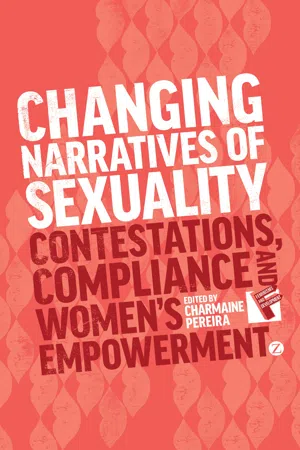
Changing Narratives of Sexuality examines the tensions and contradictions in constructions of gender, sexuality and women's empowerment in the various narrations of sexuality told by and about women. From storytelling to women's engagement with state institutions, stories of unmarried women and ageing women, a sex scandal and narrations of religious influence on women's subjectivities and sexualities, this impressive collection explores sexuality in a wide range of national contexts in the global South.
The authors analyse what scope exists for women to subvert repressive norms and conceptions of heterosexuality, interweaving rich, contextual detail with theoretical concerns.
eBook - ePub
Changing Narratives of Sexuality
Contestations, Compliance and Womens Empowerment
- English
- ePUB (mobile friendly)
- Available on iOS & Android
eBook - ePub
About this book
Information
PART I
Negotiating Desire?

1
Rewriting Desire as Empowerment in the Women and Memory Forum’s Storytelling Project
Mona I. Ali
To write – the act that will ‘realize’ the uncensored relationship of woman to her sexuality, to her woman-being giving her back access to her own forces; that will return her goods, her pleasures, her organs, her vast bodily territories kept under seal; that will tear her out of the superegos, over Mosessed structure where the same position of guilt is always reserved for her (guilty of everything, every time: of having desires, of not having any; of being frigid, of being ‘too’ hot; of not being both at once; of being too much of a mother and not enough; of nurturing and of not nurturing …). Write yourself: your body must make itself heard. (Cixous 1989: 103)
This chapter aims at exploring the role of re/writing or not being able to re/write, desire in the dis/empowerment of women, and the deconstruction of contemporary stereotypes pertinent to male and female sexuality. Diverse bodies of folktale are analysed in the light of Cixous’s quote above with the purpose of making the connection between the ability to write one’s body and to challenge predominant stereotypes of women’s sexuality and the empowerment of women. The new folktales are part of the work of the Women and Memory Forum (WMF) and its Storytelling Group, which has been involved in rewriting old Egyptian folktales and tales from the One Thousand and One Nights in its ‘Said the Female Storyteller’ project.
Said the Female Storyteller is one of many projects of the Women and Memory Forum, an Egyptian feminist nongovernmental organization (NGO). The main concern of this NGO is with the rewriting of history from a feminist perspective for the purpose of ‘the empowerment of women through information generation and dissemination’. In other words, the main objective is ‘fill[ing] in the blank pages and mak[ing] the silences speak’ (Greene and Kahn 1985: 13). The project is based on the supposition that women’s role in creating history has long been neglected in favour of that of men. The Women and Memory Forum is of the view that this process has greatly influenced the formation of the collective public memory and the reinforcement of certain beliefs about women’s inferiority to men. Hence there is a need to exert efforts to trace the origin of these beliefs ‘in order that, their origin and tendency known, they may be consciously adopted, rejected or modified (…) a necessary aspect of the struggle for a better world’ (Popular Memory Group 1998: 79). This quotation succinctly summarizes the objectives of the Women and Memory Forum’s project of rewriting the collective public memory from a feminist perspective.
The Said the Female Storyteller project deals with one component of popular memory, which is folktales and tales from the One Thousand and One Nights. The purpose of this project is the rewriting of the tales from a gender-sensitive perspective; for, although storytelling has always been a woman’s sphere, a quick look at several collections of Arab folktales and at the One Thousand and One Nights will show that the tales in these works present the same stereotypes of women present in Arab cultures and societies.1 This can be attributed to the fact that women storytellers have internalized the images of women prevalent in the patriarchal societies to which they belong.2 These stereotyped images, in their turn, help to preserve the status quo of women in their societies. In 1998, the Women and Memory Forum initiated the project of writing/rewriting new gender-sensitive tales and performing them in storytelling evenings attended by audiences in different venues. The aim was to prompt the audiences to reconsider the validity or otherwise of the stereotypes of women in the collective memory of Arabs.3
A completely new phase of the project began in 2007 under the Pathways of Women’s Empowerment Programme. Training workshops for young men and women were organized to facilitate rewriting of the stories.4 In these workshops, the more experienced writers of new stories who had started the rewrite project guided a group of young writers and bloggers through a process of discussing the gendered character of selected readings and audio-visual materials. The trainees were then introduced to the idea of the rewriting of folktales. At the end of the second day of a three-day workshop, the trainees wrote their own gender-sensitive tales. On the third day, the new tales were then critiqued for their gender perspectives and artistic quality by the trainers and by their colleagues. Part of the training focused on the stereotyping of women in popular culture, illustrated by representations of women in the media. Some of the most common representations were found to be relevant to women’s sexuality. As the coordinator of the workshop and one of the first members of the WMF’s rewriting project, I noticed a great change in some of the new stories in tackling the issue of sexuality – whether that of men or that of women. I think the change is very significant for women’s empowerment on both macrocosmic and microcosmic levels, that is, on the level of the writers of the stories as well as on the level of the characters in the stories. It is a change that is worthy of study as it addresses important questions in the field of feminist writing and feminist activism.
The methods I use in this study are based on literary analysis and comparison of three bodies of work: the old folktales and tales from the One Thousand and One Nights as rendered in published collections of those stories; the stories of the first generation of writers in the WMF’s Said the Female Storyteller project; and the stories written by Egyptian young men and women in the Pathways three-day workshop. Additionally, I conducted telephone interviews with five of the new writers – four women and one man – whose stories deal explicitly with the issue of sexuality. The choice of interviewees was based on the visibility of issues pertaining to sexuality in their stories. Telephone interviews were utilized in order to avoid embarrassment, whether in directing the questions or in answering them. I have not sensed the need to conduct similar interviews with my colleagues in the WMF Said the Female Storyteller project as I attended almost all the discussions about the stories we produced. However, questions were addressed, as the need arose, to some of my colleagues about the meanings of certain expressions and feelings they expressed in their stories.
Rewriting the oversexual, writing the asexual
In most of the old folktales and tales from the One Thousand and One Nights, women’s sexuality is depicted as a great menace to the honour of men and to their status in society, whereas men’s sexuality is one of the defining signs of their masculinity. In the frame story of the One Thousand and One Nights (Kamal 1999: 211–16), both Shahryar and his brother are cuckolded by their unfaithful wives who betray them with black slaves. Additionally, Shahzaman, Shahryar’s younger brother, discovers that all the concubines in the palace engage in sex parties led by Shahryar’s wife in the palace garden. This ‘calamity’ is the reason given in the old book for Shahryar killing all the virgins he marries on their wedding nights. This continues for quite a long time till he gets married to Shahrazad, who would have suffered the same destiny had it not been for her resourcefulness and great storytelling skills.
In their flight at the discovery of their wives’ betrayals, Shahryar and his brother meet Sit el-Hara’ir, a woman who has been kidnapped by the Genie on her wedding night. On meeting this woman, Shahryar and Shahzaman have their belief in the unfaithfulness of women reconfirmed. According to them, Sit el-Hara’ir proves to be as loose as their wives. She invites, even forces them, to have sex with her, threatening to wake the hulky Genie if they do not do so, in an attempt to avenge herself on the Genie by forcing passers-by to have sex with her. According to her, and to the long chain of rings she has obtained from those who sleep with her, Shahryar and Shahzaman come after more than seven hundred men, while the Genie presumes he has her in his grip. She even quotes a male poet saying, ‘Do not ever trust women or women’s vows/Their contentment and their anger are flanking their vaginas’ (Kamal 1999: 215).
A statement about women’s sexuality is thus made, stereotyping women as wayward beings whose sexual drives control their actions, leading them to constitute a threat to men’s honour and to the social peace in their societies. This interpretation, supported by the lines of poetry at the end of the story, seems to ignore the real reason for the woman’s so-called unfaithfulness, namely retaliation. In fact, the woman takes revenge on her kidnapper who deprived her of her wedded husband on her wedding night. Additionally, the characters of Sit el-Hara’ir as well as the wives of Shahryar and Shahzaman are utilized to stereotype women as unfaithful creatures whom nobody, even the huge Genie, can prevent from obtaining the sexual gratification they seek. This in turn justifies Shahryar’s killing of all his one-night wives. Worse still, the women of the frame story are not the only ones with threatening sexuality. The One Thousand and One Nights and Egyptian folktales teem with such women – women who would do anything for their own sexual pleasure, including betraying husbands in their homes, eloping with their lovers, and killing co-wives and female competitors.
This depiction of women in the frame story of the One Thousand and One Nights seemed to provoke the writers of the WMF Storytelling Group. The story had two rewrites, both of which try to present women in a better light. In Somaya Ramadan’s ‘The Tale of King Shahryar and His Brother: Another Story, Unpublished’, it is Shahryar and his brother who try to seduce the woman, who implores them to save her from the Genie and to return her to her family. Although she hates the Genie for kidnapping and imprisoning her, she rejects their attempts to seduce her, ‘touching the collar of her dress to make sure nothing is revealed’ (Kamal 1999: 82). Additionally, she threatens to wake up the Genie to defend her. Nevertheless, when the brothers enter one of the bars to spend the night during their journey, Shahzaman tells a fake story about the woman in which he claims that she was totally under the spell of their sexual prowess, cuckolding the Genie who was asleep in the same place. Shahzaman even cites the lines about women’s infidelity in the old story in order to impress his audience further. Meanwhile, Shahryar is infatuated with the beautiful woman bartender who also rejects his advances; she smiles tiredly saying, ‘I don’t have time for such things’ (Kamal 1999: 86).
As we can see from the above story, Somaya Ramadan, one of the first members to join the WMF Storytelling Group, chooses to present the women in her story as very conservative, their sexuality being completely silenced. In her comment on the story and her discussion of female sexuality in the storytelling project, Ramadan admits: ‘The result [of the first experience of rewriting], as I see it, is a story that is missing something; there was still a dominant voice between the lines of my story. The women’s voices were also loaded with all the elements of a voice that is raised against oppression, instead of creating a free voice that makes its own destiny, i.e. without enough rebellion and challenge. It might have been because I felt I was doing something totally new, or maybe because I haven’t been completely liberated yet’ (Said the Female Storyteller 1999: 16–17).
The other rendition of the same story by a member of the WMF Storytelling Group was that of Sahar el-Mougy. El-Mougy’s story takes the form of a letter by Shahrazad to her sister Doniazad in which she attempts to defend Shahryar against her sister’s accusations that he is a ‘serial killer’. The major point in Shahrazad’s argument is to reveal to her sister the real reason behind the killings, which is his impotence. According to el-Mougy’s Shahrazad, Shahryar has killed those women not to avenge himself with regard to his unfaithful wife and her like; he simply wanted ‘to cover up his own shame’ (Kamal 1999: 115). Hence, in her rewriting of the frame story, el-Mougy adopts a strategy that is used to varying degrees by Ramadan in her story as well as by other members of the group, namely blaming male sexuality – or the lack of it – for the plight of women. For, while Ramadan casts the immense sexual desire of the Genie and the two brothers as responsible for the agonies of Sit el-Hara’ir and the bartender, in el-Mougy Shahryar’s sexual impotence is the basis for women suffering death at his hands. In el-Mougy’s story, Shahrazad is said to obtain sexual gratification during their intercourse although the impotent Shahryar cannot.
I was fulfilled. I became the woman I have never been before … But he is not fulfilled except after hours and hours of exhausting attempts in which the flow of silenced desire is mixed with following what my eyes reflect in each moment, fearing a look of boredom or maybe haughtiness. (Kamal 1999: 116)
El-Mougy’s story is thus an attempt at presenting a more sympathetic image of Shahryar who is ‘a man in trouble and the trouble is related to his masculinity’ (el-Mougy 2008: 221). What el-Mougy’s story ignores is the fact that, apart from Shahrazad, tens of other women have suffered and have been killed selfishly because of Shahryar’s sexual problem. Strangely enough, no comment is made on Shahrazad’s unhesitating show of love and understanding upon realizing that Shahryar has killed all the other women to ‘chop off the head of the secret after one night with each virgin’ (Kamal 1999: 115). This can be attributed to el-Mougy’s being the product of a patriarchal culture in which men’s sexual prowess is increasingly valued as the defining sign of masculinity. Consequently, el-Mougy understands, on both macrocosmic and microcosmic levels, the agony experienced by a man who is not sexually competent. Goldberg puts it this way: ‘Men have been put on the defensive and often torture themselves with anxiety about so-called impotence […] the subject has become an almost maniacal preoccupation. Some writers have termed impotence a contemporary male plague’ (Goldberg 2000: 34).
In the old story ‘The Tale of the Concubine about Men’s Wiles’, the concubine tells the story of a jeweller who sees a picture of a very beautiful woman whom he knows is a concubine of one of the ministers in India (Kamal 1999: 225–30). He then travels all the way from Persia to India to find her and to take her for himself. His journey proves a success and he returns with the woman after playing a trick on her and on the minister. The story ends when the jeweller ‘takes her at once and leaves...
Table of contents
- Cover
- About the Editor
- Title
- Copyright
- Contents
- Acknowledgements
- Preface
- Introduction Changing Narratives of Sexuality
- Part I Negotiating Desire?
- Part II Body Politics and Sexualities
- Part III Changing Institutions?
- About the Contributors
- Index
Trusted by 375,005 students
Access to over 1.5 million titles for a fair monthly price.
Study more efficiently using our study tools.
Frequently asked questions
Yes, you can cancel anytime from the Subscription tab in your account settings on the Perlego website. Your subscription will stay active until the end of your current billing period. Learn how to cancel your subscription
No, books cannot be downloaded as external files, such as PDFs, for use outside of Perlego. However, you can download books within the Perlego app for offline reading on mobile or tablet. Learn how to download books offline
Perlego offers two plans: Essential and Complete
- Essential is ideal for learners and professionals who enjoy exploring a wide range of subjects. Access the Essential Library with 800,000+ trusted titles and best-sellers across business, personal growth, and the humanities. Includes unlimited reading time and Standard Read Aloud voice.
- Complete: Perfect for advanced learners and researchers needing full, unrestricted access. Unlock 1.5M+ books across hundreds of subjects, including academic and specialized titles. The Complete Plan also includes advanced features like Premium Read Aloud and Research Assistant.
We are an online textbook subscription service, where you can get access to an entire online library for less than the price of a single book per month. With over 1.5 million books across 990+ topics, we’ve got you covered! Learn about our mission
Look out for the read-aloud symbol on your next book to see if you can listen to it. The read-aloud tool reads text aloud for you, highlighting the text as it is being read. You can pause it, speed it up and slow it down. Learn more about Read Aloud
Yes! You can use the Perlego app on both iOS and Android devices to read anytime, anywhere — even offline. Perfect for commutes or when you’re on the go.
Please note we cannot support devices running on iOS 13 and Android 7 or earlier. Learn more about using the app
Please note we cannot support devices running on iOS 13 and Android 7 or earlier. Learn more about using the app
Yes, you can access Changing Narratives of Sexuality by Charmaine Pereira in PDF and/or ePUB format, as well as other popular books in Social Sciences & Gender Studies. We have over 1.5 million books available in our catalogue for you to explore.