eBook - ePub
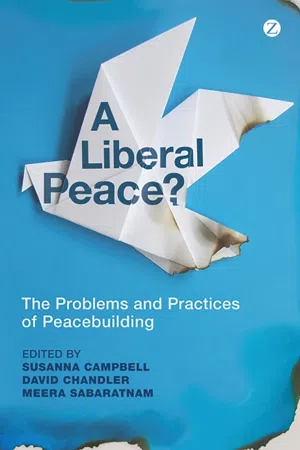
A Liberal Peace?
The Problems and Practices of Peacebuilding
- English
- ePUB (mobile friendly)
- Available on iOS & Android
eBook - ePub
A Liberal Peace?
The Problems and Practices of Peacebuilding
About this book
Moving beyond the binary argument between those who buy into the aims of creating liberal democratic states grounded in free markets and rule of law, and those who critique and oppose them, this timely and much-needed critical volume takes a fresh look at the liberal peace debate. In doing so, it examines the validity of this critique in contemporary peacebuilding and statebuilding practice through a multitude of case studies - from Afghanistan to Somalia, Sri Lanka to Kosovo. Going further, it investigates the underlying theoretical assumptions of liberal peacebuilding and statebuilding, as well as providing new theoretical propositions for understanding current interventions. Written by some of the most prominent scholars in the field, alongside several new scholars making cutting edge contributions, this is an essential contribution to a rapidly growing interdisciplinary area of study.
Information
P A R T I
Introducing the Debate
I
The Liberal Peace? An Intellectual History of International Conflict Management, 1990–2010
Meera Sabaratnam
In this volume, the term ‘the liberal peace’ is understood as the dominant critical intellectual framework currently applied to post-Cold War policies and practices of post-conflict intervention. However, as Heathershaw observes, its use within analysis has sometimes tended, misleadingly, to claim that the liberal peace has had only a singular logic or set of assumptions (2008a: 603), gradations of this logic notwithstanding. Both he and Call and Cousens (2008) note that different ideas are at work in the movements between peacebuilding and statebuilding as modes of conflict management. This chapter gives an alternative historical overview of these developments and locates the academic critiques in the context of these changes, giving a sense in which academic critique and political practice have co-evolved. These shifts and expansions reflect something rather more complex, and perhaps more opaque, than a hardening or deepening of a liberal logic in intervention – rather they reveal a reflexive anxiety about inadequacy of this logic to address seemingly intractable challenges of conflict, insecurity and underdevelopment. By tracking the recent evolution of these discourses and the critiques of the paradigm, this chapter sets the stage for the other contributions to the volume which interrogate and broaden empirically and conceptually the problem of ‘the liberal peace’.
The chapter begins through exploring the intellectual and political climate of the early 1990s and the founding principles of ‘peacebuilding’ as articulated by the UN. It then shows how these were lost almost immediately in the mid-1990s, both to unfolding global events and to new discourses about failing and collapsed states. This had important linkages with changing discourses in other aspects of institutional intervention, including the policy turn within the international financial institutions towards the question of ‘governance’. Connected to a resurgent interest in ‘grassroots’ and ‘bottom-up’ interventions, however, therapeutic discourses and practices dealing with trauma, healing and reconciliation became a central element of peacebuilding. At this time an increasingly broad set of actors, including humanitarian and transitional justice agencies, became involved. In the last ten years, however, renewed interest in the question of state fragility and the principles of statebuilding has become pervasive not just in responses to conflict but the governance of the global South more generally. In conclusion the chapter offers some reflections on the current historical juncture and how this might shape future understandings of conflict management.
UN Peacebuilding, the Early Years: From Social Justice to State Collapse
In the early days of the practice, third-party post-war interventions were seen as the basic preserve of the UN. The end of the Cold War was a watershed moment for the organisation, and in particular for its Department of Peacekeeping Operations (DPKO). Having been paralysed from all but minimal activity due to the exercise of Security Council vetoes, it found itself launching fourteen new operational missions between 1988 and 1992, compared to none in the previous ten years (DPKO 2010a). Whilst some of these operations followed the logic of traditional peacekeeping – mainly ceasefire monitoring, others began to foreshadow the more comprehensive, multidimensional and transformative operations that would become the hallmark of post-conflict peacebuilding. Early apparent successes in Nicaragua (1990) and Namibia (1990), involving relatively light-touch and well-defined missions in already-post-conflict environments, emboldened the organisation to take a more proactive stance in shaping the nature of the peace to come, through shepherding elections and demobilisation.
It was in this context that Boutros-Ghali’s groundbreaking 1992 Agenda for Peace statement was delivered. Taken widely as the foundational text for the policy of ‘post-conflict peacebuilding’, it defined it as ‘action to identify and support structures which will tend to consolidate peace and advance a sense of confidence and well-being among people’ (1992: 32). In this text could clearly be seen an understanding of conflict that was based on structural violence and social grievance as the generative causes, with economic development and political freedom intended as the appropriate remedies:
Our aims must be …– To stand ready to assist in peace-building in its differing contexts: rebuilding the institutions and infrastructures of nations torn by civil war and strife; and building bonds of peaceful mutual benefit among nations formerly at war;– And in the largest sense, to address the deepest causes of conflict: economic despair, social injustice and political oppression. (Agenda for Peace, 1992, emphasis added)
Indeed, in defining the term ‘peacebuilding’, the Agenda for Peace was about re-envisioning a role for the UN as a progressive, autonomous agent of peace, development and global justice after years of marginalisation. This theme is reinforced in the text itself through an explicit connection of the peace agenda to the contemporaneous Rio Summit and the proposed World Forum for Social Development. Establishing ‘peacebuilding’ as a defined and distinctive activity, grounded in the apparently universal aspiration of solving conflict, was intended, perhaps successfully in the short term, to channel growing Western attention towards these issues into a blossoming multilateral progressive consensus for peacemaking, development and social justice.
However, this new mandate became almost immediately besieged by events which demonstrated the split between its transformative ambitions and the shape of political events. Even as Boutros-Ghali gave his speech in June 1992, the violence in Bosnia was accelerating, and five months later Savimbi would defect from the UN’s carefully chaperoned electoral process in Angola, prompting extensive caution and delay in the Mozambique mission. In 1993, UN troops and humanitarian workers would be ambushed in Somalia, leading to the re-deployment of US troops and the Black Hawk Down incident, resulting in the US withdrawal and little appetite to involve itself in international peacemaking. The tragic and egregious failures of the UN Assistance Mission for Rwanda in early 1994 seemed to underscore the gulf between Boutros-Ghali’s projections for building peace and the mood of the contributing states, whilst the massacre at Srebenica in 1995 seemed to call into question the point of UN peacekeeping altogether. In particular, cracks were beginning to show between the expanded mandate for peacekeeping forces and their attempts to deliver humanitarian and political projects, which were clearly limited.
These peacekeeping failures had a knock-on effect on the ideas governing the expansion of peacebuilding, as the implications of a more ambitious peace operations agenda became clearer. Strangely, however, this was not a pull-back from the extended agenda, but a ramping-up of activity, ambition and response. More actors were involved, and asked to undertake a wider range of tasks. As reflected in the rather less exuberant Supplement to the Agenda for Peace (Boutros-Ghali, 1995), failures were rationalised through the perception that the nature of conflict was changing, from interstate to intrastate, and into chaotic, unmanageable situations where state institutions had collapsed:
Another feature of such conflicts is the collapse of state institutions, especially the police and judiciary, with resulting paralysis of governance, a breakdown of law and order, and general banditry and chaos. Not only are the functions of government suspended, its assets are destroyed or looted and experienced officials are killed or flee the country. This is rarely the case in inter-state wars. It means that international intervention must extend beyond military and humanitarian tasks and must include the promotion of national reconciliation and the re-establishment of effective government. (1995: section 13, emphasis added)
Nonetheless, Boutros-Ghali attempted to maintain and protect a traditional UN discourse that these were necessary precursors to addressing the injustices that underlay conflict:
As I pointed out in ‘An Agenda for Development’ (A/48/935), only sustained efforts to resolve underlying socio-economic, cultural and humanitarian problems can place an achieved peace on a durable foundation. (1995: section 22, emphasis added)
As such, the ideological and political foundations for an altogether more comprehensive, wide-ranging and co-ordinated effort at the transformation of state and society through multilateral multi-dimensional peace operations were being laid, even at this early stage, in the political arena. What we see in the Supplement is Boutros-Ghali trying to maintain the UN vision whilst accepting this more pessimistic account of conflict dynamics, which produces the idea that intervention has been insufficient rather than overambitious. This movement towards a comprehensive reform agenda in post-conflict societies was noted at an early stage by academic commentators, who pointed out its potentially radical implications (Bertram 1995).
Managing Global Chaos? The Emergence of a Field
Simultaneously with this new departure in UN thinking, the silos that that had been established in academia between ‘peace studies’ and ‘security studies’ through the 1970s and 1980s had begun to break down. In particular, peace studies was rescued from its political obscurity and engaged in the service of this new international agenda for peace. In particular, theories of human need (Burton 1987) and social grievances (Azar 1986) informed these early, Third World-friendly readings of conflict held by multilateral organisations. These readings of conflict held out the promise of peaceful resolution of conflict along politically emancipatory lines. Importantly, they corresponded with the Democracy and Development Agendas of the UN that underpinned the Agenda for Peace, and provided a scholarly rationale for how and why peacebuilding, envisaged as progressive social transformation, was necessary.
New avenues of research were facilitated by this more expansive peacebuilding programme, which argued for broadening the intervention agenda for a more comprehensive peace programme. Academic debates about conflict prevention and early warning (Lund 1996), the management of spoilers (Stedman 1997), mediation processes (Touval and Zartman 1985), the involvement of humanitarian actors (Prendergast 1996) and the importance of human rights underpinned the much wider and deeper role peacebuilding practices were beginning to assume around conflict. Slowly, this set of concerns began to develop independent momentum as an industry, with various funding streams and research streams coalescing around this agenda. For example, large collaborations such as the UNRISD War-Torn Societies Project (1994–1998) and the Carnegie Commission on Preventing Deadly Conflict (1994–1999) were tasked with developing and bringing together work on conflict prevention and resolutions specifically to address what was seen as the worrying increasing prevalence of intrastate conflict.
The substance of the first United States Institute of Peace collected volume Managing Global Chaos (Crocker et al. 1996) gives us an interesting snapshot of the moment and captures some of the core intellectual trends which supported this expansion of the notion of peacebuilding, as understood by the peace studies community. The volume itself is divided into sections on the sources of conflict, with prominence given both to ‘structural’ explanations and social-psychological explanations, a large second section on traditional means of diplomacy, collective security, peacekeeping and humanitarian intervention, a sizeable third section on conflict management via mediation, conflict prevention and problem-solving, and a final, briefer section on the consolidation of peace and the need for custodianship of the post-settlement phase. The drawing together of these questions in a single textbook volume announced assertively the presence of a coherent, professional and focused field of conflict analysis and pe...
Table of contents
- Cover
- About the Editors
- Copyright
- Contents
- About the Contributors
- Introduction
- PART I Introducing the Debate
- PART II Not Such a Liberal Peace Rethinking Intervention
- PART III Rethinking the Critique: What Next
- Index
Trusted by 375,005 students
Access to over 1.5 million titles for a fair monthly price.
Study more efficiently using our study tools.
Frequently asked questions
Yes, you can cancel anytime from the Subscription tab in your account settings on the Perlego website. Your subscription will stay active until the end of your current billing period. Learn how to cancel your subscription
No, books cannot be downloaded as external files, such as PDFs, for use outside of Perlego. However, you can download books within the Perlego app for offline reading on mobile or tablet. Learn how to download books offline
Perlego offers two plans: Essential and Complete
- Essential is ideal for learners and professionals who enjoy exploring a wide range of subjects. Access the Essential Library with 800,000+ trusted titles and best-sellers across business, personal growth, and the humanities. Includes unlimited reading time and Standard Read Aloud voice.
- Complete: Perfect for advanced learners and researchers needing full, unrestricted access. Unlock 1.5M+ books across hundreds of subjects, including academic and specialized titles. The Complete Plan also includes advanced features like Premium Read Aloud and Research Assistant.
We are an online textbook subscription service, where you can get access to an entire online library for less than the price of a single book per month. With over 1.5 million books across 990+ topics, we’ve got you covered! Learn about our mission
Look out for the read-aloud symbol on your next book to see if you can listen to it. The read-aloud tool reads text aloud for you, highlighting the text as it is being read. You can pause it, speed it up and slow it down. Learn more about Read Aloud
Yes! You can use the Perlego app on both iOS and Android devices to read anytime, anywhere — even offline. Perfect for commutes or when you’re on the go.
Please note we cannot support devices running on iOS 13 and Android 7 or earlier. Learn more about using the app
Please note we cannot support devices running on iOS 13 and Android 7 or earlier. Learn more about using the app
Yes, you can access A Liberal Peace? by Susanna Campbell, David Chandler, Meera Sabaratnam, Susanna Campbell,David Chandler,Meera Sabaratnam in PDF and/or ePUB format, as well as other popular books in Politics & International Relations & International Relations. We have over 1.5 million books available in our catalogue for you to explore.