'One of the world's most prominent radical scientists.'
The Guardian
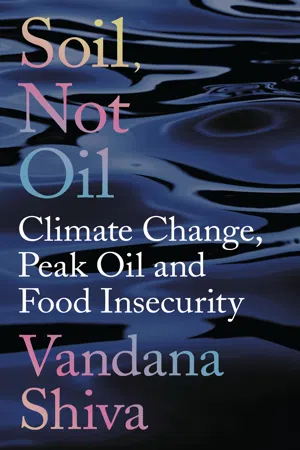
This book is classic of the environmental movement. In it, Vandana Shiva envisions a world beyond our current dependence on fossil fuels and globalization, and makes the compelling case that food crises, oil dependency and climate change are all inherently interlinked. Any attempt to solve one without addressing the others is therefore doomed to failure.
Condemning industrial agriculture and biofuels as recipes for ecological and economic disaster, Shiva instead champions small independent farmers. What is needed most, in a time of hunger and changing climates, are sustainable, biologically diverse farms that are better able to resist disease, drought and flooding. Calling for a return to local economies and small-scale agriculture, Shiva argues that humanity's choice is a stark one: we can either continue to pursue a market-centred approach, which will ultimately make our planet unliveable, or we can instead strive for a people-centred, oil-free future, one which offers a decent living for all.
This edition features a new introduction by the author, in which she outlines recent developments in ecology and environmentalism, and offers new prescriptions for the environmental movement.
- English
- ePUB (mobile friendly)
- Available on iOS & Android
eBook - ePub
About this book
Information
CHAPTER ONE
The Politics of Climate Change
Eco-Imperialism vs. Earth Democracy
Eco-Imperialism vs. Earth Democracy
CLIMATE CHANGE IS HAPPENING
The Intergovernmental Panel on Climate Change (IPCC) has recognized that since 1750 the net effect of human activities on the earth’s climate has been one of warming. Certainty about the anthropogenic basis for climate change has gone from greater than 66 percent to greater than 90 percent. The 2007 report of the IPCC, which had the participation of 2,500 scientists from 130 countries, confirmed that man-made climate change is threatening life on Earth.1 As the IPCC report states, the “warming of the climate system is unequivocal, as is now evident from observations of increases in global average air and ocean temperatures, widespread melting of snow and ice and rising average sea level.”2
The changing climate is a result of air pollution from greenhouse gases (GHGs). “Global GHG emissions have grown since prehistoric times, with an average increase of 70 percent between 1970 and 2004.”3 Carbon dioxide (CO2) is the most important anthropogenic greenhouse gas. Its annual emissions have increased from 21 to 38 gigatonnes (GT) between 1970 and 2004, an 80 percent increase. CO2 pollution from fossil fuels accounted for 77 percent of total GHG emission in 2004. The largest growth of emissions has come from the energy supply, transportation, and industrial sectors. Other significant greenhouse gases include methane (CH4) and nitrous oxide (N2O).4
By studying ice cores spanning thousands of years, scientists have been able to determine historic pollution levels. Atmospheric concentration of CO2 increased from a pre-industrial concentration of about 280 parts per million to 379 parts per million in 2005. The global atmospheric concentration of CH4 has increased from a pre-industrial concentration of 715 parts per billion to 1,774 parts per billion in 2005. The global atmospheric concentration of N2O, largely due to use of chemical fertilizers in agriculture, increased from about 270 parts per billion to 319 parts per billion in 2005.5
The impacts of this atmospheric pollution are already being felt. The decade spanning from 1998 to 2007 is the warmest on record and the eleven warmest years since surface temperatures began to be measured in 1850 have occured in the past 13 years.6 As average temperatures rise, ice melt increases, leading to sea-level rise. Globally, the sea level rose at an average rate of 1.8 millimeters per year from 1961 to 2003 with an average rise of about 3.1 millimeters per year from 1993 to 2003.7
Satellite data shows that since 1978 arctic ice has shrunk by 2.7 percent per decade. Worldwide mountain glaciers and snow are experiencing less accumulation and higher rates of melting.8 The Greenland ice sheet, which extends 1.3 million square kilometers and has an average thickness of 2 kilometers, could melt completely if the global average temperatures were to increase by 1.9 to 4.6 degrees Celsius. Such melting could lead to a sea-level rise of 7 meters.9 The resulting displacement of coastal and island communities would be a human tragedy on an unimaginable scale.
Glaciers that feed many rivers of the world are melting. When they disappear, rivers will run dry.
THIS IS WHAT CLIMATE CHANGE LOOKS LIKE
Climate change is not just a problem for the future. It is impacting us every day, everywhere. Climate change has resulted in an increase in droughts, floods, and tropical cyclones—what are known as “extreme events.” This increase has already begun. The intensity and frequency of hurricanes and cyclones is increasing. Asia was hit by the Orissa supercyclone in 1998; it killed 30,000. In November 2007, Cyclone Sidr hit Bangladesh with wind speeds of 260 kilometers per hour; it killed 4,400 and displaced 4 million. In May 2008, Cyclone Nargis devastated Myanmar. At least 84,537 people were killed and another 53,836 went missing. The intensity of Hurricane Katrina, which devastated the Gulf Coast in August 2005, is also linked to climate change.10 The higher the speed of a cyclone, the more destructive its force. Globally, category 4 and 5 storms were 50 percent more frequent between 1990 and 2004 than they were between 1975 and 1989.11
In 2003, a heat wave in August led to the deaths of 50,000 people in Europe, including 13,000 in France. Nine hundred died in England, more than 1,300 in Portugal, 8,600 in Spain, 4,600 in Netherlands, and 1,000 in Germany and Switzerland. Italy, which initially reported 8,000 deaths, later raised its death toll to 20,000.12
In January 2008, unprecedented snowstorms crippled China. Sixty centimeters of snow covered parts of Xinjiang. More than 100,000 people were evacuated after their homes collapsed under heavy snow. Temperatures plummeted to 43 degrees below zero Celcius. Twenty-one people died; 5,000 people were treated for frostbite.
Extreme droughts, extreme floods, and extreme cyclones are part of the destabilization of the climate due to greenhouse gases.
Global warming is already affecting glaciers in the Himalayas. The Pindari glacier is retreating at a rate of 13 meters a year, and the Gangetic glacier, the source of the Ganges, is retreating at a rate of 30 meters annually. In 13 years it has receded by one third of a kilometer. In a few decades there will be no glacial melt to feed the Himalayan rivers in the peak of the summer, further aggravating drought.13
Extreme rain events have grown both in number and intensity over large parts of Central India in the space of half a century. An analysis of rainfall during monsoon season from 1951 to 2000 in an area of about 1.4 million square kilometers in Central India shows that episodes of “heavy” rainfall (10 centimeters or more of rain in a single day) had increased at the rate of 10 percent per decade. Instances of “very heavy” rainfall (15 centimeters or more of rain in a day) more than doubled between 1951 and 2000. In addition, the average intensity of the four heaviest rain events during each monsoon had grown from 18 centimeters in 1951 to 26 centimeters in 2000. These empirical trends have been modeled by the Pune-based Indian Institute of Tropical Meteorology and they fit with climate change projections.14
While rainfall is becoming more extreme, so are droughts. Bundelkhand, a region divided between Uttar Pradesh and Madhya Pradesh in Central India, recorded only 350 to 500 millimeters of rainfall annually over the last five years a decrease from 1,000 millimeters annually.15 Annual rainfall has decreased and whatever rainfall does occur is concentrated in fewer days. Intensive rain leads to intensive flooding. Furthermore, rainfall patterns have shifted away from the periods when they are most beneficial for crops.
The current dry spell in the region is the longest and most severe in the region’s recorded history. Government records show that Bundelkhand only experienced 12 years of drought total during the entire 19th and 20th centuries. But the region has experienced drought for the past five years.
Seventy-five percent of the people in Bundelkhand depend on agriculture, and more than 80 percent are small and marginal farmers. Due to the extended and extreme drought, agriculture has virtually come to a halt. Locked houses are a common sight. In the past five years crop failure and debt have driven more than 400 farmers to commit suicide in the seven districts that make up the Uttar Pradesh part of Bundelkhand. Starvation deaths have been reported.16
Eighty-five year-old Ram Khilawan, a resident of Budelkhand, says he has never seen such drought in his life. He owns 1 acre of land, which had allowed enough production to feed his entire family and earn Rs 75,000 from the sale of the produce. Five years of drought have left him and his family without food and livelihood.
Five years of drought means no crops and no food. No food means malnutrition and hunger. People are surviving on a roti with salt or onion. The consumption of vegetables, pulses, and dairy items has vanished. Earlier people had chhach (cultured buttermilk) in plenty. With the drought, there is no fodder, therefore no dairy animals and no dairy products. According to a field survey carried out by Navdanya, more than 95 percent of the people in the villages surveyed in Bundelkhand were not getting enough food to eat.17
• In the monsoon of 2007, the heaviest in 30 years, more than 1,900 people died in floods in South Asia; more than 12 million were displaced in the Indian state of Bihar and 30 million across 20 states. India’s death toll between June and early August was more than 1,500. Sixty-eight thousand livestock animals perished. Total value of the losses came to Rs 12 billion.
• On July 26, 2005, Mumbai received 94.4 centimeters of rain in 24 hours. Twenty-five people were drowned after being trapped in their cars and more than 100 were killed during the flooding. Civic and public-transport services collapsed, and 5,000 army troops were deployed. Financial losses amounted to Rs 17 billion.
• Jaisalmer, a town in the Thar Desert in Rajasthan, normally receives 165 millimeters of rain annually. In 2005, the rainfall was only 148.1 millimeters, which forced the state government to declare drought. However, in August 2006, Jaisalmer received 411 millimeters of rain, 207 of which were received during a three-hour period. Barmer, which receives 277 millimeters annually, received 700 millimeters in 36 hours, which submerged more than 800 villages, affecting 2 million people. And while the desert was flooding, Cherrapunji, the wettest place on earth, was suffering a drought.
The people of Rajasthan and Bihar did not contribute to climate change. Yet they are its victims. The catastrophic impacts of climate change are not only going to take place in the distant future. They are taking place now.
ECO-IMPERIALISM AND FALSE AND UNJUST SOLUTIONS TO CLIMATE CHANGE
The approaching climate crisis is a consequence of nearly two centuries of dependence by industrialized countries on fossil fuels. Industrialization, in fact, is equated with a transition to a fossil fuel economy. Unfortunately, development too has been defined as industrialization.
In biology, the term development refers to self-directed, self-regulated, and self-organized evolution from within. In the terms of Chilean scientists Humberto Maturana and Francisco Varela, systems that self-organize and self-renew are autopoetic systems.18 19. And in the language of David Pimentel of Cornell, autopoetic systems are based on endosomatic or metabolic energy. If the economic domain were to think of development in the same way, it would lead to a flourishing of biodiversity and cultural diversity. Development would conserve resources and energy while improving human well-being and human welfare.
Unfortunately, development in economics has the opposite meaning. In economics, development is an externally driven process. It refers to self-organizing, self-regulating systems as “un-developed” and “underdeveloped” and suggests that they should be made dependent on external inputs—external resources, energy, and money. Living systems, living societies, living cultures are thus transformed into mechanical systems, or, in Maturana and Varela’s terms, into allopoetic systems—systems run from external sources. In energy terms these are based on exosomatic energy. Systems that are autopoetic and endosomatic need no external energy inputs. They are self-organizing and self-generative. They are models for a post-oil future.
Indigenous communities are fully aware of the authentic meaning of development. Years ago, I worked with communities resisting displacement from dams being built on the Suvernarekha River in what is now the largely tribal state of Jharkhand. Niti Mai, a tribal woman, had this to say about the dams as development: “Real development only happens when the people exercise their rights. We shouldn’t have to give up our rights for someone else’s benefits. We want development, not destruction.”
Development cannot be defined by the colonizer, by those imposing allopoetic systems on society for their own ends—profits and power. Development must be defined autopoetically, from within. Local communities must define what they see as their development. When street vendors resist Wal-Mart, it is their definition of improvement of retail that should count, not Wal-Mart’s. When peasants resist Special Economic Zones and indigenous people resist mines, it is they who should define development, not the automobile, real estate, and mining corporations. This has always been a justice imperative. It is now also a climate imperative.
In a period of peak oil and climate change, we need to de-link development from industrialization. We need to de-link it from oil. We need to relink it to the maintenance of living systems on the basis of living energies. We need to relink it to soil. We need to do this not just to mitigate climate change. We need to do it so we can adapt. And we need to do it to establish social and ecological justice.
Self-organizing, self-regulated autopoetic systems are diverse and multidimensional. They display structural and functional diversity. They can heal themselves and adapt to changing environmental conditions. Mechanically organized industrial systems are designed externally. They are structurally uniform and functionally one-dimensional. Mechanically organized systems do not heal or adapt; they break down under stress. When a twig of a tree breaks, the branch heals itself. When a part of a car breaks, the car cannot repair itself. It must be taken to the mechanic.
Mechanical-industrial systems are responsible for the increasing amount of greenhouse gases in the atmosphere and the decreasing ability of societies and ecosystems to adapt to the resulting climate change.
The imposition of the mechanical-industrial paradigm for production and distribution of food, clothing, and other basic needs in the South was initially carried out by the World Bank and IMF through “development” aid. It is now imposed through World Bank/IMF structural adjustment programs (SAPs) and the WTO rules of so-called free trade, which are, in effect, rules for the freedom to destroy resources, deplete energy, and pollute the atmosphere.
Globalization is, in effect, the globalization of energy-intensive, resource-wasteful, fossil fuel–driven industrialization of our production and consumption patterns. Globalization forces non-sustainability on the world. The players are neither individual citizens nor individual countries. The players are global corporations who move production of goods around the globe to where they can obtain the highest profit margins by bearing the lowest costs.
In the face of climate change, corporate globalization advocates business as usual: allow corporations to gain increasing control of the earth’s resources—energy, water, air, land, and biodiversity—to continue to run the industrialized globalized economy. This path can only last a few decades, and at very high social, economic, and ecological costs. I call this path eco-imperialism and it is totally undesirable.
Eco-imperialism is a complex dynamic. It includes the control over the economies of the world through corporate globalization and transforms the resources and ecosystems of the world into feedstock for an industrialized globalized economy. It contains the oil wars being fought in the Middle East, Central Asia, and Africa and the new land and food wars triggered by the emergence of industrial biofuels. Eco-imperialism also characterizes the control over the foreign policy and strategic security policy of countries like India through the recent US-India nuclear agreement. And it refers to the attempts to engineer the planet.
Eco-imperialism is a mechanistic paradigm, based on industrial technologies and economies that assume limitless growth. It is the poor and other species who, in a world of limited resources, lose their share of the earth’s resources through overexploitation by the rich and powerful. Instead of restraint and limits, the imperialist project seeks to increase corporate control over resources. Eco-imperialism is intolerant of the freedom and sovereignty of the other, be it other communities, other countries, or other species. In the contemporary context of globalization, peak oil, and climate change, eco-imperialist responses do not solve the problem of climate chaos. Rather, they allow corporations and rich countries to take over the resources and policy spaces of the poor.
CARBON TRADING: PRIVATIZING THE ATMOSPHERIC COMMONS, CREATING A SUPERMARKET OF POLLUTION
Polluting the atmosphere is an enclosure of the commons. What was once a resource available to all, the atmosphere, has been privatized by the oil and coal companies, the automobile and power companies, as a place to dump their pollutants. The buildup of carbon dioxide from coal and oil has deprived humans and other animals of their share of a clean, unpolluted atmosphere. It is the poor, those who have contributed the least to the degradation of the atmosphere and the destruction of its capacity to recycle carbon that bear the heaviest costs.
In the wake of the first privatization of the atmosphere, we now face a second privatization—this ...
Table of contents
- Cover
- Title
- Praise
- Copyright
- Table of Contents
- Preface to the 2016 Edition
- Introduction: Triple Crisis, Triple Opportunity
- Chapter One: The Politics of Climate Change
- Chapter Two: Sacred Cow or Sacred Car
- Chapter Three: Food for Cars or People
- Chapter Four: Soil Not Oil
- Conclusion: Unleashing Shakti: Our Power to Transform
- About the Author
Trusted by 375,005 students
Access to over 1.5 million titles for a fair monthly price.
Study more efficiently using our study tools.
Frequently asked questions
Yes, you can cancel anytime from the Subscription tab in your account settings on the Perlego website. Your subscription will stay active until the end of your current billing period. Learn how to cancel your subscription
No, books cannot be downloaded as external files, such as PDFs, for use outside of Perlego. However, you can download books within the Perlego app for offline reading on mobile or tablet. Learn how to download books offline
Perlego offers two plans: Essential and Complete
- Essential is ideal for learners and professionals who enjoy exploring a wide range of subjects. Access the Essential Library with 800,000+ trusted titles and best-sellers across business, personal growth, and the humanities. Includes unlimited reading time and Standard Read Aloud voice.
- Complete: Perfect for advanced learners and researchers needing full, unrestricted access. Unlock 1.5M+ books across hundreds of subjects, including academic and specialized titles. The Complete Plan also includes advanced features like Premium Read Aloud and Research Assistant.
We are an online textbook subscription service, where you can get access to an entire online library for less than the price of a single book per month. With over 1.5 million books across 990+ topics, we’ve got you covered! Learn about our mission
Look out for the read-aloud symbol on your next book to see if you can listen to it. The read-aloud tool reads text aloud for you, highlighting the text as it is being read. You can pause it, speed it up and slow it down. Learn more about Read Aloud
Yes! You can use the Perlego app on both iOS and Android devices to read anytime, anywhere — even offline. Perfect for commutes or when you’re on the go.
Please note we cannot support devices running on iOS 13 and Android 7 or earlier. Learn more about using the app
Please note we cannot support devices running on iOS 13 and Android 7 or earlier. Learn more about using the app
Yes, you can access Soil, Not Oil by Vandana Shiva in PDF and/or ePUB format, as well as other popular books in Biological Sciences & Environmental Science. We have over 1.5 million books available in our catalogue for you to explore.