'Development management' is an idea that blends the seemingly innocuous claims of managerialism with notions of modernity and utopian ideals of 'third world' progress. This book views both phenomena as problematic and modernizing interventions. In doing so, it overturns and reclaims such ideas as participation, community, governance, NGOs, and civil society. The contributors argue that the practices of development are often threaded together by the language of managerialism - reports, logframe, encounters with the boss - yet all of these serve to further development's disengagement from the mundane.
In voicing such concerns about the way development is going, and about the encroachment of managerialism, The New Development Management will breathe fresh life into post-development debates.
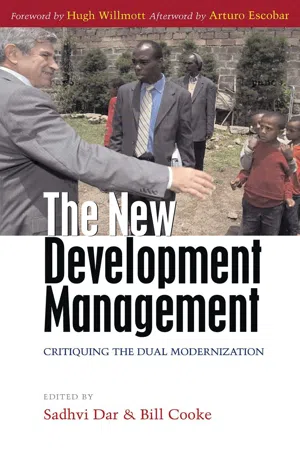
eBook - ePub
The New Development Management
Critiquing the Dual Modernization
- English
- ePUB (mobile friendly)
- Available on iOS & Android
eBook - ePub
The New Development Management
Critiquing the Dual Modernization
1
Introduction: The New Development Management
A Dual Modernization
This book offers critical perspectives on the contemporary and ubiquitous uses of managerialism in international development interventions. Our use of the term critical is not as an alternative to important. Nor are we critical in some sense that management ideas have not been applied properly in development, or that there are development practices that must be improved managerially. We are critical in the sense that we believe there is something intrinsically wrong with the very idea of management and its applications in international development. As editors, we – and, we think, the contributions here – are:
… critical of established management practices and the established social order. Our premise is that structural features of contemporary society, such as the profit imperative, patriarchy, racial inequality, and ecological irresponsibility, often turn organizations into instruments of domination and exploitation …
This quotation, with which the main thrust of this book resonates, is from the domain statement of the critical management studies (CMS) interest group of the (American) Academy of Management (2007). In identifying with it we, as editors, align ourselves with what has emerged over the past fifteen years or so as CMS. Nevertheless, we are committed to making this book more than a critical management studies volume about development and development management. It is, equally, a contribution to postdevelopment, or what our (colonizing?) instincts might lead us to term critical development studies.
In bringing CMS and critical/postdevelopment understandings together, we are motivated by the intellectual approaches that these ostensibly separate fields share. This is notwithstanding the diverse range of social theorizing, epistemological framings, and methodologies that are encompassed within each field. An example of this sharing is the self-evident similarity between the landmark (in development studies) Foucauldian deconstruction of development discourses and explanation of their material consequences in James Ferguson’s (1990) The Anti-Politics Machine: Development, Depoliticization and Bureaucratic State Power in Lesotho and the important (in management studies) Foucauldian deconstruction of human resource management discourses, linking them to their material consequences, in Barbara Townley’s (1994) Reframing Human Resource Management: Power, Ethics and the Subject at Work. Both these studies question the ethics of managerialization (in Townley) or bureaucratization (in Ferguson) through seemingly mundane and neutral practices. These practices are described as often culminating in a singular and rational project logic that has dehumanizing effects on the lives of those impinged upon (as workers, as beneficiaries, as stakeholders) by such projects. This logic also is instrumental in constructing a regime of truth that makes particular, and often unethical, realities more legitimate than others.
Identifying the similarity in these approaches to the ethics of organizing (broadly, and not unproblematically, defined) indicates how the demarcation between critical work on development and critical work on management might begin to be bridged. But this demarcation in itself must also be an object of critical attention. Not least, this chapter and this book imply, it serves to sustain modernization and the modern as an enduring and dominating (in intent) worldview with implications for a diversity of social institutions and arenas. We do not therefore proclaim this book as marking the invention of a brand-new, novel field. Instead it is committed to exploring the interconnections, engagements and relevances that the critical management and postdevelopment understandings can have for one another.
In singling out Ferguson and Townley, we do not wish to propose that CMS and postdevelopment scholarships are wholly Foucauldian. Both embrace (in often uncomfortable simultaneity) neo-Marxism and Critical Theory; feminist, postmodernist, and/or postcolonialist perspectives; critical environmentalism, and much more. Subsequent chapters exemplify and rehearse much of this range. Further, there are already reviews and collections that describe the two fields. For CMS, key works in this genre are Grey and Fournier (2002), Grey and Willmott’s reader (2005) and Adler, Forbes and Willmott’s recent review (2007). For postdevelopment, there is particularly Rahnema and Bawtree (1997) and Kothari and Minogue (2001), but also see Sachs (1991) and Crush (1995b).
CMS and postdevelopment work are often also criticized for the same reasons. Postdevelopment has been called impractical, woolly theorizing (Parfitt, 2002) that does nothing to alleviate poverty, leaving no practical options open for tackling what development agencies do (or are trying to do), and so making the situation worse.
CMS is similarly attacked for its lack of instrumental value or relevance (as acknowledged, for example, in Grey and Fournier, 2002; see also The Economist, 2004), on the grounds that while it is very good at presenting critical argument against managerialism, it is not at all inclined to suggest a real alternative (Parker, 2002).
But perhaps the most relevant concern here is a point debated, but yet to really emerge in print, that CMS might itself be some kind of colonizing discourse, First World in its origins, but domineering over different expressions of opposition to managerialism elsewhere. This point of criticism also potentially applies to this book. Our response would be to recognize, first, that we of course believe social phenomena to be complex, complicated and multidimensional. Just as one singular approach to alleviating poverty (as sanctioned by multilateral agencies such as the World Bank or International Monetary Fund [IMF], and even some international nongovernmental organizations [NGOs]) cannot fit all socially embedded geographies, histories and people, nor can there, or should there, be one institutional or conceptual challenge to managerialism in the form of CMS. Yet, at the same time, and second, we would also resist the homogenization of CMS that this potential critique entails, and reiterate the diversity of positions within it. Third, we maintain the possibility of, and indeed the necessity for, an international solidarity in opposition to an amoral, virally pernicious, globalizing managerialism that tries to obliterate borders and difference. In our view such solidarity requires a democratic, tolerant and self-critical approach to analysis and action, wary enough to avoid the paralysis and disdain that too much self-regarding self-critique will bring.
The point here, then, would be to establish some kind of mutuality in the engagements between CMS and ‘alternative alternatives’ to it, in this case post-development thinking. This mutuality might be strengthened by a recognition that, at a very basic level, both fields acknowledge and share certain groundings in social theory, in epistemological concerns connecting knowledge to power, and in methodologies that guide the way knowledge is constructed in social contexts. Such a mutuality would also require us to acknowledge that there have been before us critical encounters between development and management – in a broad sense in Escobar (1988), more recently and specifically in Taylor (2001) on managerialism and participatory development, in Hickey and Mohan (2004), or in Kothari (2005). We have three small examples of how this mutuality might begin to work. These also build towards our central point about a dual modernization, the need for a critique thereof. Among other things, they describe modernity as a cultural and ideological motif (in the form of Maslow’s hierarchy of needs); as operationalized through institutional mechanisms (in the shape of the World Bank); and discursively embedded, even in claims to theories of postmodernity.
The first example relates to Maslow’s hierarchy of needs, ubiquitous in orthodox management teaching as a theory of motivation at work and in marketing (Cullen, 1997). Maslow’s hierarchy suggests that people have five levels of need, and that they seek to satisfy needs at one level before moving up to the next. At the bottom of the hierarchy are physiological needs; once these are satisfied basic safety needs take priority; then social needs, then esteem needs, and then, at the top of the hierarchy, self-actualization, the fulfilment and extension of individual potential. Critical management scholars do not primarily debate whether Maslow ‘works’ or not. Rather, they might consider the extent to which the biological/psychologistic essentialisms implicit in the hierarchy sustain a particular set of would-be hegemonic cultural norms. These are individualizing, in the way they separate the self from the social, and place the former over the latter. They are also gendered, in the analysis of Cullen (1997), kitsch according to Linstead (2005), and a product of US Cold War liberalism for Cooke et al. (2005).
But what Maslow also argued (and which is often overlooked) was that nations could also be categorized according to his hierarchy of needs. In his view, only the US came close to his definition of utopia (and that was the term used), of a society able to offer its members self-actualization. Certain other countries – in his diaries, for example, Cuba, the Congo – required regimes that only had to meet lower-level needs and were therefore lower down the hierarchy of nations (Lowry, 1979). Maslow himself recognized a rough proximity of his hierarchy to a Marxist epochal schema of societal development. Switching our framing of Maslow from CMS to one suggested by postdevelopment theorists like Escobar (1995a, 1995b) or Rist (1997) points us also to Rostow’s (1960) ‘phases of development’ model. From this new point of view, Maslow’s hierarchy is, now, inter alia, a modernization theory in the post-development sense of the word. Embedded within it are assumptions about the correct nature of social progress, from the ‘primitive’ to utopia; and the natural place of ‘developed’ countries, specifically the US in the hierarchy of nations, in relation to those in the rest of the world. Once seen in this way, Maslow’s hierarchy is, as well as everything else, a modernizing/modernist motif that proliferates through management education, and thence the workplace, and other parts of managed daily life.
Our second example connects directly to present-day development projects and develops from an analysis of the way in which the World Bank uses soft management techniques. These techniques are used to draw governments of poorer countries around the world into implementing Poverty Reduction Strategy Papers (PRSPs). The evidence (see chapters 2 and 7 by Jonathan Murphy and Bill Cooke respectively for a summary) is that behind ostensible Bank/PRSP concern for poverty reduction there still exists a set of neoliberal requirements in terms of economic, social and fiscal policy. Also associated with PRSP implementation is a narrative that suggests that the failure of their predecessors – notably the infamous structural adjustment programmes – was a consequence not of their flawed (to say the least) ultra-neoliberalism, but of the failure of World Bank experts to achieve ‘ownership’ for such programmes on the part of national governments. Hence the turn to soft managerialism is a tool of neoliberalism, rather than a shift to a genuine democratic participation (see Cooke, 2002).
Moreover, there is something revealing in this application via PRSPs of the managerial to the nation-state. In the academy, in the business school (and possibly even in CMS) ‘organization(s)’ is/are typically assumed as the primary or default social arrangement within which management is located, and within which managerialism should be critiqued. But, it can be argued (again, see Cooke, 2002) this privileging of organization is a discursive trick. Naming diverse social arrangements in diverse state, social, and public arenas as generic organization(s) renders them undifferentiated: from one another, and from private sector organizations. At the same time they become more amenable to that mode of governance that claims dominion over organization, that is, managerialism (see also Chapter 3 in this volume by David Lewis). As such, the writing of ‘organization’ over other social locations, seals the managerialist promise of modernity – of control and stability leading to progress and ultimately a utopian society. Now, not all critical writers agree on this position on organization (see Parker, 2002b) or concede the claim to utopia (see Pieter de Vries in Chapter 9). Overall, though, reviewing the uses of managerial techniques from (post)development orientations reveals this colonization by the managerial; the folie-à-deux of soft managerialism and neoliberalism; and the potential and real consequences, even for critical scholars, of privileging organization as an object in this way.
Our third example revolves around managerialist appropriations and uses of postmodernism and postmodernity. At the turn of the millennium, Rosalind Eyben, the then head of Social Development at the UK government’s Department for International Development (DfID), stated that ‘as orthodox development loses its dominant position, so we can take advantage of recent postmodernist organizational theory which has been developed in business management faculties to explain the success of certain transnational corporations’ (2000: 10). Dealing with this simultaneous claim to postmodernity, the business academy and corporations is problematic. We should flag straight away that there are different, and indeed contradictory, positions on postmodernism/postmodernity in different chapters in this book (compare Chapter 8 by Kym Thorne and Alexander Kouzmin with Chapter 10 by Sadhvi Dar). One response, from a CMS perspective, to Eyben’s claim would be to revert to a distinction between postmodern ontology (reality) and postmodern epistemology (way of knowing) (for example, see Parker, 1992, Boje et al., 1994). Eyben refers to the former, and alludes to an apparent corporate switching from modernist bureaucratic hierarchies to fragmented, loosely connected organizational forms, signified by terms like networks and partnerships. What Eyben is actually seeing hope in is some kind of ultra- or hyper-modern mode of organizing; and the benchmarking use of transnational corporate success shows the extent to which a modernist/modernizing epistemology, and indeed ideology, remains embedded.
A particularly relevant comparator here, selected from critical management’s extensive dealings with postmodernity and postmodern epistemology, is Gibson Burrell’s book Pandemonium and its review by Campbell Jones (1997). Burrell claims to be presenting ‘retro-organization theory’ but, as Jones points out, he draws on much of his own earlier postmodernism work. The very format of the text is a challenge to the linear histories of organization and management – the book reads from the front to back and back to front, so that any one page contains fragments of different narrative threads. In content there is a similar attempt to disrupt management’s, and organization studies’, linear meta-narrative of orderly progress and improvement. That is, importantly for us here, Burrell recognizes and takes apart the idea of modernization implicit in accounts of management over time, and in much contemporary organization theory. Burrell also argues that this linear grand narrative has a silencing effect. Particularly relevant to a development context, Burrell challenges this silence by claiming to write the absent voice of the peasantry back into his relating of past and present (hence the claim to retro-organization theory). But that absence is still framed disciplinarily, that is, from organization studies, which too has an exclusionary effect. As Jones (1997: 2) points out:
Burrell manages to avoid almost all of the existing work that has made an effort to theorize the status of peasants. He fails to connect with the foundational works in peasant studies … He makes no mention of the Journal of Peasant Studies, and offers nothing from the extensive work of the Subaltern Studies group … or the efforts to develop a postcolonial theory …
Jones then goes on to make the now common problematization of post-modernist relativism and truth claims (rehearsed most uncompromisingly here in Chapter 8 by Thorne and Kouzmin). For all these reservations, Jones does not write off Burrell completely, and neither would we. Indeed, what follows in this coll...
Table of contents
- Cover
- About the Editors
- Title
- Copyright
- Contents
- Dedication
- Acknowledgements
- List of Contributors
- Foreword
- 1 Introduction: The New Development Management
- 2 The Rise of the Global Managers
- 3 Nongovernmentalism and the Reorganization of Public Action
- 4 ‘Arrive Bearing Gifts…’: Postcolonial Insights for Development Management
- 5 Managerialism and NGO Advocacy: Handloom Weavers in India
- 6 International Development and the New Public Management: Projects and Logframes as Discursive Technologies of Governance
- 7 Participatory Management as Colonial Administration
- 8 Borders in an (In)Visible World: Colonizing the Divergent and Privileging the ‘New World Order’
- 9 The Managerialization of Development, the Banalization of Its Promise and the Disavowal of ‘Critique’ as a Modernist Illusion
- 10 Real-izing Development: Reports, Realities and the Self in Development NGOs
- Afterword
- Bibliography
- Index
Trusted by 375,005 students
Access to over 1.5 million titles for a fair monthly price.
Study more efficiently using our study tools.
Frequently asked questions
Yes, you can cancel anytime from the Subscription tab in your account settings on the Perlego website. Your subscription will stay active until the end of your current billing period. Learn how to cancel your subscription
No, books cannot be downloaded as external files, such as PDFs, for use outside of Perlego. However, you can download books within the Perlego app for offline reading on mobile or tablet. Learn how to download books offline
Perlego offers two plans: Essential and Complete
- Essential is ideal for learners and professionals who enjoy exploring a wide range of subjects. Access the Essential Library with 800,000+ trusted titles and best-sellers across business, personal growth, and the humanities. Includes unlimited reading time and Standard Read Aloud voice.
- Complete: Perfect for advanced learners and researchers needing full, unrestricted access. Unlock 1.5M+ books across hundreds of subjects, including academic and specialized titles. The Complete Plan also includes advanced features like Premium Read Aloud and Research Assistant.
We are an online textbook subscription service, where you can get access to an entire online library for less than the price of a single book per month. With over 1.5 million books across 990+ topics, we’ve got you covered! Learn about our mission
Look out for the read-aloud symbol on your next book to see if you can listen to it. The read-aloud tool reads text aloud for you, highlighting the text as it is being read. You can pause it, speed it up and slow it down. Learn more about Read Aloud
Yes! You can use the Perlego app on both iOS and Android devices to read anytime, anywhere — even offline. Perfect for commutes or when you’re on the go.
Please note we cannot support devices running on iOS 13 and Android 7 or earlier. Learn more about using the app
Please note we cannot support devices running on iOS 13 and Android 7 or earlier. Learn more about using the app
Yes, you can access The New Development Management by Sadhvi Dar, Bill Cooke, Sadhvi Dar,Bill Cooke in PDF and/or ePUB format, as well as other popular books in Economics & Political Economy. We have over 1.5 million books available in our catalogue for you to explore.