This ground-breaking collection investigates the relationship between feminist activism and legal reform as a pathway to gender justice and social change.
Since the advent of feminist movements legal reform has been a popular and yet contentious vehicle for seeking women's rights and empowerment. This important book looks at comparative insights drawn from field-based research on the processes, the challenges, and the outcomes of legal reform and feminist activism. Feminist Activism, Women's Rights, and Legal Reform brings together cases from Middle East, Latin America, and Asia of the successes and failures of reform efforts concerning the promulgation and implementation of new family laws and domestic violence codes.
- English
- ePUB (mobile friendly)
- Available on iOS & Android
eBook - ePub
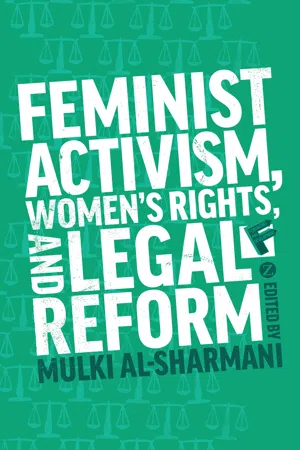
Feminist Activism, Women's Rights, and Legal Reform
About this book
Information
1
Debating Islamic Family Law in Palestine
Citizenship, Gender, and ‘Islamic’ Idioms
Unlike today’s atmosphere in which pessimism prevails, the mood in the Palestinian territories during the second half of the 1990s was optimistic; somehow, Palestinians were confident that they were about to harvest the first intifada’s sacrifices. With the establishment of the national authority in 1994, they were hopeful that they would finally be able to focus on their internal ‘social’ problems, including gender issues. It was in this context that the Palestinian women’s movement took the lead in campaigning for family law reform as part of the state-building project anticipated after the signing of the Oslo agreements between the PLO and Israel in 1993, which led to the establishment of the Palestinian Authority (PA).
This initiative of the women’s movement triggered various reactions from different political and social groups, which led to a discussion of family law in the public sphere so intense that it came to be recognized as the first major social debate in Palestinian history. In comparison with other Arab and Muslim countries, this focus on family law in Palestine is not unique. In all these countries, the debate has been based on the struggle for power and hegemony. The Moroccan, Egyptian, Iranian, and Yemeni debates of the 1990s focused on the place of Islam, the Shari‘a and religion in people’s lives, and on determining who could claim the right to exercise ijtihad (independent reasoning).1 They also referred to notions of national and cultural authenticity and the ways in which various expressions of traditionalism and modernism are contested. All these elements are to be found within the Palestinian debates as well.
The debate on family law in Palestine presented certain similarities with those under way in other parts of the Arab world, in that personal status was used by many political actors to further their interests and gain power. For instance, when a project for family law reform was tabled in the Legislative Assembly in 1997, it elicited hostile reactions from the Islamist members. Their discourse, despite contextual differences, showed many resemblances to the Islamist discourses from other Arab countries. Similarly, the religious establishment, fearing to lose influence over Shari‘a courts, launched attacks on the women’s movement activists, linking them with the ‘West’ and the ‘conspiracy against Islam’. One distinct feature of the debate in Palestine was that it originated in the context of an ongoing struggle for liberation and state building, whereas in other Arab countries it was debated in the context of escalating tension between an already established state and emerging civil society.
This chapter presents the various issues at stake, beginning with a brief discussion of the political context in which the family law debate took place in Palestine. Then I offer a detailed analysis of the Model Parliament for Women and Legislation (MP), which was the climactic event of the debate, and some concluding remarks.
Political context of the debate in Palestine
The process of state building in Palestine counts as one of the most complex experiences in Third World history. The PA lacks independence, sovereignty, and control over its borders and resources. Even in those disconnected areas of the West Bank and Gaza Strip that are formally under its control, the PA’s power is largely hampered by Israeli restrictions on the movement of individuals and goods, by the Israeli right – stipulated in the Oslo agreements – to supervise security in most areas, and by the presence of hundreds of thousands of hostile Jewish settlers on Palestinian land, whose numbers continue to increase steadily. Twenty years after the Oslo agreement, the Israeli settlements have expanded to cover 70 per cent of the West Bank land, ending the two-state solution and shattering the Palestinians’ dream of independence.
Under these circumstances, the situation has been worsened by the PA’s lack of previous experience in governance, the undemocratic political structure, and the presence of a strong Islamist opposition. These deficits are combined with a severe shortage of natural resources and extreme economic dependence on Israel and the international donor community. The hostilities since 2000 show that signing a ‘peace accord’ on paper without establishing justice on the ground easily enables the iron fist of the powerful to prevail. As Hammami and Hilal (2001) observe, Israel now enjoys control over Palestinian public funds and hampers Palestinian workers’ access to the Israeli labour market, while fragmenting the occupied territories into dozens of encircled areas. Thus, it has made the PA’s ability to practise self-rule, or even to carry out its assigned task as guarantor of Israeli security, a virtually impossible task.
The debate on family law began during the first years after the Oslo agreements. A central feature of Palestinian politics during that period was that while many Palestinians were enthusiastically debating the laws and challenging their newly established government on the basis of equal citizenship, they were aware of the framework on which their new reality was being constructed, namely agreements that deprived them of their fundamental right to self-determination and independence; that approved and sustained their inequality with Israel; and that, by virtue of being signed by Palestinian representatives and approved by the international community, amounted to a written surrender and acceptance of the unequal relation with the state of Israel.
Furthermore, the PA’s discourse since the signing of the Oslo agreements has focused increasingly on negotiation at the expense of resistance, thus delegitimizing the resistance-based discourse of Islamists. The negotiation discourse has portrayed the Israeli abuses of Palestinians’ human rights as mere violations of the peace process. Islamists, on the other hand, view the PA as no more than guardians of Israel’s security (Sh’hada 1999). Avoiding the discourse of rights, as Welchman et al. (2002) argue, weakened the legitimacy of the emerging PA and gave credibility to the Islamists’ opposition, based on rights. This influenced the responses of these two players on the gender issue, particularly in the field of family law.
The post-Oslo political circumstances created a contradictory environment for the women’s movement.2 On the one hand, there was a conducive atmosphere; nationalists continued to recognize the role of the women’s movement as vital; it was still the most active social movement (Hammami and Johnson 1999: 319). The project of a Palestinian ‘state’ was still in the making and there was thus room for negotiating gender; laws were being drafted and therefore social groups could lobby for change. However, the PA as an administrative body lacked power and resources – and thus the struggle for independence and self-determination remained the top priority.
The likelihood of political compromises between the strong conservative Islamist movement and the PA at the expense of the gender issue was a real concern. It was these contradictory circumstances that provided the political opportunity for the women’s movement to initiate programmes and activities for legal reform, culminating in the Model Parliament for Women and Legislation (Abdulhadi 1998; Welchman et al. 2002). It raised issues related to equal citizenship at a time when the nationalist movement was at its ‘lowest ebb’ (Abdulhadi 1998: 661). The latter’s failure to address issues related to social rights, democracy, and freedom of speech was striking (Hammami and Johnson 1999: 319). The nationalist movement had faced severe setbacks abroad since the early 1980s due to the PLO’s military defeat in Lebanon, and in the occupied territories it was confronted with the rise of alternative political initiatives in the wake of the intifada.3 More generally, the new international order, after the collapse of the Soviet Union, was a decisive moment for many national movements, including the PLO. The 1991 Gulf War was another breaking point because it altered the international and regional balance of power, putting the PLO in danger of being reduced to nothing more than a disintegrating and destitute bureaucracy located in Tunis. Its only aim was survival and its only claim to legitimacy was that it represented Palestinians (Usher 1995). After 1993, political disputes over the Oslo agreements further impeded the nationalist movement from meeting the expectations of its constituents (Usher 1995).
The women’s movement’s public appeal reflected a particular political strategy. Instead of grounding its equality discourse on specific, exclusive gender rights, the movement communicated its message in the idiom of nationalism, state building, and democracy, on which no national faction would disagree. Peteet (1999) points out that this strategy emanated from the movement’s deliberate attempt to locate its arguments within the human rights and democracy paradigm rather than around issues related to sexuality. The women’s movement’s ability to enter the ‘monopolised public space’ (Bishara 1998) with new claims and demands allowed left-wing factions to reassert their presence in the political arena following a a growing demobilization of political activities in the West Bank and Gaza in the wake of the Oslo agreement and the multiplication of security services by the PA (Bishara 1998). In other words, advocating family law reform ‘open[ed] up the possibility of new democratic alliance’ with these factions (Hammami and Johnson 1999: 337). The same factions that were apologetic vis-à-vis the Islamists during the first intifada (1987–1991) now became supporters of a Model Parliament for Women and Legislation. It was the social question posed by the MP, which the leftists had long failed to advocate, that made possible a renewed engagement with the ‘masses’. One leftist leader commented on the MP campaign, saying that ‘the [MP] was like a light and we had to respond’ (Zakut 1999, cited in Hammami and Johnson 1999: 335).
Despite the ideological differences and heterogeneity within the women’s movement, a common element emerged, namely a shift towards the public questioning of gender relations. This process was paralleled by a gradual institutionalization of the women’s movement itself through the establishment of study centres and grassroots organizations focusing on empowerment and awareness as well as the setting up of women’s departments within ministries. Further, a number of organizations established programmes reflecting the importance of family law reform and the provision to women of adequate advice and counselling in matters of divorce, child custody, sexual abuse, and violence in the domestic sphere.
The women’s movement, while appearing in public as a body unified around the question of family law reform, was in fact subjected to a number of limitations. Power relations developed within it based on differences in locality, access to material resources or publicity, and the expression of divergences with mainstream discourse on family law. Unity vis-à-vis others was no more than a mantle hiding divergences of vision and over access to power resources. Such differences were marked by strong criticism and counter-criticism expressed in memos and meetings, but they did not emerge in public. The reasoning behind this consensus on hiding discord was that washing dirty linen in public would give the Islamists further ammunition and thus would not be in the interest of any organization. In this sense, the women’s movement had – at least – two facets: one of unity and harmony when encountering other political actors, and the other marked by the exchange of invective within the movement itself.
The Model Parliament for Women and Legislation
The activities and initiatives of the women’s movement culminated in the campaign for family law reform known as the Model Parliament for Women and Legislation in 1997–9. The MP project resulted from a four-year review of gender-based laws by a number of women’s organizations and human rights centres. Established in 1997, the MP project proposed Palestinian legislation based on equality and human rights. The campaign for family law reform was viewed as the first major social debate in the history of Palestine. It engaged a wide spectrum of political and social groups. For the first time, political actors of diverse backgrounds and interests used Palestinian television stations, radio, newspapers, and posters to communicate a politicized gender discourse.
When the MP project started, its activities were organized in the West Bank by the Women’s Centre for Legal Aid and Counselling (WCLAC), which had taken the initiative and obtained funding for the project in both Gaza and the West Bank. However, when the Gazan MP preparatory committee (of which I was a member)4 received the proposed working manual from the West Bank, written by a Jordanian lawyer familiar with the West Bank legal system and laws (Khadr 1998), which was supposed to review all the gender-based laws implemented in Palestine, the committee found that no Gazan law had been considered. This generated a sense of frustration and anger among the members.5 The Gaza committee decided to ignore the West Bank manual entirely and design its activities according to what it described as ‘Gazan specificity’. It decided to focus on family law only and to leave other less controversial laws to be reviewed by the West Bank group. Not only the women’s movement, but all political actors, including Islamists, recognized the special significance of family law.
Further, instead of appealing to human rights conventions and international measures when presenting its proposed reforms, the Gaza committee worked from within the context of the Shari‘a. It sought points of leverage by appealing to the principles of takhayyur (selection from different schools of fiqh), thinking that this would prevent accusations of going beyond the boundaries of the Shari‘a. In this sense, the suggestions made were not innovative. The final text included proposals that the minimum marriage age be set at 18 for men and women; that the institution of guardianship be abolished; that alimony (nafaqa) be paid from the date of separation; that legal rights of inheritance be protected by the state; that polygyny be subject to state regulation; that unilateral divorce be replaced by courts making the decisions; that mothers’ renunciation of their custody rights be disallowed; and that custody decisions should apply to children up to the age of 18, with the best interests of children being the guiding principle for deciding cases (Nashwan 1998). The reforms proposed by the Gaza MP were in many ways similar to, or even less ‘revolutionary’ than, the laws already applied in other Arab countries. For example, it was suggested that women should be guaranteed their legally prescribed (and Shari‘a-sanctioned) share of inheritance. Concerning the rights of the wali, the draft proposed activation of the already specified right of women to initiate their marriage contract as stipulated in the Book of Personal Status Rulings.6 Further, the MP committee proposed to limit polygyny to exceptional cases, to subject it to the authorization of a judge, and to require that both the first and the second wife be informed in advance (Nashwan 1998). Despite all the efforts to accommodate wider social perspectives, it appeared that the Islamists were not convinced of the MP’s sincerity. As one religious scholar put it, ‘We know that the MP use the Shari‘a as a mask to further their evil project. They use it for public consumption and that is wors...
Table of contents
- Cover
- About the Editor
- Title
- Copyright
- Contents
- Acknowledgements
- Preface by Andrea Cornwall
- Introduction Legal Reform and Feminist Activism
- 1 Debating Islamic Family Law in Palestine: Citizenship, Gender, and ‘Islamic’ Idioms
- 2 Readjusting Women’s Too Many Rights: The State, the Public Voice, and Women’s Rights in South Yemen
- 3 Reforming Egyptian Family Laws: The Debate about a New Substantive Code
- 4 Men Aboard? Movement for a Uniform Family Code in Bangladesh
- 5 From Status to Rights: The Shifting Dimensions of Women’s Activism in Iranian Family Law Reform
- 6 Moroccan Divorce Law, Family Court Judges, and Spouses’ Claims: Who Pays the Cost When a Marriage is Over?
- 7 Organizing to Monitor Implementation of the Maria da Penha Law in Brazil
- 8 Implementing Domestic Violence Legislation in Ghana: The Role of Institutions
- About the Contributors
- Index
Trusted by 375,005 students
Access to over 1.5 million titles for a fair monthly price.
Study more efficiently using our study tools.
Frequently asked questions
Yes, you can cancel anytime from the Subscription tab in your account settings on the Perlego website. Your subscription will stay active until the end of your current billing period. Learn how to cancel your subscription
No, books cannot be downloaded as external files, such as PDFs, for use outside of Perlego. However, you can download books within the Perlego app for offline reading on mobile or tablet. Learn how to download books offline
Perlego offers two plans: Essential and Complete
- Essential is ideal for learners and professionals who enjoy exploring a wide range of subjects. Access the Essential Library with 800,000+ trusted titles and best-sellers across business, personal growth, and the humanities. Includes unlimited reading time and Standard Read Aloud voice.
- Complete: Perfect for advanced learners and researchers needing full, unrestricted access. Unlock 1.5M+ books across hundreds of subjects, including academic and specialized titles. The Complete Plan also includes advanced features like Premium Read Aloud and Research Assistant.
We are an online textbook subscription service, where you can get access to an entire online library for less than the price of a single book per month. With over 1.5 million books across 990+ topics, we’ve got you covered! Learn about our mission
Look out for the read-aloud symbol on your next book to see if you can listen to it. The read-aloud tool reads text aloud for you, highlighting the text as it is being read. You can pause it, speed it up and slow it down. Learn more about Read Aloud
Yes! You can use the Perlego app on both iOS and Android devices to read anytime, anywhere — even offline. Perfect for commutes or when you’re on the go.
Please note we cannot support devices running on iOS 13 and Android 7 or earlier. Learn more about using the app
Please note we cannot support devices running on iOS 13 and Android 7 or earlier. Learn more about using the app
Yes, you can access Feminist Activism, Women's Rights, and Legal Reform by Mulki Al-Sharmani in PDF and/or ePUB format, as well as other popular books in Social Sciences & Gender Studies. We have over 1.5 million books available in our catalogue for you to explore.