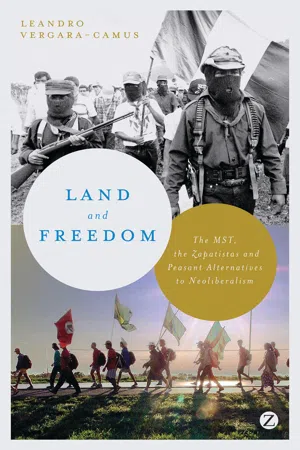
The Zapatistas of Chiapas and the Landless Rural Workers' Movement (MST) of Brazil are often celebrated as shining examples in the global struggle against neoliberalism. But what have these movements achieved for their members in more than two decades of resistance and can any of these achievements realistically contribute to the rise of a viable alternative?
Through a perfect balance of grassroots testimonies, participative observation and consideration of key debates in development studies, agrarian political economy, historical sociology and critical political economy, Land and Freedom compares, for the first time, the Zapatista and MST movements.
Casting a spotlight on their resistance to globalizing market forces, Vergara-Camus gets to the heart of how these movements organize themselves and how territorial control, politicization and empowerment of their membership and the decommodification of social relations are key to understanding their radical development potential.
eBook - ePub
Land and Freedom
The MST, the Zapatistas and Peasant Alternatives to Neoliberalism
- English
- ePUB (mobile friendly)
- Available on iOS & Android
eBook - ePub
Land and Freedom
The MST, the Zapatistas and Peasant Alternatives to Neoliberalism
1 | PEASANT STRUGGLES AND PRIMITIVE ACCUMULATION
Land struggles against neoliberal restructuring
Many people have highlighted the fact that the current re-emergence of land struggles throughout the South is a response to the profound economic and social crisis triggered by the implementation of neoliberal policies. Since the previous models of development were already deficient in producing ‘urban social safety valves’ in the form of employment opportunities and instead had resulted in high levels of unemployment and an enormous informal sector, neoliberalism simply led to the exacerbation of those consequences (Bernstein 2004; Moyo and Yeros 2005; Bryceson 2000b; North and Cameron 2003). For Latin America specifically, some authors (De Janvry et al. 1989) have talked about a ‘double (under-)development squeeze’, which involves both a ‘land squeeze’, as smallholders are less and less able to increase their landholdings or even secure land, and an ‘employment squeeze’, due to the reduction of employment opportunities in the countryside and in urban centres. In this context, access to land becomes a refuge from neoliberal restructuring. The principal objective of families involved in land struggles is to at least secure their subsistence or the social reproduction of the family household through the production of food, which they do not need to acquire through the market.
In Brazil and Mexico, neoliberalism, although differently implemented, has generated dramatically high rates of rural and urban unemployment far beyond the high levels that already existed. Brazilian agriculture has gone through a process of modernization and market concentration, allowing large modernized farms to compete internationally, but at the cost of jeopardizing the survival of small producers and generating higher levels of rural unemployment and landlessness (Dias and Amaral 2002). The election of Lula to the presidency brought some form of relief from extreme poverty in the countryside, as he introduced and expanded a conditional cash transfer programme first called Fome Zero and later Bolsa Família. In contrast, in Mexico, agriculture has in general not gone through a process of market concentration, but highly subsidized agricultural imports from the USA have pushed ejidatarios to hold on to their land and subsistence production (mainly of maize) or to migrate (Rubio 2004). Only a small proportion of medium producers have been able to find a niche in fruit and vegetable markets through contract farming with agribusiness (Barros Nock 2000; Mackinlay 2008; Pechlaner and Otero 2010). Hence, in both cases, neoliberal restructuring, in addition to unemployment and the fall in the prices of agricultural products that it generated in the countryside, has also exacerbated the unemployment crisis in the cities. Thus, through the 1990s until the mid-2000s, landless rural workers and indigenous peasants were seeking to get hold of land, or were defending their right to land, in order to secure the subsistence and the future of their families and communities. Rural–urban exodus is no longer an option.1
I argue in this chapter that the rise of the MST and the EZLN is indeed due to the different kinds of neoliberal restructuring that have taken place in Brazil and Mexico. However, I contend that the particular character of the land struggles by the MST and the EZLN, as well as their respective development alternatives, cannot simply be explained by the neoliberal restructuring of the countryside. The differences between these two movements must be explained with regard to the different path of capitalist agrarian development and state formation in Brazil and Mexico, which can be traced to different regimes of land property rights dating to the mid-nineteenth century. Hence, in order to understand the nature and consequences of different types of neoliberal restructuring, we need to look farther back at the struggles over property rights to land and the types of agrarian transitions to which the specific balance of class forces led. In contrast to other analytical perspectives, my approach to the agrarian transition will particularly focus on the political character of the development of capitalist relations (Araghi 2009), by stressing the class nature of the imposition of private property rights to land and concomitantly the class struggle it generates between landowners (traditional or capitalist) and peasants.
Agrarian transitions, struggles over property rights and the development of capitalism
Drawing on Marx’s concept of primitive accumulation and his understanding of the role of competition, as well as on the work of Ellen Wood and Karl Polanyi, I contend that the result of the social conflicts that surrounded the establishment of private property rights to land in Brazil and Mexico led to different paths of capitalist development, which still condition the nature of the neoliberal globalization of agriculture and land struggles of subaltern classes in each of these countries. More specifically, owing to different balances of class forces, the establishment of absolute private property rights was more complete in Brazil than in Mexico, where it was stopped and reverted by the peasant revolution of 1910–17 and the subsequent creation of the ejido form of land tenure. In turn, the different property regimes led in the twentieth century to a much more capitalist countryside in Brazil than in Mexico and to particular forms of state intervention in each country. This ‘capitalist countryside’ had the effect of turning generous credits to grain producers of the 1970s into the catalyst that completed the commodification of land, pushed the fully capitalist development of agriculture, and marginalized peasant producers and rural workers. In Mexico, because of a different property regime and state formation, neoliberal reforms have triggered a profound crisis of peasant agriculture.
In response, the MST and the EZLN sought land distribution through mobilization, cast their struggle in relation to the existing or newly reformed legal arrangement, and looked for ways to protect the access to land of their members within the parameters of their historical experience with the state. Following from this, I will argue that there is an important distinction between the struggle for land of the MST and that of the EZLN. Even if both are facing the historical process of so-called primitive accumulation, they are confronted by different phases of this process. The militants of the MST are responding to the development of fully capitalist social relations in the countryside, while the Zapatista communities are fighting the mere establishment of the conditions for the development of fully capitalist relations.
Since the rise of the post-Washington consensus, it has become fashionable to focus on institutions. This is specially the case with private property rights because they are associated by many with positive outcomes for economic development and for the poor in particular. Indeed, in the early 1990s, neo-institutionalism challenged some of the assumptions of neoclassical economics, such as the inherent efficiency of the market and the no less inherent inefficiency of the state. Among the many arguments that neo-institutionalists were putting forward were the centrality of certain institutions, particularly private property rights and state bureaucracies, and the importance of understanding economic development as the result of politics that lead countries to specific historical trajectories and market capitalisms (Zysman 1994). Douglas North (1990) in particular moved away from some neoclassical assumptions by emphasizing the importance of informal as well as formal constraints on individual behaviour and recognizing the state partly as an institution that could be used by certain individuals to their advantage. This shift of focus towards a more dynamic view of institutions, however, has recently slipped into ahistorical policy advice where the establishment and enforcement of private property rights are presented as the panacea to underdevelopment and poverty. The work of Hernando de Soto (2000) is a case in point. If he correctly identifies property rights as fundamental for the development of capitalism, he wrongly assumes that the enforcement of private property rights places everyone, particularly the poor, on the same playing field. Nowhere in his analysis does he consider the possibility that a privileged minority can use its control of the state and the market to exclude others from control of or access to resources. In fact, for De Soto the enforcement of private property rights is more beneficial to the poor than informal access to resources. As my analysis will show, this is far from being the case and has not tended to be the view of peasants and landless rural workers.
Historically inclined neo-institutionalism has brought back the need to understand institutions as the result of power relations and conflicts between actors with their own interests and strategies. However, most neo-institutionalist studies never really abandoned the idea that the market is necessarily the more efficient way of allocating resources (Saad-Filho 2005). Their disagreement with neoliberalism is over the role of state institutions in facilitating market transactions. In their comparative analysis, in the last instance, what they very often seek to find is why an efficient market was or was not established. This search for an explanation for the emergence of an efficient market impedes a focus on the social and political effects of the establishment of markets based on the private property rights to access to resources of certain groups. A historical materialist perspective that takes institutions seriously, but which sees them as being the result of conflict between classes that want to gain or retain access to resources more than a search for efficiency, represents a compelling alternative. This alternative can be found in a reframing of the agrarian question.
Recent approaches to the agrarian question Cristóbal Kay and Haroon Akram-Lodhi recently brought the classic agrarian question debate, which can be traced back to the work of Marx, Engels, Kautsky and Lenin, back to the fore of the academic discussions on neoliberal rural transformations (Akram-Lodhi and Kay 2009, 2010a, 2010b). Although several points of entry (or problematics) to the classic agrarian question can be discerned, the central preoccupation of this first wave of Marxist analysis of rural transformation by capitalism was to explain the processes that lead to the subordination of agriculture to capital, as well as the consequences of these processes for the different rural classes. Surveying the contributions to their book, Akram-Lodhi and Kay (2010a, 2010b: 264–70) contend that there are today seven agrarian questions:
1 the agrarian question of class forces; agrarian transitions are the results of class conflict and are thus contingent on specific national and regional contexts.
2 the agrarian question of path-dependency; imperialism introduced capitalist relations of production into the countryside and that the inexorable consequence is the deepening of capitalist relations and proletarianization.
3 the decoupled agrarian question; the agrarian question of capital has been resolved and what remains is the agrarian question of labour in which the main question is no longer capital accumulation or control, but rather the simple reproduction of labour.
4 the agrarian question of the global reserve army; moving away from a nation-state-based analysis, current processes of neoliberal restructuring and peasant dispossessions need to be analysed as consequences of the restructuring of the global food regime that is driven by the restructuring of labour forces in the South and the North.
5 the agrarian question of the corporate food regime; in which the analysis is also cast at the world-system level but in which the focus is placed on the increased control of agriculture and food by transnational corporations with the resulting marginalization of peasant producers. This variant of the agrarian question argues in favour of politicizing the agrarian question by placing food at the centre of the debate and sides with the concept of food sovereignty of Via Campesina.
6 the agrarian question of gender; which points to the limited scope of the current discussion on the agrarian question because of the serious absence of gender analysis, and highlights the ways in which gender relations are key in determining the nature of agricultural production, class formation and unequal distribution of assets and work.
7 the agrarian question of ecology; which points to the other major limitation of the agrarian question debate, reminding us that the debate needs to insert the processes of restructuring within their environmental context because accumulation, forms of agriculture and conflict over resources are constrained by biophysical agroecological settings.
Although this taxonomy has the advantage of highlighting particular sub-questions within the broader classic agrarian question, and I will engage with several of these dimensions throughout the book, I believe that the core of the dispute around the agrarian question remains the same, namely: who will control and how will they control the resources necessary to sustain life?
In his seminal and colossal book on the agrarian question, Terence Byres (1996) sought to develop an analytical approach to explain the variety of paths to agrarian transition, i.e. the transition to capitalist agriculture. Byres proposes a ‘case-oriented comparative approach’ that ‘needs to be ordered by, and rooted in theory: in ideal types which theory establishes, and the hypotheses which theory suggests’ … while the analysis ‘must be grounded on … secure theoretical foundations that remain sensitive both to diversity and historical contingency’ (ibid.: 12). Following Kautsky and especially Lenin, Byres organizes his case studies around two ideal types: transitions leading to ‘capitalism from above’, epitomized by the ‘Prussian junker path’, and transitions leading to ‘capitalism from below’, exemplified by the ‘American farmer path’. The approach that Byres adopts is preoccupied with the ways in which capitalist development takes hold in the countryside and ultimately contributes to the process of industrialization in the city. Byres highlights five factors which are determinant for the type of agrarian transition: class formation, peasant differentiation, class struggles, the historical conjuncture and the role of the state (ibid.: 6–7). However, his more than four-hundred-page study of Prussia and the United States does not dwell too much on the role of the state. Among the named factors, class struggle and peasant differentiation stand out. Following Robert Brenner (1977), Byres considers that an analysis of the balance of class forces during an agrarian transition yields better explanatory results than analyses emphasizing other factors. However, a focus on the balance of class forces needs to be completed with an analysis of the class differentiation developing within the peasantry (ibid.: 65–8). Of particular interest to Byres, especially in his analysis of the United States, was the ways in which market coercion and the imperative of competition gradually emerge in the practices of what he calls ‘advanced petty commodity producers’, without generating fully capitalist producers. In his view, this is due to the fact that the technology that was being developed at the time, although saving labour time, was appropriated for farms run by family labour, blocking in this way the development of fully capitalist relations in the countryside (ibid.: 393–6).
More recently, in his comparison of England, France and Prussia, Byres synthetized his analytical framework by underlining the need to focus on three elements: the kind of landlord class, the kind of class struggle, and the kind of peasant differentiation (Byres 2009: 58). However, of the three elements the process of peasant differentiation becomes the predominant explanatory factor in his assessment of the different agrarian transitions. In Byres’ words, peasant differentiation ‘is not an outcome but a determinant variable: a causa causans rather than a causa causata […] Differentiation is no mere outcome’ (ibid.: 58). For him, as for many other Marxist scholars, peasant differentiation is central to the process of agrarian transformation because it is often the rich strata within the peasantry itself which become capitalist producers while the other strata remain or are transformed into wage labourers, semi-proletarians or subsistence peasants. The emphasis is thus more on the end result of the class struggle than on the core object of class struggle itself, which in my view is the control of the means of production. For instance, although he looks at the ways in which peasants and rural workers resist their marginalization and dispossession, Byres does not give special attention to the process of establishment and enforcement of private property rights to land, because he considers peasant differentiation and the development of productive forces – changes in forms of producing, the technology used, the amount of capital mobilized, etc. – to occur independently of the establishment of absolute private property rights. In his most recent work, Byres also abandons the focus on market coerci...
Table of contents
- Cover
- About the Author
- Title
- Copyright
- Contents
- Abbreviations
- Acknowledgements
- Introduction
- 1 Peasant Struggles and Primitive Accumulation
- 2 Neoliberalism and New Forms of Peasant Rebellion
- 3 The New Modern Prince and Autonomous Rural Communities
- 4 Resistance, Alternative Development and the Market
- 5 Revolution in Times of Neoliberal Hegemony
- Conclusion
- Notes
- References
- Index
Trusted by 375,005 students
Access to over 1.5 million titles for a fair monthly price.
Study more efficiently using our study tools.
Frequently asked questions
Yes, you can cancel anytime from the Subscription tab in your account settings on the Perlego website. Your subscription will stay active until the end of your current billing period. Learn how to cancel your subscription
No, books cannot be downloaded as external files, such as PDFs, for use outside of Perlego. However, you can download books within the Perlego app for offline reading on mobile or tablet. Learn how to download books offline
Perlego offers two plans: Essential and Complete
- Essential is ideal for learners and professionals who enjoy exploring a wide range of subjects. Access the Essential Library with 800,000+ trusted titles and best-sellers across business, personal growth, and the humanities. Includes unlimited reading time and Standard Read Aloud voice.
- Complete: Perfect for advanced learners and researchers needing full, unrestricted access. Unlock 1.5M+ books across hundreds of subjects, including academic and specialized titles. The Complete Plan also includes advanced features like Premium Read Aloud and Research Assistant.
We are an online textbook subscription service, where you can get access to an entire online library for less than the price of a single book per month. With over 1.5 million books across 990+ topics, we’ve got you covered! Learn about our mission
Look out for the read-aloud symbol on your next book to see if you can listen to it. The read-aloud tool reads text aloud for you, highlighting the text as it is being read. You can pause it, speed it up and slow it down. Learn more about Read Aloud
Yes! You can use the Perlego app on both iOS and Android devices to read anytime, anywhere — even offline. Perfect for commutes or when you’re on the go.
Please note we cannot support devices running on iOS 13 and Android 7 or earlier. Learn more about using the app
Please note we cannot support devices running on iOS 13 and Android 7 or earlier. Learn more about using the app
Yes, you can access Land and Freedom by Leandro Vergara-Camus in PDF and/or ePUB format, as well as other popular books in History & Latin American & Caribbean History. We have over 1.5 million books available in our catalogue for you to explore.