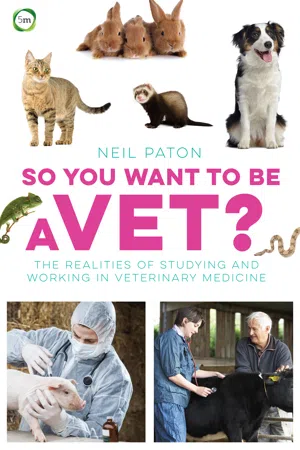
The publication of Alf Wight's James Herriot books led to an upsurge in interest in the veterinary profession amongst the public and inspired many to study veterinary medicine. However the profession has changed markedly since those days with many more opportunities for people entering the veterinary field – such as job prospects in bioscience research, government work, specialisation in exotic animal medicine, animal welfare advisory work, international development work and a whole host of other career options. The landscape of the veterinary curriculum has also broadened considerably with topics like animal behaviour, ethics, business management, client communication, veterinary public health and clinical skills sitting alongside clinical veterinary medicine.Authored by a Royal Veterinary College tutor with extensive experience within the veterinary profession and with teaching new students, this book provides a thorough explanation of what prospective students can expect to study at veterinary school, and discusses career options available to new graduates, as well as a useful overview of current issues in the wider veterinary profession, and an honest and thought-provoking discussion of what veterinary life is actually like.So You Want to Be a Vet will be a useful resource and advisory guide to those considering entering veterinary school and following veterinary medicine as a career path. It will also be beneficial to qualified vets and agricultural students.
eBook - ePub
So You Want to Be a Vet: The Realities of Studying and Working in Veterinary Medicine
- English
- ePUB (mobile friendly)
- Available on iOS & Android
eBook - ePub
So You Want to Be a Vet: The Realities of Studying and Working in Veterinary Medicine
About this book
Information
Topic
MedicinaSubtopic
Medicina veterinaria1
Introduction
Why Have I Written this Book?
In the summer of 2012 a letter that I wrote appeared in the Veterinary Times replying to a colleague who believed that undergraduates were unprepared for veterinary practice as these bright, motivated and idealistic students were broken by the university system and the profession as a whole. My response defended the profession and its members, as they are a diverse, hard-working and caring bunch. I offered to teach any potential applicants that my fellow contributor felt were unprepared on a course that I run with colleagues at an agricultural college in South Wales. This course focuses on farm animals and this book is an extension of the aims of that course.
This course was developed after a discussion over coffee one day where the subject was how school pupils could get experience for applications to veterinary school. The result of that conversation was a week-long course on farm animal veterinary medicine for potential applicants. The planning of that course and the thoughts that have gone into this book are the same.
Preparation is a large part of the success of anything. A career in veterinary medicine is no different. Part of the preparation is determining whether the career is right for you. This book is part of that and an attempt to give potential applicants an insight so that only those most suited to the profession will apply. There may be misconceptions about the career among applicants and those that are supporting them in the application process, through education and their career. Through this book I am hoping to correct these misconceptions so that the decision – and the support to make the decision – is based on the correct perception as much as possible. This preparation will hopefully contribute to a reduction in the mental health issues that concern the profession currently. Not only have I known colleagues of mine from school and early college training that have committed suicide, but there is a high level of mental health issues within the profession and many members use alcohol to cope with the demands of the career. Veterinary surgeons work long hours and may work in areas or practices that have little support professionally or clinically. This can be as a result of the remote location or the culture of the practice that graduating veterinary surgeons find themselves working in. This can be a contrast from the university course where there are trained and experienced staff to provide support. Fellow students who are going through the same stage will also be there to provide emotional support.
The long hours put physical pressure and mental stress on the individual veterinary surgeon. The work that is carried out can be of two contrasting types. First, it can be mentally challenging and this can increase the mental exhaustion of the veterinary surgeons, as it may have to be done when the full picture is not known and important details have to be hazarded at. The other type of work is of a routine and repetitive nature, where there is little opportunity for intellectual challenge, such as testing cattle for tuberculosis or vaccination of animals. The tasks are relatively easy to learn but the level of attention must remain high in order to pick up on those animals that do require further investigation and may require further work. Both of these will induce frustrations in veterinary surgeons that may lead to mental stress and illness. If this goes wrong then the client may complain and without balancing praise, it can appear that the feedback is all negative, which will add to the potential for illness. The curriculum trains students to be self-critical and this can compound feelings of failure.
All of this is done in an environment that requires hard physical effort that will sap the reserves of the veterinary surgeon.
The contrast between the support in university and that frequently experienced in practice is huge. The transition from a course where intellectual challenges are almost daily to a job where routine and repetition are more normal is not an easy one to make.
Veterinary surgeons are a highly motivated bunch and extremely self-reliant, and the people involved in the profession can be highly competitive. On the surface this is a good set of attributes to have, but they can be counterproductive. Once a problem has started then it can be difficult for many to seek help, whether that is from colleagues or professional organisations. So attributes such as being empathic but not emotionally involved, being self-critical and highly self-sufficient may all predispose the veterinary surgeon to mental illness. This can manifest as alcoholism, depression and suicide.
All of this was circulating in my head when the discussions about developing the course were being held over many cups of coffee. Our thoughts were that we needed to prepare students as best we could for the realities of farm animal veterinary practice realities. Like that course, this book is an attempt to let prospective students get an accurate idea about what veterinary surgeons get up to on a dayto-day basis, so that anyone reading this book can have enough information in order to make a rational decision about joining the veterinary profession. Part of producing a successful student on any course is ensuring that the correct students are recruited to the course, and this book and the course are an attempt to help that process.
Who am I?
I am a lecturer and I teach veterinary students in their clinical years. This is stimulating work, as the students present frequent fresh views and enthusiasm, but my career has taken in a lot of other types of veterinary practice. As a young Scot, I started as most students do, working at my local veterinary practice in Angus and after a gap year teaching English to Tibetan refugees and harvesting on South Uist, I started at the Royal (Dick) School of Veterinary Studies, completing a BSc in veterinary pathology and a Bachelor’s in veterinary medicine and surgery. Mixed practice in Aberdeenshire beckoned immediately after graduation, and my beginner mistakes were made there. I was a mixed-practice veterinary surgeon for three years and gained experience with all species, including native wildlife.
A PhD beckoned after that and I conducted basic research on cattle, organising experiments to determine host responses to infection by a food poisoning bacterium. In the period that followed, I worked in overnight emergency practices, farm animal practice and sole charge companion animal practices both in the UK and Australia.
As an undergraduate I took the opportunity to work as a research assistant in the Indonesian tropical rainforest, to conduct pharmaceutical research in the deserts of Jordan and to maintain and improve the health of zoo animals in Thailand.
All of this has led me to my current position of lecturing and living in the south of Wales with my wife and three children on a smallholding raising sheep and pigs. Within Wales I am involved in representing the profession as president of the Welsh branch of the British Veterinary Association and work with the farming industry to eradicate disease.
This is not a boast in order to suggest that I have been everywhere and done everything, but rather to demonstrate that I have a reasonable background on which to base my discussions and interpretations of veterinary medicine as a whole. In some ways, I am not the right person to write this advice. The typical veterinary surgeon of the future will not be a middle-aged male, so it might be more appropriate for a woman to write the book as the profession will be predominantly female in the future. However, I hope I have the empathy to represent our profession in all our various guises.
What do we Call Ourselves?
I am a veterinary surgeon and that’s how I generally describe myself on forms and when introducing myself to others. The job comes with other titles that others who fill the same function in society use – some use ‘vet’ or ‘veterinarian’. These titles are protected and only used by those qualified from an accredited degree course. Upon qualifying as a veterinary surgeon then, as a courtesy, Australia, the USA and most of Europe will allow the use of ‘doctor’. In the United Kingdom this has just been allowed in 2015. I intend to use the term ‘veterinary surgeon’ throughout the book.
A Brief History of the Profession
Animals and man have had a long association and it is likely that local healers throughout the ages have tried to treat animals. To this day, the use of ethnic treatments still occurs where the availability of antibiotics and other medical products are unavailable. The first evidence of a named person who was considered as an authority on treating animals occurred around 3000 BC. Called Urlugaledinna, he lived in Sumer in Mesopotamia and worked as a royal physician. There are also documented laws relating to treating animals within the Sumerian Empire. Healing appears to have been monopolised by priests throughout early veterinary history, with the training slowly becoming more formalised with the passing of time, until it became linked with human medicine. Veterinary medicine was developed in the Roman, Greek and Arabic Empires. In the Middle Ages up to the beginning of the Enlightenment, the treatment of animals was carried out by farriers (horses) or cow leeches (farm livestock). In the UK, the Odiham Agricultural Society was instrumental in pushing for animal health specialists and was among the first to push for formal veterinary education. Claude Bourgelat was a Frenchman who was well respected as an expert in horses and their care, and he set up the first veterinary school of the modern era in Lyon in 1762. Between 1762 and 1800 there were 19 veterinary schools opened in Europe. One of these was the London Veterinary School in 1791, the first veterinary school opened in the United Kingdom. A graduate of Lyon, Vial de St Bel, was the first professor of the London Veterinary School, which later became the Royal Veterinary College. Iowa State University is the oldest state veterinary school in the United States. Older private courses were established but are now defunct. A graduate of Edinburgh founded Ontario Veterinary College in 1862, making that Canada’s oldest veterinary course. Melbourne Veterinary School is the oldest in Australia.
The methods used have paralleled those in use in human medicine, with disease first being ascribed to spirits, and prayers and rituals invoked to rid the animals of disease. Humours have been blamed, with bloodletting being used to ‘balance’ these. Surgical techniques involved lancing abscesses or bloodletting for thousands of years. Firing was later used to increase healing as the teachings of Hippocrates and Aristotle gained influence on medicine. It wasn’t until the Enlightenment that this started to change.
What I Intend to Achieve
The veterinary profession has a long history but the true popularity came with the books that were written by James Alfred Wight – using the pen-name of James Herriot, a veterinary surgeon in Yorkshire. These books are really easy to read and paint a picture of the job that is romantic and satisfying. The popularity and romance of the books and the later TV series saw an increase in the number of applicants to university courses due to the increased attention paid to the profession. I have read a few of the books and I must stress that they are not representative of the veterinary profession as members today experience it. As with the course, it is my intention with this book to try and give readers an accurate picture of what veterinary surgeons are involved in when they get up and go to work.
So this book provides an overview of the veterinary profession and will help you to understand the profession as it is and as it might be. It will hopefully make you think a little harder about the issues that the veterinary surgeons face on a day-to-day basis. It will also consider the range of careers that you can undertake once you qualify from the university course. Being a clinical veterinary surgeon like James Herriot is only one of the options available.
Over the course of the book I will discuss the requirements for getting into veterinary university courses, but I hope to convince you that these requirements are not just hurdles you have to jump but have a deeper function in helping you decide your career. The course will be outlined to allow you as a prospective student to get a flavour of what you will be getting involved in.
Veterinary medicine is a small but important part of working with animals, so how we fit in as part of a team is important, as are the issues that the profession currently faces and will face in the future. All of this will be discussed and will hopefully allow you to think about areas of veterinary medicine and the profession that you may not have considered before.
The final career that you decide upon will depend on your interests, and this book will consider the full range of careers available to you. It will look at some of the things going on in veterinary clinics and farms. Veterinary surgeons also contribute to science, politics and the development of countries that are still developing, and we will consider what has been achieved in these areas. These issues all have ethical and welfare implications, and these will be discussed by looking at how veterinary surgeons have dealt with them and what still needs to be dealt with.
Veterinary surgeons love acronyms and we will look at a selection of these to explain what they are and to give further insight. These will mainly be the organisations that are involved in veterinary medicine.
The economics of veterinary medicine will be looked at, from the costs of courses that students will have to pay, through to national disease problems. The salary that a graduate can expect to receive throughout their career and the value of veterinary treatment will be looked at, and in both cases the perception of the public of high salary and expensive treatments can be considered.
The profession is a fast moving one with changes happening all the time, it is very difficult to predict what changes will happen but I will have a go at future gazing.
What is not Intended
This is not a textbook of the veterinary profession and veterinary medicine. It is intended to provide guidance to areas that I felt might be of interest to the reader. The subjects are not covered comprehensively as that would be a veterinary curriculum in its own right. I have simplified some things, hopefully not too much and not in a misleading way but further reading might be helpful in areas where interest is piqued. Some interesting websites are included as references.
My hope for this book is that you – and whoever you discuss your options with – use it to help make a good decision. That decision may be to join the profession or not. The decision is yours but I hope that this book helps.
2
Becoming a Vet
Key Points
- Work experience should help you to decide whether being a veterinary surgeon is the right choice for you.
- The academic requirements are very high and places are limited.
- Some courses will require additional examinations – the biomedical aptitude test (BMAT).
- The courses all cover the same areas but the approach to teaching will be different and you need to be comfortable with the way of teaching.
- The course is a five-year commitment.
- Outside activities are very important for many reasons – even at university a balance between work and play must be struck.
- There is a requirement to attend veterinary practices through the holidays, which means that the ability to work summer jobs is limited and may mean more loans are needed.
The first part of any journey in the veterinary world is training, whether that is at the advanced stage of carrying out sophisticated and pioneering surgery or being the face of veterinary politics, but everyone has to start somewhere and for most vets the training and preparation starts well before the first day at vet school. If you choose this course then you will be learning and training for the rest of your life! As in most things, we should start at the beginning of a vet’s career and get that right before moving onto more complicated things.
Most veterinary students decide that they wanted to be a vet at a young age and hold on to this desire throughout their school career, sacrificing many weekends off and social activities along the way. Such commitment is necessary; as you are no doubt aware, the entrance to get into veterinary school is highly competitive. In common with a number of other careers, a degree of work experience is required and expected before you enter the course of study, as well as the academic requirements of the institution. In the UK, most careers guidance staff and teachers who give advice on possible career paths will suggest that a student tries to spend weekends with a vet and see what the career involves. Certainly this is how I got my first taste of the career in Scotland some 20 years ago.
Your First Experience with a Vet
Even at this early stage of your budding career there are certain expectations if you are to get the best out of your time at any vet practice. These are important because it’s not just the time that you spend at the vet’s that is i...
Table of contents
- Cover
- Half Title
- Title
- Copyright
- Dedication
- TABLE OF CONTENTS
- CHAPTER 1 Introduction
- CHAPTER 2 Becoming a Vet
- CHAPTER 3 Veterinary Surgeons Treating Animals
- CHAPTER 4 Vets and Allied Professions
- CHAPTER 5 Vets and the Acronyms
- CHAPTER 6 Veterinary Careers
- CHAPTER 7 Vets and Economics
- CHAPTER 8 Vets and Ethics
- CHAPTER 9 Veterinary Surgeons and Welfare
- CHAPTER 10 Veterinary Surgeons and Politics
- CHAPTER 11 Veterinary Surgeons in Science
- CHAPTER 12 Veterinary Surgeons and Development
- CHAPTER 13 Future Scanning
- CHAPTER 14 Summary
- Appendix 1
- Appendix 2
- Useful Sources of Information
- Index
- Plates
Trusted by 375,005 students
Access to over 1.5 million titles for a fair monthly price.
Study more efficiently using our study tools.
Frequently asked questions
Yes, you can cancel anytime from the Subscription tab in your account settings on the Perlego website. Your subscription will stay active until the end of your current billing period. Learn how to cancel your subscription
No, books cannot be downloaded as external files, such as PDFs, for use outside of Perlego. However, you can download books within the Perlego app for offline reading on mobile or tablet. Learn how to download books offline
Perlego offers two plans: Essential and Complete
- Essential is ideal for learners and professionals who enjoy exploring a wide range of subjects. Access the Essential Library with 800,000+ trusted titles and best-sellers across business, personal growth, and the humanities. Includes unlimited reading time and Standard Read Aloud voice.
- Complete: Perfect for advanced learners and researchers needing full, unrestricted access. Unlock 1.5M+ books across hundreds of subjects, including academic and specialized titles. The Complete Plan also includes advanced features like Premium Read Aloud and Research Assistant.
We are an online textbook subscription service, where you can get access to an entire online library for less than the price of a single book per month. With over 1.5 million books across 990+ topics, we’ve got you covered! Learn about our mission
Look out for the read-aloud symbol on your next book to see if you can listen to it. The read-aloud tool reads text aloud for you, highlighting the text as it is being read. You can pause it, speed it up and slow it down. Learn more about Read Aloud
Yes! You can use the Perlego app on both iOS and Android devices to read anytime, anywhere — even offline. Perfect for commutes or when you’re on the go.
Please note we cannot support devices running on iOS 13 and Android 7 or earlier. Learn more about using the app
Please note we cannot support devices running on iOS 13 and Android 7 or earlier. Learn more about using the app
Yes, you can access So You Want to Be a Vet: The Realities of Studying and Working in Veterinary Medicine by Neil Paton in PDF and/or ePUB format, as well as other popular books in Medicina & Medicina veterinaria. We have over 1.5 million books available in our catalogue for you to explore.