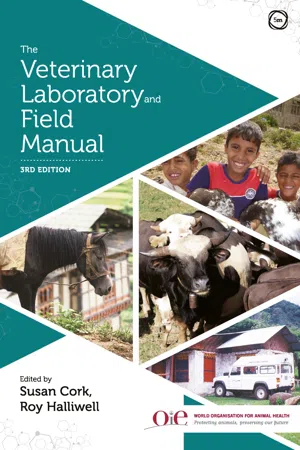
Isolated regions of the world are often at the forefront of emerging diseases and, to be effective in disease prevention and control, they require basic resources for field sample collection and testing in conditions vastly different from those available in well-equipped reference laboratories. Technical support for field extension staff, and the availability of reliable diagnostic testing facilities, are also vital to ensure sustainable livelihoods for subsistence farmers.This technical handbook aims to provide an easy to follow overview of the basic laboratory techniques, and sample collection guidelines, that we consider useful for staff working in district veterinary facilities in regions that lack the infrastructural support available for staff with ready access to national veterinary laboratories. The Veterinary Laboratory and Field Manual 3rd Edition provides the reader with a summary of basic diagnostic procedures and sample submission guidelines and also advocates for improved communication between animal health extension staff, veterinarians, laboratory staff and farmers. Case studies are used to illustrate key concepts.Basic laboratory disciplines are covered including – parasitology, microbiology, haematology, serology / immunology and pathology. There are also sections on laboratory infrastructure and equipment. There is additional content on common clinical presentations, One Health approaches to Antimicrobial resistance, the role of the OIE, disease surveillance and wildlife disease monitoring. Supplementary tools for use in the field and laboratory are also available online.This new edition of The Veterinary Laboratory and Field Manual is updated to include content on pen side tests, selection and integration of new technologies, engagement with international agencies and programs, and the One Health approach to disease monitoring.Animal Health extension staff in isolated regions of the world, and NGOs, can benefit from this book as well as policy makers supporting veterinary work in rural areas and veterinary para-professionals involved in One Health work.
- English
- ePUB (mobile friendly)
- Available on iOS & Android
eBook - ePub
The Veterinary Laboratory and Field Manual 3rd Edition
About this book
Information
Topic
MedicineSubtopic
Veterinary MedicinePart II
Specialties
chapter 3
Parasitology
3.1 Introduction
Parasitology is an important part of any routine health monitoring programme and often forms the largest component of the work in regional and district veterinary laboratories. Gastrointestinal worms, and other helminths, protozoa and ectoparasites are responsible for reduced productivity and a range of clinical problems in young and adult livestock. Faecal examination is the most common diagnostic approach employed to detect endoparasitic infection in a host. It must be noted that parasites that have predilection to various organ systems such as central nervous system, circulatory, musculo-skeletal, respiratory and, to some extent, urinary system may also shed their infective stages (for example, eggs, cysts, oocysts, trophozoites, larvae and so on) in the host’s faeces. A comprehensive faecal evaluation can provide very useful information about the parasitic status of the host. Government and commercial veterinary diagnostic laboratories may offer a wide range of parasitological tests and have the ability to handle large numbers of samples using semiautomated systems. However, in resource poor settings, and at the district level, more basic manual tests and field adapted protocols are commonly used.
Classical parasitology testing performed in regional and district laboratories does not require cost prohibitive resources but it is worth investing in good quality microscopes. The basic laboratory protocols for parasitology are generally easy to perform but interpretation of the results requires adequate knowledge of at least general parasitology. In this chapter, we will outline the most frequently performed parasitology tests, along with a brief mention of some more specialized techniques. The emphasis will be on techniques that can be performed using simple protocols yet produce reliable results. The following sections will outline key parasitic diseases and the relevant diagnostic procedures used in veterinary helminthology, protozoology and entomology. Further information on the biology of a wider range of parasitic diseases can be found in the references provided at the end of the chapter.
3.2 General helminthology
Helminths (worms) are an important group of organisms. There are both free-living and parasitic species but in veterinary medicine the term generally refers to the latter.
There are two main groups or phyla:
- nemathelminthes: nematodes (roundworms), currently, they are classified as phylum: nematoda
- platyhelminthes: trematodes (flat worms) and cestodes (tapeworms).
There is also a group of helminths of lesser veterinary importance, the acanthocephala (thorny headed worms).
Nematodes are the most abundant of the worms but not all are parasitic, there are many free-living forms and some parasitize plants. There are a wide range of parasitic nematodes, the adults of which have a predilection for a particular organ in the host. While the majority reside in the gastrointestinal tract (for example, Haemonchus sp., Trichostrongylus sp., Ascaris sp., Trichuris sp.), some live in the lungs (for example, Dictyocaulus sp., Protostrongylus sp.), peritoneal cavity (Setaria sp.), kidney (Stephanurus sp.), eye (Thelazia sp.), connective tissue (Onchocerca sp.) and meninges (Paraelaphostrongylus tenuis). The life cycle of nematodes can be simple; with the eggs hatching in the environment and developing into infective larvae that are ingested by the host and reach the gastrointestinal tract to develop into adults, for example, Haemonchus contortus. Others have complex life cycles with larval stages migrating through organs such as the liver or lungs before reaching gastrointestinal tract to reside as adults, for example, Ascaris suum. The life cycle can also be direct or indirect. The latter requires development of early parasitic stages in a suitable intermediate host (for example, houseflies for Habronema muscae). With the majority of helminths having an environmental component to their life cycle the diseases that they cause can be seasonal and are effected by climatic conditions. In addition, some parasitic helminths have specific host and habitat preferences limiting their distribution to specific parts of the world.
Trematodes and cestodes are considered to be more primitive than nematodes. They are largely hermaphrodites (that is, the sexes are not separate) with the notable exception being the schistisomes. Most trematodes and cestodes that are parasitic to animals have an indirect life cycle requiring an intermediate host. For example, the majority of trematodes use snails as intermediate hosts; whereas, most cestodes exist by cleverly exploiting the predator–prey relationship between the intermediate and definitive hosts (for example, Taenia spp.). Adult trematodes invariably reside in the organs of the gastrointestinal system (for example, Paramphistomum sp., Fasciola sp. and so on) with one exception (Schistosoma sp. in blood vessels). Similarly, adult cestodes generally reside in the gastrointestinal tract of the definitive host (usually a predator), however, the larval forms tend to have a predilection for various organ systems in the intermediate hosts (usually prey species).
Some ‘parasitic’ worms appear to live ‘in balance’ with the host causing little apparent harm (for example, Cooperia sp. of sheep). However, some are highly pathogenic and cause poor production and ill health in livestock (for example, Haemonchus contortus of sheep). The disease caused by helminths may be subclinical or clinical. Clinical signs depend on (1) the number and species of parasite present, (2) the location of the parasite(s) in the body and (3) the general immune status of the host animals (which can be determined by age, previous exposure, concurrent disease, nutrition and so on). Clinical disease is also exhibited if the host animal becomes physiologically stressed as a result of lack of feed, harsh climate, concurrent disease, pregnancy or during seasonal migration. Not all animals in a herd or flock will be equally infected with a particular parasite species because some animals may be genetically susceptible, whereas others may have a degree of resistance. Parasites residing in resistant animals will often shed fewer eggs than those in more susceptible animals. This is exemplified by the fact that in a horse herd with strongyle infection only 20–30% are heavy egg shedders, the remaining animals are often either low or moderate shedders. For this reason, eggs counts are often used to determine which animals in a herd need to be given treatment (anthelmintic).
In the last few decades it has become more widely accepted that helminthic infection is not always harmful. The beneficial role of helminths for host health has been documented through the ‘hygiene hypothesis’ developed to explain the steep increase in inflammatory bowel disease and allergic response in hosts that are devoid of parasitic infections. Nevertheless, treatment or control measures are warranted when helminth infection is perceived to be the cause of poor animal health or is documented to significantly decrease the production of a livestock unit.
A sound helminth control strategy requires breaking the life cycle(s) of the species implicated. The majority of helminth parasites have a life cycle that has an environmental component (for example, egg development and hatching of larvae), which may require a specific range of temperature and humidity. Environmen...
Table of contents
- Cover
- Half Title
- Title
- Copyright
- Dedication
- Contents
- Contributors
- Foreword
- Preface
- Acknowledgements
- List of figures, plates and tables
- I LABORATORY AND EQUIPMENT
- II SPECIALTIES
- III SPECIAL TOPICS
- IV APPENDICES
- Glossary
- Index
Trusted by 375,005 students
Access to over 1.5 million titles for a fair monthly price.
Study more efficiently using our study tools.
Frequently asked questions
Yes, you can cancel anytime from the Subscription tab in your account settings on the Perlego website. Your subscription will stay active until the end of your current billing period. Learn how to cancel your subscription
No, books cannot be downloaded as external files, such as PDFs, for use outside of Perlego. However, you can download books within the Perlego app for offline reading on mobile or tablet. Learn how to download books offline
Perlego offers two plans: Essential and Complete
- Essential is ideal for learners and professionals who enjoy exploring a wide range of subjects. Access the Essential Library with 800,000+ trusted titles and best-sellers across business, personal growth, and the humanities. Includes unlimited reading time and Standard Read Aloud voice.
- Complete: Perfect for advanced learners and researchers needing full, unrestricted access. Unlock 1.5M+ books across hundreds of subjects, including academic and specialized titles. The Complete Plan also includes advanced features like Premium Read Aloud and Research Assistant.
We are an online textbook subscription service, where you can get access to an entire online library for less than the price of a single book per month. With over 1.5 million books across 990+ topics, we’ve got you covered! Learn about our mission
Look out for the read-aloud symbol on your next book to see if you can listen to it. The read-aloud tool reads text aloud for you, highlighting the text as it is being read. You can pause it, speed it up and slow it down. Learn more about Read Aloud
Yes! You can use the Perlego app on both iOS and Android devices to read anytime, anywhere — even offline. Perfect for commutes or when you’re on the go.
Please note we cannot support devices running on iOS 13 and Android 7 or earlier. Learn more about using the app
Please note we cannot support devices running on iOS 13 and Android 7 or earlier. Learn more about using the app
Yes, you can access The Veterinary Laboratory and Field Manual 3rd Edition by Susan Cork, Roy Halliwell in PDF and/or ePUB format, as well as other popular books in Medicine & Veterinary Medicine. We have over 1.5 million books available in our catalogue for you to explore.