Historically animal law has been a piecemeal legislative process of amendments and repeals. The slow progress of the legislation has finally resulted in the introduction of the two main criminal statutes affecting animals, the Animal Welfare Act 2006 and the Dangerous Dogs Act 1991. These two statutes account for almost all offences of animal abuse in every conceivable form relating to the duty of owners and their concurrent liability and responsibility. A Practical Approach to Animal Welfare Law – designed to be informative and interesting to a broad, lay audience – covers all aspects of those two Acts as they affect animals in our care. This book analyses the law relating to the criminal responsibility of owners and their duty of care for the welfare of their animals including injuring and killing them. The prosecution of offenders is investigated through the enforcement powers of the inspectors and the consequent sentencing by the courts. In doing so it deals with all manner of animal abuse as well as dangerous dogs and dangerous people. The relevance of each Act to the various authorities is analysed, providing a practical guide for people involved in various everyday activities with animals and their behaviour. This book is an essential reference source for those whose work involves animal law – including academics, legal practitioners, local authorities and the police. Equally it will be a valuable source for those working in animal related areas such as breeding, exhibitions and the rights and welfare of animals by charitable organisations and sanctuaries. A Practical Approach to Animal Welfare Law concludes with an analysis of the role and status of animals in English Law. There is a unique discussion on reform and the future of animal welfare and animal rights. That analysis applies to many jurisdictions on a national and international level, particularly in relation to common law countries. This is no staid law book. The warmth and compassion of the author shines through the text, as he engages the reader in this difficult subject through case reports, stories, examples, analysis and discussion. Creating an exceedingly useful, insightful and interesting resource for a broad range of animal experts, workers and owners.
- English
- ePUB (mobile friendly)
- Available on iOS & Android
eBook - ePub
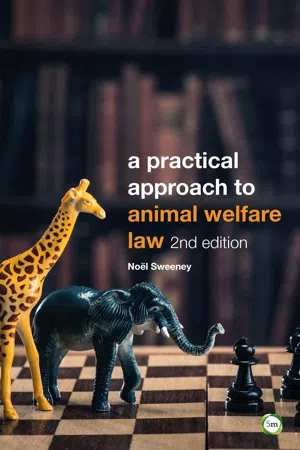
A Practical Approach to Animal Welfare Law 2nd Edition
About this book
Animal Welfare Act 2006
1
Animal Welfare Act 2006
1.1 Value
The Protection of Animals Act 1911 [POA] belied and denied its name. It was deliberately drafted with limited protection for animals in mind. That Act concentrated on the concept of cruelty and allowed animal abusers to escape their just deserts by a combination of legal loopholes and judicial fudges. Each deficiency in that Act was drafted and thereafter interpreted narrowly in favour of defendants to the detriment of animals. Domestic animals were barely protected while wild animals were used and abused at will. The POA purposely exempted hunting and vivisection from its terms to protect people practising those interests. An accurate impression can be deduced from the expression that defined a domestic animal as one ‘which is tame or which has been or is sufficiently tamed to serve some purpose for the use of man’. Their value was assessed by us on their ‘use’ to us.
After almost a century the POA was finally replaced by the AWA. In approach, content and spirit the AWA is a radical departure from the POA. The AWA swept away the cobweb ideas and ushered in a new way of thinking about animals in relation to ownership and harm and society. No advocate with a sense of purpose would now be able to rely on the old ideas within the POA to persuade any court in the future.
While the POA was primarily concerned with cruelty, the AWA is concerned with welfare. The words ‘cruel’ and ‘cruelty’ are not used in the AWA at all. Instead, the word ‘suffering’ is used throughout. That is consistent with the twin limbs of ‘duty’ and ‘responsibility’ that are imposed upon people for the treatment of their animals. Those legal inconsistencies that riddled the POA, especially in the treatment of farm animals and wild animals in captivity, were addressed by the AWA. The AWA places a duty of care on the person responsible for the animal’s welfare. That stance is a change of principle that aims to protect animals from their natural predators: humans.
A pivotal point that is repeated in sections 4 and 9, dealing with the ‘prevention of harm’ and the ‘promotion of welfare’ states the principle without prevarication: Nothing in this section applies to the destruction of an animal in an appropriate and humane manner.
That underlines the value of an animal’s life now as unless the manner of their death is ‘appropriate’ and ‘humane’, it is unlawful. The AWA restricts an owner’s right to treat an animal in a way that harms its welfare. Therefore, the owner has a primary duty to care for his animals rather than choose to destroy his property. As death is the result of a final act or omission, that clause places an onus on the owner of animals to take account of their welfare. In his choice of the form of their life and death, he is liable for the manner of it if that is inappropriate or inhumane. After all, pleasure and pain is shared by all living beings.
That concept of ‘welfare’ underpins the whole of the AWA. It is the cornerstone of the principles within it. While the idea of welfare was of concern to Henry S. Salt more than a century ago, it has only had legal significance since the 1960s. Salt, a visionary teacher, markedly noted in Animals Rights Considered in Relation to Social Progress [1892]: ‘to live one’s life – to realise one’s true self – is the highest moral purpose of man and animal alike.’
1.2 Thing
Salt’s view applies to Marshall Rosenberg, the American psychologist, too. Rosenberg was a pioneer of non-violent communication. He used a giraffe as a model to aid his patients and assist their recovery. His approach centred on the belief that a giraffe was such a graceful creature that people empathised with the feeling they gained in his company, and this helped to assuage their pain. Although the giraffe was a huge animal, he was gentle and calm, which proved to be a balm for Rosenberg’s perturbed patients.
In 2016 Aryanna Gourdin travelled from Utah in America to South Africa for a hunting safari. She killed a giraffe. Gourdin posed beside the dead giraffe, holding her rifle and smiling for the camera. She posted photos on social media of her trophy plus other animals she had shot. Gourdin, who was accompanied by her father, is 12 years old.
The going rate to kill a giraffe is £2,500. Africa is a microcosm of our value of all animals. Their net worth to us is measured by the premise and assessed on the basis that they have no legal ‘personality’. [See: Chapter 20]
Our legal system classes a furry striped animal activated by a ventriloquist’s arm as being no different than the real thing. Each one, be it a toy or a tiger, is a different form of the same item, though each one is no different in law. ‘Property’ is a concept that permeates our law. As a matter of law an animal is just a ‘thing’. That is why the AWA is concerned with welfare not ‘rights’. Therefore, while there are criminal sanctions for abuse of animals and a prohibition on causing them ‘unnecessary suffering’, their fate and fortune and future rests in our hands. Whether we care for their welfare or not, we control their daily lives in many ways because it is our calculated choice to deny them a legal voice.
2
AWA in Action
2.1 Aim
The UK’s AWA balances the benefit of controlling animals with a burden on people who choose to look after and live and work with them. It is a criminal Act whose purpose is to protect those animals from ‘unnecessary suffering’ by ensuring we adopt a ‘good practice’ when dealing with them during our collective daily lives.
While wild animals are still largely denied protection, in certain limited circumstances the AWA can apply to them. The protection extends to an animal that is owned by a person or there is someone who is responsible for them. Yet the offences relating to ‘animal fighting’ have a much wider application and catches those who are directly and indirectly involved in that criminal activity. Although animal experiments and vivisection are outside the scope of this book, the AWA is so wide in effect that it relates to that area too. In general the Act extends the mantle of law to cover domestic and farm animals as each are often used and abused by us. The AWA seeks to protect those animals’ interests against their abusers.
2.2 Freedom
The AWA incorporates the principles outlined by the Brambell Committee in its Report of the Technical Committee to Enquire into the Welfare of Animals Kept Under Intensive Livestock Husbandry Systems [1965]. As a result, the term ‘welfare’ was adopted in the legislation to protect animals. By relying on ‘welfare’ it was positively and purposely using a term that was usually applied to children.
That concept of welfare from the Brambell Report was endorsed by the Farm Animal Welfare Council [FAWC], which was formed in 1979. The FAWC concluded that all animals should have the ‘five freedoms’, which are:
- Freedom from hunger and thirst – by ready access to water and a diet to maintain health and vigour.
- Freedom from discomfort – by providing an appropriate environment.
- Freedom from pain, injury and disease – by prevention or rapid diagnosis and treatment.
- Freedom to express normal behaviour – by providing sufficient space, proper facilities and appropriate company of the animal’s own kind.
- Freedom from fear and distress – by ensuring conditions and treatment, which avoid mental suffering.
Although those ‘Freedoms’ are less than ideal, they are the minimum requirements to ensure animals are properly treated by people who have a duty of care towards them, are responsible for them, intend to kill them, or engage in all those matters. Those ‘Freedoms’ are the core of the AWA.
The AWA is based on and adopts the principle that the welfare of the animal is paramount. During the trial of Gray v. RSPCA [2010] A20090060 some of the defence counsel relied on the POA in their submissions. That approach was misconceived as if it had any validity the AWA would be a legal paper tiger without bite or teeth. HHJ Tyrer took the opportunity to fix the court’s judgment on the principles that formed the AWA. The judge declared the irrelevance of the POA to their decision: ‘Before the passing of this new Act [AWA], there was a great deal of case law on the meaning of the previous provisions of section 1 of the Protection of Animals Act 1911. In our judgment the old jurisprudence is no longer relevant.’
HHJ Tyrer confirmed the supremacy of the AWA. Gray appealed to the High Court. Oddly, one counsel relied on authorities relating to the POA again. He tried to revive the dead law of the POA.
Lord Justice Toulson [LJ] dismissed his submission: ‘That Act [POA] was the corner piece of animal welfare legislation prior to its repeal and replacement by the 2006 Act. The judge took the view that the language of section 1 of the 1911 Act, and authorities as to its construction, were irrelevant to the construction of section 4 of the 2006 Act. The judge was right.’
That attempt by the defence to rely on the POA was pointless as the AWA swept away all the old ideas and replaced them with new concepts that were hitherto unknown within animal law. Both judges were forthright and right. If either of the judges had decided otherwise the result would have cast the AWA into a lasting legal limbo. [See: 2.7]
Animals to which the Act applies
2.3 Animal Welfare Act 2006 s.1
- (1) In this Act, except subsections (4) and (5), ‘animal’ means a vertebrate other than man.
With a knowing nod to the idea we are all Darwin’s cousins, the AWA defines animals it applies to as ‘a vertebrate other than man’.
The AWA does not apply to an animal while it is in a foetal or embryonic form. That is a questionable omission as causing ‘suffering’ to a pregnant animal would be an aggravating feature. Human foetuses have legal protection for that reason. If an animal is pregnant its needs and welfare are affected because of its condition. The unborn progeny can have their pending birth terminated and their welfare affected as a result of any abuse directed at their prospective parent.
Nevertheless, the AWA allows for changes in legal protection according to the advancement of knowledge and science. The ‘appropriate national authority’ that governs the regulations is the Secretary of State for England and the National Assembly for Wales. They have power to extend and make and amend the regulations. In 2015 the International Institute for Species Exploration confirmed the existence of many new animals and plants. They include such a variety as a cart-wheeling spider, a feathered dinosaur and a bone-house wasp. This provision would allow the authorities to include such creatures within the protection of the AWA.
Though the Act can be amended, it must relate to the promotion of animal welfare. The power may only be exercised if it is satisfied ‘on the basis of scientific evidence’ that animals of the kind concerned are ones capable of experiencing ‘pain or suffering’.
‘Pain’ is not defined directly in the Act. ‘Suffering’ is defined as ‘physical or mental suffering and related expressions shall be construed accordingly’. Animals can feel mental suffering and in extreme cases even post-traumatic stress disorder. The resonance between a human reaction to conditions and animals’ behaviour are related and shared. Prisoners can become mentally disturbed, known colloquially as ‘cabin fever’ or ‘stir crazy’, which is a condition that can be reflected by animals in war zone and a zoo. Bad dog breeders can induce such a state by confining dogs in boxes, making them breeding machines as a means of creating a profit. Those conditions manifestly affect their actions, causing the dogs high levels of stereotypical stress.
Hence, on balance the cogent conclusion confirms the size of the cell and the bars on a cage can induce negative stress regardless of whether the one incarcerated is a human or an animal. For each one the suffering is a similar strain.
Even so, ‘pain’ should be accurately defined in the AWA. The definition should be amended to include all forms of physical ill-treatment and psychological pain. Whether or not there was any proven ‘fear’ involved in the killing of an animal should be defined to remove any lurking doubt. An animal’s life has value because they are alive. Moreover, like the soldiers they serve beside, the dogs of war can and do suffer from psychological stress: each of our heroes can be affected by P-TSD.
A continuing problem within the POA, which resulted in many bad decisions, was the concentration by judges on whether the animal that was abused suffered ‘cruelty’ or not. As that Act has rightly been confined to a legal graveyard, so should those ideas. An animal’s ‘suffering’ should be defined to include every form of mental and physical pain that is similar to the suffering of a child. That approach would take account of the particular vulnerability of each respective victim. Indeed, in a reverse situation that proves the point, the High Court of New Zealand confirmed that the cruelty offence in the Animal Welfare Act 1999 is derived from the Court of Appeal decision in R. v. Hende [1996] 1 NZLR 153, which dealt with the offence of wilfully ill-treating a child in a manner likely to cause unnecessary suffering. That progressive decision accentuates that children and animals share the core condition of welfare that is the pivot upon which the law balances to protect the weak.
‘Protected animal’
2.4 Animal Welfare Act 2006 s.2
An animal is a ‘protected animal’ for the purposes of this Act if:
- (a) it is of a kind which is commonly domesticated in the British Islands,
- (b) it is under the control of man whether on a permanent or temporary basis, or
- (c) it is not living in a ...
Table of contents
- Cover
- Half Title
- Title
- Copyright
- CONTENTS
- Introduction
- Table of Cases
- Table of Statutes
- Table of Statutory Instruments
- ANIMAL WELFARE ACT 2006
- DANGEROUS DOGS ACT 1991
- ANTI-SOCIAL BEHAVIOUR, CRIME AND POLICING ACT 2014
- Index
Trusted by 375,005 students
Access to over 1.5 million titles for a fair monthly price.
Study more efficiently using our study tools.