Laser therapy has become increasingly popular in small animal practice and has many benefits to the patient – including reduced inflammation, faster tissue healing and less pain, and can be used in a wide variety of conditions including wounds, sprains and fractures.Aimed at the first opinion vet, this very practical book covers the most important aspects of laser use in the practice environment. But it does so in a slightly different approach, taking two (often mis-aligned) perspectives – fundamental science and clinical applications – and combining them for a robust, useful guide to the practice of laser therapy.It includes: how lasers work on tissue, how to use them in different scenarios, how to maximise results, how to use them on different conditions including soft tissue, musculoskeletal and neurological, how to integrate lasers with other therapies, when not to use lasers or use with caution, how to choose the equipment and implement it in the practice environment and promote the treatment to clients. The book also includes case studies to illustrate the use of lasers in practice on a range of conditions in different animals including dogs, cats and exotics.Veterinary Laser Therapy in Small Animal Practice combines the clinical and scientific approaches reflected in the work of the two authors, showing how both sides together can help you have a positive impact on the patient.
“Goodbye,” said the fox. “And now here is my secret, a very simple secret: It is only with the heart that one can see rightly; what is essential is invisible to the eye.”
— Antoine de Saint-Exupéry
After reading that last section you should feel like Harry Potter with the Elder Wand in your hand as you wield your laser. It is a powerful tool. But now it’s time to burst your bubble and tell you that light doesn’t do ANY of that. If you shine light on a vial of growth factors, you will get a slightly warmer vial of growth factors, nothing more. The body can, however, be triggered to synthesize more of them. In fact, all of the effects we just highlighted are simply enhancements of the body’s ability to regulate itself in a positive direction. And light can be that catalyst in a completely non-invasive way. In order to do so, it has to be absorbed, and by something that is somewhere early in the chain of interactions that causes the body to release those growth factors. The really cool part is that the body is so good at communication within itself that the initial trigger of these eventual events can be seemingly unrelated to the desired effect. More on that later, but first, what does it even mean for something to absorb light?
When you spill water on the table, you use a paper towel to “absorb” the water. But that is not the same. The water molecules are still completely intact, they have just bonded with the particles in the towel. Then you simply move them somewhere else, by either throwing them into the trash or wringing them down the drain. With light, though, the story is different. Light comes into an interaction, but does not come out. So what is light and how can this be explained?
1.1 Electromagnetic radiation
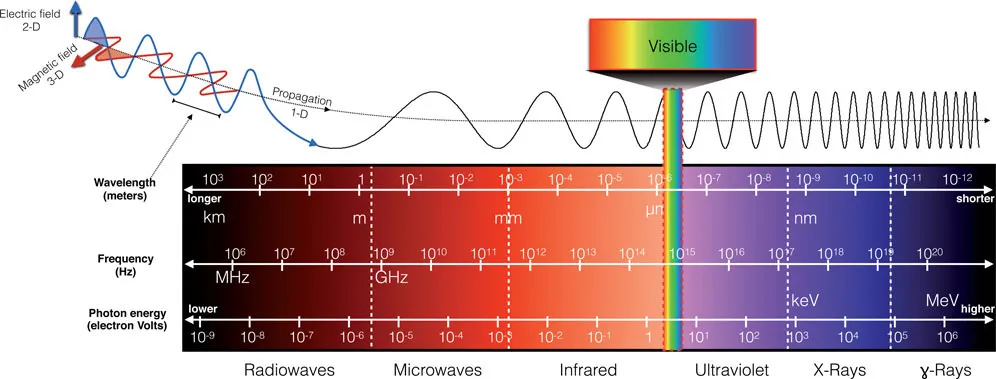
Light has some very cool properties, both classical and quantum-mechanical (in fact, both at the same time), and can be described in a bunch of different ways. But before you get scared off by the scary “quantum” word, let’s simplify this pragmatically. Light is simply an oscillating electric and magnetic field. We call the distance between any two peaks of this oscillation the wavelength of light. One important, but somewhat obvious feature of light is that it always travels at the same speed (in a vacuum; we’ll get to what happens in a medium later). That said, another equivalent way to define light is by the frequency, i.e. the number of oscillation cycles per unit of time. (NOTE: This is not to be confused with pulse frequency or repetition rate. That has to do with turning light on and off periodically. We’ll get to that later.) Since we know the wave’s propagation speed (distance traveled per unit of time), if we know how many times it oscillates, we also know the distance between oscillations, and vice versa (Fig. 1.1).
The ONLY fundamental difference between the different flavors of light is this one-dimensional scale of the oscillating wave, whether you are referring to it as wavelength or frequency. In fact, depending on the region of the full spectrum of light (fittingly enough, called the electromagnetic spectrum), one or the other of these quantities is preferred. My favorite AM sports radio station when I was growing up broadcasted using light at 660 kHz (frequency); I heated up my coffee in the microwave this morning with light at 2.45 GHz (also frequency); but my favorite color is 450 nm (wavelength of blue light). Indeed these are all just different colors of light; the human eye only evolved to contain cones that can detect wavelengths from about 390–700 nm, which is what we call the visible part of the spectrum. The near-infrared spans from about 700–1100 nm. I’ll bounce between these descriptions (wavelength and frequency) many times, but either one of them tells the whole story.
Figure 1.1 Structure of light as an electromagnetic wave (top). You can also see the scale of photon energy across the full electromagnetic spectrum.
This is the full, classical picture of light as it pertains to the kinds of therapy discussed in this book, i.e. nonionizing (and in particular, visible and infrared) light incident on living biological tissue. There is so much more interesting stuff to learn about light, but not much of it will help you in the clinic, so we will not cover it here.
OK, one more tidbit because it’s cool and head-spinning and it will affect how we talk about light a little later on: it turns out that the energy of light is directly proportional to its frequency (and therefore inversely proportional to its wavelength). To compound this, the amount of energy any “piece” of light carries is discrete or “quantized.” These individual packets of light are called photons and make up the quantum picture of light.
The main question remains: why does frequency, this one characteristic of this phenomenon we call light, determine such a broad range of implications, i.e. from destruction to manipulation, from imaging to therapy?
Oddly enough, that question boils down to a different kind of question: what happens when something that wiggles bumps into something else that wiggles? We’ve already established that light can be described as an oscillating field. Well, matter is made up of atoms, groups of them called molecules, and big groups of them called tissues. Inside the atom, electrons are orbiting the nucleus in a cloud that has some structure to it and has an equilibrium state. Molecules are atoms connected by bonds, which are made up of some sharing of these electron clouds and which also have an equilibrium state. And most of the equilibrium states of these entities are electrically neutral. This doesn’t mean that there are no charged particles, but rather that there are as many positively charged things as there are negatively charged things.
But light is an oscillating electromagnetic field, and charged particles in this kind of field experience a force. So shining light on matter exerts a force on these equilibrium states, and as it passes by, the matter creates some recoil force, much like a spring (warning: we physicists use the concept of springs to explain everything). The force experienced by the matter is proportional to the energy of the field (frequency of the light) and the mass and charge of the particles (atomic/molecular structure) of the matter.
So matter, in effect, is just a bunch of charged atomic nuclei tied together with a bunch of springs. The types of interactions you get, then, are simply regulated by the frequency of oscillation of the light and how this corresponds to the frequency of oscillation of the bonds of the things they bump into.
1.2 Absorbing light
Absorption happens when the frequency of light is close to the natural frequency of the thing it interacts with. Just like pushing a child on a swing, if you push in sync with the natural rhythm, you can transfer the most energy of your push to the child. But as I mentioned above, light is “quantized,” so this energy transfer is an all-or-nothing kind of thing: you don’t absorb a piece of a photon. If a photon of light transfers all of its energy to the incident matter, we call that an absorption event.
On the atomic scale, the transitions between electron energy levels correspond to light’s frequency in the X-ray region of the spectrum, which is why X-rays interact strongly with atoms, so much so that individual electrons can be knocked completely out of orbit in what is called ionization. This kind of process leads to all sorts of sporadic and dangerous effects, because when an atom is missing an electron, it does whatever it can to steal one from another atom, and the chain continues. Molecular bonds can be broken and whole molecules can be destroyed this way. In fact, more than two-thirds of all light-induced mammalian DNA damage happens when water becomes ionized into what’s called a hydroxyl radical.
On the molecular level, though, the bonds are much more flimsy, i.e. they have much slower natural frequencies (which makes sense because bigger things move more slowly), and so light in the visible and infrared range takes over the interactions. And because lower frequency means less energy, the interactions are often not as catastrophic to the matter. Instead, the molecular bonds that absorb the incident light’s energy wiggle and twist and stretch and contract. Though smaller in magnitude, these types of molecular manipulations lead to all types of changes in chemistry (more on this in section 1.3).
Absorption, even of visible and infrared light, is not always calm, though. If matter has a particular bond with a natural frequency that coincides with the incident light, and a lot of light is used, the absorption events lead to re-enforced vibrations that create heat and can literally shake molecules apart. This is why putting things that contain water (e.g. most of your food) in the microwave, which uses light with a frequency (and therefore energy) that is 200,000 times less than visible light, heats your food much better than holding that day-old pizza next to your desk lamp, however bright it may be. The bonds in water have a huge absorption peak (a resonant frequency of bending/twisting) in the microwave region of the spectrum. This same idea is used in surgical lasers to ablate tissue in a very efficient, localized way.
In general, then, targeting something in tissue with your laser means finding something in the cells of that tissue that does something productive when it absorbs light, determining the resonant frequency of that something, then using the color of light that coincides with that frequency. Simple. So what in the body absorbs light and what happens once it does?
1.3 Light’s bio-targets
Here I need to ...
Table of contents
Cover
Half Title
Title
Copyright
Contents
Preface
Acknowledgments
Abbreviations
Some of what you will see
Introduction: light as a healing tool
Part 1 Light’s actions in the body
Part 2 Pointing the light into the patient
Part 3 Using light in your practice
Appendices
References
Index
Trusted by 375,005 students
Access to over 1.5 million titles for a fair monthly price.
Study more efficiently using our study tools.
Frequently asked questions
Yes, you can cancel anytime from the Subscription tab in your account settings on the Perlego website. Your subscription will stay active until the end of your current billing period. Learn how to cancel your subscription
No, books cannot be downloaded as external files, such as PDFs, for use outside of Perlego. However, you can download books within the Perlego app for offline reading on mobile or tablet. Learn how to download books offline
Perlego offers two plans: Essential and Complete
Essential is ideal for learners and professionals who enjoy exploring a wide range of subjects. Access the Essential Library with 800,000+ trusted titles and best-sellers across business, personal growth, and the humanities. Includes unlimited reading time and Standard Read Aloud voice.
Complete: Perfect for advanced learners and researchers needing full, unrestricted access. Unlock 1.5M+ books across hundreds of subjects, including academic and specialized titles. The Complete Plan also includes advanced features like Premium Read Aloud and Research Assistant.
Both plans are available with monthly, semester, or annual billing cycles.
We are an online textbook subscription service, where you can get access to an entire online library for less than the price of a single book per month. With over 1.5 million books across 990+ topics, we’ve got you covered! Learn about our mission
Look out for the read-aloud symbol on your next book to see if you can listen to it. The read-aloud tool reads text aloud for you, highlighting the text as it is being read. You can pause it, speed it up and slow it down. Learn more about Read Aloud
Yes! You can use the Perlego app on both iOS and Android devices to read anytime, anywhere — even offline. Perfect for commutes or when you’re on the go. Please note we cannot support devices running on iOS 13 and Android 7 or earlier. Learn more about using the app
Yes, you can access Veterinary Laser Therapy in Small Animal Practice by María Suárez Redondo, Bryan J. Stephens in PDF and/or ePUB format, as well as other popular books in Medicine & Veterinary Medicine. We have over 1.5 million books available in our catalogue for you to explore.