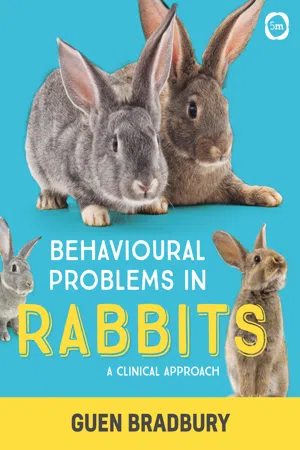
Struggling with problem behaviour in rabbits can leave you frustrated, embarrassed, and feeling helpless. You're not alone – over forty percent of the 1.5 million pet rabbits in the UK show behaviours that their owners wish they didn't! The lives of these rabbits, and their owners, can be improved by tackling bad behaviours at the root.Behavioural Problems in Rabbits: A Clinical Approach by rabbit behavioural expert Guen Bradbury, gives you the tools you need to address any unwanted behaviour in a rabbit under your care. Whether you are an owner, a veterinary surgeon or nurse, or if you rehome rabbits, this book will help you:Understand what influences rabbit behaviourDiagnose the cause of a specific problem behaviourLearn the principles of modifying rabbit behaviourConstruct an achievable plan to change a specific behaviourReview and refine the behaviour modification plan as needed
- English
- ePUB (mobile friendly)
- Available on iOS & Android
eBook - ePub
Behavioural Problems in Rabbits: A Clinical Approach
About this book
1
Introduction
You have picked up this book, so you obviously have an interest in rabbit behaviour problems. Maybe you’re a veterinary surgeon or in a position of responsibility and people come to you for expert advice? Maybe you are encountering unwanted behaviour in your own rabbit? Maybe you’ve studied unwanted behaviours in different species and you’re wondering how these differ in rabbits? This book will help you to understand rabbit behaviour problems, and give simple, evidence-based advice to improve them.
Let’s imagine that a friend of yours has a rabbit that she loves dearly, and asks you for some advice. Her rabbit is often affectionate towards her, but occasionally bites and scratches when she tries to get him out of his hutch. She doesn’t understand why the rabbit does this. Her internet searches suggest that she puts on gloves when she handles him, that she needs to show him that biting doesn’t work, that she should handle him more so he becomes accustomed to it. Her vet recommends that she get the rabbit neutered. She’s asked you whether you have any suggestions.
You have some ideas – you can see that there are a few aspects of the way that this rabbit is kept that are not perfect. But how do you know which aspects are likely to be contributing the most? Which aspects should you suggest that your friend changes first? And will those husbandry changes alone resolve the problem?
This book contains practical, useful advice on resolving unwanted behaviours in rabbits: whether that’s for your friend, your client or even yourself. You can read it from cover to cover to build a structured understanding of rabbit welfare, motivations and the general principles of rabbit learning, or you can dip in and out of it to find advice on managing specific unwanted behaviours.
I have set up the following chapters to mirror a basic behavioural consultation:
- IntroductionThis section gives an overview of how humans interact with rabbits: how the pet rabbit was domesticated, what the societal expectations of pet rabbits are, and how different ownership styles affect an owner’s relationship with their pet. This will help you to manage the owner’s behaviour as well as the rabbit’s, setting up the consultation to lead to an outcome that the owner can realistically achieve.
- What is the problem behaviour?This section covers the sort of information that you need to get from the owner to address a problem behaviour, and the various tools you can use to help you to get the comprehensive history that you need.
- Why is the problem behaviour hap pening?This section aims to help you to get to a diagnosis. It is structured around a framework for assessing welfare in rabbits, and considers the diet, environment, health, and ability to assess normal behaviour. These factors inform how the rabbit interprets its situation. Understanding what rabbits need will help you to make sense of what is missing in an individual rabbit’s husbandry.
- How can I change behaviour?This section introduces the general principles of management of an unwanted behaviour. It provides advice on how to help owners to read their rabbit’s behaviour more carefully, so they can adjust their interactions appropriately. It explains how to change a rabbit’s situation with minimal stress. Additionally, it describes methods of training rabbits, gives tips and suggests behaviours that should be trained to help the rabbit to cope with its environment.
- How can I resolve a specific behavioural problem?This section gives advice on specific behavioural problems, categorised as those that occur between the rabbit and its owner; between the rabbit and its companion rabbit; between the rabbit and its environment; and those that are self-directed.
- ConclusionThis section briefly recaps and reminds you of the key points.
Finally, there is a useful appendix of advice sheets for owners on different aspects of behavioural or environmental modification that have been covered within the text. These can be photocopied and handed out to owners where appropriate.
Returning to our hypothetical situation, let’s imagine that you’ve now read this book. You feel much more confident about the advice that you want to give your friend. You can ask her about what she feels a good outcome would be. You can discuss how rabbits feel about being handled. You can talk about environmental modifications and you can help her understand what her rabbit is trying to communicate. You can give specific advice to help her to resolve this problem. When she encounters hurdles in the process, you can discuss them and suggest how these barriers can be overcome. As she finds her relationship with her rabbit beginning to improve, she’s likely to become more motivated to improve its welfare. You can then advocate other improvements in the rabbit’s welfare, such as the introduction of a rabbit companion. You have improved the welfare of both the rabbit, and of your friend as well.
It is hard for humans to communicate with prey species like rabbits. Evolutionarily, humans are predators, and so we have not evolved to understand the subtleties of communication of prey species. This means that understanding their motivations and drives requires more work and is less intuitive. However, the skills that we can learn (patience, building trust, recognising subtle signals, developing a balanced relationship) are very transferable. Understanding rabbit behaviour can give us new insights into how we interact with other animals and even how we interact with our fellow humans.
Good luck! I hope you enjoy the book. If you have any questions, please don’t hesitate to get in touch: my contact details are at the back.
Changing expectations
In this section, we’ll explore why there is frequently a mismatch between how rabbits want to behave around humans, and how humans want to behave around rabbits.
Rabbits have been popular children’s pets for many years, but the demographic of rabbit owners, and their expectation of their rabbits, is changing. The ‘in a hutch, in a shed’ model of husbandry, though regrettably still seen, no longer represents the norm. These changing expectations have improved rabbit welfare in a number of ways, but can place other stresses on these animals. Many owners now expect their rabbits to live in the house without destroying it, to enjoy frequent, unsolicited cuddles without complaint and to display strong, affectionate relationships with humans.
The 2016 PDSA Animal Wellbeing (PAW) survey reported that 3% of homes in the UK have a rabbit, with an estimated population of 1.5 million rabbits. About 25% of rabbits were purchased because the children wanted a pet.
Considering an animal’s natural history can provide some context to its behaviour. Unlike wild dogs and cats, the wild rabbit is a herbivorous prey species. This species forms more than 50 per cent of the diet of more than 30 different predators. This alarming statistic explains a lot of the rabbit’s behaviour in captivity. When thinking about any rabbit behaviour, it is worth remembering that their ingrained primary motivation is to avoid being eaten!
Rabbits can make very good pets. They require relatively little human interaction if kept in same-species pairs or groups, they are more eco-friendly than cats and dogs (herbivores rather than carnivores), they can be easily provided with a diet that is close to their natural diet, they do not require the same degree of interaction and care when the owner goes away (less dependent on human companionship), they are quiet (fewer problems with neighbours) and they can be friendly and affectionate if well managed.
In the 2016 PAW report, rabbit owners were significantly less likely than dog or cat owners to say that owning their pet made them happy.
Although many owners expect that the rabbits that they acquire will be interactive and low-maintenance pets, it seems that the expectation is frequently not met. The experience of owning rabbits may be unrewarding and frustrating for some owners. Owners may describe their rabbit as ‘boring’ (reflecting insufficient opportunity to express normal behaviours), ‘timid’ (reflecting husbandry and interactions that fail to meet the rabbit’s emotional needs) or ‘grumpy’ (reflecting a lack of awareness of rabbit behaviour resulting in expression of aggressive behaviour). Owners who have problems with their rabbit’s behaviour may find it very hard to get appropriate advice. Vets aren’t yet taught about rabbit behaviour at university, there are few behaviourists who work specifically with rabbits, and internet advice is often conflicting.
When asked specifically about behavioural problems in their rabbit, 50% of rabbit owners in the 2016 PAW report said they would go to a veterinary professional for help, 38% would rely on internet advice, and 14% of owners wouldn’t seek help.
So, it’s clear that there is a general misunderstanding about what rabbits need from their environment and their interactions, and there is very little training available to interested individuals to improve their understanding. Remedying that by digging into the ecology, evolution and history of the rabbit– human relationship will show us the context within which modern domestic rabbit behaviours occur. We’ll start by thinking about how humans, as a species, have ended up keeping rabbits as pets.
Domestication
This section describes how rabbits were domesticated, and why this affects their behaviour in captivity.
Domestication refers to the long-term process in which one species controls various aspects of care and reproduction of another species, which results in a change in the second species that makes it more valuable to the first species. This process generally makes the domesticated species more able to cope with life in captivity and less well adapted to life in the wild.
It is helpful to compare rabbit domestication to that of other pet species: dogs were domesticated (i.e. began to be appreciably different from the wild grey wolves) between 40,000 and 100,000 years ago; cats were domesticated about 10,000 years ago; and rabbits were domesticated about 1,400 years ago. Dogs have been domesticated for much longer than rabbits, which is part of the reason that humans find it inherently easier to read dog behaviour.
However, this ability to understand a species’ behaviour does not just depend on how long the animal species has been domesticated. Route and reason of domestication also makes a difference. The ancestors of domestic dogs probably scavenged around human habitation. The animals with a lower flight threshold (i.e. those that were tamer) could get closer to humans and therefore got more food. These scavenging dogs probably started to alert humans when danger threatened, so humans realised that a close relationships with dogs was valuable. This relationship benefited both humans and dogs. When humans encouraged dogs to live close by, the tamer animals would have an advantage over the more fearful ones. Selection for specific traits then became more common, meaning dogs could be bred for hunting, guarding, herding, hauling, killing vermin and, more recently, appearance.
These differing selection pressures resulted in the many dog breeds that exist today.
Rabbits, on the other hand, were domesticated in AD 600, initially as a low-maintenance food source, and subsequently for their fur. As a result, the selected traits were body size and coat characteristics (Figure 1.1). Unlike dogs, rabbits have never been deliberately selected for behavioural traits.
So, while dogs were domesticated a long time ago, and were mostly selected on behavioural characteristics, rabbits were domesticated relatively recently, and were mostly selected on physical characteristics. As a result, their instinctive responses and range of behaviours are very different. The relationships that dogs and rabbits can form with humans are very different and humans should interact with them accordingly.
Looking in more detail, dogs appear to have a relationship with humans analogous to the parent–child relationship. A famous study (Belyaev, 1979) involved the domestication of silver foxes. The scientists bred litters of silver foxes, and then bred the tamest animals together (those that were most willing to approach the scientists). Within 20 generations, the foxes were more like dog...
Table of contents
- Cover
- Half Title
- Title
- Copyright
- Dedication
- Contents
- Preface
- Key points
- 1 Introduction
- 2 What is the problem behaviour?
- 3 Why is the problem behaviour occurring?
- 4 How can I change behaviour?
- 5 How can I resolve a specific behavioural problem?
- 6 Conclusion
- Appendix: Advice sheets
- Glossary
- Further reading
- Bibliography
- Index
Trusted by 375,005 students
Access to over 1.5 million titles for a fair monthly price.
Study more efficiently using our study tools.