Animal Welfare has been a subject of intellectual and academic study for a long time. In the past philosophers, thought-leaders and scientists have contributed to the debate, and seismic changes such as the advent of post-war industrial farming have brought about changes in attitudes to the way animals are farmed. Animal welfare as a science and philosophy can be understood as a trajectory through history of our understanding of our relationship with animals, enhanced in recent years through studies into animal behaviour and cognition and societal changes in the way we view animals.Animal Welfare Science, Husbandry and Ethics charts the history of our understanding of farm animal welfare, throughout time – the human use of animals in different eras, and farming in different systems – seeing the emergence of intensification and science and technology. The book examines the human – non-human animal relationship with a philosophical approach, examining the connections and disconnections between animals and people, and charts the beliefs and motives of different philosophers, theories and movements in animal welfare from early history to the present. The book also looks at our current animal welfare systems, examining what is working and what isn't, the pathway to how we got here, and looks at future considerations for animal welfare putting forward the author's thoughts on achieving a sustainable animal welfare model.Intended for animal welfare students, teachers, researchers and academic libraries, Animal Welfare Science, Husbandry and Ethics introduces a complex subject requiring an understanding of the underlying factors and drivers of human behaviour and farming systems. Only by acknowledging the complexity, and understanding the factors contributing to that complexity, can we hope to develop an equitable and sustainable animal welfare for the future.
eBook - ePub
Animal Welfare Science, Husbandry and Ethics: The Evolving Story of Our Relationship with Farm Animals
- English
- ePUB (mobile friendly)
- Available on iOS & Android
eBook - ePub
Animal Welfare Science, Husbandry and Ethics: The Evolving Story of Our Relationship with Farm Animals
About this book
Chapter One
The simplicity and complexity of animal welfare
I am a dog. I have four legs and a tail. The food I have is meat. Sometimes I dig in the garden. This is bad. When I am good I chase sheep. (Fisher, 1961)
The wolf, the dog and mankind
A collie, longingly and with devotion and loyalty, looks across to distant hills. The bronze statue erected by the region’s run holders or farmers, and those who appreciate the value of the sheepdog, is a tribute to the animal that helped them graze sheep in New Zealand’s (NZ) mountainous high country. Situated near the Church of the Good Shepherd, this dog is visited by tourists from around the world, its popularity undoubtedly due, at least in part, to the especially long and close relationship between mankind and dogs (Figure 1.1).
Our worlds are the culmination of thousands of years of entwined biological, social and cultural evolution. The diversity and success of both dogs and people reflect the inextricable and synergistic relationship we have shared for at least 15,000, perhaps as long as 100,000 years (Vila et al., 1997). It is a relationship founded on symbiosis – among other things, dogs provide assistance and companionship in return for food and shelter – a relationship at the heart of being human. As many have noted, to be human is to have an innate attraction to nature, to bond with special others (family, friends, homes, land and countries) including drawing in and interacting with animals and other life forms, in diverse and complex ways. These bonds can be strong and crucial to the health and well-being of individuals and communities, and some can be very lasting.
Our worlds are the result of thousands of years of interactions, coevolution and displacement of animals and humans. Wolves and Neanderthals have given way to Dalmatians, Jack Russells and mongrels, and athletes, soldiers, teachers and many more. The diversity and success of modern dogs and humans are arguably due to the extraordinary inextricable and synergistic relationship we share, evident in the relative reduction in brain volume from the wolf to the dog as also occurred in humans as each used and became dependent on the other’s intellect. Dogs, unlike wolves, can read humans, domestication selecting animals able to understand humans (Hare et al., 2002). Reduced fear, acceptance of the other, and even a love of travel are some of the human and canine traits responsible for this long-lasting symbiotic relationship. As the science fiction novelist, Kim Stanley Robinson (2012), remarked: ‘individual intelligence probably peaked in the Upper Paleolithic, and we have been self-domesticated creatures ever since, dogs when we had been wolves’.
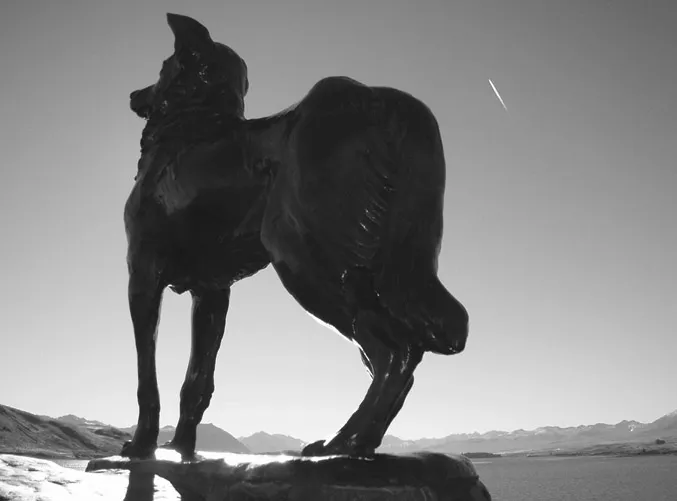
Figure 1.1 Beannachdan Air Na Cu Caorach (blessings on the sheepdogs) at Lake Tekapo, New Zealand (Photo: Mark Fisher). (Available in colour in the plate section between pages 178–179.)
The diversity and success of both dogs and people are inarguable, we share a good life. Dog-wolves provided hunter-gatherers with comfort and companionship, found and attacked prey, cleaned the camp of food scraps and vermin, or were a source of food (Derr, 2012; Fagan, 2015). There were few limits to their utility as they guarded, herded, hauled, warmed beds, were sacrificed to the gods, provided medicines, and accompanied and guided humans in this world and the next. The spiritual importance of the relationship was also evident in the belief that dog-wolves rebalanced humans with the forces of their world, judged ethical behaviour, ensured rituals were carried out properly and protected humanity.
To be a dog, as with other species having a symbiotic relationship with humans, is to survive and thrive – there are fewer canines in wild or natural populations. Many of the close ties between dog-wolves and man, forged some 15,000 or more years ago, remain today. Like many animals, dogs can be sources of labour, entertainment, learning and commerce, used to maintain social order and provide companionship, used symbolically in expressing human characters and relationships, or be part of the wild. However, it is as members of our households and families that dogs have claimed a part in our lives. At one level, they were workers, for example providing the labour for a kitchen’s rotisserie. The Turnspete or turnspit dog was bred to run on a wheel or turnspit to turn meat whilst it was roasting over an open fire. These spaniel-sized, short-legged and long-bodied dogs were considered ugly, but their strong legs and stamina ensured meat was cooked evenly. Popular in the 16th to 19th centuries in large kitchens in England and America as kitchen utensils, they were replaced by electricity and became extinct by 1900.
At another level, dogs are more intimate members of the family, something clear in an anecdote, part of a collation of the continuity of mental life in animals and humans (Romanes, 1882). A contemporary of Charles Darwin, George Romanes (1848–1894) told of a dog that was used to accompanying a nursemaid and baby belonging to its mistress, on walks. On one occasion, the wind forced the nursemaid to draw her shawl over the baby and turn for home. However, her progress was halted by the dog becoming hostile, preventing the nursemaid from continuing, seemingly without the baby. The dog’s faithful sentinel-like actions were only resolved when the nursemaid revealed the baby. Sometimes the relationship is very mutual and symbiotic: ‘By degrees, the distance between Nira [a woman] and Majnoun [a black poodle] narrowed until each could anticipate what the other wanted. Nira could tell when exactly Majnoun wished to eat or go for a walk. Majnoun knew when it was time to comfort her, when it was time to sit quietly by her side’ (Alexis, 2015).
At other times, we are unsure of the proper extent and limits of the relationship; friends and workmates can also be commodities, competitors, victims and pawns. Essentially identical animals can be pampered or persecuted, deliberately abused in violent domestic relationships, or the losers of our throwaway society. None of this is new. Since ancient times, dogs have had their behaviours altered by castration, teeth removed, or their vocal cords destroyed with hot fat. In some parts of the world, dogs are slaughtered, their meat a source of food and medicine and believed to bring good luck, health and vitality, its consumption part of a culture’s identity (Podbersccek, 2009). Today’s pets may be pampered but some suffer from separation anxiety, the distress evident in mournful whining, excessive vocalization, and destructive and abnormal behaviours when left alone at home (Schwartz, 2003; Sherman and Mills, 2008). And selective breeding for performance or looks has produced, either deliberately or accidentally, abnormalities such as breathing difficulties in bulldogs and hip dysplasia in sheepdogs. Finally, many unwanted dogs are surrendered, euthanized or abandoned, for diverse reasons: aggression and behavioural problems, hyperactivity, house soiling, fearfulness and escaping, being unfriendly to other pets and people, unsuitable or ill, or, commonly, being incompatible with their owners’ circumstances, for example, housing restrictions, divorce, death, pregnancy, birth of a child, need to travel, allergies in the family, lack of time for an animal, finances or having been an unwanted gift (Scarlett et al., 1999; Protopopova and Gunter, 2017). ‘Nevertheless, he is the one who holds the dog still as the needle finds the vein and the drug hits the heart and the legs buckle and the eyes dim’ (Coetzee, 2000).
The reason for beginning this book about farm animal welfare with dogs is because dogs are our longest-serving animal companions. Dogs made us human, evident in some of our mythology. For example, to the Yarralin people of northern Australia, in the Dreaming, the dingo, or wild dog, and humans were one. Human ancestry, for them, is such that ‘dingos are thought still to be very close to humans: they are what we would be if we were not what we are’ (Rose, 2000). Others’ myths also tell of humans born of the union of woman and dog-man, or of wolves that were once people. To the Black Tatars of Siberia, a naked dog was left to guard the first humans while their souls were being procured from heaven. In God’s absence, the devil took the soulless people and defiled them with spittle, in exchange for giving the dog golden hair. God, on returning, turned the humans inside out so that we now have spittle and impurity in our intestines (Campbell, 1968). The dog is also an animal many of us are exposed to from our youngest days and throughout most of our lives. We continue to share our modern world with dogs in important, diverse and complex ways (Figure 1.2), the complexity of expectations of their place in society not unlike that of farm animals. It is a relationship we can easily understand, unlike that which many of us, in affluent western communities, have with today’s farmed pigs, poultry, goats, cattle, sheep and deer. As we understand our relationship with the dog, it is hoped that we will come to understand our relationship with farm animals, a relationship as extraordinary as humans have with dogs. There is, however, one significant difference. The relationship we have with dogs is largely a personal one, between individuals, whereas the relationship most of us, in the western world, have with farm animals is an impersonal but collective or societal one.
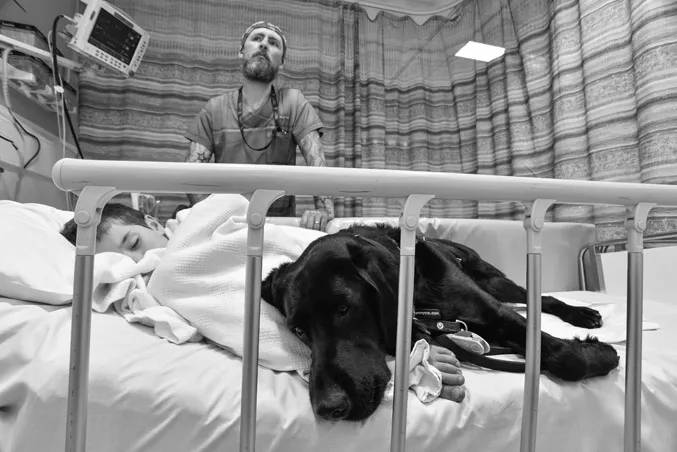
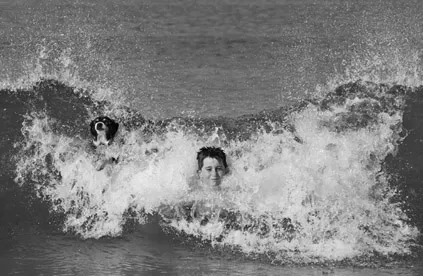
Figure 1.2 Two examples of how inseparable dogs’ and humans’ worlds can be. A young autistic boy in hospital with his ever-present assistance dog (Photo courtesy Louise Goossens/Capital and Coast District Health Board) and another youngster and his dog, surfing (Photo courtesy Heather O’Brien). (Available in colour in the plate section between pages 178–179.)
In evolving from a ‘ferocious wolf’ to a ‘loyal companion’, the dog epitomizes our evolution. We were once like wolves. Protohuman hominids, Australopithecines, who lived in Africa 6.5–1.5 million years ago, lived as vegetarians by gathering, or as omnivores, supplementing that diet by hunting small mammals, reptiles and insects. In the non-human sense of the word, Australopithecines were animals, primates without significant technical or cultural attributes (Finlayson, 2009). Finding ways to accumulate knowledge and power, practices and sciences, humans are smarter as a species than as individuals. And the extraordinary and synergistic relationship with animals, epitomized in our relationship with the dog, is part of our success, along with speech, morality and learning to live together, and farming, enabling us to develop markets and trade, become specialized, develop transportation systems and focus on efficiency.
Pigs, cows, hens, sheep, goats … red deer and mankind
What began between wolves and humans eventually extended to other animals, and plants, as humans became farmers, herded animals, settled and ultimately transformed our physical and social environments into the worlds we now know. Just as humans and dogs were drawn together, so too were humans and sheep, goats, camels, reindeer, pigs, hens, turkeys, ducks, geese, guinea pigs, horses, donkeys, buffalos, zebus, llamas, alpacas, cattle, pigeons, water buffalos, guinea fowl, yaks, gaurs, banteng, rabbits, goldfish and carp among others, as well as more recently red deer. All domesticated – tamed and kept in a human-managed environment that controls their breeding, territory and food supply – a special relationship between animals and humans.
While not as old or as entwined as the relationship between man and dogs, the extent and diversity of the relationships are simply remarkable. Cows can be sacred or the source of milkshakes and hamburgers. Pigs hunt truffles for humans, are hunted by humans with dogs for sport and for food, or their carcasses are decorated as part of religious activities (the apple wedged between the jaws of a roast pig symbolized the rebirth of the sun in a pagan midwinter festival honouring Freya, a Norse goddess of fertility, Bezant, 1999). Chickens have been part of our sports and gambling worlds, are now our most significant source of protein (eggs and meat), and one of them, the rooster Chauntecleer, is the hero in the fable The Book of the Dun Cow (Humber, 1966; Lawler, 2015; Wangerin, 1978). Llamas, donkeys and camels have transported merchandise, horses have facilitated conquests of peoples and rats have been implicated in devastating plagues. The Romans farmed carp in ponds and the fish was popular in medieval times, while Fantail, Ranhu, Bubble eye and other variously shaped and coloured goldfish have become fashionable and popular ornaments (Balon, 2004; Teletchea and Fontaine, 2014).
One of the more remarkable illustrations of the nature of the relationship is the modern dairy industry. It was not only founded on the domestication of sheep and goats, and later cattle, but also on genetic mutations in humans enabling the digestion of lactose or milk sugar. Lactase, the enzyme that enables children and other young mammals to digest milk until weaning, now continues to be produced in older children and adults. The genetic variants allowing humans to continue to produce lactase, and thus digest milk, are now widely spread in different human populations (Cochran and Harpending, 2009).
Traditional farming, then, is a special relationship between species, an elaborated form of mutualism, a relationship where both parties benefit. The ancient or domestic contract (Kilgour, 1985; Rollin, 2008) – we take care of the animals and the animals take care of us – reflects the coevolution of both. Possibly having its origins in hunter-gatherer societies constraining the killing of animals to those needed for survival, and in a command not to kill for fun or self-aggrandizement, in return for being able to live peacefully with the spirit of wildlife (see Rodd, 1990), it is a hypothetical contract. While no individual animal makes a choice, the transition from the wild to the farm, with its many impacts and changes, is assumed to be reasonable. Richard Adams’ (1920–2016) Watership Down (1972) in telling of the adventures of a small group of wild rabbits escaping their warren’s destruction for urban development highlights the ‘choice’ animals have made. The rabbits came across another warren where the inhabitants were well fed and healthy, unnaturally big, strong and protected from elil, their enemies. Unlike the wild rabbits who lived as they pleased, these rabbit...
Table of contents
- Cover
- Half Title
- Title
- Copyright
- Dedication
- Contents
- Acknowledgements
- Foreword
- Chapter One The simplicity and complexity of animal welfare
- Chapter Two Drawing on the wealth of agriculture
- Chapter Three High farming and hard work
- Chapter Four Husbandry from beyond the farm gate
- Chapter Five People are people through animals
- Chapter Six Thinking like a mountain
- Chapter Seven The fall and rise of the hunter-gatherer
- References
- Index
Trusted by 375,005 students
Access to over 1.5 million titles for a fair monthly price.
Study more efficiently using our study tools.