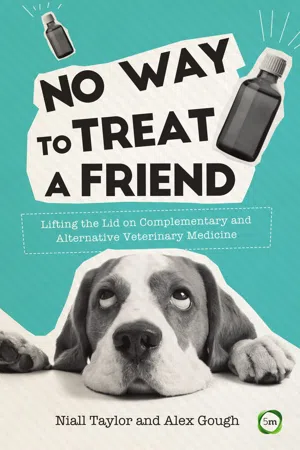
No Way to Treat a Friend is an informative and readable exposé of Complementary and Alternative Veterinary Medicine (CAVM). Written in an accessible style and illustrated with stories and cases from veterinary practice about real animals, this book is a counterweight to the mass of 'pro' literature in existence which uncritically promotes CAVM without consideration of whether or not it works or could even be harmful to our animal companions.The book takes a close look at how thinking can go wrong and how animals can appear to respond to treatment even when it is ineffective. Individual alternative practices are examined including homeopathy, acupuncture, raw diets and the anti-vaccination lobby and we find out if their claims stand up to scrutiny. With a thoroughly scientific line, it is not an attack on different belief systems, but a rigorous analysis of the facts, and a consideration of typical CAVM arguments, as well as a helpful explanation for people who may be unfamiliar with what the various therapies entail.Following on from the several successful books questioning the use of complementary therapies in human medicine such as Bad Science, No Way to Treat a Friend looks at their use in veterinary medicine. This is a valuable resource for veterinary practitioners as well as lay people who are interested in popular science, animal topics, animal welfare and medical matters.
eBook - ePub
No Way to Treat a Friend: Lifting the Lid on Complementary and Alternative Veterinary Medicine
- English
- ePUB (mobile friendly)
- Available on iOS & Android
eBook - ePub
No Way to Treat a Friend: Lifting the Lid on Complementary and Alternative Veterinary Medicine
About this book
Information
Topic
MedicineSubtopic
Veterinary MedicinePart One
Science and belief in medicine, the nature of understanding, how it can go wrong and what happens when it does.
Chapter One
What Is Complementary and Alternative Veterinary Medicine?
COMPLEMENTARY and Alternative Veterinary Medicine (CAVM), the animal-oriented part of the wider field of Complementary and Alternative Medicine (CAM), is a diverse and varied subject. Enter the phrase into the internet search engine of your choice and you will get more than 650,000 hits; miss out the word veterinary and you get nearly 6 million.
Look closer at your search engine hits and in a very short space of time you will discover dozens of separate varieties including (in vague order of popularity): homeopathy, Bach flower remedies, tissue salts, homeopathic colour remedies, acupuncture, acupressure, aquapuncture, moxibustion, herbal medicine, nutraceuticals, chiropractic, magnet therapy, animal reflexology, orthomolecular and mega-vitamin therapy, ayurvedic medicine, reiki (wild and ordinary), laser therapy, aromatherapy, zero balancing, chakra balancing, qi-gong, crystal healing, pranic healing, energy healing, intuitive healing, spiritual healing, and the intriguingly named TAT.
In addition there are some areas that, while not strictly CAVM, nevertheless fall under the same alternative umbrella, being only loosely, if at all, based in science. These include the more far-fetched claims made for certain diets (often those involving feeding raw food to animals such as the Bones and Raw Food (BARF) or the Raw Meaty Bones (RMB) diets), the vaccine/anti-vaccination ‘debate’ and several diagnostic techniques such as kinesiology, dowsing, animal communicators, pet psychics and mediums, and Kirlian photography.
But what exactly is CAM, how is it defined, indeed can it be defined at all? Before getting into the meat of the subject in later chapters, in this first chapter we will take a brief look at important matters of definition and identity and try to tease out a few common threads from this motley collection of practices and beliefs. We’ll try to discover if there is a common denominator by considering the views of those ‘insiders’ who practise it and those ‘outsiders’ who are perplexed by it. We’ll have a look at the definitions arrived at by various legal, medical and professional bodies and we’ll see if CAM can be defined by what it is alleged to do, or how it is claimed to do it. And, most importantly we will discover the difference between CAM and CAVM.
In later chapters we will discover how CAM actually manages to achieve the things it does, or at least appears to.
§
Mechanisms – Vital energy
Although each individual practice has its own jargon to describe it, many are vitalistic in nature – claimed by practitioners to act by influencing so-called vital-energy. This energy is generally held to be ancient and integral with life itself and examples include the Qi of the acupuncturists the vital-force of the homeopaths and the innate intelligence of the chiropractor. Even some raw-feeding advocates believe in the life energy of raw, but not commercially prepared food, as you will discover in Chapter Seven.
These arcane energies are sometimes given a modern gloss, enabling proponents to have the best of both worlds by laying claim to both the provenance of ancient spirituality as well as the latest science. Currently the most popular contender drafted in to impart credibility is quantum physics with its counter-intuitive concepts and quirky (to the non-expert ear) terms such as strangeness and charm, entanglement and inter-connectedness, all echoing much of the obscure language used in CAM. This is nothing new, and in past ages other genuine phenomena that at the time seemed to defy understanding, such as magnetism or electricity, have been co-opted to lend a scientific respectability to non-scientific therapies.
Strangely though, it is usually the case that someone who believes in one type of CAM will believe in many other forms as well, despite the fact the ostensible mechanisms may be different or even contradictory in nature. Homeopathy, for instance, claims that most, if not all conventional drugs will interfere with the effects of a homeopathic remedy yet it is rare to hear that acupuncture, which also claims to influence vital energy, suffers (or even causes) the same adverse effect. Acupuncturists, who manipulate the mystic Qi by the precise placement of needles along defined pathways, are usually quite content also to employ homeopathy, which claims to manipulate a more diffuse, less constrained vital-force simply by means of tablets or drops. Herbalists know full well that the potency of their tinctures increases as they become more concentrated after prolonged infusion or distillation yet at the same time (with a few worthy exceptions) are often to be seen employing homeopathic remedies that instead are required to be diluted in order to achieve the same boost in potency. Crystal therapists seem happy that the life force can be manipulated by the proximity of their chosen gems as well as the remedies of the homeopath or the hand-wavings of the Reiki practitioner – no contradiction is perceived.
A purported mechanism of action – vital energy – which is as obscure as CAM itself is an inadequate and circular explanation for anyone hoping for an objective definition of the subject. Defining a set of practices by saying they manipulate a force that has stubbornly remained undetectable by science and is perceived only by practitioners themselves tells us little of what individual practices claim to do or how they claim to be able to do it.
Effects
Another way of trying to make sense of CAM is to look at each therapy in terms of what it actually does (rather than what it claims to do) in the real world.
At one extreme there is the overtly fraudulent. For instance the stock-in-trade of the Psychic Surgeon is deliberate deception as simple conjuring tricks are employed to introduce various pieces of animal organs by sleight of hand into a bogus surgical field to be passed off as tumours or other masses, removed via an incision that heals instantly, leaving no trace. There is no possibility Psychic Surgeons can believe they actually do what they claim since they have purposely to conceal the piece of tissue before ‘healing’ commences. Their performance is done in the full knowledge, by the practitioner, that they are deceiving their patients.
Then there are modalities that have no material effect but whose practitioners genuinely believe in the power of what they do. These techniques appear to involve doing nothing at all to the patient, for instance homeopathy (which relies on sugar tablets or plain water for its effect), crystal healing, reiki and distant healing. In such cases, although the practitioners may be sincere, there is no way, given what we know about how the universe works, that their remedies or techniques can be effective. Any effect associated with their use is due to the factors discussed in Chapter Two of this work but is disingenuously portrayed by practitioners and users alike as being as a result of, rather than in spite of, the alternative treatment.
Finally, there are practices where something material is unquestionably done to the patient but it is uncertain whether the intervention is helpful or even relevant to the health of the patient. Herbal remedies we know contain plant material brimming with active ingredients often in quite unpredictable, occasionally harmful quantities. Acupuncture needles, when inserted into patients during a brain scan, are clearly seen to have an effect on the brain. Chiropractic involves vigorous manipulations and twisting, often accompanied (in human patients certainly) by an impressive array of clicks and pops; clearly something is happening in all of these cases. The debate with this group of techniques centres around their perceived benefits and, to a lesser extent, the supposed mechanisms that underlie them.
The evidence for any useful effect from almost all of these practices (particularly outside specialist publications) is, to be polite, equivocal in the extreme, as we will see in subsequent chapters. The exception being herbal medicine, where effects are widely recognised but where debate centres around the suitability or otherwise of using remedies that are crude and unrefined relative to conventional pharmaceuticals and which therefore may have unpredictable effects.
Official and legal definitions
The American Veterinary Medical Association (AVMA), describes CAVM as ‘a heterogeneous group of preventive, diagnostic, and therapeutic philosophies and practices. The theoretical bases and techniques of CAVM may diverge from veterinary medicine routinely taught in North American veterinary medical schools or may differ from current scientific knowledge, or both.’1
The British Small Animal Veterinary Association (BSAVA), in its position statement says: ‘Complementary and alternative therapies are a diverse group of practices and products not considered part of conventional (mainstream) medicine.’2
The USA’s National Centre for Complementary and Alternative Medicine (NCCAM) describes CAM as ‘a group of diverse medical and health care systems, practices, and products that are not presently considered to be part of conventional medicine.’3
In 2000 the UK’s House of Lords conducted a comprehensive inquiry into Complementary and Alternative Medicine, which looked closely at the reasons for its popularity as well as matters of training, regulation, research and funding. In the remit for the inquiry CAM is defined by what it isn’t, rather than what it is:
‘Complementary and Alternative Medicine (CAM) is a title used to refer to a diverse group of health-related therapies and disciplines which are not considered to be a part of mainstream medical care.’
Unable to discover an adequate, all-encompassing definition for CAM, the Select Committee instead elected to consider a list of therapies, grouped into three categories.
The first group comprised the ‘Big Five’; those that the report referred to as ‘professionally organised alternative therapies’; namely homeopathy, acupuncture, herbal medicine, chiropractic and osteopathy – these are also broadly the most popular therapies.
The second group encompassed complementary practices, used alongside conventional medicine without making any diagnostic claims. These included Bach flower remedies, Maharishi Ayurvedic Medicine, aromatherapy, body work therapies, reflexology and shiatsu.
Group three comprised a larger number of alternative practices that the committee considered had a particularly weak evidence base, including Anthroposophical, Ayurvedic and Chinese Herbal Medicine, crystal therapy, dowsing, iridology and radionics. The alternative disciplines in groups one and three were defined as those that ‘… purport to provide diagnostic information as well as offering therapy.’
The committee’s findings also highlighted the tolerance of the state to CAM as enshrined in legislation: ‘The Common Law right to practise medicine means that in the United Kingdom anyone can treat a sick person… provided that the individual treated has given informed consent … The Common Law right to practise springs from the fundamental principle that everyone can choose the form of health care that they require.’4
Definition by exclusion – CAM as the outsider
‘Alternative medicine is a large residual category of health care practices generally defined by their exclusion and “alienation from the dominant medical profession.”‘Ted Kaptchuk, A Taxonomy of Unconventional Healing Practices.5
It suits the agenda of many its supporters to define CAM as having been purposely sidelined by ‘The Establishment’ in a series of legislative turf wars over the years. The story goes that a scheming and self-interested medical elite has colluded and conspired with cronies in government and big business to ensure CAM practitioners are kept to the margins while The Establishment keeps its hands on the levers of power and its nose in the trough.
This argument is frequently heard in debates with proponents of CAVM and raw feeding in the veterinary press and on discussion forums when anyone who is critical of such things is condemned as being ‘in the pay’ of either the large pharmaceutical companies or the manufacturers of commercial pet foods. Such accusations are made wholly without evidence, of course, but they do serve as a useful device by which proponents can deflect the argument away from more awkward questions of efficacy and safety.
But just how accurate is this claim that the practices we regard as CAM were purposely abandoned as the medical establishment (physicians, surgeons and apothecaries) managed to use political and financial clout to get its foot in the door of state orthodoxy at the expense of equally deserving disciplines? How true is it that CAM is oppressed, the outsider looking in?
The 1858 Medical Act
The nineteenth century was a time of great progress, in industry, science and medicine. Lister’s writings on the importance of disinfection, Pasteur’s work on germ-theory, the invention of vaccination, the development of anaesthetics, were all signs of a growing rational basis for medicine and a gradual turning away from the unproven methods of previous ages; not just the damaging practices of heroic medicine such as firing, purging and bleeding, which we will look at in more detail in later chapters, but other ‘irregular’ practices – homeopathy, animal magnetism, mesmerism and phrenology.
There is no doubt that scientific and medical bodies resisted the use of such practices, but this resistance was, to quote the London Journal of Medicine of 1851, ‘not one of policy but of principle’. Objections were founded on science and common-sense rather than self-interest.6
In the UK the chief piece of legislation blamed for the alleged margin-alisation of CAM is the 1858 Medical Act. Mike Saks of the University of Lincoln, UK is quite clear about its significance, and where the blame lies: ‘Alternative medicine did not officially exist in Britain before orthodox medicine came into being with the 1858 Medical Registration Act’.7
In reality, what passed for the medical establishment prior to the 1858 act in the UK was an unsustainable mess, with an ossified medical elite, and general practitioners of all hues disenfranchised and largely disregarded – the mood of the country was such that something had to change.
With growing scientific confidence and public pressure on the medical establishment for improved accountability and safety came the demand for better organisation and greater inclusivity in the practice of medicine. Likening the situation in medicine prior to the act to end the corrupt rotten boroughs – the ‘Gattons’ and ‘Old Sarums’ – of the political system at the time, historian Michael Roberts argues that science-based practices of the time were slowly emerging from the prevailing chaos of the ‘“medieval”, guild-based corporations of the profession, with their increasingly dys-functional occupational demarcations into physicians, surgeons and apothecaries’. This was so much the case that some modern commentators now see legislation such as the 1858 Act as simply endorsing a prevailing trend of increasing professionalisation and specialisation in medicine that was inevitable anyway, even without parliamentary and legislative help.
But if the medical establishment thought it was going to get things all its own way in the drafting of the act it had another thing coming. Unorthodox practitioners had the backing of highly significant figures in parliament. At the time homeopathy was the darling of the nobility during a period in British history when aristocratic and Royal patronage was a major influence in politics. The chief advocate of homeopathy in Britain at that time was Dr F Quin, the physician of Prince Leopold of Saxe-Coburg, who dined regularly with royalty and may himself have been an illegitimate son of one of the wealthiest families in the country. Other blue-blooded lobbyists for ‘irregular’ medical practitioners included the Lords Ebury and Elcho and the Dukes of Edinburgh and Beaufort. Even the President of the General Board of Health and...
Table of contents
- Cover
- Half Title
- Title
- Copyright
- Dedication
- Contents
- Foreword
- Preface, About the Authors and Note to the Reader
- Acknowledgements
- Introduction
- Part One
- Part Two
- Conclusion (NT, AG)
- References (by chapter)
- Recommended reading
- Appendix
- Glossary
- Index
Trusted by 375,005 students
Access to over 1.5 million titles for a fair monthly price.
Study more efficiently using our study tools.
Frequently asked questions
Yes, you can cancel anytime from the Subscription tab in your account settings on the Perlego website. Your subscription will stay active until the end of your current billing period. Learn how to cancel your subscription
No, books cannot be downloaded as external files, such as PDFs, for use outside of Perlego. However, you can download books within the Perlego app for offline reading on mobile or tablet. Learn how to download books offline
Perlego offers two plans: Essential and Complete
- Essential is ideal for learners and professionals who enjoy exploring a wide range of subjects. Access the Essential Library with 800,000+ trusted titles and best-sellers across business, personal growth, and the humanities. Includes unlimited reading time and Standard Read Aloud voice.
- Complete: Perfect for advanced learners and researchers needing full, unrestricted access. Unlock 1.5M+ books across hundreds of subjects, including academic and specialized titles. The Complete Plan also includes advanced features like Premium Read Aloud and Research Assistant.
We are an online textbook subscription service, where you can get access to an entire online library for less than the price of a single book per month. With over 1.5 million books across 990+ topics, we’ve got you covered! Learn about our mission
Look out for the read-aloud symbol on your next book to see if you can listen to it. The read-aloud tool reads text aloud for you, highlighting the text as it is being read. You can pause it, speed it up and slow it down. Learn more about Read Aloud
Yes! You can use the Perlego app on both iOS and Android devices to read anytime, anywhere — even offline. Perfect for commutes or when you’re on the go.
Please note we cannot support devices running on iOS 13 and Android 7 or earlier. Learn more about using the app
Please note we cannot support devices running on iOS 13 and Android 7 or earlier. Learn more about using the app
Yes, you can access No Way to Treat a Friend: Lifting the Lid on Complementary and Alternative Veterinary Medicine by Niall Taylor, Alex Gough in PDF and/or ePUB format, as well as other popular books in Medicine & Veterinary Medicine. We have over 1.5 million books available in our catalogue for you to explore.