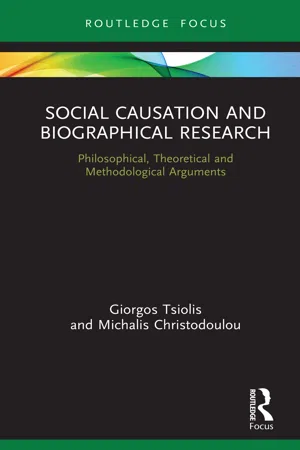
This book extends debates in the field of biographical research, arguing that causal explanations are not at odds with biographical research and that biographical research is in fact a valuable tool for explaining why things in social and personal lives are one way and not another. Bringing reconstructive biographical research into dialogue with critical realism, it explains how and why relational social ontology can become a unique theoretical ground for tapping emergent mechanisms and latent meaning structures. Through an account of the reasons for which reductionist epistemologies, rational action models and covering law explanations are not appropriate for biographical research, the authors develop the philosophical idea of singular causation as a means by which biographical researchers are able to forge causal hypotheses for the occurrence of events and offer guidance on the application of this methodological principle to concrete, empirical examples. As such, this volume will appeal to scholars across the social sciences with interests in biographical research and social research methods.
eBook - ePub
Social Causation and Biographical Research
Philosophical, Theoretical and Methodological Arguments
- 120 pages
- English
- ePUB (mobile friendly)
- Available on iOS & Android
eBook - ePub
Social Causation and Biographical Research
Philosophical, Theoretical and Methodological Arguments
About this book
Information
1 Introduction
Singular causation and biographical research
In the social sciences, there are three ways through which social researchers can claim explanatory theories: the deductive-nomological (D-N) model, empathy and generative mechanisms. Roughly speaking, these have their philosophical foundations in positivism, hermeneutics–interpretivism and critical realism (CR), respectively. In the first case, I know something only if I know the general law in which it is subsumed; in the second case, I know something only if I can make it intelligible by specifying an agent’s beliefs and desires; and in the third case, I know something only if I know what made it what it is. In the past, the deductive-nomological model of explanation enjoyed a monopoly over the meaning of the term “explanation”, while hermeneutics was the major opponent to such a crude and positivistic account. However, in the last twenty years, mechanism-based explanations have come to constitute a third, distinct philosophical approach to social causation, providing more subtle and promising ideas than the other two, even though some of its assumptions have been shaped by the former. Nevertheless, as we demonstrate in the rest of the book, the proponents of causal mechanisms have tried to differentiate themselves both from the D-N approach and from the statistical Hume-inspired view of causation.
Needless to say, this development has a long history in the philosophy of science, but it has only been in recent years that social scientists have endeavoured to implement most of these philosophical ideas in the realm of social theory and methodology. In this sense, our book is not a treatise on the philosophy of science, but rather aims to elucidate how socio-ontological and epistemological ideas from the philosophy of social science may provide a new language for approaching causal analysis in the philosophy and methodology of qualitative social research. The bedrock of this new language is “causal explanation” and the reason is that a paradigm shift has taken place in the philosophy of social science. This shift has to do with social scientists gradually acknowledging the need for explaining social phenomena causally, rather than just describing them thickly. We believe that systematic dialogue between the philosophy of social science and social research would be very fruitful for the simple reason that philosophers provide answers regarding, for example, in what sense a social entity is social, while social scientists investigate empirically the extent to which these answers are viable in research practice. In a similar vein, Joas and Knöbl (2009, 16) dispute the division of labour between those who
see themselves as theoreticians and those who view themselves as empiricists or empirical social researchers. These two groupings scarcely register each other’s findings any more. But theoretical and empirical knowledge cannot truly be separated. This lecture on the “nature” of theory is thus intended to provide us with an opportunity to think about what theory is, its importance to empirical research and the way in which empirical knowledge always informs its theoretical counterpart.
This book defends the view that a science of society is possible by taking into account a limited naturalism through which quantitative and qualitative research approaches participate in a mutually profitable dialogue. This can be achieved, we believe, not by taking physics or physicalism as a model but by showing how causal thinking can be inserted into the ontological and epistemological assumptions through which social scientists make sense of the entities of the social world. Although a great many scholars have presented various arguments as to how causal thinking may sustain quantitative methods, we believe that causal thinking has not yet been implemented in the social ontologies and epistemologies of the qualitative tradition. The reason is well known and has to do with the main interpretivist ontological thesis that the social is meaningful. Without disputing the merits of such a thesis, we believe that it cannot constitute the ground for social policy measures exactly because it prioritizes thick descriptions and not causal explanations. Without causal knowledge of why things happen or why social processes are of this nature and not another, policy interventions are mere guesses in the dark.
According to Kincaid (1996), the adoption of naturalism as a social ontology for qualitative research has been attacked from two angles. First, from those who believe that causality is a law-like conception of approaching social action that is not only inappropriate but also dangerous for social sciences because humans are depicted as not being active agents. What qualitative researchers should do is grasp the meaning of social action through empathy. In this way, the goal of objectivity is but a dream, because even scientists see things from their own point of view. A more radical denial of accepting naturalism in qualitative social science comes from Kuhn-inspired arguments that see social science as a form of rhetoric or as a social institution in which knowledge is a product of power relations or social conventions. Second, there are those who have been identified with positivist thinking, where what counts as scientific is only whatever is measurable and can be verified through the methods of physics. Those who adopt these views talk about causality and unification based on the ideal of how physicists practise science.
In contrast to both of these views, we believe that social science can claim causal knowledge of the social world by making use of non-experimental evidence and of evidence related to “texts” (interviews, field notes) and not only to “numbers”. This is a difficult project because we have to be very clear about how we conceive of causality, given that this is a plural term with more than one possible approach available (Reiss 2009). In addition, we have to show in detail in what sense a knowledge of the social connected with qualitative methods can be causal and how a mechanism-based account of causality can be of use for qualitative researchers. Within the relevant literature three issues seem to be the most controversial. The first concerns whether findings of causal mechanisms are transferable and generalizable or not (Knight 2009); the second concerns whether theoretical understandings concerning mechanisms are formal or substantive (Gross 2009) and the third concerns where they have to be searched: on the individual and the action level, or on the emergent level of social groups, social relations, structures and institutions (Sawyer 2004).
At the beginning of this book, we have to state clearly some of the philosophical ideas pertaining to a well-known (and for some, highly disputed) distinction between two kinds of properties: the primary properties of the physical world, which are mind-independent; and the phenomenal properties or qualia, which depend on the subject. In Kantian terminology, the first kinds of non-phenomenal properties, referring to things-in-themselves, are called “noumena”; while the second kinds of properties, referring to things-as-perceived, are called “phenomena”. The philosophical tradition of phenomenalism has determined the genesis of qualitative research. As Bunge (2006) has noted, this tradition holds a specific stance regarding qualia, namely that only phenomena exist in the sense that existence depends on perception, so whatever is beyond phenomenalists’ ken (primary properties related to the world) is regarded as either unknowable or inexistent. For phenomenalists, only phenomena or qualia can be known. This kind of ontological and epistemological phenomenalism is the background assumption of both the reductionist aspirations of ontological individualists discussed in the second chapter and of Verstehen social theorists. Both of these currents tend to exaggerate the importance of individual motives and decisions at the expense of holistic realities like social structures or social relations, the properties of which reside in the outer social reality. By assuming that without sentient beings there is no universe, phenomenalists (and qualitative researchers) prefer to retreat from reality or to remain indifferent to explaining social transformations. In contrast to the epistemology and ontology of phenomenalism, in this book we hold the thesis that qualia are not exclusively psychological occurrences or mental states but rather are relational properties. Although qualia are first-person processes that do not exist in the physical world, they emerge from the encounter of the subject and the world. Only on condition of a relational social ontology can causal explanations be claimed as third-person observations that identify why things occur in specific ways. In short, no third-person perspective, no scientific advancement. The corollary for social science may be that people’s perceptions of the external world (that is, qualia) can be studied as “noumena” and that appearances call for explanation in terms of unobservable relational properties, instead of being explainers. This is why the third chapter is devoted to elaborating the premises of this social ontology.
Traditionally, the most used approach to causal explanations in social science stems from individual-oriented ontological premises that state that a mechanism-based explanation should analyze the details of the rationality of individual action. Remaining faithful to the abovementioned phenomenalist philosophical dogma, ontological individualists hold that social mechanisms are found on the level of individual action and are liable to being modelled by scientists in order to predict similar actions. One other feature of this kind of approach to social mechanisms is its emphasis on theorizing the substantive level of causality and on identifying how it works within specific domains of reality. Gundersen (2018) maintains that a mechanism-based explanation grounded on ontological individualism is a threat to the autonomy of the social sciences because of the reductionism it entails, as the emergent upper-level strata can be explained by reference to their lower and elementary particulars. Although this belief sounds logical, we do not think that this threat should make us dismissive of humans’ reasoning. For us, a working definition of a mechanism is that a mechanism-based explanation claims that to explain a phenomenon, one must consider how it is generated through the interactions among its constituents. As a consequence, we think that social science can successfully explain processes of the social world without copying the premises of the D-N model and without being afraid of adopting a realist view towards mental entities.
We hold that the main problem with ontological individualism is its reliance on rational action theory and its inability to explain real-life experiences. For this reason, in this book we focus on what the idea of social emergentism has to confer on the issue of explanation because of two ideas that we deem crucial for the philosophical and methodological grounding of social research: the first is the concept of non-reductive relational properties and the second is that by studying the particular/singular, one can gain knowledge of the universal. Both of these ideas rest on the thesis that knowing the social world is to think causally about it and that even if human actions are meaningful, they can still be causally explained. It is on this thesis that the first four chapters of the book are focused. We believe that this thesis is what differentiates the contemporary version of methodological holism from its traditional expression in social theory, structuralism and functionalism. Instead of reproducing well-known interpretivists’ dictates, like that of prioritizing the meaningfulness of the social or of critiquing power relations, we aim to explore the (ontological and epistemological) conditions under which qualitative research (especially reconstructive biographical research, RBR) can claim causal explanations of the social world and detect generative mechanisms that make things happen.
Mechanism-based accounts of causality are usually grouped under three theoretical traditions. First is the pragmatist conception of causality, in which causal explanations in social science prioritize social action as a problem-solving activity (Gross 2009). Despite its impact on qualitative research and its profound contribution of the methodological insights of “abduction”, we think that the pragmatist approach to mechanism-based accounts of causality remains committed to a flat social ontology that fails to take into account how and why specific social situations become problematic for social actors. Given that this is a huge and disputable statement that deserves deep analysis, we do not deal with this issue in our book. The second approach sees causality as a process-tracing procedure that tries to identify the path leading from one event (the cause) to another (the effect) and to describe these intermediary steps (Mahoney 2008; Ragin 2008). The causality-as-process-tracing approach states that what researchers need to do is to describe the details of the path connecting two distinct events. Although promising and enabling causal explanations for qualitative research, it is more focused on the methodological particularities of causality, not on the theoretical and epistemological grounding for explaining emergent phenomena. The third approach to mechanisms is inscribed within the CR tradition which is thoroughly presented in the third chapter.
We must stress that “mechanism” is a causal notion in the sense that it describes the entities that make something happen or that produce something, informing us about how entities, their relations and their properties give rise to the phenomenon of interest. It has been argued that the definition of mechanism propounded by the philosophers Machamer, Darden and Craver (2000: 3) is the one that fits best with the entities treated by the biological and social sciences. These authors say that “mechanisms are entities and activities organized such that they are productive of regular changes from start or set-up to finish or termination conditions”. More refined versions of this definition are that “a mechanism for a phenomenon consists of entities and activities organized in such a way that they are responsible for the phenomenon” (Illari and Williamson 2012, 121) and that “a mechanism for a phenomenon consists of entities (or parts) whose activities and interactions are organized in such a way that they produce the phenomenon” (Glennan 2017, 14). One crucial component of these definitions is that they dispute the Humean and regularity conception of causality in so far as mechanisms can work only once or irregularly. The relevance of a mechanism-based explanation is that it identifies the difference that entities, properties and their interactions make to the outcomes of interest. If the presence of an entity or of changes in its properties or activities truly does not make any difference to the effect to be explained, it can be ignored.
The approach to causation upon which we try to articulate our argument for framing causality through biographical research accepts two things about causality. First, the term “causality” is not equivalent to determinism, designating a causal connection between states of affairs, outcomes or events. Second, we see causality primarily as an ontological term in the sense that causal connections are a trait of the things themselves, not solely a way of knowing things. We hold that logical necessities are quite different from social necessities because a logical connection is not always causal given that it does not produce something. In other words, Humean constant ...
Table of contents
- Cover
- Half-Title
- Series
- Title
- Copyright
- Contents
- List of figures
- List of abbreviations
- 1 Introduction: Singular causation and biographical research
- 2 Philosophical arguments on social causality: Cases of reductionism
- 3 Critical realism: Causal mechanisms as emergent powers
- 4 Causal explanation as process tracing
- 5 Relating cases with phenomena: Arguments for generalizing through mechanisms
- 6 The relational subject and latent meaning structures
- 7 Why the temporal is causal
- 8 Case reconstruction and relational mechanisms in biographical research practice
- 9 Epilogue: Summarizing the argumentation
- Index
Trusted by 375,005 students
Access to over 1.5 million titles for a fair monthly price.
Study more efficiently using our study tools.
Frequently asked questions
Yes, you can cancel anytime from the Subscription tab in your account settings on the Perlego website. Your subscription will stay active until the end of your current billing period. Learn how to cancel your subscription
No, books cannot be downloaded as external files, such as PDFs, for use outside of Perlego. However, you can download books within the Perlego app for offline reading on mobile or tablet. Learn how to download books offline
Perlego offers two plans: Essential and Complete
- Essential is ideal for learners and professionals who enjoy exploring a wide range of subjects. Access the Essential Library with 800,000+ trusted titles and best-sellers across business, personal growth, and the humanities. Includes unlimited reading time and Standard Read Aloud voice.
- Complete: Perfect for advanced learners and researchers needing full, unrestricted access. Unlock 1.5M+ books across hundreds of subjects, including academic and specialized titles. The Complete Plan also includes advanced features like Premium Read Aloud and Research Assistant.
We are an online textbook subscription service, where you can get access to an entire online library for less than the price of a single book per month. With over 1.5 million books across 990+ topics, we’ve got you covered! Learn about our mission
Look out for the read-aloud symbol on your next book to see if you can listen to it. The read-aloud tool reads text aloud for you, highlighting the text as it is being read. You can pause it, speed it up and slow it down. Learn more about Read Aloud
Yes! You can use the Perlego app on both iOS and Android devices to read anytime, anywhere — even offline. Perfect for commutes or when you’re on the go.
Please note we cannot support devices running on iOS 13 and Android 7 or earlier. Learn more about using the app
Please note we cannot support devices running on iOS 13 and Android 7 or earlier. Learn more about using the app
Yes, you can access Social Causation and Biographical Research by Giorgos Tsiolis,Michalis Christodoulou in PDF and/or ePUB format, as well as other popular books in Social Sciences & Emigration & Immigration. We have over 1.5 million books available in our catalogue for you to explore.