The Dynamics of Human Development
eBook - ePub

The Dynamics of Human Development

A Partial Mobility Perspective

  1. 90 pages
  2. English
  3. ePUB (mobile friendly)
  4. Available on iOS & Android
eBook - ePub

The Dynamics of Human Development

A Partial Mobility Perspective

About this book

This book studies the dynamic aspects of the Human Development Index (HDI) through a partial mobility perspective. It offers a new axiomatic structure and a set of mobility indices to discuss partial trends and interrogate the human development status at the subgroup and subregional levels. While traditional human development theories are primarily concerned with static distributions corresponding to a point in time, this book looks at an oft-neglected side of HDI and focuses on relative changes in human development that may not be captured by the absolutist framework. In addition, the authors also introduce the concepts of jump and fractional mobility which aid in tracking the development and stagnation among various groups within a population.

This work breaks fresh ground in the study of human development. It will be of great interest to scholars and researchers of economics, development economics, political economy, and development practitioners.
Frequently asked questions

Yes, you can cancel anytime from the Subscription tab in your account settings on the Perlego website. Your subscription will stay active until the end of your current billing period. Learn how to cancel your subscription.
At the moment all of our mobile-responsive ePub books are available to download via the app. Most of our PDFs are also available to download and we're working on making the final remaining ones downloadable now. Learn more here.
Perlego offers two plans: Essential and Complete
  • Essential is ideal for learners and professionals who enjoy exploring a wide range of subjects. Access the Essential Library with 800,000+ trusted titles and best-sellers across business, personal growth, and the humanities. Includes unlimited reading time and Standard Read Aloud voice.
  • Complete: Perfect for advanced learners and researchers needing full, unrestricted access. Unlock 1.4M+ books across hundreds of subjects, including academic and specialized titles. The Complete Plan also includes advanced features like Premium Read Aloud and Research Assistant.
Both plans are available with monthly, semester, or annual billing cycles.
We are an online textbook subscription service, where you can get access to an entire online library for less than the price of a single book per month. With over 1 million books across 1000+ topics, we’ve got you covered! Learn more here.
Look out for the read-aloud symbol on your next book to see if you can listen to it. The read-aloud tool reads text aloud for you, highlighting the text as it is being read. You can pause it, speed it up and slow it down. Learn more here.
Yes! You can use the Perlego app on both iOS or Android devices to read anytime, anywhere — even offline. Perfect for commutes or when you’re on the go.
Please note we cannot support devices running on iOS 13 and Android 7 or earlier. Learn more about using the app.
Yes, you can access The Dynamics of Human Development by Atanu Sengupta,Abhijit Ghosh in PDF and/or ePUB format, as well as other popular books in Economics & Development Economics. We have over one million books available in our catalogue for you to explore.

Information

Year
2020
Print ISBN
9781032125237
eBook ISBN
9781000292886

1
DYNAMICS OF HUMAN DEVELOPMENT

The perspectives of partiality
Democracy will never be supplanted by a republic of experts – and that is a very good thing.
Piketty (2014)

1.1 Introduction

The debate concerning growth and development has occupied an extensive place in mainstream intellectual discourse on economics. One school of thought put emphasis on growth, arguing that high growth rate of the economy will bring automatic development. On the contrary, other schools of thought disputing this argument believe that without ensuring the development of the masses, high growth rate is useless and will not be sustainable. However, researchers have found strong links between growth and development (Ramirez, Ranis and Stewart 1998; Ranis and Stewart 2000, 2001; UNDP 1996). We do not intend to study the link. The present study wishes to introduce an ethical dimension into the development analysis.
Economists, regardless of their economic thought, took it upon themselves to find different techniques to capture the magnitude of development and inequality (Dalton 1920; Morris 1979; Sen 1973, 1976, 1982, 1987, 1997, 1999a; Dardanoni 1993; Streeten 1992, 1994; Shiva Kumar 1991; Fukuda-Parr and Shiva Kumar 2004; Sengupta and Ghosh 2010, 2012a, 2013a). Depending on those various techniques, governments are advised to formulate their policy. Improvement of human development, however, does not merely depend on the income s/he commands but also on a broad set of parameters that determines the quality of her/his life. The argument has been pushed forward by the new paradigm of human development that seeks to capture it quantitatively (Sen 1985, 1987; UNDP 1990; Haq 2004). A major breakthrough in these fields has been the publication of Human Development Report (HDR) by UNDP since 1990, where a single number has been estimated to capture the multidimensional socioeconomic status of a country. Human development is a broader concept that captures broader aspects of life that make it worth living. Generally, three dimensions are considered in this regard: a long and healthy life measured by life expectancy at birth, knowledge measured by two indices (expected years of schooling and mean years of schooling), and a decent standard of living measured by gross national income per capita in purchasing power parity (UNDP 2016). They are combined with proper weight to generate a unique scalar measure: the Human Development Index (HDI). These basic rights are defined to be essential and are by no means exhaustive. HDI is popular due to its simplicity even among policymakers. Despite the methodology of HDI, the estimation has received several criticisms (for details see Sen 2004a, 2004b; Fukuda-Parr and Kumar 2004; Raworth and Stewart 2004; Fukuda-Parr 2006; Haq 1995, 2004). However, in this book, our goal is neither to challenge the formulation of HDI nor to seek out its deficiencies. Traditional HDI literature has been primarily interested in static distributions corresponding to a particular point in time. The dynamic aspects of HDI have been a neglected area; it receives little systematic attention. The study in relative dynamics of HDI is still rarer. In this book we focus on the dynamic aspects of HDI using mobility literature from a partial perspective.

1.2 A discourse on positional objectivity

In this book we analyse the mobility of HDI from a positional objectivity perspective rather than from an absolutist perspective. The distinction is due to Sen (1993). According to Sen (1993), there are three broad approaches to human cognition: objective (or absolutist); subjective (or purely relativist); and positionally objective. Objectivity emphasises the object without any reference to the context: ‘a view from nowhere’ (Nagel 1986). Subjectivity gives importance to all possible viewpoints from which the object may be evaluated.1 Positional objectivity is a midway point. It emphasises the objectivity as perceived from a definite position (Sen 1993). Let us consider the following claims:

(A) The sun is much larger than the moon in size.

The claim is an ‘objective’ fact verified by astronomical data. However, this fact cannot explain the occurrence of a total solar eclipse. How can the ‘tiny’ moon cover the ‘huge’ sun? The answer can be drawn from the following ‘positional claim’:

(B) From the earth, the sun and moon look similar in size.

The claim is based on a positional observation: the observation from the earth. However, purely relativist claims are many. A blind person may see neither sun nor moon. Hence, they do not exist for him. It may also include persons with some disorder in vision or motor control who may also visualise the sun and moon in different ways. They are all relative positions. However, all these positions cannot claim to be positionally objective. As noted by Cohen (1978), ‘For if a man does not see a mirage under appropriate conditions, there is something wrong in his vision. His eyes have failed to register the play of light in the distance.’ According to Sen (1993), ‘there could be a good practical reason for excluding special mental tendencies, particular form of inexperience, and so forth, from the permissible parameterization in determining positional objectivity.’ It is these considerations that separate the positional objective view from a pure relativist view.
In social science, the distinction between absolutist and positional objectivist is vital. An exercise of this kind has already been done in the case of growth rate in income to evaluate changes in human welfare by Basu (2001). He tried to replace overall growth rate (in per capita income) by the growth rate of the lowest quintile of income group as a measure of social welfare:
Essentially, it says that in evaluating an economy’s state or progress, we must focus primarily on how the poorest people are faring. A first cut at doing this – and the criterion that I want to advocate in this section – is to look at the economic condition of the poorest 20 percent of the population. In other words, instead of bothering about the per capita income of the nation as a whole, we should be concerned about the per capita income of the bottom quintile. Instead of equating a country’s progress with the growth rate of per capita income in general, we should look at the growth rate of the per capita income of the poorest 20 percent of the population.
(Basu 2001, p. 65)
In effect, he is trying to view development from a particular position: a positional objective outlook. His measure is both relative and partial.
In this context Basu (2001, p. 67) argues that he is taking the Rawlsian position:
Although Rawls (1971), in his abstract models, could focus attention on the worst-off person, in reality we seldom know who the worst-off is. … So the suggestion that we concentrate on the poorest 20 per cent is the pragmatic part of the recommendation.
In fact, he quotes notable authorities (such as Sen 1999b and Streeten 1994) to further his point:
Answering an interviewers’ question about what is a ‘successful’ economy, Amartya Sen (1999b) pointed out, ‘this concerns how the worst-off members of society share in that society. Neglect of people at the bottom of the ladder would indicate a failed economy.’
(quoted from Basu 2001, p. 83)
However, to be fair to the absolute school, partial analysis can fulfil Basu’s requirement even outside the relative school. For example, Basu and Foster (1996) defined isolated illiteracy as illiterate persons who reside in a household where nobody is literate. On the other hand, proximate illiterates are those whose family has at least one literate person. It is argued that isolated illiterates are worse off than the proximate literates. One can measure the probability of a person being an isolated illiterate. This is obviously a partial measure concentrating only on the isolated illiterates instead of considering the position of other persons. By Basu’s criterion, this is a Rawlsian measure. However, this measure is defined in the absolute space.
We again take a peep at one such viewpoint made by Piketty (2014) in his analysis of the macroeconomics of growth and distribution. He was discussing the distribution of income between capital and income. He made a sharp distinction between historical time and political time. Long-run data shows that the share of capital and labour is roughly constant in the most advanced countries of the world. Notwithstanding this fact, there is considerable variation in the factor share over short run. What, then, is the reality: the long-run constancy or the short-run fluctuations? To quote Piketty (2014, p. 51):
To be sure, these substantial variations over a twenty-five year period do not change the fact that over periods of fifty or hundred years, wages have always accounted for roughly two-thirds of added value, so that the increase in workers’ purchasing power of 250 percent since 1950 and 700 percent since 1870 cannot be explained by the changes in the capital-labour split. But why would that matter to the workers who lived through the twenty-five years from 1975 to 1990? Their standard of living increased sharply from 1968 to 1982 and then stagnated from 1983 to 1995 while output continued to grow. How could they not associate the improvement in their standard of living with re-distribution from capital to labour?
(italics ours)
The labourers thus regard any view that loads the long-run reality as ‘Right-ists’ (Piketty 2014). To them, wage increase is always associated social struggles and direct transfer rather than fiscal transfer (Piketty 2014). Again, to quote Piketty (2014, p. 52):
It is not so much rejection of the logic of fiscal redistribution and price system that sustains left-wing skepticism of redistribution through taxation; it is rather historical reality.
(italics ours)
In his book, he frequently encounters this difference, and there is even a clash between historical and political time. The previous macro analysis makes one thing clear. The partial approach has to be distinguished sharply from the aggregate versus group-level dynamics. This approach is not about the dynamics of groups vis-à-vis the dynamics of the aggregate. It is assessment of a particular dynamic situation (whether group or aggregate) from different viewpoints rooted in differential objective reality. As Piketty (2014) showed, the workers argue with the change in their share as postulated by the long-run data and that revealed in the short-run dynamics. It is not a comparison between the share of labour and capital as is often thought. It is the argument to get what they perceive as a ‘legitimate’ share in the expanding horizon of national output.
Another interesting example has been given by Nobel Laureate economist Robert Fogel. Fogel (1989) discusses the living conditions of the slaves in 19th-century U.S. South. It was shown that slaves were provided with consumption levels in excess of those of some members of the free populace. For example, the material condition of the British industrialist worker in the 19th century was no better than the cotton slaves of America. In fact, in some respect they were worse off. An interesting case was recorded in Virginia where a woman petitions to be reenslaved to the master of her slave husband. As Fogel (1989) argued, there was a substantial decrease of the black population after the slavery ended. Even the so-called indices of female empowerment (such as wage differential, percentage spend in household chores, etc.) were better under slavery. It was found that the slaves were not materially worse off than the industrial labourers in the 19th century. Although it is true that slaves had no freedom, they could visualise themselves as no better off than the workers of industrial England (Fogel and Engerman 1974; Fogel 1989; Engerman 2006). Hence there is a conflict between an ‘outside’ view that emphasises freedom and the ‘inside’ view that emphasises material benefits.
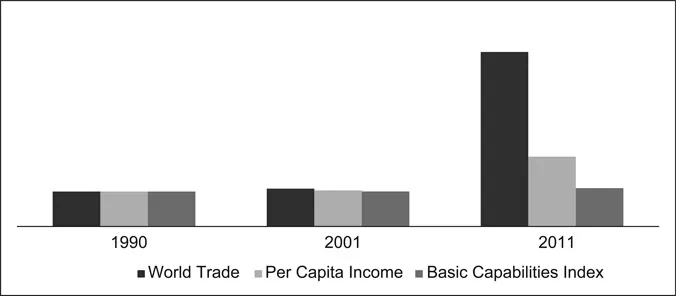
To rethink this idea, we consider the assessment of Social Watch2 in its October 2011 issue (Figure 1.1). What is the condition of the global economy today? There is no single answer to this basic question. A trade theorist may claim that world welfare is directly related to the expansion of world trade. A utility function which is also an increasing function of the volume of trade surely embodies the unprecedented rise in welfare. A growth theorist will rely on the expansion of per capita income. To this theorist, world utility has risen but at a slower rate. A social choice theorist is keener on the expansion of basic capability. She would not vouch for any reasonable expansion of the world situation. As Nigeria, Somalia, South Sudan, and Yemen are devastated by new famines from 2016 and later, she is least assured of a happier and wealthier world. According to the 2017 estimates of FAO, 37 countries are still dependent on food aid. Out of this, 28 countries are in Africa alone. It is this partial approach that can bring out these differences in the same dynamics of human development. Views may be different depending on the objective reality that one proposes to adhere. All are the descriptions of reality. All have a strong objective basis.3 There are no group or aggregative dynamics here.
Figure 1.1 Basic Capabilities Index (BCI) Developed by Social Watch
Source: ht...

Table of contents

  1. Cover
  2. Half Title
  3. Title Page
  4. Copyright Page
  5. Dedication Page
  6. Contents
  7. List of tables
  8. Preface
  9. Acknowledgements
  10. List of abbreviations
  11. 1 Dynamics of human development: the perspectives of partiality
  12. 2 Partial mobility: relative changes in human development
  13. 3 Jump in the dynamics of human development
  14. 4 Fractional mobility in human development
  15. 5 Some general issues in the partial mobility of human development
  16. 6 Conclusion
  17. References
  18. Index