This book provides a comprehensive analysis of Lithuanian foreign policy by employing the theory of small states and the agent-perspective to assess how President Dalia Grybauskait? impacted Lithuanian foreign policy in 2009–2019 and which, in turn, could affect changes in international structures. The book is based on original interviews with Grybauskait? and all her foreign policy advisors, as well as other Lithuanian diplomats and Ministers of Foreign Affairs. In addition to providing an important case study of Lithuanian foreign policy, this monograph also discusses the impact an agent formulating and executing small-state foreign policy may have on the 'grand structures' of international relations, such as the EU and NATO. For its investigation of the mutual relationship between agent and structure, this monograph draws on the literature on foreign policy analysis (FPA) and asks questions about the extent to which a particular leader of foreign policy may determine a specific policy decision or outcome.
This book will be of particular interest to students of the Baltic region and Russia-Baltic relations, as well as to political scientists and researchers interested in FPA literature, and small-state security.
eBook - ePub
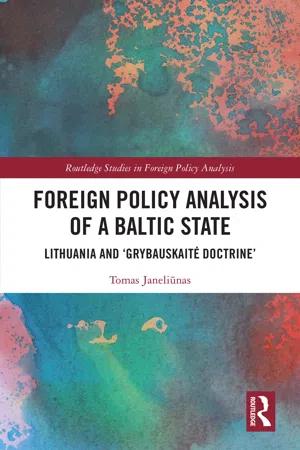
Foreign Policy Analysis of a Baltic State
Lithuania and 'Grybauskaitė Doctrine'
- 242 pages
- English
- ePUB (mobile friendly)
- Available on iOS & Android
eBook - ePub
About this book
1 Introduction
Lithuanian foreign policy rarely receives controversial assessment domestically and, even less so, in the international arena. It is widely viewed that the most important and strategic Lithuanian foreign policy decisions are based on consensus. This outlook was formed during the first decade after Lithuania restored its independence in 1990. In the early 1990s, domestic political discussions on whether Lithuania should adapt neutrality, seek association with the Nordic countries, or clearly commit to a pro-Western position were still ongoing. Until 1992, the Russian army was still deployed in Lithuania, and the main tasks of the Lithuanian government were to stabilise the economy and to establish the principal state institutions. Consequently, Lithuanian foreign policy goals were relatively simple, restricted to ensuring international recognition, establishing bilateral relations, and joining or returning to the most important international institutions. Any significant opposition to the Euro-Atlantic relation, embodied in the goal of membership in the EU and NATO, had essentially disappeared from Lithuanian politics by 1993–1994. On January 4, 1994, as a symbolic sign of this consensus, Lithuanian President Algirdas Brazauskas sent an official letter to Manfred Wörner, the then General Secretary of NATO, requesting to join the Alliance. For Lithuania, as well as for other Baltic States, Brazauskas’s letter marked the beginning of the era of Euro-Atlantic integration.
As Galbreath, Lasas, and Lamoreaux (2008) note, ‘EU and NATO memberships had increasingly became [sic] the daily mantra of Baltic political elites’ (p. 1). The West viewed the three Baltic States as a unified bloc and paid little attention to their foreign policy differences. But differences did exist. Even though they sought the same fundamental goals, the Baltic States chose different directions to pursue them; as Miniotaitė (2000) describes it, ‘first Estonia and then Latvia turned towards the North, while Lithuania, since 1995, was turning to the South, in the direction of Poland and Central Europe’ (p. 26). Lithuanian decision-makers debated whether Euro-Atlantic integration could be achieved faster by uniting with the other two Baltic States or by seeking strategic partnership with Poland (Lopata, 2010). However, such discussions were limited to sporadic debates within small circles of politicians or experts and rarely received the interest of Western scholars.
The security and foreign policies of the Baltic States are still often regarded as one inseparable object of study. This view is most likely the result of the belief that the Baltic States’ security and foreign policy are inevitably determined by shared external threats – that is, structural conditions that force the Baltic States to seek shelter in NATO and the EU. The Baltic States’ shared goal of membership in the Euro-Atlantic institutions, their regular policy coordination, and a similar tendency of treating Russia as the main source of threat seem to strengthen such structuralist assumptions. Since realist and constructivist theories (particularly those emphasising identity differences between the Baltic States and Russia) appeared to be sufficient to explain the most visible foreign and security policy decisions of the Baltic States, there was little demand to analyse the foreign policy ‘from within’ by focusing on specific actors and/or the processes of foreign policymaking.
Even in Lithuania, international relations (IR) scholars have paid more attention to the external circumstances than to the domestic factors shaping Lithuanian foreign policy. Expectedly, most energy has been spent on the analysis of external threats, namely, Russian foreign policy. Lithuanian analysts have also concentrated on security studies and relied on explaining Vilnius’ interests and policy behaviour – from bilateral relations to the effort to join the EU or NATO – through the security prism (Jakubčionis, 1995; Vitkus, 1995; Gricius, 1997). The ‘black-box’ of Lithuanian foreign policy – that is, the processes of decision-making and the relations among various domestic actors and interests that influence them – received much less attention, as if a priori discounted as inert and uninteresting.
For over ten years, the strategic outlook of Lithuanian foreign policy was incredibly straightforward – pursue deep integration with NATO and the EU, seek security assurances from the USA, and treating Russia as a threat. If and when any differences appeared, they were mostly tactical. Prior to 2004, there were occasional debates regarding which policy decisions could ensure faster integration; after joining NATO and the EU, some discussions were around the question whether Lithuania should opt to be in the safe periphery of the EU or whether it should actively promote Western values in the East and become a defensive bastion vis-à-vis Russian influence. However, as Lopata (2010), who himself was involved in some of these debates, notes, ‘there were no paradigmatic discussions on Lithuanian foreign policy. The aforementioned questions were analyzed following the inertia of the already established commitment to defend national interest through integration into collective Euro-Atlantic structures’ (pp. 128–129).
The dearth of discussions related to foreign policy among the policy elites is the primary reason why the academic literature on the formation processes of Lithuanian foreign policy is relatively scarce in Lithuania and effectively non-existent in the West. The first academic articles on the aforementioned question appeared only by the end of the 1990s (i.e. Nekrašas, 1999). In most cases, studies and articles on Lithuanian foreign policy analysed a specific political problem or even a specific policy in an attempt to explain it – usually by employing geopolitical or national interest arguments (Jonavičius, 2006; Statkus & Paulauskas, 2006). Some literature examines Lithuanian foreign policy and its evolution by invoking structural or identity factors (Miniotaitė & Jakniūnaitė, 2001). Several authors, such as Laurinavičius, Lopata, and Sirutavičiaus (2009), as well as Nekrašas (2009), have also made occasional attempts to discuss the foreign policy visions (or lack thereof) of specific Lithuanian politicians.
The first collective monograph reviewing Lithuania’s foreign policy after gaining EU and NATO membership was published as late as 2015. The book, titled The Ambitious Decade: Lithuanian Foreign Policy 2004–2014 (Jakniūnaitė, 2015), assesses the main directions of and the dominant interests behind Lithuanian foreign policy. Even though the book covers a wide range of topics, this monograph is not an example of a conceptually deep and coherent attempt to explain the factors that shape how Lithuania and its specific policymakers make certain decisions. Thus, to date, neither Lithuanian nor foreign authors have provided a thorough analysis of the positions, values, and principles employed by specific Lithuanian leaders and diplomats. One of the rare exceptions is the work by Park (2005, 2015). Park takes concrete political leaders as the primary object of analysis and explores their biographies, apparent values, beliefs, and motivations to consider and explain their foreign policy decisions. Park, together with Milda Paulionyte, also examined Dalia Grybauskaitė’s foreign policy during her first term as president (Park & Paulionyte, 2016). However, their study is concerned with the question of a particular political leader’s ability to deviate from the traditional foreign policy lines and does not cover Grybauskaitė’s entire presidency.
Studies that raise questions about how and to what extent certain political leaders or other foreign policy actors can determine a specific decision or outcome are most often associated with a separate sub-discipline of IR – foreign policy analysis (FPA). Though FPA is a broad field of research, which, for a long time, has been lacking consistent theories and methods, studies within this sub-discipline are united in their efforts to interpret the foreign policy process and decisions. Fundamentally, it tackles the questions of how and why specific policymakers chose the observed solution or position on a given foreign policy issue. As defined by Hudson (2005), FPA’s object of interpretation – its explanandum – encompasses the process and outcomes of human decisions, related to foreign actors or the impact of such decisions on foreign actors (p. 2). Seeking more precision, Carlsnaes (2007) narrows the focus of FPA to examining purposeful foreign policy actions, clear political commitments, and the role of the limits of the state.
This monograph is the first comprehensive analysis of Lithuanian foreign policy to employ the agent-perspective to assess how a particular agent – President Dalia Grybauskaitė – impacted Lithuanian foreign policy during 2009–2019, and the extent to which she affected change in global and international structures.
Grybauskaitė was a significant actor in Lithuanian foreign policy and beyond: she was well-known in Europe and had a reputation of being a strong leader in the EU, and her positions and statements were often quoted in international press. Accordingly, having analysed Grybauskaitė’s role in Lithuanian foreign policy, one may also assess what impact her normative beliefs and principal positions had on the changes in Lithuanian foreign policy, particularly towards Russia, Poland, the United States, and the EU.
Grybauskaitė was one of the few female heads of state in the world at the time of her presidency, and this provides another dimension to her portrait. From 2014 to 2018, she served as the chair of the Council of Women World Leaders, which was established in 1996; this organisation serves as a network of influential women leaders of the world. Although the President of Lithuania is not inclined to be regarded a ‘feminist’ leader, she used to stress women’s rights and their political leadership on various occasions, especially during international events. This book on Grybauskaitė’s foreign policy doctrine also contributes to the field of growing literature on feminist leadership studies.
The totality of Grybauskaitė’s beliefs and positions deserves the suggested name of a ‘doctrine’, as it reflects a relatively consistent set of ideas, normative positions, and actions. Doctrine, as Morin and Paquin (2018) define it, ‘is a set of beliefs, rules and principles guiding foreign policy. It is a self-imposed coherent framework that helps a government carry out its mission and objectives in the world’ (p. 21). Although Grybauskaitė’s doctrine has never been presented in a policy programme or an official document, the set of her fundamental beliefs and goals in foreign policy can be ascertained through her statements, speeches, and actions. Thus, the aim of this study is to crystallise the key elements of Grybauskaitė’s doctrine.
The research is based on original interviews with Grybauskaitė and with all of her foreign policy advisors, as well as with other Lithuanian diplomats and ministers of foreign affairs. The use of authentic and direct sources is a key unique contribution this monograph brings to the field. Further sources include official statements, public speeches, and previously published interviews in the Lithuanian or foreign press.
An analysis of Grybauskaitė’s own assessments and comments, as well as those of her closest advisors, all of whom were directly involved in Lithuanian foreign policy process, allows to effectively reveal these actors’ positions, attitudes, and values. By investigating the actors’ perspective, this study can help to better understand why some of their decisions deviated from the traditional Lithuanian foreign policy and why some even spurred controversy among Lithuanian politicians, diplomats, and the public.
Book structure: essential episodes of Grybauskaitė’s foreign policy
The book consists of two parts. Part I discusses conceptual issues from the perspective of FPA and IR. Three theoretical approaches are taken into account: first, a review of small states’ security and foreign policy strategies in the international arena that helps discern the most common patterns for the behaviour of a small state; second, an analysis of the relationship between the actor and structure and its role in interpreting foreign policy processes; and third, an examination of the role of political leaders in foreign policy processes, drawing on neoclassical realist models and behaviourist interpretations. These discussions prepare the theoretical basis for assessing President Grybauskaitė’s influence on the process and direction of Lithuanian foreign policy, as well as for answering if and why her personal position may be called ‘Grybauskaitė’s Doctrine’, that is, a set of principles and positions that permeated Lithuanian foreign policy.
Part I also analyses the role of the President in shaping Lithuania’s foreign policy. Further, it considers how this role has transformed under Grybauskaitė and why the institutional relationship between the presidency and the Ministry of Foreign Affairs (MFA) has changed. Before Grybauskaitė took charge as president, the most important foreign policy issues had long been not only implemented but also dealt with by the MFA, and the relationship between the presidency and the MFA had been so close that it could be considered an example of political symbiosis. However, Grybauskaitė’s governing style and her determination to take over the most important foreign policy and security issues changed this long-established state of affairs, and the centre of decision-making power shifted towards the presidency. This too can be seen as the influence of the actor on the structure – in this case, the institutional structure of policymaking.
Part II presents detailed analysis of specific topics and episodes in Lithuanian foreign policy, evaluating them consistently from Grybauskaitė’s perspective. Each chapter considers how the President of Lithuania and her advisors explain and justify the particular policy choices made on a given foreign policy issue. The instances where Grybauskaitė seemed to challenge the traditional norms of Lithuanian foreign policy (for example, fundamental mistrust of Russia, unconditional support to the United States, the seeking of best possible relations with Poland) received special scrutiny in order to carefully examine whether she succeeded or failed, and why. Here, the influence of Grybauskaitė’s personal experiences and values on her foreign policy decisions, as well as the structural factors and pressures that made Grybauskaitė adapt and change her original positions and behaviour, is assessed. Special attention is given to examples of Grybauskaitė’s innate leadership quality and her efforts to contribute to changes in international structures (i.e. Russia-EU relations or NATO priorities).
The analysis of specific episodes in Lithuanian foreign policy between 2009 and 2019 begins with the issue of cooperation and competition among the Baltic States, in Chapter 4. Although major security concerns are expressed jointly by all three Baltic States at the international stage, the day-to-day politics is full of competition and domestic interest promotion. Grybauskaitė’s stance towards the other Baltic States illustrates the necessary, but uncomfortable, partnership with Lithuania’s closest neighbours.
Chapter 5 focuses on Lithuania’s bilateral relations with Russia, follows the rather radical policy turnaround from Grybausk...
Table of contents
- Cover
- Half Title
- Series Page
- Title Page
- Copyright Page
- Table of Contents
- List of illustrations
- Acknowledgements
- About the author
- 1 Introduction
- 2 Theoretical background: structures, agents, and smallstate strategies in foreign policy
- 3 Lithuanian foreign policy process and the role of the president
- 4 The Baltic States: between cooperation and competition
- 5 Russia: the reset that never was
- 6 Relations with the USA: CIA prison, defensive plans, Obama, and Trump
- 7 Relationship status with Poland: ‘it’s complicated’
- 8 Ukraine: the revolution that started in Vilnius
- 9 The European Union and the search for leadership: from the Nordic countries to Germany
- 10 Relationship with Israel
- 11 Conclusions: Lithuanian foreign policy changes and Grybauskaite’s legacy
- Index
Trusted by 375,005 students
Access to over 1.5 million titles for a fair monthly price.
Study more efficiently using our study tools.
Information
Publisher
RoutledgeEdition
1Year
2020Print ISBN
9780367675806
9780367863180
Subtopic
Economic PolicyeBook ISBN
9781000294873
Frequently asked questions
Yes, you can cancel anytime from the Subscription tab in your account settings on the Perlego website. Your subscription will stay active until the end of your current billing period. Learn how to cancel your subscription
No, books cannot be downloaded as external files, such as PDFs, for use outside of Perlego. However, you can download books within the Perlego app for offline reading on mobile or tablet. Learn how to download books offline
Perlego offers two plans: Essential and Complete
- Essential is ideal for learners and professionals who enjoy exploring a wide range of subjects. Access the Essential Library with 800,000+ trusted titles and best-sellers across business, personal growth, and the humanities. Includes unlimited reading time and Standard Read Aloud voice.
- Complete: Perfect for advanced learners and researchers needing full, unrestricted access. Unlock 1.5M+ books across hundreds of subjects, including academic and specialized titles. The Complete Plan also includes advanced features like Premium Read Aloud and Research Assistant.
We are an online textbook subscription service, where you can get access to an entire online library for less than the price of a single book per month. With over 1.5 million books across 990+ topics, we’ve got you covered! Learn about our mission
Look out for the read-aloud symbol on your next book to see if you can listen to it. The read-aloud tool reads text aloud for you, highlighting the text as it is being read. You can pause it, speed it up and slow it down. Learn more about Read Aloud
Yes! You can use the Perlego app on both iOS and Android devices to read anytime, anywhere — even offline. Perfect for commutes or when you’re on the go.
Please note we cannot support devices running on iOS 13 and Android 7 or earlier. Learn more about using the app
Please note we cannot support devices running on iOS 13 and Android 7 or earlier. Learn more about using the app
Yes, you can access Foreign Policy Analysis of a Baltic State by Tomas Janeliūnas in PDF and/or ePUB format, as well as other popular books in Politics & International Relations & Economic Policy. We have over 1.5 million books available in our catalogue for you to explore.