eBook - ePub
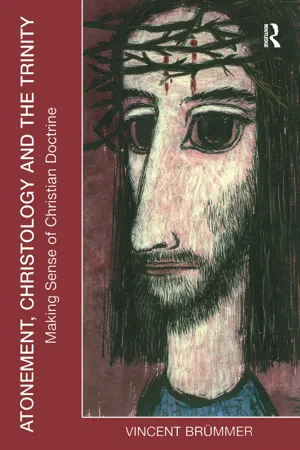
Atonement, Christology and the Trinity
Making Sense of Christian Doctrine
- English
- ePUB (mobile friendly)
- Available on iOS & Android
eBook - ePub
About this book
For many believers today the doctrines of Atonement, Christology and the Trinity seem like puzzling constructions produced by academic theologians. They are cast in unintelligible forms of thought derived from Platonism or from feudal society, and for many their existential relevance for life today remains unclear. This book introduces these doctrines and proposes a reinterpretation in the light of the claim of many Christian mystics that ultimate happiness is to be found in enjoying the loving fellowship of God. This claim is amatrix of faith in terms of which these doctrines are shown to be relevant for the life of faith of believers today. Furthermore, since this matrix can be defended within all three Abrahamic traditions, Judaism, Christianity and Islam, the proposed understanding of these doctrines can also contribute usefully to the necessary dialogue between these traditions in a globalised world.
Information
Topic
Theology & ReligionSubtopic
BuddhismPART 1
PROLOGUE
CHAPTER 1
The Intelligibility of Christian Doctrine
Mysteries and Puzzles
Whosoever will be saved: before all things it is necessary that he hold the Catholic Faith … And the Catholic Faith is this: That we worship one God in Trinity and Trinity in Unity; Neither confounding the Persons nor dividing the Substance. For there is one Person of the Father: another of the Son: and another of the Holy Ghost. But the Godhead of the Father, of the Son, and of the Holy Ghost, is all one … For like as we are compelled by the Christian verity: to acknowledge every Person by himself to be God and Lord: so we are forbidden by the Catholic Religion to say, there are three Gods or three Lords…Furthermore it is necessary to everlasting salvation: that he also believe rightly the incarnation of our Lord Jesus Christ. For the right Faith is, that we believe and confess: that our Lord Jesus Christ, the Son of God, is God and Man. God, of the Substance of the Father; begotten before all worlds: and Man, of the Substance of his mother, born in the world … One; not by conversion of the Godhead into flesh: but by the assumption of the Manhood into God. One altogether; not by confusion of substance: but by unity of Person. For as the reasonable soul and flesh is one man: so God and Man is one Christ; Who suffered for our salvation: descended into hell: rose again the third day from the dead. He ascended into heaven, he sitteth on the right hand of God the Father Almighty … This is the Catholic Faith: which except a man believe truly and firmly, he cannot be saved.1
If we were to ask ordinary believers in the pew to explain what exactly this confession means, they will probably be at a loss. Although contemporary believers would grant that these doctrines are fundamental to the Christian faith, most of them, when pressed, would have to admit that they remain puzzling conundrums. How are we to make sense of the claim that the Father and the Son and the Holy Spirit are three distinct persons each of which is to be ‘acknowledged by himself to be God and Lord’ and yet that they are not three Gods but one ‘undivided substance’? Since for us ‘persons’ are by definition distinct individual agents, it is difficult to see how three persons can be merged into one undivided substance without ceasing to be distinct persons. It seems that the various attempts to solve this conundrum either do so by maintaining the unity at the expense of the Trinity or the Trinity at the expense of the unity.
And how are we to make sense of the claim that Jesus is both wholly God ‘of the substance of the Father’ and at the same time wholly man ‘of the substance of his mother’? If Jesus is ‘wholly God’ he must presumably have the attributes of divinity like omnipotence, omniscience, omnipresence and so on. If, however, he is ‘wholly man’ he must be subject to the limitations of human existence, which seem to exclude these divine attributes. It would seem that we could only avoid looking on Jesus as some sort of divine–human schizophrenic by either maintaining his human nature at the expense of his divinity or his divine nature at the expense of his humanity.
Although believers would admit that Jesus ‘suffered for our salvation’ the way in which this is usually explained seems highly problematical. Of course, by our sinful disobedience to the will of God we fail to honour him in the way that is his due, and thus become estranged from him. However, many believers have great difficulty in accepting that they can only be reconciled with God if God’s slighted honour is restored by somebody suffering. It seems as though God wants to see blood before he can accept us again and it does not matter to him whether it is the blood of the guilty ones or the blood of his own innocent Son. Although this is not a logical conundrum like the doctrines of the Trinity and the dual nature of Christ, it is for many a moral one. It seems as though an attitude, which we would consider morally reprehensible in human beings, is quite in order for God. This caused von Harnack to remark that God has the terrible privilege of not being able to forgive out of love but instead always to require payment.2
If such doctrines at the heart of the Christian faith involve logical and moral conundrums, is it not asking rather much of us if our salvation is made to depend on our ‘truly and firmly’ believing them? How can we be required to believe doctrines, which we cannot understand? Can our eternal salvation be made to depend on such a sacrificium intellectus? In response it is often said that these doctrines express mysteries, which by definition we cannot understand. The nature and ways of God are beyond our finite powers of comprehension. Only in the next life will we be able to gain a clear understanding of what they mean.
Three in One and One in Three,
Dimly here we worship thee;
With the Saints hereafter we
Hope to bear the palm.
This response tries to justify the sacrificium intellectus rather than removing it, and it does so by confusing the puzzles of doctrine with mysteries of faith. Of course, the nature and the ways of God are mysteries for us, but not in the sense that we can know nothing about them or that they are unintelligible to us. On the contrary, we know God and his ways because he reveals himself to us, and to that extent his nature and ways are also intelligible to us. ‘Unintelligible knowledge’ is a contradiction in terms. On the other hand, God does remain mysterious to us because of the finitude of our existence and the limitations of our knowledge. We only know God to the extent that he reveals himself to us and he only reveals himself to us to the extent that we need to know him in order to live in his fellowship. Our knowledge and understanding of God are therefore adequate but also limited. Beyond these limits they remain a mystery in relation to which we should be agnostic and apophatic. Clearly the divine mysteries require us to be modest in our claims about them and willing to admit the limits of our knowledge and understanding of God. This does not mean, however, that a sacrificium intellectus is required of us within these limits. One thing of which we can be sure is that God never contradicts himself. What he does reveal to us can therefore never be riddled with logical or moral contradictions. Whenever such contradictions should arise in our understanding of God and his ways, we can be sure that we are mistaken and that we are called upon to revise our understanding in order to remove the contradictions. Our knowledge and understanding of God are not only limited, but also fallible. The puzzles of doctrine are not in God but in our fallible understanding.
In a similar way, all this also applies to our knowledge and understanding of the finite universe. The universe is also mysterious in the sense that there is always more to it than meets the eye. Our knowledge and understanding of finite things are also finite as well as fallible within these limits. When this fallibility gives rise to logical and moral puzzles this is a clear sign that we are mistaken in our claims and that these need revision in order to eliminate the puzzles. Such puzzles are there to be solved and are not to be accepted in a sacrificium intellectus.
It is here that Austin Farrer’s distinction between mysteries and puzzles is useful.3 For Farrer, reality (including the reality of God) is mysterious in the sense that there is more to it than we can grasp with our finite capacities for understanding. Such mysteries should be clearly distinguished from the puzzles of doctrine, which arise because of the limitations of the conceptual apparatus in terms of which we understand and describe them. Unlike the mysteries, such puzzles are not located in reality but in our fallible ways of understanding reality. ‘Mysteries are not to be solved but (always inadequately) described.’4 Puzzles, on the other hand, can be solved in principle by revising the conceptual apparatus in terms of which we try to describe the mysteries.
How do we set about describing the nature of things, including the nature of God and his ways with the world? According to Farrer ‘our ordinary form of speech informs us how we can do it: we do not ordinarily ask “What is its nature?” but “What is it like?” To describe a thing is to compare it to other things.’5 This suggests that the conceptual apparatus we employ in describing and understanding God and his ways consists of metaphors, which describe things in terms of their analogies with other things. It is this metaphorical apparatus which gives rise to puzzles:
God’s existence is one of the mysteries of metaphysics, not one of the puzzles of metaphysics … Such mysteries the metaphysician [and the theologian] wrestles with; he attempts to describe them by means of analogies. In his attempt to describe, puzzles certainly arise – puzzles interior to the particular analogical description he chooses to employ. Since no analogy fits perfectly, the adaptation of any analogical description to the object described must create puzzles. How is the description to be made either consistent or suitable?6
Let us now examine the nature and limits of such analogical or metaphorical use of language. How does such language give rise to puzzles? How can these puzzles be solved by revising or adapting the metaphorical language?
The Limits of Metaphorical Thinking
The term ‘metaphor’ is ambiguous. For our purposes we can distinguish two senses in which it is used in the theoretical literature on metaphor. On the one hand, it is used, especially in literary theory, to refer to a specific figure of speech, which is distinguished from the literal use of language. On the other hand, the term is also used to refer to a pervasive feature of all human thought and experience. Here the distinction between metaphorical and literal does not apply. We could say that all human thought and experience is metaphorical in this sense.7
Sallie McFague describes metaphorical thinking as
seeing one thing as something else, pretending ‘this’ is ‘that’ because we do not know how to think or talk about ‘this’, so we use ‘that’ as a way of saying something about it. Thinking metaphorically means spotting a thread of similarity between two dissimilar objects, events, or whatever, one of which is better known than the other, and using the better known one as a way of speaking about the lesser known.’8
In this sense the term ‘metaphor’ is used to refer to the conceptual activity in which we understand things by comparing them to each other.
This is an essential feature of all human thought and experience, including human thought and experience of God. One of the most basic conceptual activities characteristic of human thinking is the classification of entities according to the characteristics they have in common.9 If we wish to gain a hold on the chaos of our sensory impressions, we must recognize the similarities and differences between the things we perceive, and classify them according to these similarities and differences. In perceiving the world we do not merely register chaotic sensory impressions, nor do we perceive random undefined objects. We always perceive objects as belonging to a kind (people, chairs, tables, houses, trees and so on) and therefore having recognizable characteristics in common and differing in recognizable ways from other objects. This classificatory organization of experience constitutes our horizon for understanding the world: we intuitively seek to understand things by comparing them to similar things with which we are already familiar. I try to understand how A works or what value I should attach to A by comparing it to B, whose working or value I already understand. Understanding the world around us would be impossible without such metaphorical comparison. We understand the nature of something when we see what it is like.
Although such metaphorical thinking is indispensable, it also has its limits and can become dangerously misleading when these are ignored. This can happen in two ways. First, comparisons are odious, we say, because they tend to ignore individuality and to treat things that are analogous as though they were identical. After all, everything is itself and not another thing. Hence McFague warns us (in terms derived from Paul Ricoeur) that our generalizing metaphorical concepts ‘always contain the whisper, “it is and it is not”’.10 The danger of metaphorical thinking is that we can become so used to the generalizing ‘is’ that it becomes part of our intuitive pattern of thinking or mental set and we become deaf to the whispered ‘and it is not’. It is therefore important to remember that the meanings of the generalizing concepts we employ in our metaphorical thinking are open-ended in the sense that they contain a penumbra of associations, suggestions and implications. When in our metaphorical comparisons we use the same concept in two different contexts or with reference to two different entities, it does not necessarily follow that the whole penumbra of meaning is transferred from the one context to the other. We therefore need critical reflection in order to determine what part of the penumbra of meaning is transferred in each case. Thus, in thinking and speaking of (our relations with) God, we use the same concepts we also use in our thinking and speaking about (our relations with) each other even though we know very well that God is not like other people. Central to theological reflection on the way believers think and speak about God is the task of sorting out critically what part of the penumbra of meaning can and what part cannot be transferred to our thinkin...
Table of contents
- Cover
- Half Title
- Title Page
- Copyright Page
- Table of Contents
- Acknowledgements
- Part 1 Prologue
- Part 2 Fellowship with God: The Matrix of Faith
- Part 3 Christian Doctrine: Interpreting the Matrix
- Part 4 Epilogue
- Index
Trusted by 375,005 students
Access to over 1.5 million titles for a fair monthly price.
Study more efficiently using our study tools.
Frequently asked questions
Yes, you can cancel anytime from the Subscription tab in your account settings on the Perlego website. Your subscription will stay active until the end of your current billing period. Learn how to cancel your subscription
No, books cannot be downloaded as external files, such as PDFs, for use outside of Perlego. However, you can download books within the Perlego app for offline reading on mobile or tablet. Learn how to download books offline
Perlego offers two plans: Essential and Complete
- Essential is ideal for learners and professionals who enjoy exploring a wide range of subjects. Access the Essential Library with 800,000+ trusted titles and best-sellers across business, personal growth, and the humanities. Includes unlimited reading time and Standard Read Aloud voice.
- Complete: Perfect for advanced learners and researchers needing full, unrestricted access. Unlock 1.5M+ books across hundreds of subjects, including academic and specialized titles. The Complete Plan also includes advanced features like Premium Read Aloud and Research Assistant.
We are an online textbook subscription service, where you can get access to an entire online library for less than the price of a single book per month. With over 1.5 million books across 990+ topics, we’ve got you covered! Learn about our mission
Look out for the read-aloud symbol on your next book to see if you can listen to it. The read-aloud tool reads text aloud for you, highlighting the text as it is being read. You can pause it, speed it up and slow it down. Learn more about Read Aloud
Yes! You can use the Perlego app on both iOS and Android devices to read anytime, anywhere — even offline. Perfect for commutes or when you’re on the go.
Please note we cannot support devices running on iOS 13 and Android 7 or earlier. Learn more about using the app
Please note we cannot support devices running on iOS 13 and Android 7 or earlier. Learn more about using the app
Yes, you can access Atonement, Christology and the Trinity by Vincent Br�mmer in PDF and/or ePUB format, as well as other popular books in Theology & Religion & Buddhism. We have over 1.5 million books available in our catalogue for you to explore.