The fourth Factor X publication from the German Environment Agency (Umweltbundesamt, UBA), Sustainable Development and Resource Productivity: The Nexus Approaches explores the interdependencies of sustainable development paths and associated resource requirements, describing and analysing the necessities for a more resource efficient world.
The use of and competition for increasingly scarce resources are growing worldwide with current production and consumption patterns of industrialised economies soon to reach the point where the ecosphere will be overtaxed far beyond its limits. Against this background, this volume examines the important initiatives to monitor resource use at the international, EU and national level. The current trends and challenges related to sustainable resource use are discussed, including international challenges for a resource efficient world, megatrends, justice and equitable access to resources. In the second part of the book, contributions examine implementation strategies. They assess the concept known as circular economy and discuss the theory of growth and the role of the financial and education systems. The final section places special emphasis on practical examples. Overall, the book presents concrete ways and examples of achieving more sustainability in practice.
Discussing solutions for a more sustainable use of natural resources, this book is essential reading for scholars and students of natural resources and sustainable development and decision-makers and experts from the fields of policy development, industry and civil society.
The Open Access version of this book, available at https://www.taylorfrancis.com/books/e/9781003000365, has been made available under a Creative Commons Attribution 4.0 International License.
As has been shown in the RESCUE report (Günther et al. 2018), global greenhouse gas (GHG) emissions continue to rise despite the implementation of various climate protection measures. In 2017, fossil GHG-emissions were 37 gigatons (Gt) about 63% above 1990 levels (EK 2019). Additionally, global materials extraction has accelerated in the last decades to more than 90 Gt in 2017, which is a fifteen-fold increase compared to 1900 (UNEP 2019). Currently, an estimated four out of nine planetary boundaries have now been crossed as a result of human activity, which would drive the Earth System into a much less hospitable state. The four are climate change, altered biogeochemical cycles (phosphorus and nitrogen), land-system change, and biosphere integrity (Rockström et al. 2009; Steffen et al. 2015).
According to Günther et al. (2018):
the UNFCCC’s1 Paris Agreement was adopted in 2015 to keep the increase in global average temperature to well below 2 °C above pre-industrial levels; and to limit the increase to 1.5 °C (UNFCCC 2015). Nevertheless, global existing policies are insufficient and projected to result in about 3.3 °C warming above pre-industrial levels (Climate Action Tracker 2019).
The use of primary materials in Germany increased by 4% from 2000 and amounted to 2.64 billion tonnes (gigatons = Gt) in 2014.
The current tragedy is that improvement or turnaround in the global trends is not in sight. On the contrary, every year it gets more dramatic. No one can currently predict whether we have already passed the ‘tipping points’ and reinforcing effects are already having an accelerating impact. No one can predict whether we have not already irretrievably destroyed system elements here or there.
Urgent action is needed to ensure that humanity preserves the life-giving functions of our natural environment. In order to face these challenges, a fundamental transformation across all societal groups and economic sectors is required.
And much worse, this is nothing new – this has been known since the Club of Rome report in the seventies. Already in the 1990s, targets for dematerialisation and decarbonisation were formulated (90% down or, in other words, a factor of 10 in productivity). This is the content of many conferences, publications, political declarations of intent, policies and treaties. Looking at the development since the 1990s, much knowledge has been generated but little has been achieved.
As a reminder, the ‘basic requirement’ of sustainable development is that the functions of the environment, i.e. the natural foundations of life in their various roles, are no longer endangered for this and future generations.
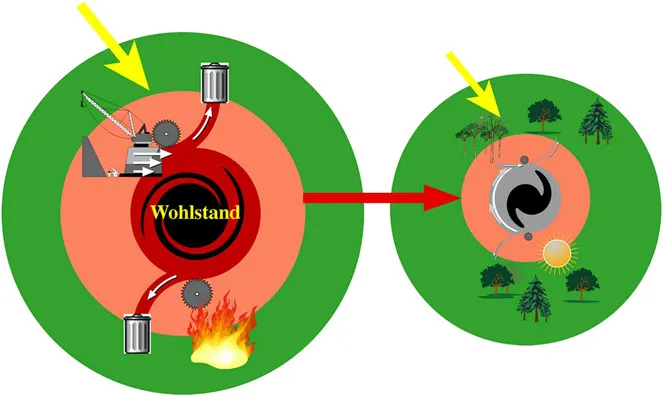
This means that our present anthroposphere must become ‘SMALLER’ to create space for the biosphere. That it must become ‘DIFFERENT’ (more productive, dematerialised, circular instead of linear) in order to meet the target of 5–8 tonnes of resource use by 2050. That it must become ‘FAIR’ to enable sustainable development for other regions and future generations. Also ultimately ‘NEUTRAL’, greenhouse gases, toxins, plastic waste must be reduced to zero as quickly as possible.
Figure 1.1 From ownership and linearity to happiness and circularity – necessary changes in our anthroposphere – the great transformation.
The path to this is the ‘Great Transformation’
This transformation needs a broad perspective in analysis and implementation. The interactions between resource conservation, climate protection, energy supply, lifestyle, economic growth – to name just a few subsystems – require a systemic and interdisciplinary approach.
At this stage in history, and perhaps for all time to come, our actions must be guided by the recognition of how little we know about our planet’s ‘survival’ system and its susceptibility. As a precautionary measure, we should therefore, attempt to minimise anthropogenic effects on this system. We should strive to prevent as far as possible any negative consequences, assuming that an undisturbed biosphere will continue to exist in a way humanity can survive and live in an agreeable manner. This precautionary principle must constitute the main guideline for all human activity if sustainable development is to be our primary aim.
RESCUE the Anthropocene
In a multi-year UBA research and cooperation project of its own, with external support based on research projects, possible solution areas for this transformation process for Germany were identified based on several scenarios. These paths and visions of the future are archetypes of sustainable development and can serve as blueprints for other regions and countries. Of course after adaptation to the general conditions in other countries.
Various studies and the results of the RESCUE (‘Resource-efficient Pathways towards Greenhouse-Gas-Neutrality’) project are presented in Part II of the book.
I would like to go into more detail on some of the insights that I consider important. There are plausible and sustainable pathways towards a greenhouse gas-neutral, post-fossil and resource-saving Germany in 2050 based on technologies that already exist today (technological feasibility). These paths are also possible trajectories for other regions.
Climate and resource protection complement each other. However, there are risks – decarbonisation and dematerialisation must always be achieved together (systemic approach necessary).
All sectors (consumption – housing – energy production – industry – transport – agriculture and land use) must be considered together (cross-sectoral coupling) and measured against their services (e.g. mobility).
An example of a synergy between resource protection and climate protection is the idea of ‘Power to Liquid’ (PTL) in aviation instead of choosing biofuels as the technological path. Since we propose a solution for aviation within the given infrastructure – we avoid building a new technological path (e.g. fuel supply, Aircrafts, engines, among others) with the associated consumption of resources. PTL is also much more resource-efficient than bioenergy. However, we need a lot of renewable energy for this and we need to start building the PTL system quickly. This path is certainly quicker to realise than a complete shift of aviation to a new technology path. This path avoids land-use competition with food and fibre (Lehmann 2017).
In all scenarios, raw material shortages (e.g. copper) are already foreseeable today if the pathways proposed in the RESCUE Study are implemented globally. This is not a shortage of quantity, it is a shortage of production quantity at a time – if everyone wants to achieve greenhouse gas neutrality – the quantity of installed renewable energies – which still need a lot of metals today – increases at a certain time. Various solutions are conceivable, the simplest solutions needing less raw materials per installed capacity and substitution by other materials. Another is to reduce the amount of energy required – here through energy efficiency and, just as importantly, resource productivity. We have no shortage of renewable energy – we have a raw material and resource limitation.
I am particularly pleased that we have succeeded in the ‘GreenSupreme’ scenario in taking a look at a transformation path that can be implemented globally and meets the Paris objectives. What do I understand by global implementation? Starting from an unfair distribution of materials in the different regions of the world, we end up in a world where everyone acts with his or her share of materials – greenhouse gas neutral.
This scenario would be a path for the world to achieve the sustainability goals. Not surprisingly, it would mean zero growth of the gross national product in the industrialised countries in the medium term. After a period of growth through transformation, we have frozen our ‘material prosperity’ at its current relatively high level. This gives other regions the chance to catch up and be carbon neutral in 2050. However, this scenario also shows that we still have a lot to do to achieve better resource use. It shows once again that the limiting factor is not renewable energies, but raw materials and resources.
One issue that has become increasingly important in the creation of scenarios and the formulation of policies is the question of lifestyle. Our private consumption, the wealth we accumulate, the way we achieve our well-being, is essential for achieving climate protection goals and a fair distribution of development opportunities in this and the next generations. It starts with food, affects the life span of products and does not stop at the number of flights per person and year. The question of ‘how much is enough’ is difficult to answer – without limiting our lifestyles we will not achieve the goals and global injustices will become increasingly severe.
System-Policies
System-Policies must become the norm because policies seeking to solve individual environmental, societal, economic, and institutional problems one at a time, without taking inter-dependencies among them into account, cannot protect the environment nor can it lead to a sustained human economy.
(Schmidt-Bleek et al. 2014)
‘System-Policies’ have several pillars and prerequisites:
One premise – we need a more or less consistent way of measuring the ‘material rucksack’.
We need data, for example, to calculate the different solutions in retrofitting building – this data must be evolved – let us start with the indicators we have today.
They have to be transparent, linear and easily understandable. Clearly, they will improve, through science, as in the case of greenhouse gases and will generate better and more reliable data.
However, let us start with MIPS, COPS, TMR, RMC or whatever you like.
Clearly we need also a land-use Indicator to lower the overall land-use of humanity.
An open question that needs to be examined very soon is how much resources we need for the various services and sectors. Just as we now set targets for the greenhouse gas emissions of a country’s sectors, we must do the same for the different services and their resources use we need. Unlike greenhouse gas neutrality, it is a more complex analysis. Nevertheless, the usual policy cycle must be followed when formulating this policy. So measurement – determination of the goal – formulation of policies, measures and instruments – implementation – monitoring – and then again from the beginning.
Looking at the nexus of resource policy and biodiversity, it has been shown that resource policy approaches basically work in synergy with the goals and measures of the Biodiversity Strategy and vice versa.
All policy proposals formulated today include a very high number of individual measures. In resource protection, only ‘soft’ measures and instruments are currently implemented. And very few countries are starting to implement resource policies – not consistently and quickly enough in my opinion.
At present, raw materials policy, resource protection, climate policy, agricultural policy and other fields are not interlinked. The example of environmentally damaging subsidies shows that we spend a lot of money on the wrong things – even though society and politics are not prepared to reduce them (Köder et al. 2016).
Important pillars of such an integrated Policy are substitution and avoidance. Substitution is replacing of greenhouse gas- and resource-intensive technologies, services and products with decarbonised and dematerialised alternatives. Avoidance is the reduction of the consumption of products and activities through effici...
Table of contents
Cover
Half Title
Title Page
Copyright Page
Dedication
Contents
Foreword by Harry Lehmann
In memoriam Friedrich Schmidt-Bleek
List of contributors
Part I Setting the scene
Part II Core aspects of an integrated resource policy
Part III Case studies of existing solutions
Part IV Pioneering innovations
Index
Trusted by 375,005 students
Access to over 1.5 million titles for a fair monthly price.
Study more efficiently using our study tools.
Frequently asked questions
Yes, you can cancel anytime from the Subscription tab in your account settings on the Perlego website. Your subscription will stay active until the end of your current billing period. Learn how to cancel your subscription
No, books cannot be downloaded as external files, such as PDFs, for use outside of Perlego. However, you can download books within the Perlego app for offline reading on mobile or tablet. Learn how to download books offline
Perlego offers two plans: Essential and Complete
Essential is ideal for learners and professionals who enjoy exploring a wide range of subjects. Access the Essential Library with 800,000+ trusted titles and best-sellers across business, personal growth, and the humanities. Includes unlimited reading time and Standard Read Aloud voice.
Complete: Perfect for advanced learners and researchers needing full, unrestricted access. Unlock 1.5M+ books across hundreds of subjects, including academic and specialized titles. The Complete Plan also includes advanced features like Premium Read Aloud and Research Assistant.
Both plans are available with monthly, semester, or annual billing cycles.
We are an online textbook subscription service, where you can get access to an entire online library for less than the price of a single book per month. With over 1.5 million books across 990+ topics, we’ve got you covered! Learn about our mission
Look out for the read-aloud symbol on your next book to see if you can listen to it. The read-aloud tool reads text aloud for you, highlighting the text as it is being read. You can pause it, speed it up and slow it down. Learn more about Read Aloud
Yes! You can use the Perlego app on both iOS and Android devices to read anytime, anywhere — even offline. Perfect for commutes or when you’re on the go. Please note we cannot support devices running on iOS 13 and Android 7 or earlier. Learn more about using the app
Yes, you can access Sustainable Development and Resource Productivity by Harry Lehmann in PDF and/or ePUB format, as well as other popular books in Biological Sciences & Ecology. We have over 1.5 million books available in our catalogue for you to explore.