This is a comprehensive new operational military history of the Ottoman army during the First World War. Drawing from archives, official military histories, personal war narratives and sizable Turkish secondary literature, it tells the incredible story of the Ottoman army's struggle from the mountains of the Caucasus to the deserts of Arabia and the bloody shores of Gallipoli. The Ottoman army, by opening new fronts, diverted and kept sizeable units of British, Russian and French forces away from the main theatres and even sent reinforcements to Austro-Hungary and Bulgaria. Against all odds the Ottoman army ultimately achieved some striking successes, not only on the battlefield, but in their total mobilization of the empire's meagre human and economic resources. However, even by the terrible standards of the First World War, these achievements came at a terrible price in casualties and, ultimately, loss of territory. Thus, instead of improving the integrity and security of the empire, the war effectively dismantled it and created situations and problems hitherto undreamed of by a besieged Ottoman leadership. In a unique account, Uyar revises our understanding of the war in the Middle East.
"Mesut Uyar's long awaited history of the Ottoman's Army's operations in the First World War is a brilliant addition to the field" - Edward J. Erickson, Marine Corps University, First World War Studies
When the Ottoman reformers – known by Europeans at that time as the ‘Young Turks’1 – forced Sultan Abdülhamid II to restore the constitution and reopen Parliament on 24 July 1908 or face a relentless campaign of military mutinies and unrest, Ottoman intellectuals and the general public believed they were witnessing the beginning of a new age of peace and prosperity.2 They were to be disappointed. The great powers of Europe and the countries that bordered the vast Ottoman Empire were not swept by the same optimism, regarding these developments as marking the prime time to advance their territorial and political aims, lest a reinvigorated Ottoman government pose a threat to their colonial empires.3 Writing at the time, British Foreign Secretary Sir Edward Grey observed that,
1For the history of the late Ottoman reform movements see Şükrü Hanioğlu, Preparation for a Revolution: The Young Turks, 1902–1908, Oxford University Press, Oxford, 2001; Feroz Ahmad, The Young Turks: The Committee of Union and Progress in Turkish Politics 1908–14, Clarendon Press, Oxford, 1969; Ernest E. Ramsaur, The Young Turks: Prelude to the Revolution of 1908, Khayats, Beirut, 1965.
2Hanioğlu, Preparation for a Revolution, pp. 273–278.
3Joseph Heller, British Policy Towards the Ottoman Empire, Frank Cass, London, 1983, pp. 9–16, 19–22, 29; L. Bruce Fulton, “France and the End of the Ottoman Empire”, in (ed.) Marian Kent, The Great Powers and the End of the Ottoman Empire, Frank Cass, London, 1983, pp. 141, 156–159, 166; R.J.B. Bosworth, “Italy and the End of the Ottoman Empire”, in (ed.) Marian Kent, The Great Powers and the End of the Ottoman Empire, pp. 57–60; C. Jay Smith Jr., The Russian Struggle for Power 1914–1917: A Study of Russian Foreign Policy during the First World War, 2nd printing, Greenwood Press, New York, 1969, pp. 63–64.
if Turkey really establishes a constitution, and keeps it on its feet, and becomes strong herself, the consequences will reach further than any of us can yet foresee. The effects in Egypt will be tremendous and will itself be felt in India…. If there is a Turkish Constitution in good working order and things are going well in Turkey, and we are engaged in suppressing by force and shooting a rising in Egypt of people who demand a constitution too, the position will be very awkward.4
4Dispatch from Sir Edward Grey to Sir Gerard Lowther (British ambassador in Constantinople), 31 July 1908. G.P. Gooch and H. Temperley (eds.), British Documents on the Origins of the War 1898–1914, vol. 5, His Majesty’s Stationery Office (HMSO), London, 1928, [hereafter, British Documents], p. 2.
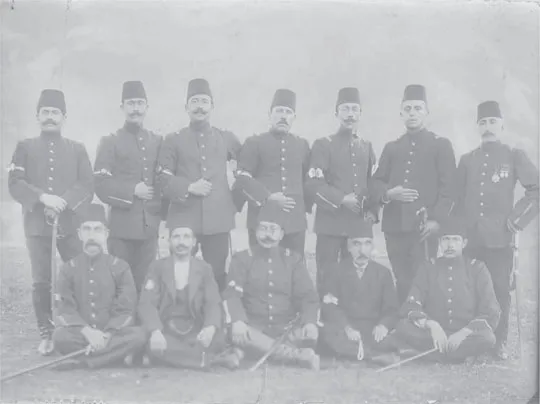
Figure 1.1Ottoman officers proudly showing their armlets as a support to the constitution.
The search for a new era of peace and prosperity was not confined to Turkey, with the autonomous princedom of Bulgaria proclaiming independence on 5 October.5 However, the Austro-Hungarian Empire moved to curtail this spirit of independence, annexing Bosnia and Herzegovina on 6 October, thus formalising a supervisory role over the two provinces of the Ottoman Empire that had lasted almost 30 years.6 On 17 October, the island of Crete also appeared to dampen the flames of independence within its citizenry with its proclamation of union with Greece.7
5Hasan Ünal, “Ottoman Policy During the Bulgarian Independence Crisis, 1908–9: Ottoman Empire and Bulgaria at the Outset of the Young Turk Revolution”, Middle Eastern Studies, vol. 34, no. 4, October 1998, pp. 140–150.
6Bernadotte E. Schmitt, The Annexation of Bosnia, 1908–1909, England University Press, Cambridge, 1937, pp. 35–47.
7Theodore P. Ion, “The Cretan Question”, The American Journal of International Law, vol. 4, no. 2, April 1910, pp. 278–284. The Ottoman attempts to gain the support of the Great Powers and some Balkan states failed miserably. See Ünal, “Ottoman Policy”, pp. 150–156, 162–167.
Within the Ottoman Empire, the French constitutional formula of liberty, equality and fraternity inspired the populace into several months of joyful mass demonstrations and public speeches of goodwill which presented colourful stories for digestion by the Western newspapers. Ultimately, however, the so-called grand revolution of the constitution served only to enlarge the fault lines and fractures between different ethnic, communal and religious groups inherent in such a vast empire.8 When the pace of progress did not meet inflated expectations, political radicalism and frustration took hold, exacerbating many of the existing problems of the empire.9
8“Turkey: Joyful Demonstrations”, The Scotsman, 28 July 1908, p. 7; “New Year in Turkey: Remarkable Outburst of Pro-British Feeling”, The Manchester Guardian, 28 July 1908, p. 7.
9G.F. Abbott, Turkey in Transition, Edward Arnold, London, 1909, pp. 77–103, 177–199.
Civilian and military reformers had established a secret organisation, the Committee of Union and Progress (CUP or İttihad ve Terakki Cemiyeti), as early as 1889. However, they did not consider it sufficiently mature and capable of governing the empire at this stage, ruling out a coup d’état in favour of retaining the status quo while attempting to influence the government from behind the scenes.10 The organisation continued to increase in strength and prominence until, by 1908, the CUP was sufficiently well known as a reformist organisation to be identified as a likely scapegoat for any expressions of discontent.
10Hanioğlu, Preparation for a Revolution, pp. 279–284; M. Naim Turfan, Rise of the Young Turks: Politics, the Military and Ottoman Collapse, I.B. Tauris, London, 2000, pp. 146–151; Handan Nezir Akmeşe, The Birth of Modern Turkey: The Ottoman Military and the March to World War I, I.B. Tauris, London, 2005, pp. 57–60, 87–89.
The first serious unrest occurred on 13 April 1909 (better known as 31 March Incident due to the old Rumi calendar date) with a mutiny staged by several disgruntled military units. The 3rd and 4th Light Infantry (avcı) battalions, brought from Macedonia to İstanbul to protect the new regime, now mutinied against it, their ranks bolstered by the 2nd Battalion which joined the revolt later in the day.11 The mutiny took the government by surprise, the mutineers facing no more than token resistance from the local gendarmerie. Their success encouraged other dissidents, chief among them theology students (suhte) and recently purged rankers (alaylı). The soldiers opposed the imposition of wide-ranging military reforms and resented the growing political power of the academically trained young officers (mektebli). The rallying cry of the mutineers was the re-establishment of Islamic law (Sharia). They vowed loyalty to the sultan and lobbied for the government to be dismissed. The reigning party’s ineffectual and feeble response provided further encouragement,12 and some of the provincial garrisons in Anatolia also joined the uprising.13 Mobs attacked Armenians in Adana and the Cilicia region, sparking bloody inter-communal fighting.14
11The avcı battalions were founded following the Macedonian revolt of Ilinden in 1903 to conduct counter-insurgency operations. All members of the battalions were specially selected based on their physical and mental capability and their loyalty to the regime. As counter-insurgency troops, they achieved remarkable results in a very short time, but also became a refuge for military opposition to the Abdülhamid regime. Not surprisingly, they played a crucial role during the constitution mutinies. See Kazım Karabekir, İttihat ve Terakki Cemiyeti 1896–1909, Türdav Ofset, İstanbul, 1982, pp. 202, 448–449; Mustafa Turan, Taşkışla’da 31 Mart, Aykurt Neşriyat, İstanbul, 1964, pp. 59–68.
12Dispatch from Sir Gerard Lowther to Sir Edward Grey, 20 April 1909, British Documents, vol. 5, pp. 313–318; Victor R. Swenson, “The Military Rising in Istanbul 1909”, Journal of Contemporary History, vol. 5, no. 4, 1970, pp. 172–180; David Farhi, “The Şeriat as a Political Slogan: Or the Incident of the 31st Mart”, Middle Eastern Studies, vol. 7, no. 3, October 1971, pp. 275–277, 280–289; Karabekir, İttihat ve Terakki Cemiyeti, pp. 425–444; W.M. Ramsay, The Revolution in Constantinople and Turkey: A Diary, Hodder and Stoughton, London, 1909, pp. 60–61, 106–112; Abbott, Turkey in Transition, pp. 200–210; Celal Bayar, Ben de Yazdım: Milli Mücadele’ye Gidiş, vol. 1, Baha Matbaası, İstanbul, 1965, pp. 141–154, 164–166.
13Ziya Yergök, Harbiye’den Dersim’e, (ed.) Sami Önal, Remzi Kitabevi, İstanbul, 2006, pp. 210–222; Behiç Erkin, Hatırat 1876–1958, (ed.) Ali Birinci, Türk Tarih Kurumu Basımevi, Ankara, 2010, pp. 86–87; Bayar, Ben de Yazdım, vol. 1, pp. 159–163.
14Meltem Toksöz, “Adana Ermenileri ve 1909 İğtişaşı”, in İmparatorluğun Çöküş Döneminde Osmanlı Ermenileri: Bilimsel Sorumluluk ve Demokrasi Sorunları, Bilgi Üniversitesi Yayınları, İstanbul, 2011, pp. 155–161; Yücel Güçlü, Armenians and the Allies in Cilicia 1914–1923, University of Utah Press, Salt Lake City, 2010, pp. 40–49; Bedross Der Matossian, “From Bloodless Revolution to Bloody Counterrevolution: The Massacres of 1909”, Genocide Studies and Prevention, vol. 6, no. 2, Summer 2011, pp. 156–164.
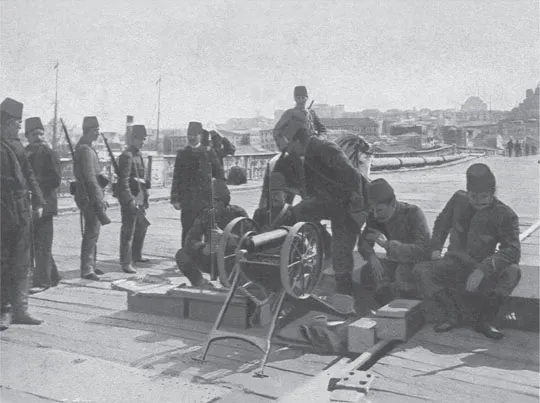
Figure 1.2 Soldiers of the Army of Action positioning a Maxim MG99 gun on the Galata Bridge during the 31 March Incident.
The CUP leadership reacted decisively to the unrest by mobilising loyal military units in Macedonia. The ‘Army of Action’ (Hareket Ordusu), which consisted of two reserve divisions and hordes of volunteers (ranging from Macedonian revolutionaries to Albanian bandits), suppressed the counter-revolutionary uprising in İstanbul on 24 April, then moved to the provinces to quash any overt expressions of dissent.15
15Swenson, “The Military Rising in Istanbul”, pp. 180–183; Farhi, “The Şeriat as a Political Slogan”, pp. 289–291; Karabekir, İttihat ve Terakki Cemiyeti, pp. 444–463; Ramsay, The Revolution in Constantinople, pp. 136, 138, 174–175, 206–208; Abbott, Turkey in Transition, pp. 211–277; Bayar, Ben de Yazdım, vol. 1, pp. 204–264; Celal Bayar, Ben de Yazdım: Milli Mücadele’ye Gidiş, vol. 2, Baha Matbaası, İstanbul, 1966, pp. 329–346, 359–363; Zekeriya Türkmen, Harekat Ordusu ve Kurmay Yüzbaşı Mustafa Kemal, Genelkurmay Basımevi, Ankara, 1999, pp. 9–44.
The decisive response to the uprisings energised and to a certain extent radicalised the CUP leadership, particularly the young offi...
Table of contents
Cover
Half Title
Series
Title
Copyright
Dedication
Contents
List of figures
List of maps
Preface
A note on transliteration
1 Prelude to war
2 The decision to go to war
3 Opening moves
4 The year of uncertainty: 1915
5 The year of glory and disappointment: 1916
6 The dreams and realities: 1917
7 The year of disasters: 1918
Epilogue
Bibliography
Index
Trusted by 375,005 students
Access to over 1.5 million titles for a fair monthly price.
Study more efficiently using our study tools.
Frequently asked questions
Yes, you can cancel anytime from the Subscription tab in your account settings on the Perlego website. Your subscription will stay active until the end of your current billing period. Learn how to cancel your subscription
No, books cannot be downloaded as external files, such as PDFs, for use outside of Perlego. However, you can download books within the Perlego app for offline reading on mobile or tablet. Learn how to download books offline
Perlego offers two plans: Essential and Complete
Essential is ideal for learners and professionals who enjoy exploring a wide range of subjects. Access the Essential Library with 800,000+ trusted titles and best-sellers across business, personal growth, and the humanities. Includes unlimited reading time and Standard Read Aloud voice.
Complete: Perfect for advanced learners and researchers needing full, unrestricted access. Unlock 1.5M+ books across hundreds of subjects, including academic and specialized titles. The Complete Plan also includes advanced features like Premium Read Aloud and Research Assistant.
Both plans are available with monthly, semester, or annual billing cycles.
We are an online textbook subscription service, where you can get access to an entire online library for less than the price of a single book per month. With over 1.5 million books across 990+ topics, we’ve got you covered! Learn about our mission
Look out for the read-aloud symbol on your next book to see if you can listen to it. The read-aloud tool reads text aloud for you, highlighting the text as it is being read. You can pause it, speed it up and slow it down. Learn more about Read Aloud
Yes! You can use the Perlego app on both iOS and Android devices to read anytime, anywhere — even offline. Perfect for commutes or when you’re on the go. Please note we cannot support devices running on iOS 13 and Android 7 or earlier. Learn more about using the app
Yes, you can access The Ottoman Army and the First World War by Mesut Uyar in PDF and/or ePUB format, as well as other popular books in History & Middle Eastern History. We have over 1.5 million books available in our catalogue for you to explore.