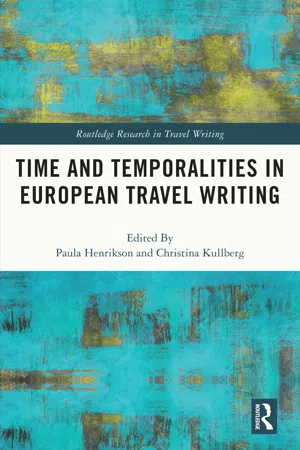
This book is a collective effort to investigate and problematise notions of time and temporality in European travel writing from the late medieval period up to the late nineteenth century. It brings together nine researchers in European travel writing and covers a wide range of areas, travel genres, and languages, coherently integrated around the central theme of time and temporalities. Taken together, the contributions consider how temporal aspects evolve and change in regard to spatial, historical, and literary contexts. In a chapter-by-chapter account this volume thus offers various case studies that address the issue of temporality by showing, for example, how time is inscribed in landscape, how travellers' encounters with other temporalities informed other disciplines; it interrogates the idea of "cultural temporalities" in regard to a tension between past and future, passivity and progression; and focuses on how time is entangled in identity construction proper to travelogues.
eBook - ePub
Time and Temporalities in European Travel Writing
- 232 pages
- English
- ePUB (mobile friendly)
- Available on iOS & Android
eBook - ePub
Time and Temporalities in European Travel Writing
About this book
Information
1 Time and Temporality in Travel Accounts from the Fourteenth to Sixteenth Centuries*
Mandeville, Tucher, Ecklin
Outlines of Christian Spatiotemporality
Travelling and travel literature are deeply connected with space: They are grounded in the need for orientation and the desire to possess reliable information about itineraries and places. Travelling is also an activity in time; each place represents different time strata, and travel texts are, for their part, temporally organised. Time has particular importance in the Christian context, in which practices such as pilgrimage intertwining sacred places and salvation history lend special qualities to space and time. This is evident in one of the first examples of the travel literature genre from late antiquity. Four manuscripts from the eighth to the tenth centuries contain an itinerary referred to in the literature as Itinerarium Burdigalense.1 It served as a guidebook for pilgrims travelling from Bordeaux to the holy sites in and around Jerusalem. According to a note on the entry for Constantinople, which may have been made by users at that time, an actual journey took place at the time of the consulship of Dalmatius and Zenophilus: the travellers left Chalcedonia on the third kalends of June (May 30; kalends are the first days of a month according to the Roman calendar) and reached Constantinople again on the seventh kalends of January (December 25). The corresponding consulships can be dated to the year 333 CE.2
The text was written in the late Roman/early Christian period when people first began to consider making pilgrimages to the Holy Land. In his Onomastikon (295 CE), Eusebius of Caesarea compiled an alphabetical list of biblical place names, linking them with then-present-day places, “on the basis of late Roman road maps, he designed a topographical network with a record of the distances between places that served to insert stories from the Bible into the landscape”,3 thereby creating sites from memory. After the ecumenical Council of Nicea (325 CE), Emperor Constantine commissioned the Church of the Nativity in Bethlehem, the Church of the Holy Sepulchre in Jerusalem, and the Church of the Ascension on the Mount of Olives in order to lend visible form, at the historical foundations of the Christian religion, to the faith thus rendered concrete by the Nicene Creed. In his catechetical lectures to those preparing for baptism (ca. 350 CE), Cyril of Jerusalem propagated the special value of celebrating the liturgy of Holy Week at the scene of the actual events (13,22).
The Itinerarium Burdigalense thus belongs to a new, Christianised topography of the Roman Empire in which Jerusalem represented the centre.4 At the same time, it shows how interest in the holy sites differed from the general need to orient oneself while moving through the world. The beginning and closing sections of the text consist of simple lists of potential hostelries (mansio), stations to change horses (mutatio), and towns and villages (vicus, civitas, etc.) as well as the distances between them. Only occasionally is a reference inserted to the historical event associated with a location: “Viminatium, where Diocletian killed Carinus”, “Libyssa: here lies King Annibalianus, erstwhile king of the Africans”. The biblical, Judeo-Christian references increase with growing distance from Constantinople: “The Apostle Paul was born here”, “This is where Elias went up to the widow and asked her for food”, “it was here that King Ahab reigned, and here that Elijah spoke his prophecies”, “here is the field where David struck Goliath dead”. Upon reaching the Holy Land, more extensive narrative digressions ensue. Apart from the time of the journey, which is measured in distances, the text touches on the temporal dimensions of history and the history of salvation. The reader encounters the site of Abraham’s sacrifice as well as various locations significant for the story of Jacob. Complex layers are associated with Jerusalem:
In Jerusalem, there are two large pools at the side of the temple, that is, one on the right hand, and one on the left, which were made by Solomon; and further in the city are twin pools, with five porticoes, which are called Bethsaida. Persons who have been sick for many years are cured there; the pools contain water that is red when it is disturbed. There is also a crypt here, in which Solomon used to torture devils. Here is also the corner of an exceedingly high tower, where our Lord ascended and the tempter said to Him, ‘If thou be the Son of God, cast thyself down from hence.’ And the Lord answered, ‘Thou shalt not tempt the Lord thy God, but him only shalt thou serve.’5
Spatial information ostensibly dominates here: The original includes phrases such as “in Hierusalem” (in Jerusalem), “ad latus templi” (at the side of the temple), “ad dexteram” (on the right hand), “ad sinistram” (on the left hand), “interius civitati” (further in the city) – and time and again “ibi” (there). At the same time, however, deeper temporal layers open up: the time of Solomon is compared to the time of Christ. From the pools of Solomon’s temple one can see directly to the twin pools of Bethesda, which are associated with ...
Table of contents
- Cover
- Half Title
- Series Page
- Title Page
- Copyright Page
- Table of Contents
- List of Figures
- List of Contributors
- Introduction*: Time, Temporality, and Travel Writing
- Chapter 1: Time and Temporality in Travel Accounts from the Fourteenth to Sixteenth Centuries*: Mandeville, Tucher, Ecklin
- Chapter 2: Like Moses on the Nile*: Competing Temporalities in Jean-Baptiste Du Tertre’s Histoire générale des Antilles habitées par les François (1654/1667)
- Chapter 3: Signs of Travel and Memory*: The Case of the Wooden Slabs in Jukkasjärvi (1681–1736)
- Chapter 4: Almanacs, Polytemporality, and Early Modern Travel
- Chapter 5: Time Travel in the Pacific*: Maritime Exploration and Eighteenth-Century German Historiography
- Chapter 6: Ruins and Revolutions*: Jacob Berggren on Classical Soil
- Chapter 7: Jerusalem in Every Soul*: Temporalities of Faith in Fredrika Bremer’s and Harriet Martineau’s Travel Narratives of Palestine
- Chapter 8: Temporalities of the Anti-Modern: Angel Ganivet’s Neo-Romantic Mapping of Western Civilisation
- Index
Trusted by 375,005 students
Access to over 1.5 million titles for a fair monthly price.
Study more efficiently using our study tools.
Frequently asked questions
Yes, you can cancel anytime from the Subscription tab in your account settings on the Perlego website. Your subscription will stay active until the end of your current billing period. Learn how to cancel your subscription
No, books cannot be downloaded as external files, such as PDFs, for use outside of Perlego. However, you can download books within the Perlego app for offline reading on mobile or tablet. Learn how to download books offline
We are an online textbook subscription service, where you can get access to an entire online library for less than the price of a single book per month. With over 1.5 million books across 990+ topics, we’ve got you covered! Learn about our mission
Look out for the read-aloud symbol on your next book to see if you can listen to it. The read-aloud tool reads text aloud for you, highlighting the text as it is being read. You can pause it, speed it up and slow it down. Learn more about Read Aloud
Yes! You can use the Perlego app on both iOS and Android devices to read anytime, anywhere — even offline. Perfect for commutes or when you’re on the go.
Please note we cannot support devices running on iOS 13 and Android 7 or earlier. Learn more about using the app
Please note we cannot support devices running on iOS 13 and Android 7 or earlier. Learn more about using the app
Yes, you can access Time and Temporalities in European Travel Writing by Paula Henrikson, Christina Kullberg, Paula Henrikson,Christina Kullberg in PDF and/or ePUB format, as well as other popular books in Literature & European Literary Criticism. We have over 1.5 million books available in our catalogue for you to explore.