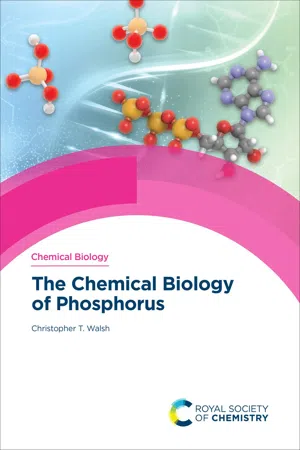
Alexander Todd, the 1957 Nobel laureate in chemistry is credited with the statement: "where there is life, there is phosphorus". Phosphorus chemical biology underlies most of life's reactions and processes, from the covalent bonds that hold RNA and DNA together, to the making and spending 75 kg of ATP every day, required to run almost all metabolic and mechanical events in cells. Authored by a renowned biochemist, The Chemical Biology of Phosphorus provides an in-depth, unifying chemical approach to the logic and reactivity of inorganic phosphate and its three major derivatives (anhydrides, mono- and diesters) throughout biology to examine why life depends on phosphorus. Covering the breadth of phosphorus chemistry in biology, this book is ideal for biochemistry students, postgraduates and researchers interested in the chemical logic of phosphate metabolites, energy generation, biopolymer accumulation and phosphoproteomics.
- 546 pages
- English
- ePUB (mobile friendly)
- Available on iOS & Android
eBook - ePub
Chemical Biology of Phosphorus
About this book
Information
Table of contents
- Cover
- Title
- Copyright
- Dedication
- Preface
- Contents
- Section I Introduction to Phosphorus and Inorganic Phosphates
- Chapter 1 Introduction to Phosphorus Chemical Biology
- Chapter 2 Inorganic Phosphate, Pyrophosphate, and Polyphosphate
- Section II ATP and Nucleoside Triphosphate Congeners: Substrates for Phosphoryl-, Pyrophosphoryl-, and Nucleotidyl Transferases
- Chapter 3 ATP as the Premier Biological Phosphoryl Transfer Reagent
- Chapter 4 Nucleotidyl Transfers (ATP and NTPs)
- Chapter 5 Pyrophosphoryl and Adenosyl Transfers from Mg–ATP
- Chapter 6 Activated Phosphoryl Groups and Biosynthetic Paths to ATP
- Chapter 7 Phosphomonoesters: Enzymatic Formation and Decomposition
- Section III Types of Phosphorylated Metabolites and Metabolic Logic
- Chapter 8 Phosphodiesters and Phosphotriesters
- Chapter 9 Phosphorylases: Inorganic Phosphate as Oxygen Nucleophile
- Chapter 10 N–P Bond Chemical Biology
- Chapter 11 C–P Bonds in Biology: Phosphonates and Phosphinates
- Chapter 12 P–S Bonds: Phosphorothioates
- Section IV Phosphoproteomics
- Chapter 13 Scope and Roles of Posttranslational Protein Phosphorylations
- Chapter 14 Noncanonical Phosphoproteomes
- Chapter 15 Canonical Phosphoproteomics: Phosphoserine, Phosphothreonine, and Phosphotyrosine
- Chapter 16 Noncanonical Phosphoproteomics – II
- Chapter 17 Broad Biological Arcs from Only Four Types of Phosphate Molecules
- Subject Index
Trusted by 375,005 students
Access to over 1.5 million titles for a fair monthly price.
Study more efficiently using our study tools.
Frequently asked questions
Yes, you can cancel anytime from the Subscription tab in your account settings on the Perlego website. Your subscription will stay active until the end of your current billing period. Learn how to cancel your subscription
No, books cannot be downloaded as external files, such as PDFs, for use outside of Perlego. However, you can download books within the Perlego app for offline reading on mobile or tablet. Learn how to download books offline
Perlego offers two plans: Essential and Complete
- Essential is ideal for learners and professionals who enjoy exploring a wide range of subjects. Access the Essential Library with 800,000+ trusted titles and best-sellers across business, personal growth, and the humanities. Includes unlimited reading time and Standard Read Aloud voice.
- Complete: Perfect for advanced learners and researchers needing full, unrestricted access. Unlock 1.5M+ books across hundreds of subjects, including academic and specialized titles. The Complete Plan also includes advanced features like Premium Read Aloud and Research Assistant.
We are an online textbook subscription service, where you can get access to an entire online library for less than the price of a single book per month. With over 1.5 million books across 990+ topics, we’ve got you covered! Learn about our mission
Look out for the read-aloud symbol on your next book to see if you can listen to it. The read-aloud tool reads text aloud for you, highlighting the text as it is being read. You can pause it, speed it up and slow it down. Learn more about Read Aloud
Yes! You can use the Perlego app on both iOS and Android devices to read anytime, anywhere — even offline. Perfect for commutes or when you’re on the go.
Please note we cannot support devices running on iOS 13 and Android 7 or earlier. Learn more about using the app
Please note we cannot support devices running on iOS 13 and Android 7 or earlier. Learn more about using the app
Yes, you can access Chemical Biology of Phosphorus by Christopher T Walsh in PDF and/or ePUB format, as well as other popular books in Physical Sciences & Biochemistry. We have over 1.5 million books available in our catalogue for you to explore.