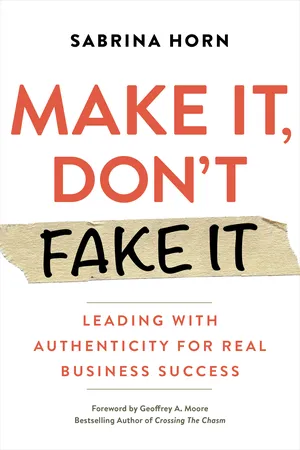
An award-winning CEO and communications expert shows how authentic leadership eliminates the need for the shortcuts that sabotage success. "Fake it till you make it" just doesn't work — at least not long enough to build a sustainable business. Driven to succeed under constant pressure, entrepreneurs and business leaders alike can be tempted to exaggerate their strengths, minimize weaknesses, and bend the truth. Through the twin lenses of running her own national public relations firm and advising thousands of executives for a quarter-century, Sabrina Horn revisits the core of leadership; defines authentic, reality-based business integrity; and shows readers how to attain and maintain it. With firsthand accounts of sticky situations and painful mistakes, Horn lays out workable strategies, frameworks, and mental maps to help leaders gain the clarity of thought necessary to make sound business decisions, even when there are no right answers. In her straightforward, no-nonsense style, she shares the power of humility and empathy, mentorship and self-assessment, and a strong core value system to build a leader's confidence and resilience. Horn's fake-free advice will empower readers to disarm fear, organize risk, manage setbacks and crises, deal with losing and loneliness, and create a culture and brand designed for long-term success.
- 192 pages
- English
- ePUB (mobile friendly)
- Available on iOS & Android
eBook - ePub
About this book
Information
CHAPTER ONE
SOME REALLY BAD ADVICE
As this is a book about achieving business success with integrity, it is important to understand something about why people lie. It is obvious that lying should not be our modus operandi, yet it happens all the time, in various forms and for different reasons. Understanding what compels people to fabricate the truth, to fake it, and to just plain lie is useful in coming up with the strategies and tools to avoid or prevent it.
There is a broad spectrum of fakery, from the perfectly innocent—Adler’s “acting as if”—to the perfectly criminal. In what follows, I explain that continuum with examples. To help you visualize it, I offer my Fake-O-Meter (figure 1). Note that the phrase “FAKING IT” marks the point at which certain types of lies pass from relatively harmless to costing you and others time, money, and reputation.

FIGURE 1 Fake-O-Meter
THERAPEUTIC, USEFUL, AND NECESSARY LIES
Biologically, intellectually, politically, and morally, we live in an impure world. We have to make peace with that reality and navigate it as well as we can. But let’s agree from the get-go that not all lies are equally bad and that some are therapeutic, useful, or even necessary. With this in mind, we can go on to define the degree of moral impurity with which we are willing to live.
Acting As If
As we saw in the introduction, Alfred Adler’s confidence- building approach of “acting as if” is a therapeutic use of pretending (in this case a benign type of lying), with origins in psychology. You pretend—to yourself—to be more confident by acting as if you were as confident as you would like to be.
The result, Adler and others have found, is that you actually feel more confident and, feeling confident, you perform as if you were truly confident. This may lead to more successful outcomes in your interactions, which serve to further reinforce your feelings of confidence. With a bit of luck, a virtuous circle is formed, in which successful outcomes produce greater confidence, which produce more successful outcomes, and so on.
“Acting as if” can be especially useful to anyone who suffers from imposter syndrome, the strong and even debilitating feeling that you are undeserving of your achievements. Those afflicted feel that they are frauds and fear that they will be exposed for faking their way to success, when in reality they never faked it at all and earned success honestly. People who already struggle with issues of self-efficacy and perfectionism often fall victim to “imposterism.” It is actually a common disorder, affecting as many as a third of high achievers, both men and women. About 70% of adults experience it at least occasionally.1
If you are troubled by imposterism, “acting as if”— pretending how it would be if you felt that you were competent, accomplished, and deserving of praise and admiration—may help change how you feel. You can also reflect upon, assess, and appreciate your actual achievements. Inventory them, admire them, but do not compare them to the achievements of anyone else. Measure your own achievements, not those of others.
Other strategies in the “acting as if” category include “dressing for success”—for instance, wearing black or red to feel more powerful. Visualization also can be helpful when preparing to face new or potentially challenging situations, a practice I have often found helpful. I previsit the scene in my imagination as a way of rehearsing how it might unfold, thereby becoming more comfortable with how to navigate it. I call this watching myself in my own movie. The ethical common denominator in all of these forms of “acting as if” is that the pretending is strictly between you and your own imagination. No part of it is being done at the expense of another person.
But can “acting as if” cross the line from therapy to actually faking it? And can that faking be undertaken to the detriment of someone else? Absolutely.
While you cross no ethical line by faking confidence itself, you must not fake external reasons to back up your confidence. For example, you may act as if you are confident that your business proposal is a winner, but if you tell a prospect that you have the data to prove it when no such data exists, you are crossing an ethical line, and quite possibly a legal one as well.
The Little White Lie
“Little white lie” is one of those expressions that everyone believes they understand but which turns out to have a wide and remarkably vague range of meaning. Some believe a white lie is any benign, trivial, or harmless falsehood. The problem with this definition is that it leaves far too much to individual judgment; what I might consider trivial and harmless, someone else may find scandalous. Besides that, even telling trivial lies may get you busted and, therefore, branded as a liar or a fibber. Either way, people may become reluctant to trust you.
The safer definition is to think of a white lie as something you say to be polite, to avoid hurting someone’s feelings, or to avoid upsetting someone unnecessarily.
WIFE: “Does this outfit make me look fat?”
HUSBAND: “You look gorgeous in anything.”
Often, a white lie takes the form of rendering an opinion that is absolutely the most positive you can come up with. At a dinner party, your host serves a spectacularly bland meal.
HOST: “How did you like the fish?”
YOU: “I loved the delicate flavor.”
In a business context, white lies are often a disservice. Whenever a client asked me for my opinion, I told the truth, though I sometimes modulated it to be as constructive as possible within the confines of the truth. For instance, if something the client proposed was flawed, I would try to comment truthfully on what was good about it and use that positive element as a platform from which to suggest improvements. With respect to my own feelings, this was a white lie. For the purposes of making a suboptimal project better, however, it avoided demoralizing or even alienating the client while moving the project toward improvement.
Finally, white lies can reduce life’s friction from day to day. “How are you?” is among the most conventional greetings we offer one another. Sometimes, however, you have a headache, feel anxious, or didn’t get a good night’s sleep. But do you really want to get into all that? So you answer, “Just fine. And you?”
Necessary Lies
The third type of “innocent” lying in this category is necessary lies. The sudden, unexpected loss of a loved one may be met with denial or a refusal to acknowledge reality. Such evasion of facts is not immoral or unethical. Indeed, it may be an emotionally necessary or at least unavoidable initial response to the loss.
Or consider this: an EMT arriving on an accident scene begins treating a gravely injured man.
“Am I going to die?” the victim gasps.
Acting on a strictly professional assessment, the most accurate answer might well be “Yes, probably.” But the medic knows the value of hope and responds instead, “No. Hang in there. We are going to take very good care of you!”
And finally, people lie to protect their privacy and that of their family. They may lie in situations of physical danger, to save themselves or others. These are necessary lies and there is no argument there.
FAKING IT: THE BRIGHT RED LINE
It is at this point that “acting as if” and other types of lies in this category cross a threshold into faking it, because the fakery is being conducted at another person’s expense, albeit without malice. Anxious to make a good impression or to avoid making a bad one, we may tell a tall tale, twist, cover up, augment, wing it, deliberately deform, or evade the truth. A personal lack of confidence, insecurity, or a perceived inadequacy leads many of us into this kind of fakery. These types of lies are more interpersonal, simpler, and not as egregious as others we discuss later, as measured on the Fake-O-Meter.
Twisting and Evading
It was the summer before my senior year in high school and I had a job working at a popular stationery store in town. The owners, a nice elderly couple from Poland, sold magazines, chewing gum, cigars, cigarettes, baseball cards, candy, stuff like that. I often thought that maybe someday I could own a nice little store like this, too.
The thing is, they ran an open cash register business; they never shut the cash drawer to ring up a sale. It was just money in and change out. With every sale, I had to do the math in my head, even calculating the sales tax. Unfortunately, I just couldn’t add or subtract that quickly, and I was too embarrassed to ask for a pencil and paper. Using the cash register was out of the question; it would have required them to change their business model. I wanted the owners to think I was smart, like them.
It went down like this. A customer would walk up to the counter with a magazine, some gum, a pack of cigarettes, and a couple of greeting cards. I’d act like I was doing the mental arithmetic and then arrived at some random number that might be acceptable.
“Uh, sure. That’ll be eight dollars, please,” I’d say, hoping the customer’s reaction would be positive.
Maybe the figure was close. Maybe it wasn’t. In reality, it was total improv. One hundred percent.
Amazingly, it worked—for a little while. But the day of reckoning came, when the owners realized I was essentially giving their merchandise away. With admirable patience, they presented me with the pad of paper and pencil I should have asked for in the first place. It certainly was easier, writing it all down, but they stood over me and watched me like a pair of hawks. The surveillance was so unnerving, I still couldn’t add or subtract on the fly, especially when someone gave me a twenty to break on a $3.28 sale.
I did not make it at the stationery store. I was fired, and I learned my first hard lesson in the consequences of faking it. In retrospect, that lesson may not have been hard enough. Certainly, I had no intention of cheating my employers, but cheat them I certainly did. This instance of fake it till you make it was at their expense, and thus I had blithely crossed the line into petty fraud.
Tall Tales
In my twenties, I learned the fake it lesson again. This time, though, I did it for love. I wanted to impress Jeff, an entrepreneur who had his own start-up, and when the subject turned to skiing, I mentioned that I loved downhill.
“Really?” he asked.
“More than anything.”
“You any good?”
“I’m double black diamond good,” I laughed.
At this, he invited me to ski the double black diamond run at Squaw Valley, the site of the 1960 Winter Olympics, near Lake Tahoe, California. I figured, how hard could it be? Growing up on the East Coast, I had skied on sheer ice in Vermont and New Hampshire and was a decent intermediate skier.
Without skipping a beat, I accepted, and he made the arrangements.
When I got off the chairlift at the top of the mountain, I thought I was going to die. This was it; game over. Call the chopper, bring the stretcher. Eventually pulling myself together, I slid down the entire vertical drop on my side. Clearly, faking it had not worked for me. I definitely wasn’t going to make it with Jeff, either.
Winging It
Fast-forward a few years to when, as a young executive, I was sitting in front of a client who was going on and on about some new technology he wanted us to promote. Wanting to impress him, I nodded my head in bogus understanding, though I didn’t have a clue what he was talking about.
Did I pull it off? Yeah. Did I have to backtrack? Usually.
I never felt great about it, and it was kind of stressful. I should have just brought the discussion back to how we could help him from a marketing standpoint, or suggested that we do a deep dive into his technology at some other time. In the moment, I didn’t have the confidence to stop, ask a question, or redirect the conversation. It would have been so simple. But then, hindsight is the Great Simplifier.
There also were side effects I had to consider. As a leader, you are always under a microscope. If I faked it, others around me would likely follow my example. Even small acts of fakery, harmless in themselves, nurture a let’s-just-wing-it culture, which I did not want to create in my company. Sometimes in business, you do just have to wing it. That is also a reality. Yet it is the proverbial exception that proves the rule. Winging it, more often than not, is faking it and therefore is not a sustainable business practice.
EXAGGERATION LIES
Exaggeration is the false assertion that something is greater or better than it actually is. It is one of the most common ways to fake it till you make it in business today. Instances of exaggeration, their eventual exposure, and the resulting consequences range widely in severity.
A really popular example is lying on your résumé or in a job interview to appear more accomplished. In fact, a 2017 study revealed that 85% of employers caught applicants lying on résumés or applications.2 Other common examples of lying through exaggeration include inflating a product’s actual capabilities to garner more customers or to secure venture capital (VC) funding, and overstating company revenues to attain a higher valuation. At any point, the fakery can be exposed. The customers or VCs will discover that the product doesn’t do what management promised and the auditors will uncover the faulty financials. The consequences can range from losing professional credibility or a job opportunity, to losing financial support, customers, and revenue, to getting sued and, at a still-realistic extreme, facing criminal prosecution. Definitely not the right strategy to achieve success.
Hype Cycle Lies
Hype is a kind of exaggerational fakery prevalent within marketing and PR, which are all about image and perception building. It is more sophisticated and broader in scope than simply twisting the truth a little to impress a friend. I cannot begin to tell you how many times prospective clients came to us saying, “Build our buzz. Make us a hot company to watch!” If I had a nickel, as they say.
Thankfully, there are ways of building brands for companies that actually deserve to be “hot,” as you’ll see in chapter 4. The harder trick, I discovered, was helping those companies that were viable but perhaps less interesting “wannabes,” while also steering clear of the ones that thought they could use PR to be something they could never live up to. The bottom line, as I mentioned in the introduction, was always an exercise in identifying their “real” story, remaining within the boundaries of the truth while also highlighting what was genuinely most interesting, beneficial, or different. As our clients’ agents or representatives, this was as much an exercise in advising them on what not to say (“We’re going to close a huge deal next week that’s going to be a real game changer!”) as it was in communicating their true stories (“The benefits our current customers are experiencing are an indicator of early market traction.”).
Company credibility and reputation are ...
Table of contents
- Cover
- Title Page
- Copyright Page
- Contents
- Dedication
- Foreword
- Introduction
- Chapter One: Some Really Bad Advice
- Chapter Two: So, You Want to Start a Company . . .
- Chapter Three: Becoming a CEO
- Chapter Four: Becoming and Staying an Authentic Brand
- Chapter Five: Get Used to Lonely
- Chapter Six: Airtight
- Chapter Seven: Leader and Loser Both Begin with the Letter L
- Chapter Eight: Way Off the Menu
- Chapter Nine: The Founder’s Curse
- Notes
- Acknowledgments
- Index
- About the Author
- About Horn Strategy, LLC
Trusted by 375,005 students
Access to over 1.5 million titles for a fair monthly price.
Study more efficiently using our study tools.
Frequently asked questions
Yes, you can cancel anytime from the Subscription tab in your account settings on the Perlego website. Your subscription will stay active until the end of your current billing period. Learn how to cancel your subscription
No, books cannot be downloaded as external files, such as PDFs, for use outside of Perlego. However, you can download books within the Perlego app for offline reading on mobile or tablet. Learn how to download books offline
Perlego offers two plans: Essential and Complete
- Essential is ideal for learners and professionals who enjoy exploring a wide range of subjects. Access the Essential Library with 800,000+ trusted titles and best-sellers across business, personal growth, and the humanities. Includes unlimited reading time and Standard Read Aloud voice.
- Complete: Perfect for advanced learners and researchers needing full, unrestricted access. Unlock 1.5M+ books across hundreds of subjects, including academic and specialized titles. The Complete Plan also includes advanced features like Premium Read Aloud and Research Assistant.
We are an online textbook subscription service, where you can get access to an entire online library for less than the price of a single book per month. With over 1.5 million books across 990+ topics, we’ve got you covered! Learn about our mission
Look out for the read-aloud symbol on your next book to see if you can listen to it. The read-aloud tool reads text aloud for you, highlighting the text as it is being read. You can pause it, speed it up and slow it down. Learn more about Read Aloud
Yes! You can use the Perlego app on both iOS and Android devices to read anytime, anywhere — even offline. Perfect for commutes or when you’re on the go.
Please note we cannot support devices running on iOS 13 and Android 7 or earlier. Learn more about using the app
Please note we cannot support devices running on iOS 13 and Android 7 or earlier. Learn more about using the app
Yes, you can access Make It, Don't Fake It by Sabrina Horn in PDF and/or ePUB format, as well as other popular books in Business & Etica aziendale. We have over 1.5 million books available in our catalogue for you to explore.