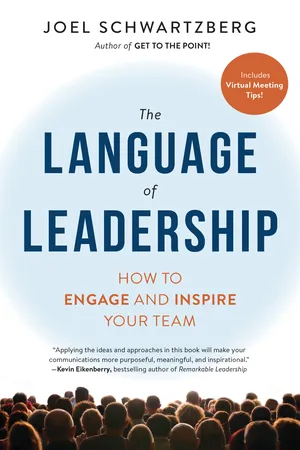
Convey the essence of leadership with every communication. Everything you communicate has the power to secure or sabotage your impression. But whileyou may be an empathic, visionary, responsive, inspiring, authentic, supportive, and humble leader, the lasting impact of those qualities hinges on your ability to communicate them effectively in words and expressions. Drawing on his decades of experience as a presentation coach, executive speechwriter, and national champion public speaker, Joel Schwartzberg offers unique mindsets, actionable tactics, anddiverse examples to help you leverage the most powerful leadership tool you have: your voice. Whether you're giving speeches, telling stories, sending emails, posting messages, recording videos, or running Zoom meetings, these are essential practices for establishing authority and engaging your audience. The Language of Leadership will show you how to inspire, not merely inform, communicate with purpose and power, and sell—not just share—your most important ideas.
- 168 pages
- English
- ePUB (mobile friendly)
- Available on iOS & Android
eBook - ePub
About this book
Information
1
Think Before You Speak: Developing a Leadership Communication Mindset
Ninety percent of leadership is the ability to communicate something people want.
—Dianne Feinstein
Utilizing the Language of Leadership starts where all ideas begin: in your head, not with your mouth or on your keyboard. This first chapter focuses on strategic mindsets that will enable you to formulate meaningful points.
Content Is Not King
Some of my executive clients—and a surprising number of online articles—insist that “useful information” is a crucial driver of effective leadership.
These may be leaders who do the following:

These inclinations may come from a bias that content is inherently substantial and influential, whereas messages of inspiration are inherently shallow and fluffy. But here’s the problem with focusing heavily or exclusively on content: information alone rarely inspires.
Think back to the last time you were inspired. Were you inspired by paragraphs or by a point? By content or by commitment? By details or by dedication? By a book’s table of contents or by its blurb?
In each of these examples, the former word informs, and the latter word inspires.
I’m not saying information isn’t valuable. It certainly educates and enlightens. It also fills in gaps in understanding and provides essential context and updates. It informs, but it does not typically inspire, and if it does inspire, that’s because the audience is already fully aware of the content’s value and implications.
In leadership communications, information only becomes inspiring when it’s explicitly connected to a purpose—often in the form of a goal or a vision statement.
Here are some examples of that connection:
Informational Content: Statistics
Inspiring Content: The impact of the statistics
Informational Content: Three tactics
Inspiring Content: The result of adopting the three tactics
Informational Content: The history of our organization
Inspiring Content: The beneficial lessons we can extract from our history
Executive communication coach and author Laurie Schloff, whose clients include Bain Capital, Fidelity Investments, and Allstate, says that although many of her clients are experts in their fields, their greatest communication successes pair knowledge with inspiration.
“One of my clients tended to focus on facts, research, and statistics about their product’s ingredients, which was interesting to them but overwhelming and boring to their audience of prospective customers,” Laurie told me. “With coaching, these executives shifted the focus of their communications from merely informative descriptions of their product to influential and inspiring messages about the health, well-being, and environmental impact of the product, resulting in a measurable increase in online sales.”
Keep in mind that while subject matter experts are qualified to share content, only leaders have the official job of inspiring a team through clear and succinct expressions of hope, vision, context, purpose, drive, appreciation, impact, aspiration, empathy, and the “why.”
The Dynamic Duo: Purpose and Power
I consider two forces essential for effective executive communication: purpose and power. I call them forces because their value is in their potency.
Purpose is the compelling reason an idea has value and should be activated. It inspires a team because it gives them a meaningful cause to align with and a motivation to commit.
Purpose often manifests in language dealing with goals and strategy and is frequently referred to as the “why.”
The following are three examples of purpose-driven statements:
Parul Agarwal, an executive coach whose clients include leaders from Morgan Lewis and Deloitte, says executives who convey purpose regularly can inspire their teams to think more strategically themselves.
“Leaders who successfully embed purpose into their organizations’ DNA create employees who not only care about their day-to-day work—they also become purpose-driven brand champions,” she told me.
Power is the leader’s perceived strength of commitment. It engages a team because it grabs and holds their attention.
Power manifests in the confidence, credibility, authority, and competence with which you convey a message and is often referred to as presence.
To be clear, power doesn’t mean displaying aggression or dominance—nor is it gender-specific. It merely means you stand behind what you assert. Leaders can communicate messages of kindness and empathy as powerfully as they convey messages of accountability and ambition.
These words can project power when delivered with volume and emphasis:
Commitment | Compassion |
Kindness | Elevate |
Vision | Impact |
Propose | Empower |
Critical | Enable |
Investment | Purpose |
Inspire | Together |
Now | Empathy |
Conveying power in a presentation or speech takes so much energy that it may exhaust you when you’re done. Low on energy? Eat a candy bar, drink some coffee, splash water in your face, because no matter how important your message is, it won’t sell itself.

To best leverage the must-haves of purpose and power, ask yourself some of these questions before you address your team—and don’t proceed without first knowing the answers.
Purpo...
Table of contents
- Cover
- Title Page
- Copyright Page
- Dedication
- Contents
- Introduction: The Language of Leadership
- 1 Think Before You Speak: Developing a Leadership Communication Mindset
- 2 Make It So: Key Targets and Tactics
- 3 Plug In: Leveraging Your Tech Tools
- 4 Scenario Studies: Targeted Tactics for Specific Events
- Conclusion: The Last Lesson
- Recommended Reading
- Acknowledgments
- Index
- About the Author
Trusted by 375,005 students
Access to over 1.5 million titles for a fair monthly price.
Study more efficiently using our study tools.
Frequently asked questions
Yes, you can cancel anytime from the Subscription tab in your account settings on the Perlego website. Your subscription will stay active until the end of your current billing period. Learn how to cancel your subscription
No, books cannot be downloaded as external files, such as PDFs, for use outside of Perlego. However, you can download books within the Perlego app for offline reading on mobile or tablet. Learn how to download books offline
Perlego offers two plans: Essential and Complete
- Essential is ideal for learners and professionals who enjoy exploring a wide range of subjects. Access the Essential Library with 800,000+ trusted titles and best-sellers across business, personal growth, and the humanities. Includes unlimited reading time and Standard Read Aloud voice.
- Complete: Perfect for advanced learners and researchers needing full, unrestricted access. Unlock 1.5M+ books across hundreds of subjects, including academic and specialized titles. The Complete Plan also includes advanced features like Premium Read Aloud and Research Assistant.
We are an online textbook subscription service, where you can get access to an entire online library for less than the price of a single book per month. With over 1.5 million books across 990+ topics, we’ve got you covered! Learn about our mission
Look out for the read-aloud symbol on your next book to see if you can listen to it. The read-aloud tool reads text aloud for you, highlighting the text as it is being read. You can pause it, speed it up and slow it down. Learn more about Read Aloud
Yes! You can use the Perlego app on both iOS and Android devices to read anytime, anywhere — even offline. Perfect for commutes or when you’re on the go.
Please note we cannot support devices running on iOS 13 and Android 7 or earlier. Learn more about using the app
Please note we cannot support devices running on iOS 13 and Android 7 or earlier. Learn more about using the app
Yes, you can access The Language of Leadership by Joel Schwartzberg in PDF and/or ePUB format, as well as other popular books in Business & Business Communication. We have over 1.5 million books available in our catalogue for you to explore.