Offers a faithful, constructive way to deal with dissent
What happens when we approach disagreement not as a problem to solve but as an opportunity to practice Christian virtue?
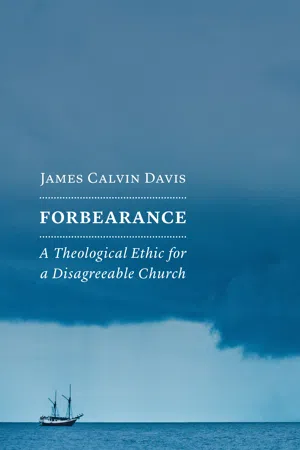
In this book James Calvin Davis reclaims the biblical concept of forbearance to develop a theological ethic for faithful disagreement. Pointing to Ephesians and Colossians, in which Paul challenged his readers to "bear with each other" in spite of differences, Davis draws out a theologically grounded practice in which Christians work hard to maintain unity while still taking seriously matters on which they disagree.
The practice of forbearance, Davis argues, offers Christians a dignified, graceful, and constructive way to deal with conflict. Forbearance can also strengthen the church's public witness, offering an antidote to the pervasive divisiveness present in contemporary culture.
- 240 pages
- English
- ePUB (mobile friendly)
- Available on iOS & Android
eBook - ePub
About this book
Information
Topic
Teologia e religioneSubtopic
Ministro del culto cristianoCHAPTER 1
Forbearance and Biblical Character
In July 2014, the General Assembly of the Presbyterian Church (USA), that denomination’s highest governing body, considered an overture calling for divestment in three companies that provide supplies for Israel’s control of the occupied territories. Past overtures labeled Israeli occupation of these lands apartheid, calling for divestment from or boycotts of any corporations that supported “non-peaceful” pursuits in Palestine. Opponents of such overtures argued that the conflict over land between Israel and the Palestinians was more complicated than the denomination’s one-sided approach, that the proposed measures would aggravate the situation in the Middle East and alienate Presbyterians’ Jewish neighbors here at home, and that such a public expression from the denomination opened the PC(USA) to the charge of being anti-Semitic. The issue was debated heatedly in 2012, with a similar overture for divestment ultimately failing by a stunning two-vote margin, eliciting an audible gasp from the Assembly when the tally was announced. This time around the push for divestment prevailed, and divided Presbyterians struggled to deal with the international implications of this denominational decision while also navigating the complications to interfaith relations in their own neighborhoods.
In 2004, the United Methodist Church opened a new chapter in its decades-long struggle over the issue of homosexuality, when it narrowly voted to add language to its Book of Discipline that made it a punishable offense within the denomination for clergy to perform same-sex marriages or themselves identify as “self-avowed practicing homosexuals.”1 Since that vote, a number of clergy have been accused of transgressing these prohibitions. Supporters of traditional views on sexuality have insisted that clergy who run afoul of the Book of Discipline should be prosecuted and defrocked. Defenders of ordination and marriage equality for gay and lesbian persons have been just as vocal in their opposition to the disciplinary language; some, in fact, have publicly disobeyed the prohibitions in order to call attention to what they perceive to be an injustice of the church. In the meantime, bishops and other officials have struggled to maintain denominational unity between the groups, with representatives from both sides threatening schism if their views do not prevail. In response, at the 2016 General Conference, the United Methodist Church made a controversial move to delay a final decision regarding LGBTQ equality, voting instead to ask the denomination’s Council of Bishops to commission a group to study the issue and report back by 2020. The battles that remain among Methodists are mirrored in similar struggles among American Episcopalians, Presbyterians, Lutherans, and other mainline Protestant denominations.
The evangelical community, too, is increasingly divided over issues of sexuality, but perhaps no topic has caused more consternation among evangelicals in the last two decades than concerns over climate change. For years, environmental stewardship struggled for attention among evangelicals, regularly overshadowed by the higher priority placed on issues such as abortion and gay marriage. But in the first decade of the twenty-first century, a growing number of evangelicals began to see climate change as a pressing theological and moral issue, arguing that the Bible entrusts with human beings the care for creation, and that we are failing that responsibility by contributing to the destruction of the planet. “Creation Care,” as many evangelicals call it, got a boost of momentum when Richard Cizik, former chief Washington lobbyist for the National Association of Evangelicals, went public with his insistence that environmentalism should be an evangelical concern. Traditionalist evangelical leaders such as James Dobson and Charles Colson publicly countered that there was no consensus within evangelicalism on either the science or the moral imperatives associated with global warming, and the power struggle within the association eventually cost Cizik his job. But Cizik, ethicist David Gushee, and other evangelical leaders continue to rally more evangelicals to the cause, resulting in a deep rift between Creation Care advocates and their evangelical opponents.2
First Presbyterian Church is in many ways a typical college-town congregation.3 Located near a prestigious school of music, First Presbyterian reflects the community’s appreciation for artistic culture. But similar to many college-town churches, First Presbyterian also hosts a deep commitment to social justice. Recently the congregation had to deal with an apparent conflict between these priorities. The church’s organ was in dire need of work, with replacement estimates exceeding one million dollars, and repair estimates promising only slight savings and ongoing maintenance issues. Supporters of the project to rehabilitate or replace the organ emphasized the importance of music to the church’s worship and its contributions to the cultural life of the city. Critics pointed out that the same sum of money might be applied to the congregation’s commitment to combatting homelessness and poverty, locally and globally. The congregation remains united in its appreciation of both its worship life and its mission to persons beyond its walls. Increasingly, however, members of the congregation found themselves at odds in a complicated disagreement about which of these priorities—music or mission—would represent a more appropriate commitment of scarce financial resources.
In my own congregation in Middlebury, Vermont, we labor to maintain a sense of community among persons who identify along an extraordinary theological range. While United Church of Christ in denominational affiliation and governance, my church is in reality an interdenominational congregation, peppered with former Catholics, diaspora Presbyterians (including myself), displaced Methodists, implicit Unitarians, and at least one Buddhist, in addition to lifelong Congregationalists. Accompanying those different denominational roots are theological and liturgical preferences that sometimes struggle to mesh. We somewhat regularly find ourselves debating the decision to include a confession of sin in the Sunday liturgy, our relationship with the traditional creeds and doctrines of the church, and the authority of Scripture. None of the debates threatens to rend our congregation, in part because of the theological dexterity of our pastor, but the convictions that animate these disagreements run deep enough that they require deliberate maintenance, and from time to time some in our church family wonder what holds us together—and whether it makes sense for us all to gather as one body on Sundays.
Do you recognize your own congregation or denomination among these portraits? Of course, conflict is not all there is to say about the life of the church in the United States, but truth be told, conflict is increasingly a dominant characteristic of the churches with whom we identify. And the issues that divide us extend well beyond the illustrations I have offered here. Abortion, immigration, evolution, health care, interfaith relations, property rights, the deity of Christ—the list of issues over which congregations and denominations debate and disagree grows longer, while the road between conflict and division grows shorter. We seem to have more over which we disagree and less tolerance for the disagreement. And too often we avail ourselves of the luxury that comes from living in a society of “voluntary associations.”4 We volunteer to disassociate; we gather together our like-minded allies and we split.
Christians have been disagreeing about matters profound and mundane since Peter and Paul. Leaders in the early church famously disagreed about the importance of joining the Jewish community by means of circumcision as a prerequisite for entry into Christian fellowship. Christian leaders in the third and fourth centuries battled over the meaning of the Trinity, and the precise way in which the human and the divine cohabited in the person of Jesus. Throughout the medieval and early modern periods, Christians disagreed over fundamental theological convictions such as the definition of church authority, the best modes of scriptural interpretation, and the nature and extent of salvation. They also debated all kinds of practical implications of Christian faith, like the acceptability of loans with interest or the morality of Christian participation in war. During the Reformation, Protestant Christians divided from the Roman Church, but they also disagreed among themselves over the definition of a “true” church and the proper understanding of the Lord’s Supper. Since the Reformation, Protestants have been dividing and dividing and dividing, over theological matters great and small, so that the very character of American religion is division into a seemingly infinite variety of communities and sub-communities.
For as long as there has been a church, then, there has been disagreement and division in it. Seen in this context, the divisiveness we experience in the contemporary American church would seem to be nothing extraordinary. As I write, American Christians remain divided about the wars in Afghanistan and Iraq; were the invasions legitimate by the standards of just war, unjustified by those standards, or unjustified because the standards themselves are a perversion of the priority of peace for which Jesus himself stood? Do those wars make us morally culpable for the atrocities committed by ISIS? American Christians remain deeply divided over the situations in Syria and Palestine, and whether the United States has a right or duty to intervene more directly in either situation. We disagree on what justice requires in the current economy. Does it require government simply to ensure structural reforms in the financial sector in order to provide equal opportunity for all citizens to reap the benefits of capitalism, or does it require government to guarantee a basic minimum income, education, and health care for everybody, underwritten by public aid? Christians disagree over immigration policy, matters of church governance, the role of women in ecclesial leadership, and the authority of Scripture. We disagree about a lot in the contemporary church, but all of the infighting is just the church—as Hank Williams Jr. once crooned—“carrying on a family tradition.”
None of these matters of debate is trivial in the eyes of those who fight for or against them. Frequently the combatants understand nothing less than the integrity of the church and its witness to be at stake. To my mind, however, neither the longevity of our tradition of division nor the seriousness of the issues justifies the threat to the unity of the church that we inflict with such abandon. For a tradition that values the virtues of community, that conceives of the church as a “family” of faith and the “Body of Christ,” our inability to maintain community would seem to be a significant theological failure, no matter how much historical precedent exists. Especially in an age of shrinking membership and evaporating cultural presence, it also seems practically appropriate to seek another way to approach the matters over which we disagree. Are there ways in which we can negotiate our differences that are truer to the priorities of love, neighborliness, and unity that characterize the message of Jesus? What might it mean to negotiate disagreement in ways that are better governed by the virtues of Christ?
To seek something different from this long legacy of division is natural and just as consistent with the history of the church as our penchant for schism. Once upon a time, we executed for blasphemy and declared war over matters of religion, but since the seventeenth century the church in the west has resorted largely to ecclesial division, not violence, as a response to its disagreements—an improvement in strategy, to be sure. Yes, there were political and practical motivations for the abandonment of “wars of religion” in the modern west. Increasing religious pluralism and the demands of international stability required that we negotiate religious differences without bloodshed. But freedom of conscience, religious pluralism, and the negotiation of difference in nonviolent ways increasingly were seen as important theological values as well. Christians began to see that there are better and worse ways to navigate disagreement, and violence was a worse way. So while disagreement and division among Christians are as old as the tradition itself, Christianity has evolved in the manner in which it negotiates all of that difference. Might we continue the evolution, finding ways to approach disagreement in the church that are a more constructive reflection of Christian values, that serve as alternatives to the penchant for division that especially characterizes American Protestantism?
Encountering Difference while “Thinking Theologically”
In recommending a different way of negotiating difference in the church, I do not mean to suggest that we should artificially minimize the differences or eliminate conflict between us. In fact, we should anticipate a plurality of perspectives as people in the church attempt to discern what is right and true in the confluence of Christian belief and our contemporary world. And we should expect some conflict between these different assessments of truth, as Christians together embrace the task of thinking theologically. For “thinking theologically” is what all of us are called to do, not just highly trained academics but pastors and lay members of the Christian community.
What does it mean to “think theologically” as the church? I define the task this way: Christian theology is the collective project of understanding ourselves, the human community, the world, and the cosmos in relation to God, through the interpretive lens of what Jesus Christ reveals to us about God and in conversation with the best sources of knowledge available in our time and place. Allow me to highlight a couple of components to this understanding of Christian theology.
First, as I have asserted already, Christian theology is a responsibility of the whole church. Some members of the church will be trained to offer instruction or expertise, and that leadership is important if we are to think theologically with responsible understanding of both the past and the present, but the task of theology ultimately belongs to the entire church.
Second, the objective of theology is to understand ourselves in the most expansive context possible; that is, we seek to understand ourselves in relationship to the human community and the greater cosmos, and to understand the cosmos in relation to God. In fact, when done well, Christian theology pushes us beyond nationalism, anthropocentrism, and other constricted understandings of our own importance to more expansive contexts for truth and responsibility.5
Third, we interpret the cosmos, its subsets, and our places in them through the lens of what Jesus Christ discloses to us about the attributes and intentions of God. Jesus Christ becomes the prism through which our speculations about what is “really real” or “really going on” are refracted. Our perceptions of truth strive for consistency with what we believe to be important to the divine character, which we Christians believe we have glimpsed in the incarnation of God in Christ.
Finally, this interpretation of ourselves and our universe in relation to God actively engages the insight of other sources of knowledge available to us—science, history, philosophy, literature, and other disciplines. Christian theology is not done in a vacuum but strives to correlate what we learn from Scripture and Christian tradition with what we know from these other sources of information. For as Douglas F. Ottati writes, “these additional inquiries will be understood, first and foremost, as attempts to develop and refine—in a way that engages culture and takes account of recent knowledge and experiences—the piety and practical vision of human life and the world offered by a particular Christian community.”6 The effort to correlate sometimes shapes our interpretation of the data gleaned from other disciplines, but sometimes it prompts a revision of our understanding of what religious tradition has told us is right and true.7
Conceived of this way, the task of thinking theologically includes a number of opportunities for Christians to come to different understandings. In order to view ourselves and the universe through the lens that Jesus Christ provides for understanding God, we must decide what it is exactly that Jesus disclosed about God in his life, ministry, death, and legacy. Of course, Christians have drawn very different conclusions about what we know about God through Jesus. Those possibilities for different interpretations are on display in the Bible itself; the four Gospels tell essentially the same loose biographical account, but in the process they depict Christ in remarkably different ways and commend distinct conceptions of what it means to follow the way of Jesus. Compare, for instance, Luke’s depiction of discipleship as solidarity with the marginalized to Mark’s frantic apocalypticism, or Matthew’s moralism to John’s mystical emphasis on love. The diversity of interpretation on display in the Gospels is poignantly magnified in the New Testament epistles, as the realities of living as the community of Jesus created disagreements over the liturgical, theological, moral, and social implications of that identity.
And if the Bible features a plurality of theological interpretations of what Jesus Christ disclosed ...
Table of contents
- Title Page
- Copyright
- Contents
- Preface
- Acknowledgments
- 1. Forbearance and Biblical Character
- 2. Humility
- 3. Patience and Hope
- 4. Wisdom
- 5. Faithfulness
- 6. Friendship
- 7. Truth
- 8. Justice
- 9. Forbearance as Social Witness
- Appendix
- Notes
- Selected Bibliography
- Index of Names and Subjects
- Index of Scripture References
Trusted by 375,005 students
Access to over 1.5 million titles for a fair monthly price.
Study more efficiently using our study tools.
Frequently asked questions
Yes, you can cancel anytime from the Subscription tab in your account settings on the Perlego website. Your subscription will stay active until the end of your current billing period. Learn how to cancel your subscription
No, books cannot be downloaded as external files, such as PDFs, for use outside of Perlego. However, you can download books within the Perlego app for offline reading on mobile or tablet. Learn how to download books offline
Perlego offers two plans: Essential and Complete
- Essential is ideal for learners and professionals who enjoy exploring a wide range of subjects. Access the Essential Library with 800,000+ trusted titles and best-sellers across business, personal growth, and the humanities. Includes unlimited reading time and Standard Read Aloud voice.
- Complete: Perfect for advanced learners and researchers needing full, unrestricted access. Unlock 1.5M+ books across hundreds of subjects, including academic and specialized titles. The Complete Plan also includes advanced features like Premium Read Aloud and Research Assistant.
We are an online textbook subscription service, where you can get access to an entire online library for less than the price of a single book per month. With over 1.5 million books across 990+ topics, we’ve got you covered! Learn about our mission
Look out for the read-aloud symbol on your next book to see if you can listen to it. The read-aloud tool reads text aloud for you, highlighting the text as it is being read. You can pause it, speed it up and slow it down. Learn more about Read Aloud
Yes! You can use the Perlego app on both iOS and Android devices to read anytime, anywhere — even offline. Perfect for commutes or when you’re on the go.
Please note we cannot support devices running on iOS 13 and Android 7 or earlier. Learn more about using the app
Please note we cannot support devices running on iOS 13 and Android 7 or earlier. Learn more about using the app
Yes, you can access Forbearance by James Calvin Davis in PDF and/or ePUB format, as well as other popular books in Teologia e religione & Ministro del culto cristiano. We have over 1.5 million books available in our catalogue for you to explore.