We live in an urban age. To a degree unprecedented in human history, most of the world's people live in cities. It is thus vital, say Mark Gornik and Maria Liu Wong, for Christians to think constructively about how to live out their faith in an urban setting.
In
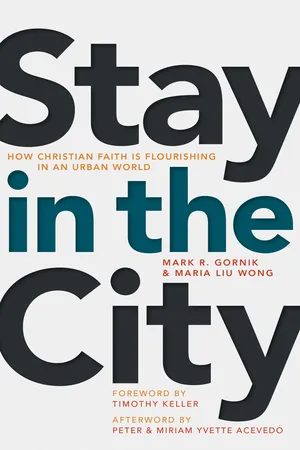
Stay in the City Gornik and Liu Wong look at what is happening in the urban church—and what Christians everywhere can learn from it. Once viewed suspiciously for their worldly temptations and vices, cities are increasingly becoming centers of vibrant Christian faith. Writing from their experience living and working in New York City, Gornik and Liu Wong invite readers everywhere to join together in creating a more flourishing—and faith-filled—urban world.
eBook - ePub
Stay in the City
How Christian Faith Is Flourishing in an Urban World
- 95 pages
- English
- ePUB (mobile friendly)
- Available on iOS & Android
eBook - ePub
About this book
Information
Topic
Teología y religiónSubtopic
Ministerio cristianoChapter 1
More Is Going On
If you want to experience joyous singing, dancing, and praising God, go to Manida Street in the Hunts Point neighborhood of the South Bronx. Here, nestled among the blocks of residences, shops, restaurants, and warehouses, you will find the Damascus Christian Church of Hunts Point.
Led by pastors Jonathan and Soñia Roque, Damascus doesn’t just meet on Sunday afternoons for worship but throughout the week for prayer, Bible study, shared meals, and neighborhood ministry. In fact, each day begins with a 6:00 a.m. call-in prayer meeting by phone. Few churches seem more committed to children and families, with their young people involved in leading the service. Throughout the year, members can attend the Damascus Bible Institute, which offers classes in the Bible and Christian doctrine.
Founded over seventy-five years ago in the Bronx by the ministerial couple Leoncia and Francisco Rosado, the church also began a ministry to men and women with addictions. Today the Council of Damascus Christian Churches includes over two hundred affiliated Damascus churches in the United States and Latin America, just as committed to evangelism, healing, prayer, and worship as when they were founded. Jonathan is not only the pastor of the church but also the bishop of the Council of Damascus Churches.
The people who attend are New Yorkers: families, social workers, police officers, students, educators, and health-care workers. There is no full-time paid staff at Damascus of Hunts Point, and their old building has an endless litany of leaks and problems to be solved. The people of Damascus are all stretched by a faith that moves across work, church, and life. But together they pray without ceasing, carry one another’s burdens, and continue to live out the church’s founding vision to bless the city and invite all people to begin a new life in Christ. They are a family of brothers and sisters in Christ.
***
Urban life is marked by constant, unpredictable, and dynamic movement in every direction and space. It is full of surprise and the unexpected. You never know what is going to happen, whom you may meet, or what you will find when you walk out the door in the morning.1
Here is one of the biggest surprises in the story of the church in New York, North America, and cities across the world: instead of a place where faith struggles and dies, the twenty-first-century city is where the church comes to grow and thrive. Whether Pentecostal or Catholic, mainline or evangelical, new things are percolating as the church has stayed in the city and responded to God, enacting and proclaiming the gospel.
We see this in our city. Every Sunday, across New York’s diverse neighborhoods, from the South Bronx to Manhattan to Queens, Staten Island, and Brooklyn, men and women, children and young people, and families and singles leave their homes and apartments to attend church. By subway or bus, driving a car or walking, they go to meet in schools, recreation centers, traditional church buildings, retired nursing homes, reconfigured hotel buildings, warehouse spaces, and rented meeting halls—anywhere there is a room or a corner to sing, pray, hear the Word, and share a meal.
We see this in cities around the world, from Africa and Asia to Latin America and Europe and North America, on university campuses and on side streets in favelas, in rented rooms or hotels where workers gather midday in Asia, and in the high-rise offices of investment firms across the globe.
Surprised by what God is doing in the city? You are not alone. We are continually. So was the apostle Paul.
As Wayne Meeks showed in The First Urban Christians, Paul had a vision for birthing, growing, and connecting together new churches in the Roman urban world.2 City by city, Paul proclaimed Christ and the kingdom of God, “the mystery hidden for ages in God,” as we read in Ephesians (3:9). In Acts 18, we find a description of the apostle Paul’s ministry in the city of Corinth, a growing and diverse city in his day. But Paul does not feel things are going so well. He is in the city doing difficult missionary work, proclaiming the gospel alongside people like Priscilla, Aquila, Silas, and Timothy. Together they are working to build new communities of followers of Jesus in the city.
Paul is a servant of God, but perhaps he has fears, disappointments, and uncertainty about the impact of his apostolic work. Into this moment, when he feels alone and discouraged in his efforts, God speaks a word not of judgment but of joy and encouragement: Do not be afraid. Keep up your ministry. I am with you. I have many people in this city (Acts 18:9–10).
The language of “I am with you” is the language of God’s covenant that began with Abraham. But God is also with Paul through people in the city who are doing things he has no idea about. As The Message translation puts it, “You have no idea how many people I have . . . in this city.”
This word to Paul recalls what God spoke to Elijah in 1 Kings 19. Fearing for his life, Elijah says to God, “I alone am left.” And then God tells him there are seven thousand faithful in Israel. You are not alone. There is more going on than you know about.
Like Paul, even a prominent church leader might not know about certain things going on in the city. This is not a judgment, but an invitation to open our vision to see things going on that we might not otherwise perceive. It is also a recognition that the church is in God’s hands, not Paul’s or ours.3
The same is true today. While many churches have stayed faithful in the city across the course of years, particularly African American congregations and parishes, arguably the most important factor for the growth of faith today is global migration between cities. As people have moved around the world and to cities, they are bringing their faith and faith communities with them. Migrations today, born from war and displacement in the Middle East and violence in Central America, for example, bring new challenges to Christian conviction and mission. But in almost any American city today, we can see how immigration over the past decades has brought into view a whole world of Christianity. Every day it seems there are new church signs in Spanish. Churches with congregations rooted in Asia have been established and are growing, while evolving in language and cultural emphasis with new waves of immigration. And African churches are sprouting up everywhere. Overall, migration has been a major net gain for Christianity.4
As is so often the case in our global economy and world, the churches that appear to be growing most rapidly are doing so through decentralized networks of relationships and movements across cities. This is not unlike the first century, when the expansion of the church was based on networks of leaders, evangelists, pastors, and families that supported, trained, and helped one another.5 This was, and is, the ecosystem of urban church life.
I (Mark) remember when my vision and world were turned upside down. It was 1998 and I had just moved from Baltimore to do church and community development work in Harlem. On first view, the neighborhood resembled closely my Sandtown neighborhood in Baltimore, a community marked by population loss, abandoned buildings, and struggles in the basics of life. But I soon began to see something else.
All around us in New York were signs of a new global migration—West Africans from Senegal, Ghana, Gambia, and the Ivory Coast were moving to Harlem and opening new restaurants and businesses. While many of our neighbors were Muslim, I began to wonder if some of the new African immigrants might be Christian.
After doing a little bit of homework, I learned about and visited the Emmanuel Worship Center, an Ethiopian Pentecostal church in the Bronx. The pastor mentioned another church led by African Christians in Brooklyn called the Redeemed Christian Church of God. After visiting them on a Sunday for worship, I learned that Redeemed was part of a ministry based in Lagos with thousands of churches around Africa and the world. One of the next churches I visited was right up the street from the seminary—the Presbyterian Church of Ghana, a church with over 175 years of history in Africa, now bursting at the seams in Harlem.6
Over the next ten years, I learned that there were over two hundred African churches in the city. Just as remarkable to me, as I spent my Sundays and more in the neighborhoods and churches of the city, I learned that there are well over two thousand churches in New York founded and led by Christians from Africa, Asia, Latin America, and the West Indies. It was right in front of me, but more was going on than I was able to imagine without a larger way of seeing, thinking, and being bodily present to the work of the Spirit in the city. I needed a new framework to understand how the church was growing and ministry was being practiced.
Today, it is estimated that more than one in ten New Yorkers is a Pentecostal Christian.7 With New York’s history of religious tolerance going back to the Dutch, it is fertile ground for new church life based on the evangel, the good news, to thrive. Like the first-century church, and like early Methodism, today’s expansion of the church is based on networks of leaders, evangelists, pastors, and families that support, train, and help one another.
In Ephesians, Paul emphasizes the unity of the church. The body of Christ is the abundance of God’s salvation expressed in one new people of peace. As the historian of Christian mission Andrew Walls observes, it is only by listening to and learning from one another in the diversity of all of the cultures, languages, and histories where Christ is being formed that we can reach the fullness of Christ.8 When this occurs, it is the gift of an Ephesians moment.
But amidst such diversity and change, we may also think of the differences between us. In Philippians 3, Paul recognizes a variety of ways in which God is working through people. He knows that Christians don’t all do things the same way, but all are on a journey to seek the kingdom of God. In the midst of such Christian growth and diversity, Paul’s challenge is a basic one: to hold fast to what has been attained and do everything in the name of Jesus.
The church has stayed in the city, getting used to surprises and waiting on God to move. This is good news indeed.
QUESTIONS TO CONSIDER

Chapter 2
Whatever You Do
Bola, a banker in midtown Manhattan, labors long hours in the banking industry, navigating the complexities of local needs and the global economy. Since moving to New York fro...
Table of contents
- Title Page
- Copyright
- Dedication
- Contents
- Foreword by Timothy Keller
- Prologue: Urban Christians
- Introduction: Stay in the City
- 1. More Is Going On
- 2. Whatever You Do
- 3. Art and Public Faith
- 4. Make Yourselves at Home
- 5. The Next Generation
- 6. Lessons for the Long Run
- Epilogue: Joy in the City
- Afterword by Peter and Miriam Yvette Acevedo
- Acknowledgments
- More about City Seminary of New York
- Notes
Trusted by 375,005 students
Access to over 1.5 million titles for a fair monthly price.
Study more efficiently using our study tools.
Frequently asked questions
Yes, you can cancel anytime from the Subscription tab in your account settings on the Perlego website. Your subscription will stay active until the end of your current billing period. Learn how to cancel your subscription
No, books cannot be downloaded as external files, such as PDFs, for use outside of Perlego. However, you can download books within the Perlego app for offline reading on mobile or tablet. Learn how to download books offline
Perlego offers two plans: Essential and Complete
- Essential is ideal for learners and professionals who enjoy exploring a wide range of subjects. Access the Essential Library with 800,000+ trusted titles and best-sellers across business, personal growth, and the humanities. Includes unlimited reading time and Standard Read Aloud voice.
- Complete: Perfect for advanced learners and researchers needing full, unrestricted access. Unlock 1.5M+ books across hundreds of subjects, including academic and specialized titles. The Complete Plan also includes advanced features like Premium Read Aloud and Research Assistant.
We are an online textbook subscription service, where you can get access to an entire online library for less than the price of a single book per month. With over 1.5 million books across 990+ topics, we’ve got you covered! Learn about our mission
Look out for the read-aloud symbol on your next book to see if you can listen to it. The read-aloud tool reads text aloud for you, highlighting the text as it is being read. You can pause it, speed it up and slow it down. Learn more about Read Aloud
Yes! You can use the Perlego app on both iOS and Android devices to read anytime, anywhere — even offline. Perfect for commutes or when you’re on the go.
Please note we cannot support devices running on iOS 13 and Android 7 or earlier. Learn more about using the app
Please note we cannot support devices running on iOS 13 and Android 7 or earlier. Learn more about using the app
Yes, you can access Stay in the City by Mark R. Gornik,Maria Liu Wong in PDF and/or ePUB format, as well as other popular books in Teología y religión & Ministerio cristiano. We have over 1.5 million books available in our catalogue for you to explore.