- 180 pages
- English
- ePUB (mobile friendly)
- Available on iOS & Android
eBook - ePub
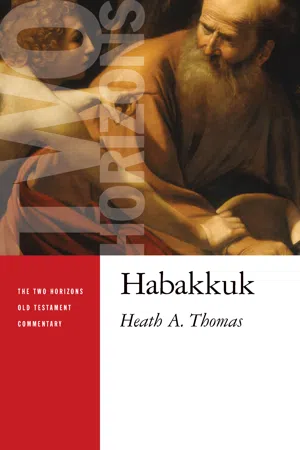
Habakkuk
About this book
The book of Habakkuk has much to teach us about suffering and complaint, faith and fear, and the fidelity of God in times of trouble; it generates reflection on prayer, peace, violence, and faithfulness. In this volume—one of the few commentaries examining Habakkuk by itself—Heath Thomas explores this overlooked Old Testament prophet in order to hear God's word for us today.
Information
Print ISBN
9780802868701
Subtopic
Bibelkritik & -auslegungPART I
INTRODUCTION AND COMMENTARY
Introduction
The French philosopher Voltaire liked to make jokes about the prophet Habakkuk. With biting wit, Voltaire teased that the prophet “smelt too strongly of brimstone” to be tolerated by pious Protestants.1 Evidently, it got so bad that he fabricated the events of Habakkuk’s life in various lectures. While in Germany a scholar confronted the philosopher about the infelicities in his narrative about the prophet, all jokes aside. Voltaire defiantly refused to back down, retorting: “Sir, you do not know much about this Habakkuk. This rogue is capable of anything!”2
Why did Voltaire think Habakkuk more hellish than holy? What was the grudge? It is not entirely clear. Perhaps Voltaire did not like the fact that “this rogue” asked forceful questions that might be construed as faithless, especially in Hab 1:2–4. If this is the case, then Voltaire is not alone. Jewish and Christian interpreters throughout the history of the book’s reception have held similar positions on Habakkuk, as will be revealed in this commentary. Whatever Voltaire’s issue may have been, this commentary hopes to demonstrate the book that bears Habakkuk’s name is theologically rich and extraordinarily pertinent in the way that it negotiates human suffering and the confusion that arises from it.
This volume reads the book of Habakkuk theologically. That statement may not help as much as one would hope, however, because a “theological” commentary can mean many things. Despite the range of perspectives on theological commentaries, the goal here is to explore the book in such a way that it helps readers of Habakkuk hear God’s address. The specifics of this approach are elucidated more fully in A Manifesto for Theological Interpretation.3 As indicated in the Manifesto, this goal does not for one moment avoid academic rigor regarding philological, historical, sociological, or literary dimensions of Habakkuk, which have generally been set under the rubric of “biblical criticism.” Nor does it mean that this is an ecclesial commentary that lies outside the purview of academic and critical exploration of Habakkuk. Rather, here biblical criticism is recalibrated within the larger aim of hearing God’s address through the prophetic book.
Another way of saying this is that biblical criticism is not an end in and of itself in this theological commentary. With its emphasis on seeing the Scriptures against a historical canvas, biblical criticism is salutary, but alone it remains insufficient for theological interpretation. It is insufficient because it is an effort, for many today, to bracket out either the truth of what the Bible claims or to negate the possibility of divine agency within its field of study. Biblical criticism proceeds on purely naturalistic or humanistic grounds. Because the primary object and agent of Scripture is God and his agency in the world, biblical criticism alone cannot sustain theological interpretation. In a long but fertile quote, Murray Rae puts his finger on the inbuilt limitations of biblical criticism, traditionally defined. The principal reason for its limitation is
that naturalistic approaches, whether ontological or methodological, preclude the historian from engaging with the subject matter of the Bible, which is precisely the engagement of God with his creation through the course of human history. The Bible tells of the divine economy. It makes no sense, therefore, to suppose that we can study the Bible well by setting aside the category of divine agency.4
Theological interpretation understands that the Scriptures testify about God, who has spoken to various peoples at various times in history through various peoples (prophets, apostles, etc.), a claim attested in Heb 1:1. But the word of God, spoken in the past, has been received and written for reception by later generations. In both the former revelation of God to people in history and the way that revelation has been inscribed in the word of God, Scripture is the record and canonical deposit of God’s revelation.5 The record of revelation is the reality that God has, in fact, spoken and worked with and through his people in the past and Scripture testifies to God’s former speech and action. As it relates to the book of Habakkuk, God spoke to the prophet in the past, and the book of Habakkuk records that past revelation which apparently was for the prophet and his immediate audience. And yet Scripture is also the deposit of revelation as well. God’s revelation of himself disseminates far and wide by the deposit of former revelation into written and canonical Scripture. Theologian Herman Bavinck describes the relationship between the record and deposit of revelation in this way:
The written word differs from the spoken in these respects that it does not die upon the air but lives on; it is not, like oral traditions, subject to falsification; and that it is not limited in scope to the few people who hear it but is the kind of thing, rather, which can spread out to all peoples and to all lands. Writing makes permanent the spoken word, protects it against falsification, and disseminates it far and wide. . . . True, Scripture is to be distinguished from the revelation that precedes it, but it is not to be separated from that revelation. Scripture [as a “deposit” of revelation] is not a human, incidental, arbitrary, and defective supplement to [the record of] revelation but is itself a component part of revelation. In fact Scripture [as the deposit] is the rounding out and the fulfillment, the cornerstone and capstone of revelation.6
Bavinck’s words above indicate the fundamental reality that God speaks, communicating himself to a needful humanity.
Attuning our reading to an attentive “listening for God’s address” arises from the Christian affirmation of the Triune God. Scripture in its full testimony speaks to the redemption and comprehensive rule of Jesus, the only begotten of the Father. Transformation through reading the Scriptures occurs with the initiative of God the Father, through Christ, by the illumination of the Holy Spirit. It is the Father who offers the book of Habakkuk, from which he speaks and then leads us to the Son, whom we see and to whom we respond by the prompting of the Spirit. This movement of the Triune God toward a needful humanity is missional and rooted in God’s eternal love.
Reading for transformation, then, is a Trinitarian movement into which we are drawn. As we read for transformation, the Lord ushers readers to a richer understanding and love of both God and the world. Such reading will be alert to (at least) four interweaving threads throughout the tapestry of this commentary:
1. Attention to the historical, philological, literary, and theological context of Habakkuk enables one to hear God’s address. Yahweh, who is revealed as Israel’s God and pictured as Israel’s Father (Exod 4:22), provided the oracles of Habakkuk to his people in the past. Its historical context (language, background, social world, etc.) reveals Israel’s God, his ways, his message, and his testimony that he wants to give to his people. Especially in Habakkuk, God’s message is one of judgment and yet hope, which his people may embrace in faith. Neglecting the discrete witness that God has given to the prophet and his people leads to a denial of the Father’s work with Israel and the importance of his word. It also neglects the context in which we understand God, his ways, his world, and his purpose with creation. Without the context, our understanding of the culmination of God’s work in Christ suffers. Second, Scripture is written with literary beauty and artistic verve. Attending to the literary components of the text is vital to understanding its meaning. Its literary quality exhibits its placement within the culture of Israel and the ancient Near East. Habakkuk as a cultural phenomenon from the ancient world needs to be understood in all its particularity. Essential to this particularity is the linguistic context from which the prophetic book emerges. As such, attending to philological questions, grammar, syntax, and comparative Semitics opens up Habakkuk meaningfully.
2. The historical contexts of Habakkuk fit within the dramatic narrative of Scripture. The Old Testament repeats the events it describes with Israel over and again, and we see this iteration as a wrestling on the part of Israel in their relationship with God. The classic example is the exodus experience, including Egyptian slavery, plagues, deliverance, the miraculous crossing of the sea, worship at Sinai, and provision in the wilderness. This overarching narrative echoes throughout the Old Testament, as Cornelius Houtman has shown in his multivolume commentary and Brent Strawn confirms.7 Only a brief survey of texts reveals its pertinence in the corpus: in the second generation of Joshua and Caleb in the entrance and conquest of Palestine (Josh 1–12), in the Elijah narrative at Sinai (see esp. 1 Kgs 18), in the exile and wilderness imagery of Isa 40–55, and in the recitals of the Psalter (Pss 18; 29; 77; 78; 105), among other texts. Exodus tradition is drawn upon in Hab 1 and especially Hab 3. Yet for all its diverse reception and repetition in the Old Testament, the moments of Israel’s history enfold within God’s larger purposes of redemption of the entire world as testified by the Old Testament en toto. God’s destiny for Zion as the picture of a broken and battered city, yet ultimately the picture of new heavens and new earth, is a classic example from the book of Isaiah, and a similar picture emerges for Zion in the Minor Prophets. God’s activities with Israel in historical moments are not divorced from one another nor are they divorced from God’s plan of redemption. Rather, each historical moment is related to God’s redemption, and ultimately his redemption that comes in Jesus Christ the Son.
The Scriptures, then, disclose Christ. But this disclosure is not monochromatic. The Old Testament provides the context by which to understand Christ in his fullness: he is the Davidic messiah and suffering servant; he is the firstborn of creation; he is the fulfillment of Israel’s story; he is the prophet, priest, judge, and king; he is the second Adam; he is the second Moses; he is the faithful Israelite; he is the Son of God.
So, the Old Testament provides the matrix out of which the Scriptures disclose the fullness of Jesus. From it we understand Christ’s identity and mission. By it we come to understand God, the world, and Christ.8 Trinitarian Christian faith accepts Christ as the clue that leads us to fully understand God’s work that brings the discrete hi...
Table of contents
- Title Page
- Copyright
- Dedication
- Contents
- Acknowledgments
- Abbreviations
- Part I: Introduction and Commentary
- Part II: Theological Horizons
- Select Bibliography
- Author Index
- Subject Index
- Scripture Index
Trusted by 375,005 students
Access to over 1.5 million titles for a fair monthly price.
Study more efficiently using our study tools.
Frequently asked questions
Yes, you can cancel anytime from the Subscription tab in your account settings on the Perlego website. Your subscription will stay active until the end of your current billing period. Learn how to cancel your subscription
No, books cannot be downloaded as external files, such as PDFs, for use outside of Perlego. However, you can download books within the Perlego app for offline reading on mobile or tablet. Learn how to download books offline
Perlego offers two plans: Essential and Complete
- Essential is ideal for learners and professionals who enjoy exploring a wide range of subjects. Access the Essential Library with 800,000+ trusted titles and best-sellers across business, personal growth, and the humanities. Includes unlimited reading time and Standard Read Aloud voice.
- Complete: Perfect for advanced learners and researchers needing full, unrestricted access. Unlock 1.5M+ books across hundreds of subjects, including academic and specialized titles. The Complete Plan also includes advanced features like Premium Read Aloud and Research Assistant.
We are an online textbook subscription service, where you can get access to an entire online library for less than the price of a single book per month. With over 1.5 million books across 990+ topics, we’ve got you covered! Learn about our mission
Look out for the read-aloud symbol on your next book to see if you can listen to it. The read-aloud tool reads text aloud for you, highlighting the text as it is being read. You can pause it, speed it up and slow it down. Learn more about Read Aloud
Yes! You can use the Perlego app on both iOS and Android devices to read anytime, anywhere — even offline. Perfect for commutes or when you’re on the go.
Please note we cannot support devices running on iOS 13 and Android 7 or earlier. Learn more about using the app
Please note we cannot support devices running on iOS 13 and Android 7 or earlier. Learn more about using the app
Yes, you can access Habakkuk by Heath A. Thomas in PDF and/or ePUB format. We have over 1.5 million books available in our catalogue for you to explore.