Accessible, comprehensive, and up-to-date,
Interpreting the Gospel and Letters of John is an ideal text for students new to the discipline of biblical studies. Sherri Brown and Francis J. Moloney present a broad overview of the story of Christianity arising out of its Jewish foundations and proceed to guide readers expertly through the contents of the Gospel and Letters of John.
Maintaining that Johannine literature is best understood against the background of the Old Testament covenant metaphor, Brown and Moloney focus on the central role of covenant in the narrative of John's Gospel and highlight the Evangelist's use of fulfillment language. Helpful sidebars, maps, questions for review, and further-reading lists are placed throughout the text, making this volume well suited for classroom use.
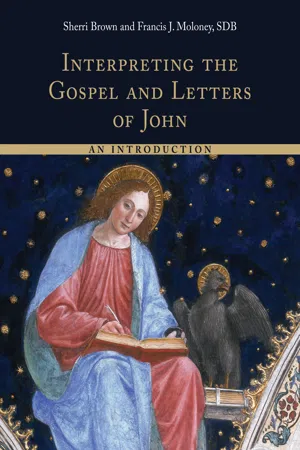
eBook - ePub
Interpreting the Gospel and Letters of John
An Introduction
- 371 pages
- English
- ePUB (mobile friendly)
- Available on iOS & Android
eBook - ePub
About this book
Information
Topic
Theology & ReligionSubtopic
Biblical StudiesCHAPTER ONE
The Origins and Development of the Bible
PURPOSE Chapter one discusses the Bible as the Scripture of Christianity by introducing the concept of canon and surveying the history and development of the Jewish and Christian canons. Understanding the complexity of the biblical text will allow for a more detailed discussion of its contents and their interpretation.
ASSIGNMENT Skim the Table of Contents of your Bible, and then thumb through the books to get a sense of the overall format and organization.
As we noted in the Introduction, both the Jewish and Christian traditions use the term Scripture to refer to those writings the community of faith has set apart as holy. Scriptures arise in religious communities to serve their particular needs as they struggle to understand their experiences of God and define themselves in relationship to the rest of their society. Since the Christian Scriptures are made up of both the Old and the New Testaments, we can discuss the composition of each part as well as how they came together to form the Bible.
Scripture, Canon, and the World That Gave Us the Bible
In the ancient world, where 90 percent of the people could neither read nor write, their shared history in relationship with God was passed down through the generations by word of mouth. Only particular forces, either internal, external, or both, compelled these communities to find the resources to record and preserve their oral traditions in more permanent written forms. As we will see in this chapter, the Jewish people began to pull their traditions together into a written narrative around 1000 BCE during the reign of King David. This time of peace and prosperity in the kingdom of Israel allowed for reflection and collection of traditions as part of court records. Some 500 years later, however, the external forces of the Babylonian Empire imposed upon the kingdom, overrunning the land and sending the people into exile from 587 to 538 BCE. This dark period in the history of the Jewish people was a key factor in solidifying the composition of their Scripture. To keep the hope of their religion alive, the people told stories and recorded them in written form for posterity. Across the next 500 years, as the people restored their homeland and developed their particular religious sensibility, they continued to preserve their experiences in written form.
Likewise, as Christianity developed, the disciples and leaders of the early movement, called apostles, passed on their experiences of Jesus Christ and his teachings by word of mouth as they moved from town to town sharing the good news and founding Christian communities. As we discussed in the Introduction, Paul created the earliest extant writings of the Christian faith with his letters to communities as he traveled through the Roman Empire on his missionary journeys. The Gospels, however, were not composed as fully developed narratives until the community felt the need to preserve them. We will discuss this in more detail in chapter four, but we can note here that by 70 CE, about 40 years after the crucifixion of Jesus, the community of believers was experiencing the death of their first generation of disciples and leaders. This internal force of loss was compounded by the devastating external consequences of the First Jewish Revolt against Rome, which occurred ca. 65–70 CE. Although the Jews led a valiant strike against the empire, the Romans eventually surrounded Jerusalem and, after an extended siege, broke through the city walls and burned everything in their path. The Jewish temple was destroyed, and both Judaism and the burgeoning Christian movement were in danger of fading into the shadows of history. The Jewish people dealt with this blow in their own way, which we will discuss in the next section, while the Christians began to compose their stories about the life and teachings of Jesus in written form. The Gospels were written across ca. 70–110 CE and circulated throughout the Christian community to share the message and affirm the faith of believers.
Josephus and His Writings
Flavius Josephus (37–100 CE), a Jewish scholar and eventual militant leader who was forced to surrender to the Romans, recorded the many events of the First Jewish Revolt against Rome (65–70 CE). The book is called The Jewish War and is a striking record, even though it is written in support of the Roman offensive. He also wrote a long history of Israel, called Jewish Antiquities. These works aid scholars in studying ancient Judaism.
The World of the Text and the Canon It Produces
The question of how an authorized collection of these writings known as Scripture developed is a question of the canon. In the end, a canon is a list of books that have authority for a given community. The word “canon” comes from a Greek word that means “rod,” or “reed.” Such canons were used for measuring. When the word is applied to a list of books, the implication is that these books are the “standard of measure” for the community. The term “canon” also indicates a plumb line, a weight on a string used to make sure a wall is straight. A canon of Scripture, therefore, also ensures that the life and thought of the community are directed by the Word of God to be correct, or “straight.”
So-called canons of scripture develop on the basis of a perceived need for authority. It is sometimes thought that the Christian canon was imposed by authorities such as bishops or emperors. As we will see below, it worked the other way: the Christians gave authority to the books that made most sense of their attempt to live and believe in a Christian way. As we discussed with the writing of Scripture, factors, sometimes internal to the group and sometimes external to it, generated questions in the Christian communities that had to be answered. They eventually became so important that leaders across early Christian communities reflected upon which books were to be “in” the canon, and which books would be excluded. This section discusses the formation of the Christian canon by surveying the history of the development of the books as well as the process that led to the selection of some books to be regarded as “inspired Scripture” and the rejection of others. This is called the process of canonization. It has nothing to do with declaring people “saints” by canonization, but it means the establishment of a small library of books that the early Christians call their canon of Scripture.
Chapters three and four will present the narrative history preserved in the Old and New Testaments in more detail. Our task here is to give a rapid overview of the pertinent history and development of the books that became the Christian Bible. The first step in the canonization process in the Jewish and Christian traditions is the grassroots perception of certain writings as sacred—as inspired by God and thus set apart as Scripture. Because of this “grassroots perception,” as the starting point of the process of canonization, the idea that the canon was imposed on believers is incorrect. Over time, however, this “grassroots perception” was followed by the felt need to set boundaries on authority. Internal or external factors, such as dissension within the community or pressure or persecution from outside the community, compelled community leaders to determine which texts had authority for the community, which texts may have been helpful but did not determine the teachings of the community or status in the community, and which texts were to be rejected as potentially destructive, or at least, not helpful to the community’s well-being and belief system. For an overview of the process of canonization of the Bible into the volume well-known today, we will begin with the sacred texts of Judaism and then follow with the development of the specifically Christian component of the biblical canon.
The Jewish Scriptures and the Old Testament
The biblical narrative begins in the book of Genesis with the story of God’s act of creating the cosmos and everything in it. The first eleven chapters of Genesis deal with what is sometimes described as the “pre-history” of Israel. But in Gen 11, the figure of Abraham appears. Thus the story narrates the development of the world as we know it, first following the expansion of humankind and the society it forms, then more narrowly focusing on God’s choice of Abraham as the righteous man through whom God will form a covenant and through whose descendants a faithful people will form. The faithful descendants of Abraham are traced through their patriarchs and matriarchs, then through prophets, leaders, and judges like Moses, Joshua, and Samuel, until the people call for a king and the nation of Israel is formed.
These early traditions reflect the people’s understanding of God and how the world came to be, as well as their own history and development as a distinctive ethnic group, were preserved by the Israelites through word-of-mouth storytelling as one generation passed on its wisdom to the next. It was likely not until Israel settled into a nation under Kings David and Solomon (ca. 1000 BCE) that its elders and scholars had the luxury and wherewithal to keep a written record. Peace, prosperity, and the construction of a temple as the house of God and the focus of worship allowed for and necessitated Israel’s entry into the literary world. In addition to the court records, the initial thread of the story of Israel’s ancient history and self-understanding as God’s chosen people began to be written. The semi-nomadic people from the time of Abraham (ca. 1800 BCE) through to the time of Moses and the Exodus (ca. 1280 BCE) lived in an oral culture and had little time or resources for the written word. A lively memory of this early history, called oral tradition, developed; and the scholars of the kingdom incorporated these ancient songs and traditions, during and after the time of King David, into their literary productions.
After a very brief period under David and Solomon as a unified nation, Israel divided into the northern kingdom of Israel (initially ruled by one of Solomon’s servants: Jeroboam) and the southern kingdom of Judah (initially ruled over by one of Solomon’s sons: Rehoboam) ca. 920 BCE. From this point, over the succeeding centuries, Judaism traces its heritage through the southern kingdom. Over time, both of these small kingdoms were threatened by enemies from all sides. These political developments also led to the rise of a new type of literature in Israel. By the eighth century BCE, prophets, spokespeople for God, began to have their pronouncements and teachings collected and edited into books bearing their names. Prophets like Isaiah and Jeremiah among others called the people and their kings back to covenant with God and warned of the consequences of breaching this covenant. Nonetheless, the northern kingdom fell to the invading Assyrian Empire in 721 BCE, and its inhabitants were deported to all parts of that empire’s domain. The southern kingdom withstood this onslaught and even prospered for a time during the seventh century BCE, but eventually it, too, fell to an invading empire. This time it was the Babylonian Empire that overran Judah and destroyed both Jerusalem and the temple, where the worship of God had been centralized. In 587 BCE, the majority of the inhabitants of Judah were deported to the regions of Babylon, and this began the period in Israel’s history known as the exile.
Literacy and Orality in the Ancient World
Most people in the ancient world were not able to read or write. A current estimate is that about five percent of the people in the cities could read and write, but it may have been a bit higher. Almost no country or village person, as in many civilizations today, was literate. It was also very expensive to acquire writing materials and books (scrolls). This led to a great deal of “oral” communication: important messages were “spoken” or even “performed” and passed down through the generations by word of mouth.
This dark historical period led to prolific literary production as the Israelites kept their faith alive by committing their story to writing, solidifying their identity and their religious tradition in the face of foreign lands and peoples. This community building that took place during the exile also kept hope alive for an eventual return to thei...
Table of contents
- Title Page
- Copyright
- Dedication
- Contents
- Illustrations
- Preface
- Introduction: The Gospel and Letters of John
- 1. The Origins and Development of the Bible
- 2. Methodology for Biblical Interpretation
- 3. The Old Testament Story: Israel and Covenant with God
- 4. The New Testament Story: Jesus and the New Covenant
- 5. John and His Writings
- 6. John as Storyteller and Evangelist
- 7. The Beginnings of the Word in John 1:1–18
- 8. The Opening Days of Jesus’s Public Ministry in John 1:19–51
- 9. The Beginnings of Jesus’s Ministry: Journeys of Faith in John 2–4
- 10. The Heart of Jesus’s Public Ministry: People and Festivals in John 5–10
- 11. Jesus and the Arrival of the Hour: Moving to Glory in John 11–12
- 12. Jesus and His Own: Glory, Love, and Discipleship in John 13–17
- 13. The Passion of Jesus: Crucifixion, Kingship, and Truth in John 18–19
- 14. The Resurrection of Jesus: The Promise of John 20
- 15. The Epilogue and Call to the Community in John 21
- 16. The Letters of John
- Conclusion: The Good News of the Community of the Beloved Disciple
- Bibliography and Further Reading
- Index of Authors
- Index of Subjects
- Index of Scripture
Trusted by 375,005 students
Access to over 1.5 million titles for a fair monthly price.
Study more efficiently using our study tools.
Frequently asked questions
Yes, you can cancel anytime from the Subscription tab in your account settings on the Perlego website. Your subscription will stay active until the end of your current billing period. Learn how to cancel your subscription
No, books cannot be downloaded as external files, such as PDFs, for use outside of Perlego. However, you can download books within the Perlego app for offline reading on mobile or tablet. Learn how to download books offline
Perlego offers two plans: Essential and Complete
- Essential is ideal for learners and professionals who enjoy exploring a wide range of subjects. Access the Essential Library with 800,000+ trusted titles and best-sellers across business, personal growth, and the humanities. Includes unlimited reading time and Standard Read Aloud voice.
- Complete: Perfect for advanced learners and researchers needing full, unrestricted access. Unlock 1.5M+ books across hundreds of subjects, including academic and specialized titles. The Complete Plan also includes advanced features like Premium Read Aloud and Research Assistant.
We are an online textbook subscription service, where you can get access to an entire online library for less than the price of a single book per month. With over 1.5 million books across 990+ topics, we’ve got you covered! Learn about our mission
Look out for the read-aloud symbol on your next book to see if you can listen to it. The read-aloud tool reads text aloud for you, highlighting the text as it is being read. You can pause it, speed it up and slow it down. Learn more about Read Aloud
Yes! You can use the Perlego app on both iOS and Android devices to read anytime, anywhere — even offline. Perfect for commutes or when you’re on the go.
Please note we cannot support devices running on iOS 13 and Android 7 or earlier. Learn more about using the app
Please note we cannot support devices running on iOS 13 and Android 7 or earlier. Learn more about using the app
Yes, you can access Interpreting the Gospel and Letters of John by Sherri Brown,Francis J. Moloney in PDF and/or ePUB format, as well as other popular books in Theology & Religion & Biblical Studies. We have over 1.5 million books available in our catalogue for you to explore.