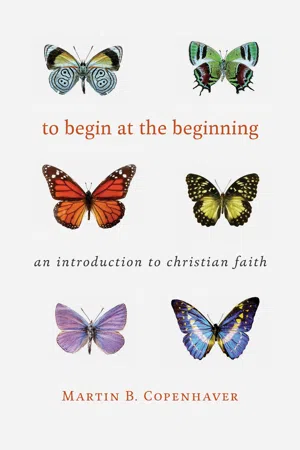
Christian faith, says Martin Copenhaver, is not a subject to be mastered like calculus or Shakespeare; it is a story to be told and a life to be lived. No matter how much or how little you know,
To Begin at the Beginning tells the story of Christian faith and invites you to take part in it.
In this book Copenhaver covers basic themes—the Bible, church, ministry, sacraments, prayer, ethics—in a clear and inviting way. His approach creates a valuable resource for pastors, an accessible guide for seekers and new Christians, and a "refresher course" for longtime Christians who want to engage anew with what they believe.
- 247 pages
- English
- ePUB (mobile friendly)
- Available on iOS & Android
eBook - ePub
About this book
Information
PART ONE
The God We Worship and Serve
CHAPTER 1
The God of Creation and Covenant
To begin at the beginning . . .
But where does this story begin? One might assume that any telling of the Christian story would begin with the creation of the world. After all, the first words of the Bible are devoted to accounts of creation, and many of the historic creeds of the Christian church begin with affirmations about God as Creator. What better place to begin?
In one important way, however, the story begins elsewhere. If the story of God’s dealings with the world were a story that had been followed from the very beginning, then naturally it would start with creation. But this is not the case. The people who wrote the creation stories were obviously not eyewitnesses. In fact, the creation accounts were not even the first parts of Scripture to be written. No one was assigned to cover the story of creation until after the people of Israel had witnessed the astonishing ways in which God had dealt with them.
The Hebrews’ initial convictions about God were not the result of philosophical musings about the origin of the universe. Rather, their faith arose out of their encounters with God midstream in the flow of history. This is a story that begins in the middle of human history, in the midst of life. It begins when God called the people of Israel out of slavery in Egypt and entered into an everlasting covenant with them. Only then did the people begin to ask what this mighty and mysterious God was up to before the Exodus. So we begin this story, not with the spirit of God brooding over the waters before creation, but with a particular people encountering a God who was revealed to them in specific ways at a certain point in their history.
The Exodus
The Exodus is the focal event of Israel’s faith. It is also, in one sense, a creation story, because it is the story of God creating a people and giving them life. The enslaved people cried out for help, and God responded: “I have observed the misery of my people . . . I have heard their cry . . . I know their sufferings. . . . So I have come down to deliver them” (Exod. 3:7–8).
Notice how the statement builds, making more wondrous claims with each step. The first two affirmations suggest only that God sees and hears what is going on. The third indicates that God is not a mere neutral observer: God assures the people that God identifies with their suffering. But the fourth affirmation is decisive. Here God assures the people that their God is intervening on their behalf. No longer merely an observer, even a sympathetic one, God has actually become an actor in the drama, willing to enter the stage of history to intercede on behalf of the helpless.
It may not be all that important to believe that the Exodus occurred in the way filmmaker Cecil B. DeMille depicted it, with the waters of the Red Sea held on either side as if by invisible dams, thus allowing the Hebrews to flee “with unmoistened foot,” as the old hymn puts it. Whatever the circumstances surrounding that escape, it was an astonishing turn of events that the people of Israel could not explain without seeing God’s saving hand in it. The eye of faith could see God’s fingerprints all over the Exodus, and the people sang a great hymn of celebration at the end of the Exodus, which includes these questions: “Who is like you, O Lord, among the Gods? Who is like you, majestic in holiness, awesome in splendor, doing wonders?” (Exod. 15:11). These are rhetorical questions, of course, and the answer is obvious: no one. Only the majestic God of the Exodus could make a way out of no way.
It was not out of detached theological reflection that the people of Israel came to believe in a God who could intervene in history. Rather, they believed in such a God because they had already seen God intervene on their behalf in the Exodus. It would forever be impossible for them to go back to the beginning without recalling their experience of a God who encountered them in the midst of life. In such a context, indulging in detached reflections about God would seem the most egregious irreverence, if not downright impossible. The Exodus was such a decisive event that nothing in the Hebrew experience could be understood in the same way again. When one otherwise ordinary day can flash with such a powerful revelation of God, the rest of Israel’s days can only be approached differently, sustained by memory, drawn by hope. When the Lord of the universe is so powerfully evident in a particular place, no place is barren enough or trying enough to force the conclusion that God is totally absent.
God’s special intervention in the Exodus came to be seen by the people of Israel as the definitive sign of God’s special relationship with them. We sometimes resist the claims of those who view themselves as singled out for special privilege, associating such claims with arrogance. It is particularly important to note in this context, then, that when the people of Israel came to understand themselves as having a special relationship with their God, they did not perceive that they deserved such a distinction.
God did not respond to the Hebrews’ pleas for help because the Hebrews were good people; the Exodus was not a matter of giving righteous people their due reward. The Hebrews were not picked out of the crowd of nations because they were particularly winsome or worthy. In fact, it was for no good or discernible reason that God helped this undistinguished and unlikely people—except that God loved them (Deut. 7:8). God’s love for Israel, which was evident in the Exodus, is an example of grace, a word and concept that signifies something that is given even though it is completely undeserved. And at the same time that the people of Israel saw themselves as having been chosen for a special relationship with God in particular ways, they also understood that that special privilege also brought special responsibilities.
The Covenant with Israel
The Hebrews had little time to rejoice in their new freedom before it became clear that this new and special relationship with God did not free them from hardship. Part of God’s promise was that after their escape the Hebrews would inherit a new homeland, a land flowing with milk and honey, a land where their descendants could live from then on. But for years after their escape, the Hebrews simply wandered in the wilderness like children separated from their parents. Their days were so filled with trial and uncertainty that some of them even pined for the good old days when they were slaves.
It was during these wanderings, at a place called Mount Sinai, that the fuller implications of what had happened between the people and God were revealed. In the Exodus the people experienced God’s gift of freedom and special favor; they also received God’s promise of prosperity and progeny. But now it was time for them to learn about their end of the deal.
The Exodus was, indeed, an instance of grace. But in response to that free and unmerited gift, the people of Israel were expected to behave in particular ways. The prophets later summarized this understanding when they envisioned God saying, “You shall be my people, and I will be your God” (Jer. 30:22; Ezek. 36:28). Here the promise and the expectation are inseparable: both are inextricable parts of this new bond between God and God’s people. After the Exodus the people of Israel knew that when God promised to be their God, it meant that there would not always be a distance between them. This God meant to be active on their behalf in powerful ways. But if God could not be counted on to keep a distance from Israel, to be God’s people also meant that they would need to continually respond to the intrusive presence of this God in their lives. For God to be in the middle of human life was a welcome realization at first. But it also meant that this God would meddle in human life, which is not always so welcome.
In particular, the Hebrews knew that they were expected to respond by observing the law that, according to the scriptural account, was given to them by God through Moses on Mount Sinai. The Ten Commandments are the summary of that law, but it takes the better part of four biblical books (Exodus, Leviticus, Deuteronomy, and Numbers) to spell out the details. It was by observing the law that the people of Israel could do their part to live out the new relationship with God established in the Exodus.
It was a particular form of contractual arrangement known as a covenant. The Hebrew word berit, which is used most often to express the idea of covenant, is literally translated “shackle” or “chain.” The term was originally used in reference to any form of binding agreement, but it eventually came to describe this unique relationship between the people of Israel and their God. At first we might wonder how we could call this gift an instance of grace because it seems to carry such a hefty price tag. When we survey all that is expected of Israel in this relationship, the covenant can begin to sound more like the familiar quid pro quo of a contractual agreement than a free and abundant gift bestowed on the Jews without regard to their merit. Yet, even though the covenant does carry expectations for Israel, the sides are by no means equal. It is God who extends a strong and constant hand to Israel, not the other way around. All Israel is expected to do is respond by grasping the hand that is freely offered.
Indeed, unconditional love—like what God offered the people of Israel—does not mean the absence of expectations. We see this same dynamic in human relationships. A mother may say to her son, “I love you. You did not earn this love, and there is nothing you can do to diminish it. I will always love you, no matter what.” And yet this mother, vowing unconditional love, will not cease to have expectations of her child. She will still expect her son to treat her respectfully, to do his homework, to help around the house. This does not mean that the mother’s vows of love are insincere. Her love is not bought with obedience, nor will it be withdrawn in response to disobedience. Her love is a given. Nevertheless, expectations still flow from such unconditional love; often the greater the love, the greater the expectations. Perhaps this principle is more clearly understood in reverse: a complete lack of expectations is a sign not of love but of something more like indifference. So we can affirm that God’s covenant with Israel was characterized by both unconditional love and great expectations.
One reason we have a hard time comprehending such a relationship is that it is so unlike most of our human experience. We are accustomed to love having a price tag—perhaps tucked away, largely hidden, for the most part unnoticed—but unmistakably there nonetheless. It is a familiar pattern that, in grammatical terms, starts with the imperative and moves to the indicative: “You do this and I will love you.” When we speak of God’s relationship with us, such as in the covenant, the order is reversed: “I love you. Do this.” First comes the indicative, a statement of fact; only then comes the imperative, the command. God’s covenant with Israel begins with a statement of God’s faithfulness, and only then does it move on to commands. To confuse the order is to misunderstand the startling nature of the relationship God established with Israel.
It’s true, some authors of Hebrew Scripture expressed the conviction that God may get so impatient with Israel’s rebellion that God will revoke the covenant promises (like parents who occasionally entertain thoughts of disowning their willful children). Like all deep and lasting relationships, the relationship between Israel and God was severely tested. More than once, Israel seemed to quit the relationship entirely, and the authors recognized that there were times when God was probably tempted to do the same. At certain points in Israel’s history, the covenant ties became so strained and frayed that prophets and kings told the people that such a bond needed to be renewed or reestablished entirely. Yet even when Israel responded to God with every kind of hot rebellion or cold indifference, the covenant promises remained.
The Law
When a network television newscaster spoke at the graduation ceremony of a major university, he began his remarks by intoning a list of the world’s ills, a familiar litany filled with statistics about the rise of violence, drug use, poverty, hate crimes, and homelessness. It was a bleak picture. But this television icon did not leave his audience on the edge of despair. When he had crushed nearly everyone under an avalanche of depressing observations, he concluded his speech something like this: “But there is a way out for our world. There is a course of action upon which all of us can agree. If all of us were to act on these simple principles, the world would be a far different place. First: ‘You shall have no other gods before me.’ Second: ‘You shall not make for yourselves a graven image.’ Third: ‘You shall not take the name of God in vain.’ ” And on he went, straight through the Ten Commandments. When he had finished the list, he sat down.
This was certainly a remarkable occasion: a network television newscaster speaking out in favor of the Ten Commandments. (Can you imagine what such an endorsement might be worth?) Nevertheless, it should be clear from our considerations here that this famous newscaster was quite wrong. The Ten Commandments are not for everyone. The Ten Commandments are not abstract principles that govern all of life, as universally understood as, say, the laws of nature. If they were universal principles, we could cite them without reference to God. We could have come up with them ourselves. If their authority came from their inherent reasonableness, they could be the findings of a focus group or a think tank.
The power of the commandments, however, stems not from their inherent wisdom and reasonableness. Rather, their power comes from their source—that is, God—and from the context in which they are given, as implicit in the covenant that bonds Israel with God that is also part of our story as Christians. The Ten Commandments and the fuller explications of the law are not so much general principles about how we should treat one another as they are ways in which we respond to the ongoing presence of the God who has chosen to be bound to us. They have a special claim on us because they were given by the God who delivered the people of Israel out of exile in Egypt and established an unbreakable covenant with them.
That is why the commandments are introduced with this reminder: “I am the Lord your God, who brought you out of the land of Egypt, out of the house of slavery” (Exod. 20:2). These are not universal principles; rather, they are particular words given to a people who have been drawn into covenantal relationship with the God who now addresses them. As God once gave them the gift of freedom from slavery, this same God gives them another gift: telling them how they might escape becoming slaves to false gods or to themselves, and how they can know more fully the freedom of life lived in relationship with this amazing God.
Consider this homely comparison. A small child is loved by her parents and picks up much about the ways of the family even before she has the capacity to fully understand them. She learns that when she cries her parents will hold her and comfort her. She learns that, when she spills her milk, her parents will help her clean up the mess and give her a fresh glass. She soon knows that, no matter what she does, her parents will not abandon her. Then, when she is older and able to understand more, her parents spell out some of the rules that govern their behavior toward other humans and give definition to what it means to be part of this particular family. They say things like, “In this family we do not hit,” “In this family we do not lie,” and “In this family we do not curse.” These rules (or “commandments”) are thus set in the context of an ongoing relationship; they are given to a child who has already experienced a particular way of life within that family. The rules are nothing new, but are more like a summary of what has guided the family all along.
How different it would be if these rules were wrested out of context and simply posted on a bulletin board in school, introduced by the words, “From now on these are the rules all students will be expected to follow.” In such a setting, the rules would be so weak, so seemingly arbitrary and groundless, that if they were to be maintained they would have to be backed up by severe punishments for those who did not obey. Under such conditions we would expect the vice principal’s office to be very busy. Something like that happens when the Ten Commandments are separated from their context in the covenantal relationship.
The newscaster who quoted the Ten Commandments is not the only one who has been led to the conclusion that they are commonsense, universal principles that are valuable regardless of their source. But if they merely represented common sense, we could have come up with them ourselves. And if that were the case, then we would have to recognize that the same humanity that came up with them also came up with Hiroshima, Auschwitz, and Soweto. At one time or another, to some people, those ideas have also seemed like good ones, manifestations of common sense. “You shall not kill” may seem obvious, but at other times, when left to our own devices, other responses have also seemed obvious.
Such are the conclusions that we are allowed to draw when the Ten Commandments, like other stipulations in the law, are cut off from their source of life. The commandments are not simply common sense. They have grown out of an uncommon relationship with a peculiar and particular God. They are not binding on everyone. They are given to those who see themselves as bound to God in a sacred covenant.
Previous Covenants
When the Israelites looked back to the dimmer reaches of their history, they did so from the vantage point of the Exodus. Old Testament scholar Lawrence Boadt says: “Genesis can be understood somewhat like a special background briefing that government officials often give to newspaper reporters before a big event. Israel understood that God had begun something big in the exodus, but they also knew that God did not just act on a whim. He had been involved in the world and in their story from the beginning.”1
The background of the story, supplied in Genesis, traces the roots of the covenant back to a time before recorded history. Before the Exodus, even before there was an Israel, there was a promise given to Abraham that would establish him as the progenitor of the Hebrews. Abraham was living in the ancient land of Ur when God told him to leave his father’s house and travel to a country that God would show to him. God also assured Abraham that he and his descendants would possess the land of Canaan and that they would be blessed, not only with prosperity but with progeny as abundant as the stars of heaven or the sands of the seashore. Abraham, needing no more motive than obedience, packed up his family and left for this unknown land. This simple (and simply momentous) arrangement was a covenant, the precursor of the covenant God would offer to Israel after the Exodus. After God offered this promise to Abraham, many years would pass before the implications of what had happened would be understood, and many more b...
Table of contents
- Title Page
- Copyright
- Table of Contents
- Preface
- Introductions
- Part One: The God We Worship and Serve
- Part Two: The Church as the Body of Christ
- Part Three: What Is Promised, What Is Required
- Part Four: Conclusion
- Notes
- Selected Bibliography
- For Further Reading
Trusted by 375,005 students
Access to over 1.5 million titles for a fair monthly price.
Study more efficiently using our study tools.
Frequently asked questions
Yes, you can cancel anytime from the Subscription tab in your account settings on the Perlego website. Your subscription will stay active until the end of your current billing period. Learn how to cancel your subscription
No, books cannot be downloaded as external files, such as PDFs, for use outside of Perlego. However, you can download books within the Perlego app for offline reading on mobile or tablet. Learn how to download books offline
Perlego offers two plans: Essential and Complete
- Essential is ideal for learners and professionals who enjoy exploring a wide range of subjects. Access the Essential Library with 800,000+ trusted titles and best-sellers across business, personal growth, and the humanities. Includes unlimited reading time and Standard Read Aloud voice.
- Complete: Perfect for advanced learners and researchers needing full, unrestricted access. Unlock 1.5M+ books across hundreds of subjects, including academic and specialized titles. The Complete Plan also includes advanced features like Premium Read Aloud and Research Assistant.
We are an online textbook subscription service, where you can get access to an entire online library for less than the price of a single book per month. With over 1.5 million books across 990+ topics, we’ve got you covered! Learn about our mission
Look out for the read-aloud symbol on your next book to see if you can listen to it. The read-aloud tool reads text aloud for you, highlighting the text as it is being read. You can pause it, speed it up and slow it down. Learn more about Read Aloud
Yes! You can use the Perlego app on both iOS and Android devices to read anytime, anywhere — even offline. Perfect for commutes or when you’re on the go.
Please note we cannot support devices running on iOS 13 and Android 7 or earlier. Learn more about using the app
Please note we cannot support devices running on iOS 13 and Android 7 or earlier. Learn more about using the app
Yes, you can access To Begin at the Beginning by Martin B. Copenhaver in PDF and/or ePUB format, as well as other popular books in Theology & Religion & Christian Theology. We have over 1.5 million books available in our catalogue for you to explore.