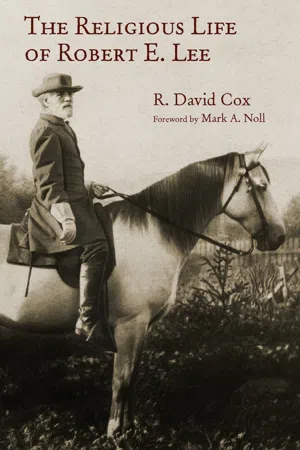
The first close examination of how Robert E. Lee's faith shaped his life Robert E. Lee was many things—accomplished soldier, military engineer, college president, family man, agent of reconciliation, polarizing figure. He was also a person of deep Christian conviction. In this biography of the famous Civil War general, R. David Cox shows how Lee's Christian faith shaped his crucial role in some of the most pivotal events in American history. Delving into family letters and other primary sources—some of them newly discovered—Cox traces the lifelong development of Lee's convictions and how they influenced his decisions to stand with Virginia over against the Union and later to support reconciliation and reconstruction in the years after the Civil War. Faith was central to Lee's character, Cox argues—so central that it directed and redirected his life, especially in the aftermath of defeat.
- 368 pages
- English
- ePUB (mobile friendly)
- Available on iOS & Android
eBook - ePub
The Religious Life of Robert E. Lee
About this book
Trusted by 375,005 students
Access to over 1.5 million titles for a fair monthly price.
Study more efficiently using our study tools.
Information
CHAPTER 1
“All Our Doings Being Ordered by Thy Governance”

September 18, 1865: A gray-suited gentleman in a brown hat, gray bearded and erect atop his steel-gray horse, rode quietly along the valley road through the fields of Rockbridge County, Virginia. Ever since leaving his temporary home in Powhatan County, he had journeyed through towns and countryside badly damaged in the brutal civil war that had ended only five months before. None was as bleak as what he saw on the outskirts of the little town of Lexington, his destination. To his right, he passed the scorched hulk of the Virginia Military Institute (VMI), burned by Federal troops under General David Hunter in retribution for the young VMI cadets whipping the Yankees in the Battle of New Market. A short distance farther, he could see the charred remains of the home of John Letcher, who, as governor of Virginia, oversaw the state’s secession from the Union not five years earlier. On the hill above it, Washington College stood, forlornly, its statue of the nation’s first president still atop its main hall, presiding over a dismal scene of broken glass and shattered buildings. The town fared hardly better. Though the area had been largely unionist before secession, it had seized the frenzy of Southern independence and sent its men into battle, not least of which was the VMI instructor Thomas Jonathan Jackson, soon to be known as “Stonewall.” For its change of loyalty, the region paid dearly. Bodies of Jackson; his aide “Sandie” Pendleton, son of the local Episcopal priest who became a Confederate general; and dozens of others lay beneath tombstones in the local cemetery.
As horse and rider climbed the hill on Main Street toward the town center, a Confederate veteran realized who they were. He let out a shout: Robert E. Lee, his former commanding general, had come to town. Word quickly spread. Allan McDonald, a young teenager who with his mother and six siblings had vainly fled to Lexington for shelter, ran to tell his brother, who immediately raced to the window and, years later, vividly recalled the scene. The former general had removed all military insignia from his old uniform, the three stars on each collar, the Confederate buttons. “Slowly he passed, raising his brown slouch hat to those on the pavement who recognized him and not appearing conscious that he more than anybody else was the object of attention.” Allan, having made himself presentable to the famous newcomer, dashed to the Lexington Hotel to watch him dismount from his horse, Traveller. He returned home with a souvenir plucked from Traveller’s tail that, he announced, he would preserve so his wife could wear it in her breastpin. He was but the first of many to rob Traveller of his hair.1 Robert E. Lee had arrived at his final post, on an assignment he believed had been ordered by God.
***
How different his ride to Lexington was from the one he made to Alexandria, on a balmy April 21, 1861, when Lee and his daughter, Mary Custis, went to church. Enslaved drivers had brought their carriage to the door of Arlington House, the mansion his father-in-law had built high on a hill on the Virginia side of the Potomac River, overlooking Washington, DC, for the nine-mile trip to Christ Church. As a family, they observed the Sabbath, sometimes at the little chapel on the estate, at other times in their parlor, but often at the old family parish. None was more regular in worship than Colonel Lee himself. At whatever post the army assigned him or wherever he traveled on temporary duty, unless prevented by military or family obligation, Lee found his way to church.
Lee held his faith dear. By 1861 he had gleaned considerable experience of American religion in general, and of his own Episcopal Church in particular. He knew his Bible and his church’s Book of Common Prayer. He followed developments through church publications. He remained on familiar terms with bishops and other clergy. He developed an understanding, a theology, that may not have been broad—he never showed any interest in the mysteries of the Trinity, for example—but was definitely deep. It was also practical, for his theological perspective helped him cope with challenges and tribulations and shaped his perspective on events of the day, including those besetting his nation at the very moment it was dissolving.
Lee’s religious life essentially began at the church to which they were driving. Though probably baptized where he was born, at the old Lee estate of Stratford Hall on Virginia’s Northern Neck, he had spent but three years there when his family had to move to Alexandria. They lived first within a block of Christ Church, then some five blocks away on Oronoco Street. Sunday by Sunday, the family could walk to the old brick edifice. During the long services, Lee as a boy could glance at the pew once owned by George Washington, on whose staff Lee’s father had served during the Revolution, and whom the elder Lee had eulogized as “first in war, first in peace, first in the hearts of his countrymen.” On some Sundays, young Lee might see members of Washington’s family, including, seated in the gallery, the man who was at once the general’s step-grandson, adopted son, and namesake: George Washington Parke Custis. Perhaps he spotted, too, Custis’s only child, a girl about his own age, Mary Anna Randolph Custis, never dreaming—or did he?—that she would become his wife.
As a youngster, Lee came to know the man in the pulpit. William Meade became Christ Church’s new rector (as Episcopalians call their pastor) at the same time the Lees moved into the neighborhood. The dynamic young cleric began immediately to challenge the worldly temper he found in his new congregation. He also established a direct connection with Robert Lee, and all the children of his parish, who recited to him their catechism, their church’s basic teachings about the Christian faith. Meade never forgot that experience. Nor did Lee.
That fine April day, the two Lees, father and daughter, rode to church along the Potomac River road. The gentle temperatures and gloriously blooming trees of the Virginia springtime belied the foul mood of the nation. It had been a disconcerting week. Even the weather had been odd. The previous Wednesday, temperatures in Washington never varied from a precise but chilly 42 degrees, morning, afternoon, and night.2 Now the weather seemed to right itself.
But dark clouds of a different sort enshrouded them. The previous Sunday, as they left Christ Church, the Lees had learned that Fort Sumter had fallen. The US Army outpost in Charleston, South Carolina, had surrendered after several days of ferocious bombardment by the seceded state’s troops. “Poor General Anderson!” Lee remarked of the commander, Robert Anderson, whom he knew through the close circles of the army. “He was a determined man, & I know he held out to the last.”3
Then, on Thursday, Lee was summoned from Arlington to Washington to meet Francis Preston Blair, a seasoned power broker, at the home of Blair’s son, Montgomery, who was Abraham Lincoln’s postmaster general. At the president’s behest, the senior Blair exhorted Lee to accept command of the military forces of the United States of America. Lee declined, then walked across the street to the War Department. There he discussed the offer with his, and the military’s, commanding officer, General Winfield Scott, “Old Fuss ’n Feathers,” who first earned his fame in the War of 1812. Colonel Lee, who had distinguished himself on Scott’s staff in the war with Mexico, reiterated his refusal. A special convention in Richmond was at that moment considering Virginia’s secession from the Union, and if it left, Lee was determined not to raise his sword against his native state. Only when Lee arrived back at Arlington did he learn that the convention in Richmond had indeed voted, the day before, to secede.
On Friday, Virginia troops began seizing Federal military complexes in Harpers Ferry and Norfolk. In Baltimore, a mob of Southern sympathizers attacked Massachusetts soldiers traveling toward Washington to defend the capital. A friend of Lee’s wife had died in the riot. On Saturday morning, as soon as Lee heard the news, he summoned his family to his study and read a letter he had already sent to Scott: his resignation from the army he had served for more than three decades. “I mention this to show you that I was not at all influenced by the exciting news from ‘Baltimore.’” Family members, most of them Unionist in sympathy, were stunned.4
At last the carriage pulled up to the familiar churchyard. The Lees strode through the doors and walked to the pew they had bought just a few years before, knelt for silent devotions, and, opening their Prayer Books, joined the congregation in the familiar rite of Morning Prayer. As Lee sat at the end of his pew, his cousin Cassius’s daughter, Harriotte, noticed that his hair had grayed since she last saw him, before she had gone away to school and he to Texas. He seemed much older to her than did her father, who was but a year younger.
That Sunday fell midway through the church’s season of Eastertide. The biblical lessons proclaimed resurrection and new life, even as the old life of the parishioners’ state and nation was ebbing. Might Lee have noted how the prayer of the day addressed the Divine? “Almighty God, who showest to them that are in error the light of thy truth, to the intent that they may return into the way of righteousness.” If that were not enough, the Epistle assigned for the day, if it was read, contained a pertinent passage: “Submit yourself to every ordinance of man for the Lord’s sake; whether it be to the king, as supreme; or unto governors, as unto them that are sent by him.”5 Did Lee make anything of these words in light of his decision?
On the surface, everything seemed so ordinary. They said the psalms, sang the hymns, and heard the Reverend Cornelius Walker preach from the lofty pulpit. The liturgy proceeded as usual to its appointed end, the rector bidding “the grace of our Lord Jesus Christ, and the love of God, and the fellowship of the Holy Ghost” upon the congregation. As the two left church, they found “that really quiet little town in another great state of fermentation,” as Mary Custis described it a decade later. Townspeople joined parishioners swirling around Colonel Lee. Though he ranked lower than other officers in Uncle Sam’s army, few matched his renown: a hero of the Mexican War, a former superintendent of the Military Academy at West Point, esteemed within the service and beyond. Rumors about him had already spread—that he had resigned his commission (true); that he had been arrested (clearly false); that he would side—well, with whom? Crowds surrounded him, Mary Custis noted, “as if their faith was pinned to him alone.”6
Following their normal pattern, the Lees walked to a relative’s nearby home for lunch. Cousin Harriotte also stopped in, hoping to share with Mary Custis that she had seen her brother Fitzhugh (or Rooney, as the family called him) on the train from Richmond. Before she could say a word, Mary Custis told her of Lee’s resignation. Of all the family, she alone was “Secesh,” and as such was first to approve. Still, Harriotte found Daughter standing apart from the crowd in a sober mood. “It is no gratification to us,” Mary Custis told her cousin, “it is like a death in the house. Since my father went to West Point, the army had been his home and his life, he expected to live and die belonging to it, and only his sense of duty made him leave it.”7
By some accounts, Lee had found a moment to huddle privately in the churchyard with John Robertson, a former congressman, a current judge, and a member of the “peace convention” that two months before had sought vainly to broker a deal between North and South to avert secession. Robertson had tried, and failed, to see Lee the previous day. Mary Custis recorded that “two gentlemen” brought to Arlington a message from “a gentleman”—Robertson?—asking Lee to meet with Governor Letcher in Richmond the next day. Accordingly, on Monday, Lee returned to Alexandria, boarded a train with Robertson, met with Letcher, and accepted command of the military forces of the now-seceded state.8 In a week’s time, he became the only person in history to be offered the command of two opposing armies.
Lee’s decision changed his life, on the grand scale and also in its mundane patterns: he and his family never again made their Sunday trip to Christ Church.
***
Just a few days shy of four years later, Lee took another ride, a long, slow, mournful trek from Appomattox to Richmond, following the hardest week of his life. On Sunday, April 2, 1865, a message from Lee interrupted Confederate President Jefferson Davis’s worship at St. Paul’s with news that the Army of Northern Virginia had to evacuate Petersburg, leaving Richmond to its fate. Lee led his troops westward in a vain search for supplies. Confronted by Federal forces, frustrated in all attempts to escape, Lee began to accept the inevitable. On Sunday, April 9, he surrendered his army to General Ulysses S. Grant.
On April 12, having obtained paroles for himself and his soldiers, and having duly reported his actions to President Davis, Lee headed toward a rented house in Richmond, the nearest thing he had to a home. Along the way, having been joined by a few remaining members of his staff, he pitched his tent outside his brother Carter’s house in Powhatan County, there being no room inside, on April 14. The next day, joined by Rooney, he entered Richmond amidst a downpour. It was Good Friday. That night in Washington, John Wilkes Booth assassinated Abraham Lincoln.
No one knows his thoughts during that hundred-mile ride. Lee never recorded them. Others, however, did record their thoughts, and they often thought of God. Lee, like many Southerners, believed that if God were on their side, they would have won the war. They lost. “Oh it is bitter! bitter!!” one young soldier wrote to his mother. “If any ones whole soul was wrapped up in the cause it was mine and I always felt and frequently said when fellow officers would get disheartened that I did not believe God would allow us to be crushed.”9 Lee, like many Southerners, had some spiritual accounting to do.
***
Four months later, in August 1865, Lee took another ride. He wanted to chat with a friend. No carriage this time, no slaves, no family with him, nor any military staff: only his horse Traveller. Though his fame had spread around the globe as a brilliant general, he was a defeated one. He had no home, no funds, no job. His wife had become physically debilitated. Six of his children had survived the war, but sickness had claimed his daughter Annie, his daughter-in-law Charlotte, and two grandchildren. Union forces had occupied his wife’s family estate, Arlington, then with purposeful vengeance turned it into a cemetery. The Lees held no hope of ever living there again.
They were better off than many. The South, and especially his native state, lay in ruins. A quarter of its men had died. A third or more of its net worth had vanished, some from war, much because of emancipation of the slaves. Hunger, poverty, homelessness pervaded the region.
In the summer of 1865, Lee, his wife, Mary, and two daughters left their temporary house in Richmond for a borrowed farmhouse forty miles to the west, on the edge of Powhatan County. Undisturbed there by inquisitive crowds like those that had plagued him in Richmond, he pondered taking up farming for a living, for...
Table of contents
- Title Page
- Copyright
- Dedication
- Contents
- Foreword by Mark A. Noll
- Preface
- Family Names and Relationships
- 1. “All Our Doings Being Ordered by Thy Governance”
- 2. “A Goodly Heritage”
- 3. “A House Divided”
- 4. “Who Setteth the Solitary in Families”
- 5. “To Illuminate All Bishops”
- 6. “With the Sign of the Cross”
- 7. “To Have and to Hold”
- 8. “Christ’s Faithful Soldier and Servant”
- 9. “This Our Bounden Duty and Service”
- 10. That, as We Grow in Age, We May Grow in Grace”
- 11. That He May Continue Thine Forever”
- 12. Of the Traditions of the Church”
- 13. Whose Never-Failing Providence Ordereth All Things”
- 14. Under the Protection of Thy Good Providence”
- 15. Help Thy Servants, Whom Thou Hast Redeemed”
- 16. Scatter Thou the Peoples That Delight in War”
- 17. Who Teacheth My Hands to War”
- 18. In the Bond of Peace, and in Righteousness of Life”
- 19. To Put Away the Leaven of Malice”
- 20. The Mouth of the Deceitful Is Opened upon Me”
- 21. Do Now Rest from Their Labors”
- Non Incautus Futuri: A Personal Epilogue
- Acknowledgments
- Select Bibliography
- Abbreviations
- Notes
- Index
Frequently asked questions
Yes, you can cancel anytime from the Subscription tab in your account settings on the Perlego website. Your subscription will stay active until the end of your current billing period. Learn how to cancel your subscription
No, books cannot be downloaded as external files, such as PDFs, for use outside of Perlego. However, you can download books within the Perlego app for offline reading on mobile or tablet. Learn how to download books offline
Perlego offers two plans: Essential and Complete
- Essential is ideal for learners and professionals who enjoy exploring a wide range of subjects. Access the Essential Library with 800,000+ trusted titles and best-sellers across business, personal growth, and the humanities. Includes unlimited reading time and Standard Read Aloud voice.
- Complete: Perfect for advanced learners and researchers needing full, unrestricted access. Unlock 1.5M+ books across hundreds of subjects, including academic and specialized titles. The Complete Plan also includes advanced features like Premium Read Aloud and Research Assistant.
We are an online textbook subscription service, where you can get access to an entire online library for less than the price of a single book per month. With over 1.5 million books across 990+ topics, we’ve got you covered! Learn about our mission
Look out for the read-aloud symbol on your next book to see if you can listen to it. The read-aloud tool reads text aloud for you, highlighting the text as it is being read. You can pause it, speed it up and slow it down. Learn more about Read Aloud
Yes! You can use the Perlego app on both iOS and Android devices to read anytime, anywhere — even offline. Perfect for commutes or when you’re on the go.
Please note we cannot support devices running on iOS 13 and Android 7 or earlier. Learn more about using the app
Please note we cannot support devices running on iOS 13 and Android 7 or earlier. Learn more about using the app
Yes, you can access The Religious Life of Robert E. Lee by R. David Cox in PDF and/or ePUB format, as well as other popular books in History & Historical Biographies. We have over 1.5 million books available in our catalogue for you to explore.