For Jesus and his contemporaries, what we now know as the Old Testament was simply the Scriptures—and it was the fundamental basis of how people understood their relationship with God. In this book John Goldingay uncovers five major ways in which the New Testament uses the Old Testament. His discussion paves the way for contemporary readers to understand and appreciate the Old Testament more fully.
Along with an overview of how Jesus and the first Christian writers read the Old Testament, illustrated with passages from Matthew, Romans, 1 Corinthians, and Hebrews, Goldingay offers a straightforward introduction to the Old Testament in its own right.
Reading Jesus's Bible will shed fresh Old Testament light on Jesus, God, and the church for readers today.
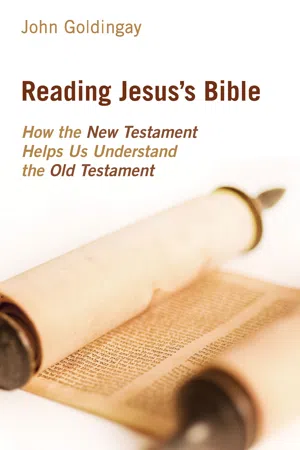
eBook - ePub
Reading Jesus's Bible
How the New Testament Helps Us Understand the Old Testament
- 270 pages
- English
- ePUB (mobile friendly)
- Available on iOS & Android
eBook - ePub
About this book
Information
CHAPTER 1
Introduction
Christian faith focuses on Jesus, and we learn of him from the New Testament. But when the New Testament writers sought to understand Jesus, they assumed that the Old Testament could play a key role in helping them. My concern in this book is to look at the way they went about this task, in order then to consider a question that is the reverse of theirs: to look at the pointers they suggest for understanding the Old Testament itself. “The Gospels teach us how to read the OT, and—at the same time—the OT teaches us how to read the Gospels. Or, to put it a little differently, we learn to read the OT by reading backwards from the Gospels, and—at the same time—we learn how to read the Gospels by reading forwards from the OT.”1
The term Old Testament does not occur in the New Testament, which obviously also does not refer to itself as the “New Testament.” Jews call their Scriptures “the Torah, the Prophets, and the Writings”; the scholarly world today calls them “the Hebrew Bible” (slightly inaccurately, as part of them is in Aramaic). In Jesus’s day, the Torah, the Prophets, and the Writings were simply “the Scriptures,”2 and they were the fundamental basis of people’s lives with God. The stories of people such as Zechariah, Elizabeth, Mary, Joseph, Simeon, and Anna (see Luke 1–2) show that people living before Jesus could gain quite an adequate understanding of those Scriptures and from them could gain quite an adequate understanding of God, of God’s purpose, of God’s ways with us, and of a relationship with God. But they also knew that God still needed to do something spectacular in order to sort the world out and fulfill his own purpose and sort out things for the people of God. That spectacular thing is what Jesus came to do.
In light of his coming, in due course the church developed a collection of written materials telling of what God had indeed done in him and of its implications, to set alongside those existent Scriptures. The church knew that Jesus came to inaugurate a “new covenant” and that he did so by dying for us; so this covenant was a kind of testament or will. Thus the collection came to be known as the “New Testament,” and by analogy Christians came to call the existent collection of Scriptures by a new name, the “Old Testament.” The expression “Old Testament” is thus anachronistic in connection with the time of Jesus or Paul. For them, these works were simply “the Scriptures.” In Western cultures, at least, the phrase “Old Testament” is also something of a slight; it rather implies that this collection of writings is antique and outdated by the “New Testament.” So from now on, I shall refer to that first collection as “the First Testament.”
So what significance attaches to the First Testament after Jesus has come? How does the New Testament refer to these writings? What pointers does it give to our interaction with them? The New Testament books vary in how much they refer to those earlier Scriptures and in the way they use them. As it happens, however, the opening pages of the New Testament offer an instructive set of concrete illustrations of what the First Testament signifies for the New Testament. The New Testament thus begins with the First Testament. It opens its account of Jesus by relating him to the First Testament and by explaining who he is by looking at him in light of the First Testament.
Actually, most of the New Testament operates that way to one degree or another. Acts does so. Paul does so, especially in Romans. Hebrews does so. Revelation does so. But the opening chapters of Matthew happen to operate that way in a particularly systematic fashion. I do not imagine that Matthew was consciously aiming to achieve this end, but whether he was trying or not, it is what he succeeded in doing. So a convenient approach to considering our question is to start from Matthew’s approach; we can then also look at insights from other parts of the New Testament alongside Matthew. Thus in this book I use Matthew’s five ways of reading the First Testament to frame how we might read the First Testament for ourselves:
- The First Testament tells the story of which Jesus is the climax. Matthew begins here (Matt 1:1–17) with a kind of summary of the First Testament story up to Jesus in the form of a list of his ancestors. The summary tells us something important about how to understand Jesus and directs us back to the First Testament story in order to expand on that understanding.
- The First Testament declares the promise of which Jesus is the fulfillment. After the list of names, Matthew goes on to tell the story of Jesus’s birth and early months (Matt 1:18–2:23). It shows how passages from the Prophets are fulfilled or filled out in what happens; it thus uses the Prophets to help us understand Jesus and directs us back to read the Prophets.
- The First Testament provides the images, ideas, and words with which to understand Jesus. Matthew’s account of Jesus’s ministry begins with his baptism by John and with God’s words to him from heaven, which come from the First Testament (Matt 3:1–17). So the account invites us to go back to the First Testament for an understanding of who Jesus’s God is.
- The First Testament lays out the nature of a relationship with God. Jesus models the nature of such a relationship during his temptations in the wilderness and teaches about it in the opening section of the Sermon on the Mount (Matt 4:1–11; 5:1–16). The first passage quotes extensively from the First Testament, and the second alludes extensively to its motifs, so that it invites us to discover more about the nature of a relationship with God by studying it.
- The First Testament provides the foundation for Jesus’s moral teaching. Jesus goes on to declare, “You have heard that it was said. . . . But I tell you . . .” (Matt 5:17–48). He is again “fulfilling” or “filling out” the First Testament, speaking like a prophet, helping people to see implications in the Scriptures that they might be avoiding, and inviting us to study what the Scriptures have to teach us about the way we should live.
The New Testament writers were concerned to help congregations understand the story of Jesus—to see more clearly who he was and what difference he should make to their lives. Their interest in the First Testament lay in helping themselves and their congregations gain this understanding. Reading between the lines of Matthew’s Gospel, we may infer that he was writing for a congregation that was mostly Jewish believers, so there would be special reason to show them how the First Testament related to Jesus. The same may be true of Hebrews. Yet in writing Romans, Paul makes the same assumption about the significance of the First Testament, and he makes clear in that letter that the Roman church was not predominantly Jewish. Likewise Luke and Acts (which are two parts of the same work) concern themselves with the significance of Jesus for the world as a whole, and they also appeal frequently to the First Testament. While the First Testament is important in a particular way to Jews who believe in Jesus, it is also important to the whole church if it wants to understand Jesus, or to understand God, or to understand itself.
Paul’s charge to Timothy puts it this way:
From infancy you have known the Holy Scriptures, which are able to make you wise for salvation through faith in Christ Jesus. All Scripture is God-breathed and is useful for teaching, rebuking, correcting and training in righteousness, so that all God’s people may be thoroughly equipped for every good work. (2 Tim 3:15–17)
When Paul refers here to “the Holy Scriptures,” he of course means the First Testament (when Paul wrote, the documents that make up the rest of the New Testament had not yet been written). It is these writings that are “God-breathed” and useful in those different ways. Most strikingly, he says that they are able to make one wise in a way that leads to salvation through faith in Christ Jesus. The First Testament (Paul says) is monumentally important to anyone who wants to trust in Jesus and live for Jesus.
My approaching the First Testament by looking at what the New Testament does with it is partly pragmatic or tactical. The First Testament is intelligible in its own right, and we do not need the New Testament to tell us what it means.3 But it is natural for Christians to assume that the New Testament ought to help us understand the First Testament. So we will consider ways in which Jesus and the first Christian writers used the First Testament and thus gave us pointers toward ways in which we might approach it. And in light of looking at and through some of those lenses that the New Testament uses, we will look at the nature of the First Testament itself.

1. Richard B. Hays, Reading Backwards: Figural Christology and the Fourfold Gospel Witness (Grand Rapids: Eerdmans, 2014), 4. Much of the quotation is italicized.
2. The Torah is the first five books, Genesis–Deuteronomy (hence also known as the Pentateuch, the five books); the Prophets section comprises Joshua, Judges, 1–2 Samuel, 1–2 Kings, Isaiah, Jeremiah, Ezekiel, and the Twelve (also known as the Minor Prophets); the Writings are Psalms, Job, Proverbs, Ruth, Song of Songs, Ecclesiastes, Lamentations, Esther, Daniel, Ezra, Nehemiah, and 1–2 Chronicles.
3. I have argued this point in a book called Do We Need the New Testament? Letting the Old Testament Speak for Itself (Downers Grove, IL: InterVarsity Press, 2015).
CHAPTER 2
Story
The First Testament tells the story of which Jesus is the climax. The First Testament story thus helps us understand Jesus, and Jesus’s story helps us understand the First Testament.
Neither Testament of the Christian Bible opens in the way that one might expect a religious book to begin. Each Testament opens not with direct teaching about God or with advice about prayer or with moral instruction (though they provide much of all those in due course). Each begins by telling a story, doing so at some length, and doing so more than once. They take this form because the essence of the faith in both Testaments is not direct teaching about God or advice about prayer or moral instruction but an account of what God has done, which is then the clue to formulating the teaching and the advice and the instruction. And the New Testament begins telling its story with a look back at the First Testament story and with some pointers about how to read it. Subsequent parts of the New Testament offer more pointers: we will look especially at Romans, Hebrews, and 1 Corinthians. Then we will look at the First Testament story in its own right.
2.1 Matthew 1:1–17: Jesus’s Backstory
To the eyes of most modern readers, the opening verses of the New Testament form an unpromising beginning, with their unexciting list of bare names, mostly from the First Testament. But they form a telling introduction to the Gospel.
This is the genealogy of Jesus the Messiah the son of David, the son of Abraham: Abraham was the father of Isaac, Isaac the father of Jacob, Jacob the father of Judah and his brothers, Judah the father of Perez and Zerah, whose mother was Tamar, Perez the father of Hezron, Hezron the father of Ram, Ram the father of Amminadab, Amminadab the father of Nahshon, Nahshon the father of Salmon, Salmon the father of Boaz, whose mother was Rahab, Boaz the father of Obed, whose mother was Ruth, Obed the father of Jesse, and Jesse the father of King David.
David was the father of Solomon, whose mother had been Uriah’s wife, Solomon the father of Rehoboam, Rehoboam the father of Abijah, Abijah the father of Asa, Asa the father of Jehoshaphat, Jehoshaphat the father of Jehoram, Jehoram the father of Uzziah, Uzziah the father of Jotham, Jotham the father of Ahaz, Ahaz the father of Hezekiah, Hezekiah the father of Manasseh, Manasseh the father of Amon, Amon the father of Josiah, and Josiah the father of Jeconiah and his brothers at the time of the exile to Babylon.
After the exile to Babylon: Jeconiah was the father of Shealtiel, Shealtiel the father of Zerubbabel, Zerubbabel the father of Abiud, Abiud the father of Eliakim, Eliakim the father of Azor, Azor the father of Zadok, Zadok the father of Akim, Akim the father of Eliud, Eliud the father of Eleazar, Eleazar the father of Matthan, Matthan the father of Jacob, and Jacob the father of Joseph, the husband of Mary, and Mary was the mother of Jesus who is called the Messiah.
Thus there were fourteen generations in all from Abraham to David, fourteen from David to the exile to Babylon, and fourteen from the exile to the Messiah. (Matt 1:1–17)
This introduction expresses an understanding of the shape of the First Testament story and its relationship to the Jesus story, and it encourages an interest both in the facts behind Israel’s story and in the way the story interprets the facts.
Abraham, David, the Exile, Jesus
So the attention of modern Western readers soon moves on from this list of names to the stories in Matthew 1:18–2:23. But the Jewish reader who came to faith in Jesus through reading these verses responded to them in a way Matthew would have appreciated. This reader had seen that the genealogy embodies an assertion about Jesus—he was a Jew. Further, it is a genealogy that not only establishes that Jesus’s ancestry goes back to Abraham, but also marks him as a member of the clan of Judah and of the family of David.1 It thus gives him a formal claim to David’s throne. It is a genealogy that (unusually) includes the names of several women, names that draw attention to the contribution made by some rather questionable unions to this genealogy even before and during David’s own time, so that the apparently questionable circumstances of Jesus’s own birth (Matt 1:19) can hardly be deemed unworthy of someone who was claimed to be David’s successor. It is a genealogy arranged into three sequences of fourteen names, a patterning that itself expresses the conviction that Jesus’s coming happens by the providence of God, which has been at work throughout the history of the Jewish people but now comes to its climax.
The genealogy appeals to the historical past, to real history. Matthew assumes that a person has to be a descendant of David to have a claim to David’s throne, and has to be a descendant of Abraham to have a “natural” share in Abraham’s promise, still more if he is to be recognized as the seed of Abraham. Matthew has in mind legal descent; someone who is adopted into a family comes to share that family’s genealogy as fully as someone born into it. Thus Jesus’s claim to David’s throne comes through his adoptive, legal father, Joseph. It is in this sense that Matthew is talking about the real ancestry of Jesus, the real historical antecedents to Jesus’s coming.
At the same time, Matthew schematizes the past when he appeals to it. There were not, in fact, fourteen generations from Abraham to David, fourteen from David to the exile, and another fourteen from the exile to Jesus (Matt 1:17), as one can see by comparing the genealogy with the material in the First Testament itself from which Matthew got much of his raw material. Josiah, for instance, was actually the father of Jehoiakim and thus the grandfather of Jeconiah (see 2 Kgs 23–25).
By shaping the genealogy so that it worked by fourteens, Matthew created a list that is more artistic and easier to remember than it might otherwise be, and a list that expresses explicitly that the providence of God had been at work in the ordering of Israelite history up to Jesus’s time, as it was at work in his birth, life, death, and resurrection.
The shaping via the exile as well as via David implies another insight. After the exile, Jerusalem had been rebuilt and its community had been reestablished, but it did not gain its independence from imperial powers, and in Jesus’s day it lived under the Romans, as in previous centuries it had lived under the Assyrians, followed by the Babylonians, the Persians, and the Greeks. Jesus’s coming links with a process that God set going with Abraham, with a process to which David was key, but a process that the exile put on hold.
In relating Jesus’s genealogy, Matthew...
Table of contents
- Title Page
- Copyright
- Contents
- Acknowledgments
- 1. Introduction
- 2. Story
- 3. Promises
- 4. Ideas
- 5. Relationship
- 6. Life
- 7. Conclusion
- For Further Reading
- Index of Subjects
- Index of Scripture
Trusted by 375,005 students
Access to over 1.5 million titles for a fair monthly price.
Study more efficiently using our study tools.
Frequently asked questions
Yes, you can cancel anytime from the Subscription tab in your account settings on the Perlego website. Your subscription will stay active until the end of your current billing period. Learn how to cancel your subscription
No, books cannot be downloaded as external files, such as PDFs, for use outside of Perlego. However, you can download books within the Perlego app for offline reading on mobile or tablet. Learn how to download books offline
Perlego offers two plans: Essential and Complete
- Essential is ideal for learners and professionals who enjoy exploring a wide range of subjects. Access the Essential Library with 800,000+ trusted titles and best-sellers across business, personal growth, and the humanities. Includes unlimited reading time and Standard Read Aloud voice.
- Complete: Perfect for advanced learners and researchers needing full, unrestricted access. Unlock 1.5M+ books across hundreds of subjects, including academic and specialized titles. The Complete Plan also includes advanced features like Premium Read Aloud and Research Assistant.
We are an online textbook subscription service, where you can get access to an entire online library for less than the price of a single book per month. With over 1.5 million books across 990+ topics, we’ve got you covered! Learn about our mission
Look out for the read-aloud symbol on your next book to see if you can listen to it. The read-aloud tool reads text aloud for you, highlighting the text as it is being read. You can pause it, speed it up and slow it down. Learn more about Read Aloud
Yes! You can use the Perlego app on both iOS and Android devices to read anytime, anywhere — even offline. Perfect for commutes or when you’re on the go.
Please note we cannot support devices running on iOS 13 and Android 7 or earlier. Learn more about using the app
Please note we cannot support devices running on iOS 13 and Android 7 or earlier. Learn more about using the app
Yes, you can access Reading Jesus's Bible by John Goldingay in PDF and/or ePUB format, as well as other popular books in Theology & Religion & Biblical Criticism & Interpretation. We have over 1.5 million books available in our catalogue for you to explore.