Authoritative study by a renowned musicologist and Reformation scholar
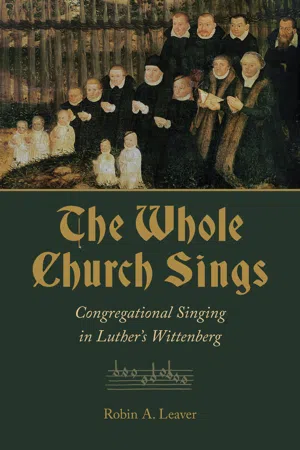
Many scholars think that congregational singing was not established in Lutheran worship until well after the start of the Reformation. In this book Robin A. Leaver calls that view into question, presenting new research to confirm the earlier view that congregational singing was both the intention and the practice right from the beginning of the Wittenberg reforms in worship.
Leaver's study focuses on the Wittenberg hymnal of 1526, which until now has received little scholarly attention. This hymnal, Leaver argues, shows how the Lutheran Reformation was to a large degree defined, expressed, promoted, and taken to heart through early Lutheran hymns. Examining what has been forgotten or neglected about the origins of congregational hymnody under Martin Luther's leadership, this study of worship, music, and liturgy is a significant contribution to Reformation scholarship.
- 220 pages
- English
- ePUB (mobile friendly)
- Available on iOS & Android
eBook - ePub
About this book
Information
Topic
Theologie & ReligionSubtopic
Christliche Konfessionen1
The Reformation Celebrated in Song
The germ of the idea of writing this book occurred in the years when the significance of the chronological countdown to 2017 had begun to dawn on people, and preparations were beginning to be made with regard to how the half-millennium of Luther’s protest in 1517 should be celebrated. The writing was completed in the months before the anniversary year had begun, when events and publications were being announced with great anticipation. The event to be commemorated is, of course, Luther’s publication of his 95 Theses, questioning the theology and practice of indulgences. Whether or not they were actually nailed to the door of the church of All Saints in Wittenberg has been a matter for debate,1 though it seems most likely, since it doubled as the university church, and the door also functioned as the university notice-board. The Theses were directed to Luther’s theological colleagues and constituted a call for debate. There is some confusion with regard to the date—was it the eve of All Saints’ Day (31 October) or All Saints’ Day itself (1 November)? Luther sometimes speaks in general terms without mentioning the date, such as “At the beginning of the Gospel I proceeded gradually against Tetzel [the primary indulgence-seller in Saxony in 1517].”2 At other times he seems to suggest that the event took place on 1 November rather than 31 October, such as: “In the year [15]17 on the Day of All Saints, I began for the first time to write against the pope and indulgences.”3 However, it needs to be borne in mind that saints’ days begin on the eve of the day before, and therefore the evening of 31 October is the beginning of All Saints’ Day.
There is some evidence that Luther and his colleagues marked the anniversary, at least in some years. For example, on the tenth anniversary in 1527 he wrote a letter to Nicholas Amsdorf and signed it: “Written at Wittenberg on the Day of All Saints, in the tenth year after the indulgences had been trampled underfoot, in memory of which we are drinking at this hour”4—no doubt it was Wittenberg beer that was being consumed. Significantly, the following year an important detail was included in the Braunschweig Church Order by Johannes Bugenhagen, Luther’s close colleague and pastor of the Wittenberg parish church. In the section “Concerning Festivals,” Bugenhagen notes that the Braunschweig Church Order was agreed and accepted on “the Sunday after Aegidius in the year 1528,” then adds: “Therefore, every year on this Sunday [after St. Aegidius Day, 1 September] a preacher should hold before us this grace, which we have experienced in order to thank Christ that He helped us continue with this Order to our salvation and that of our children.”5 Since there is reference in this section of the Church Order to singing in connection with other festivals, preaching on the anniversary of the introduction of the Braunschweig Church Order would have been in the context of the singing of appropriate hymns, though none are prescribed. But the fact that Bugenhagen, pastor in Wittenberg, commends an annual commemoration of the beginning of Reformation theology and practice in Braunschweig suggests that something similar may well have been customary in the Wittenberg parish church, when there would be preaching and the singing of appropriate hymns on 31 October each year. But there is no documentation to confirm this hypothesis.
Apparently, the earliest reference to an observance of an anniversary of Luther’s posting his 95 Theses is in a sixteenth-century manuscript in the Wittenburg University library which mentions an event that included hymn singing. It must have taken place sometime after 1564, the year the university purchased the Lutherhalle from Luther’s heirs and successors. The source indicates that in subsequent years it was customary for the university’s professors to gather together in the Lutherstube (Luther’s room) in the Lutherhalle in the early morning of the anniversary of Luther’s posting of the 95 Theses, 31 October, where they sang Luther’s version of Psalm 67, Es wollt uns Gott gnädig sein. Afterward they proceeded to the Castle Church of All Saints for a special service and sermon.6
The centenary in 1617 was marked as a significant milestone. At the Saxon court in Dresden, the centenary was celebrated in an elaborate fashion between 31 October and 2 November. Details of the services held over the three days, morning and evening, were included with the published sermons that had been given by the senior court chaplain, Matthias Hoë von Hoënegg, Chur Sächsische Evangelische JubelFrewde/ In der Churfürstlichen Sächsischen SchloßKirchen zu Dreßden/ theils vor/ theils bey wehrendem/ angestalten Jubelfest/ neben andern Solenniteten, auch mit Christlichen Predigten/ auff gnedigste anordnung gehalten (Leipzig: Lamberg, Kloseman, 1617).7 Much special celebratory music was composed by Heinrich Schütz for these services in the Dresden court chapel, involving many musicians and singers:
This music was performed by the musicians of the Elector of Saxony, our most gracious Lord: eleven instrumentalists, eleven singers, three organists, four lutenists, one theorbist, three organ choir boys, five discantists with interchange of all kinds of magnificent instruments, with two organs, two regals, three clavicymbals, and, in addition, eighteen trumpeters and two kettledrums, all presented with due solemnity under the leadership of Heinrich Schütz of Weissenfels.8
Even though there was much elaborate music, the primary thread of the music-making was supplied by congregational hymns, often with the congregation alternating with the choir and instruments. Sometimes the latter involved trumpets and timpani, as in the final section of Luther’s German Te Deum, Herr Gott, dich loben wir, or in between the verses of the six-chorus Magnificat, when the congregation sang the individual stanzas of Luther’s Erhalt uns, Herr, bei deinem Wort. Other hymns were sung throughout the three days, notably Ein feste Burg ist unser Gott, after the morning sermon on 1 November.
These celebrations in Dresden in 1617 established the model for later notable Reformation anniversaries: that the special ceremonies should follow the pattern of major festivals of the church year and be spread over three days, that there should be special sermons preached and festive music newly composed, and that the services should include the singing of the primary hymns of the Reformation period, especially the hymns of Martin Luther. However, there was not much to celebrate in the decades following the centenary because of the ravages and devastation of the Thirty Years’ War (1618–48). After decades of recovery the Saxon elector Johann Georg II directed that the churches in his domain should celebrate the 150th anniversary of the Reformation in 1667.9 In subsequent years an annual Reformationsfest gradually became normative in Saxony on 31 October.10 It was the bicentenary of 1717, however, that extensively and intensively made an astonishing impact, affecting not only Lutherans in Germany but also those in other parts of Europe.
In preparation for the bicentenary celebrations an enormous amount of literature was published: the history and progress of the Lutheran Reformation and its theology, detailed orders of worship for the churches to observe, announcements of arrangements for special orations and academic promotions in the universities, and libretti of specially composed music for the three days of the celebration. After the event Ernst Salomon Cyprian, director of the ducal library in Gotha, gathered together many of these otherwise ephemeral publications, classified them, and then reprinted them in a massive volume of more than 2,000 folio pages, thus creating an astonishing resource of reprinted documents, sermons, and other literature that had been produced to mark the 1717 bicentenary: Hilaria Evangelica, oder Theologisch-Historischer Bericht vom andern Evangelischen Jubel-Fest. Nebst III. Büchern darzu gehöriger Acten und Materien, deren das erste, die obrigkeitlichen Verordnungen, und, viele historische Nachrichten, das andere, Orationes und Programmata Jvbilaea, das dritte, eine vollständige Beschreibung der Jubel-Medaillen begreiffet [Joyful Gospel; or, theological-historical report of the second Lutheran Jubel-Fest. Comprising three books of relevant decrees and other materials: first, official directives and many historical reports; second, orations and programs of celebration; third, complete descriptions in detail of commemorative medals] (Gotha: Weidmann, 1719).11
The following is just one example of the many documents that Cyprian includes: the advance instructions of how the bicentennial of the Reformation was to be celebrated over three days in the duchy of Saxe-Weimar:
Order
According to which the soon-to-be-held Jubel-Fest of this year 1717 is to be observed in churches throughout the Weimar duchy and lands, with sermons, hymns, and prayers.
On the Holy Evening of 30 October
I. Vespers shall be held as on high festivals and shall begin with the hymn of praise Nun freuet euch lieben Christen gemein [Luther] . . . and end with the usual Der du bist drei in Einigkeit [Luther].
On the First Holy Day, 31 October
II. The early service will begin with a Latin motet or a German hymn, from the list below:
Then the usual Kyrie eleison. Then after the lesson in place of the Epistle has been read, the hymn Nun lob mein Seel den Herren [Johann Gramann].
Following after the lesson in place of the Gospel has been read, in the ducal palace [in Weimar] a newly composed work, but in other places a preexisting work, will be performed, and
After this “der Glaube” [Wir glauben all an einen Gott, Luther], and also afterward the [pulpit] hymn, Liebster Jesu, wir sind hier [Tobias Clausnitzer], is sung.
After the sermon is the general confession and the special prayer for this Jubilaeo is read . . . then the Te Deum laudamus, or Herr Gott, dich loben wir [Luther], is sung.
During Communion, the usual hymns are sung.12
On the following two days, the liturgical orders remained the same but with different readings for the Epistle and Gospel, alternative motets and cantatas, and hymns chosen from the following list:
- Wo Gott der Herr nicht bei uns hält (Justus Jonas)
- Wär Gott nicht mit uns diese Zeit (Luther)
- Es ist das Heil uns kommen her (Paul Speratus)
- O Herre Gott, dein göttlich Wort (Anarg zu Wildenfels)13
- Allein Gott in der Höh sei Ehr (Nicholas Decius)
- Ein feste Burg ist unser Gott (Luther)
- Erhalt uns, Herr, bei deinem Wort (Luther)14
The same kind of details that went into the plans in Saxe-Weimar was repeated in other Lutheran areas. A section of the index in Cyprian’s Hilaria Evangelica of similar listings of hymns sung during the bicentenary celebrations in different areas and locations comprises almost eighty entries. Hymns not only express praise and prayer, faith and commitment; they also witness to history and confirm identity. Thus the singing of particular hymns continued to be the distinctive feature of later Reformation anniversaries, especially the centenaries of 1817 and 1917.15 But it was the bicentenary of 1717 that seems to have set the standard for future anniversaries, and Cy...
Table of contents
- Title Page
- Copyright
- Contents
- Preface
- Abbreviations
- 1. The Reformation Celebrated in Song
- 2. Pre-Reformation Vernacular Song
- 3. Wittenberg Reforms, 1517–23
- 4. The Initial Repertory of Hymns, 1523–24
- 5. The Publication of the Wittenberg Hymns, 1523–24
- 6. A Congregational Hymnal in Wittenberg, 1524–26
- 7. Liturgical Developments in Wittenberg, 1523–26
- 8. From Enchyridion to Geistliche lieder, 1524–29
- Appendix 1: Enchyridion geistlicher gesenge und psalmen fur die leyen, Wittenberg, 1524–26
- Appendix 2: Geistliche Lieder, Wittenberg: Klug, 1529/33
- Appendix 3: Luther’s Hymns and Liturgical Chants in Critical Editions and Hymnals
- Appendix 4: Hymns by Authors Other than Luther
- Appendix 5: Hymn Collections, 1524–36
- Bibliography
- Index of First Lines
- Index of Names and Subjects
Trusted by 375,005 students
Access to over 1.5 million titles for a fair monthly price.
Study more efficiently using our study tools.
Frequently asked questions
Yes, you can cancel anytime from the Subscription tab in your account settings on the Perlego website. Your subscription will stay active until the end of your current billing period. Learn how to cancel your subscription
No, books cannot be downloaded as external files, such as PDFs, for use outside of Perlego. However, you can download books within the Perlego app for offline reading on mobile or tablet. Learn how to download books offline
Perlego offers two plans: Essential and Complete
- Essential is ideal for learners and professionals who enjoy exploring a wide range of subjects. Access the Essential Library with 800,000+ trusted titles and best-sellers across business, personal growth, and the humanities. Includes unlimited reading time and Standard Read Aloud voice.
- Complete: Perfect for advanced learners and researchers needing full, unrestricted access. Unlock 1.5M+ books across hundreds of subjects, including academic and specialized titles. The Complete Plan also includes advanced features like Premium Read Aloud and Research Assistant.
We are an online textbook subscription service, where you can get access to an entire online library for less than the price of a single book per month. With over 1.5 million books across 990+ topics, we’ve got you covered! Learn about our mission
Look out for the read-aloud symbol on your next book to see if you can listen to it. The read-aloud tool reads text aloud for you, highlighting the text as it is being read. You can pause it, speed it up and slow it down. Learn more about Read Aloud
Yes! You can use the Perlego app on both iOS and Android devices to read anytime, anywhere — even offline. Perfect for commutes or when you’re on the go.
Please note we cannot support devices running on iOS 13 and Android 7 or earlier. Learn more about using the app
Please note we cannot support devices running on iOS 13 and Android 7 or earlier. Learn more about using the app
Yes, you can access The Whole Church Sings by Robin A. Leaver in PDF and/or ePUB format, as well as other popular books in Theologie & Religion & Christliche Konfessionen. We have over 1.5 million books available in our catalogue for you to explore.