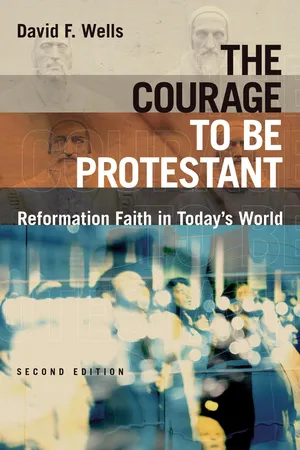
At its heart, the Protestant Reformation was about a deep, doctrinally shaped faith centered on God and his Word. But that historic, substantive faith is not faring so well in our contemporary Western context.
In his 2008 book
The Courage to Be Protestant, David Wells issued a summons to return to the historic Protestant faith, defined by the Reformation
solas (grace, faith, and Scripture alone) and by a high regard for doctrine. In this thoroughly reworked second edition, Wells presents an updated look at the state of evangelicalism and the changes that have taken place since the original publication of his book.
There is no better time than now to hear and heed Wells's clarion call to reclaim the historic, doctrinally serious Reformation faith in our fast-paced, technologically dominated, postmodern culture.
- 232 pages
- English
- ePUB (mobile friendly)
- Available on iOS & Android
eBook - ePub
About this book
Information
CHAPTER 1
Inside the Evangelical World

Humpty Dumpty sat on a wall.
Humpty Dumpty had a great fall.
All the king’s horses and all the king’s men
Couldn’t put Humpty together again.
Evangelicalism has struck an iceberg just as the Titanic did a century ago. This is an outcome as unexpected now as it was back then. Then, the Titanic seemed unsinkable. Indeed, that boast was made publicly. After all, it had the latest technology and its sheer size, it seemed, made it impervious to the perils of the sea. That turned out to be quite mistaken. This is where the parallel to the contemporary evangelical world lies. Perception now, as then, has parted company with reality.
Today, though, the appearance is one of great success in evangelicalism. Have not believers multiplied, educational institutions matured, organizations increased, religious fare on the Internet multiplied, and presses found their niches? Not only so, but is it not the case that many churches, at least in the United States, have also become inventive? They are throwing off the restraints of having to be stodgy and traditional. In a burst of creativity, and flush with this new freedom from the past, some churches now feature coffee at worship and many have rock musicians on the stage who could perform with the best of them. In an increasing number of churches, gone are the old pews, the crosses, the pulpit, and the obligatory collection. Actually, for others, gone is the church itself.
Why? Well, why not think of the local church as just a starter institution? Is it not really like a school from which those who are mature graduate? That is, let us think of it as a place to start out but not to stay in. That is what some are now saying. Therefore, instead of trekking each Sunday to a church building, why not have a floating and informal fellowship in its place, one that is virtual? Why not attend “worship” elsewhere, maybe on the other side of the country, online, where there is not only a choice of preachers but where one can hear those who can really preach? Is not doing church in these new ways what will appeal to the younger generations? For far too long, the church has lagged behind, it has been hidebound, and it has labored on the brink of irrelevance. It is always playing catch-up. No longer!
The leading edge on all of these experiments is, in fact, intent on becoming more current than current. The movers behind these changes are not only tech-savvy but acutely sensitive to every twitch in culture, every shadow, every mood, every abrupt turn. No sooner does it happen than they are on it and, in the twinkling of an eye, the church has twitched itself into a slightly new pattern. Then harmony is restored.
Not everyone, of course, is walking along these new roads. Not everyone wants to. The world of evangelical believing is multisided, and multicolored. It now embraces many, many different ways of being Christian and doing church. But a significant part of it is as I am describing it. It is tech-savvy, culturally au courant, and, for that reason, seemingly invincible. That is the appearance.
But a strange thing has happened.
Evangelical faith in all of its diversity of forms, not only its most cutting edge, has struck a submerged iceberg. Actually, what is taking it down is not so much external to it but, rather, internal. Slowly but surely, evangelicalism has been emptying itself out. This has been going on for several decades. However, the first slow movements away from the more Reformational form that it had in the 1950s and 1960s have become a cascade of change. Gone now is its doctrinal fabric, much of its earlier moral culture, and quite a bit of its serious preaching. It is true, of course, that great preachers are always few and far between in any age. But in every age there should be enough preachers to do the job, preachers who are conscientious, who know what it is to labor over Scripture during the week and then on Sunday deliver its truth with some conviction, with some insight, with some depth, and with some application to life, and in the Holy Spirit’s power. Even though many evangelical churches at the beginning of this period had uncomfortable seats and people met in unpretentious and ordinary buildings, they did know something about coming into the presence of God with reverence and awe. That was far more common then than it is today. Today, quite a few churches have made their peace with our affluent and postmodern culture. The customers want ease, comfort, and something that is both contemporary and easy on the mind. That is what they are getting. The experience of reverence and awe has become quite rare. And the consequence of all of this is that the center in evangelical faith is crumbling. That center was God and his Word. Now, the common vision that should join all evangelicals together is fading. There is little to hold together the massive number of ministries, organizations, educational enterprises, and careers that are spinning off into the evangelical empire. Today, the center has been mightily eviscerated. The result is massive fragmentation and factionalism. Because the consequences of all of this are so serious, it is worth pondering in a little more detail how exactly we have arrived at this place.
The Beginnings
I am beginning this story, not with the Book of Acts, or even with the birth of Protestantism. I am going back no further than the end of the Second World War (1939–1945). What took shape immediately after this war, both in Europe and in the United States, was a resurgence in evangelical believing. Here are the most immediate roots of contemporary evangelical believing.
Seven decades have now passed since this resurgence began. In this time, evangelicalism has matured in many ways and some of what has been achieved has been nothing less than spectacular. However, along with all of this astonishing growth there are also signs, as I have suggested, of internal weakness and decay. This is seen in many ways, but here I want to focus on just one of these. It is the decline in the role that biblical doctrine once played. But this decline, of course, involves much more than just the doctrine itself. It is really about a diminished interest in the Word of God in the life of the church. It is about not being able to hear that Word without hearing it as if it were endorsing our way of life today, our cultural expectations, and our priorities. The reality, of course, is that the truth of God’s Word is often in sharp antithesis to what is taken as being “normal” in our culture. To hear this Word, then, is to see that the Christ of this Word is against the culture in quite a few important ways. It is this sense of antithesis that has been lost. Once this is lost we cannot hear God’s Word on its own terms. We are hearing it as a “word” that comes from God but that, in fact, is partly coming from our own culture. We are therefore not meeting with God as he is but, rather, with him the way we want him to be.
Most profoundly, then, what has also been diminished through our lost appetite for the teaching of Scripture is a vision of God in his greatness, in his transcendence and holiness, as he stands over against the world in its sinfulness. This is always what is secured in the church’s understanding when doctrine has its proper place in Christian understanding. The reason is that God’s truth comes from God and when it is heard as he gave it, it takes us back to our center, to God as triune, to God in his greatness. To hear God’s Word as the Word from this God is inevitably to become God-centered. But it is this center that has become blurry, and this God-centeredness that is much scarcer. But let me begin where this resurgence itself began.
Among the things that stood out about this resurgence in the early postwar years was its doctrinal seriousness. Indeed, churches then reflected this. They did not try to hide it, as the church marketers did in the 1970s and 1980s and their successors do today. This kind of seriousness could be heard, Sunday by Sunday, in the sermons that were preached as well as in the early evangelical literature. It was certainly reflected in the pages of Christianity Today.
In both Britain and the United States this preoccupation with doctrine was one of the consequences of the bitter disputes with liberalism that had happened earlier at the beginning of last century. Liberals said Christianity is about deeds, not creeds. They said it is about life, not doctrine. Their conservative opponents who, in the United States, were called fundamentalists, insisted that Christianity is about creeds as well as deeds. It is about doctrine as well as life. It was not surprising, then, that they came to define their distinction from liberalism in terms of the different doctrine that they held.
It is true, of course, that these fundamentalists also came to think as many other cognitive minorities have. They felt alienated from the mainstream, endangered, and they protected themselves by walling themselves off from others. It was not a good defensive strategy.
Eventually, however, fundamentalism, with its oppositional attitudes, the schisms it sowed, and the intellectual isolation it made for itself, began to die down. Its replacement came in the resurgence of the 1950s and 1960s. Because it distinguished itself in some ways from fundamentalism, it came to be known as neoevangelicalism. It was led initially by Harold Ockenga, Carl Henry, and Billy Graham in the United States and by John Stott, J. I. Packer, Martyn Lloyd-Jones, and Francis Schaeffer in Europe. They, and many like them, set about building a movement with institutions, publications, and ministries, the whole of it intent on reengaging modern life and, for those with a will to do so, reentering the mainline denominations to reclaim them. But an important point of connection with the earlier fundamentalists was that they, too, were building a movement that was essentially shaped by the doctrine they believed.
Like all such movements, this one also had its symbols. Most prominent were the National Association of Evangelicals (NAE), founded in 1942, and Christianity Today, which was started in 1956. Their purposes, respectively, were to give organization and voice to this new burst of evangelical life. The NAE was an alternative organization to the liberal National Council of Churches (NCC). Christianity Today was an alternative voice to the liberal journal, The Christian Century.
It is ironic to see the paths these two magazines have taken since that time. The Christian Century has retained its intellectual integrity, despite the sagging fortunes of its liberal constituency in the “mainline,” or what are actually only the oldline, denominations. It has been bloodied over the last couple of decades but it remains unbowed. It is still resolutely liberal. Christianity Today, by contrast, and despite the swelling ranks of evangelicals it has served, has been less steadfast. Its role, in one sense, has never been easier. But now it no longer speaks with authority because it is no longer driven by the theological vision with which it started. The advice it offers is earnest enough but that advice seldom amounts to anything more than rearranging the chairs on Titanic’s deck.
As for the NAE, it is now a shadow of its former self. Actually, even a robust organization would have difficulty representing the sprawling empire that evangelicalism has become.
Like many things Christian, after a while the vision of the original evangelical leaders faded. The strength, discipline, and direction they had given to the movement were lost in the next generation or two. Evangelicalism continued to sustain many who simply lived off the capital earlier evangelicals had generated. The presses continued to roll, Christian colleges continued to graduate students, Christianity Today continued to report, but the capital was being spent. It was not being sufficiently renewed. Slowly but inexorably this great movement began to fragment.
And yet, amidst its spreading diversity, one can still find much that is strong, noble, self-sacrificial, and commendable. There are still many who think evangelicals should be doctrinally shaped, who love the Word of God, who value biblical preaching, who want to be God-centered in their thought and life, who live upright lives, and who are not ashamed of their roots in the Reformation. They are the ones who are so important in sustaining the missionary enterprise today, and the ones in whom one finds an older, and quite admirable, piety.
It would be quite unrealistic to think that evangelicalism today could look exactly as it did fifty years ago, or a hundred, or five hundred. At the same time, the truth by which it is constituted never changes because God, whose truth it is, never changes. There should therefore be threads of continuity that bind real Christian believing in all ages. It is some of those threads, I believe, that are now being lost.
The result of this, then, was that beginning in the 1970s and 1980s two large constituencies in the evangelical coalition, the church marketers and the emergents, began to drift away. And each was capitalizing on what had become critical, in-house weaknesses.
The main weakness was that, unlike the fundamentalists, evangelicals have often sat a little loose on the institution of the church. The reason, of course, was that the place of Scripture was changing. The place of doctrinal thinking was becoming more uncertain. This gave the opening and, indeed, the freedom to the church marketers in the 1970s, 1980s, and 1990s to see building the church less in biblical terms and more as a venture in capitalism. As in any business venture, they began by identifying the market. Then they designed a product to meet the identified needs.
But this was not the only outcome to a lost function of biblical authority. A different outcome was soon seen in the emergents, who quickly showed that they were more culturally oriented intellectually than biblically disciplined. For them, it quickly became a case of sola cultura rather than sola scriptura.
On Selling the Church
Church Is a Business
Let us begin with the marketers who went out of vogue in the 1990s but then morphed into the “attractional church” as the 2000s began.
In the 1970s, business-minded entrepreneurs had become the leaders in evangelicalism, replacing the first generation of leaders, who were more in the mold of the pastor-theologian. By the 1980s the overwhelming majority of religious organizations in America were evangelical.
Over the last seven decades, parachurch organizations such as these have served the evangelical cause in amazing and beneficial ways. Indeed, when the church has stumbled, it has often been a parachurch organization that has emerged to pick up what the church was failing to do. In the early postwar years these organizations stood outside the churches organizationally but lived within the church functionally. They lived to strengthen the life of the churches. Often they were doing things that individual churches could not do. And certainly it was not as common earlier as it became later for these parachurch organizations to become private entrepreneurial ventures.
In the 1980s, though, many evangelicals began thinking of the whole of evangelical faith in para terms. That was the striking departure that happened at this time. This, of course, went hand in hand with a fading interest in biblical doctrine. As doctrine shrank, the church became emancipated. It began to assume shapes that the earlier doctrinal frameworks would not have allowed.
The more traditional churches were not themselves attacked—at least not initially. But evangelicalism began to think of itself as significantly apart from the local church. This was not simply a matter of organization. It was one of attitude.
And this sentiment only accelerated as the marketers began to ply their trade in the 1980s and 1990s. Past traditions of believing, distinctive church architecture, doctrinal language, and the formalities of traditional church life all seemed like baggage that needed to be shed as rapidly as possible. Suddenly it was becoming an embarrassment. This was the major impediment to success. And success is what every entrepreneurial venture aims to achieve.
But along with these changes came something else. Whereas previously churches had been a focal point for Christian believers, now they lost that importance. As unlikely as it seems, many churches in a sense began to disappear. They began to fade into the background of people’s lives.
The leaders of this marketing enterprise understood that they were in a market, and religious customers have choices. The choices that began to be offered by way of competition, however, were all along the lines of not being churchy. This new direction was mightily reinforced by the emergence of television ministries, especially in the 1980s, not to mention the pervasive availability of religious videos and then online streaming. Church life subsided in importance for many people, if only because on Sunday morning they could, and often did, “go to church” in their living rooms in front of their television sets or online. In the last thirty years, statistics of regular churchgoing have all reflected this change. Evangelicalism was becoming para in mentality, and the local church was about to become its chief casualty.
This disappearing trick would never have been possible if evangelicals were still thinking in doctrinal terms. But they were not.
The truth is that without a biblical understanding of why God instituted the church, it easily becomes a liability in a market where it competes only with the greatest of difficulty against religious fare available on the computer screen. Not to mention all the other fare produced with slick proficiency and panache that is also on tap! And most of it has nothing to do with Christian faith. How can the church possibly compete with all this unless it has an entirely different purpose? This is especially the case in a culture bent on being distracted or entertained.
This experiment in marketing was intended to strengthen the local church, to make it more competitive, and, indeed, attractive. But it ended up mostly upending the local church. That is the irony.
The constant cultural bombardment of individualism, in the absence of a robust theology, meant that faith that had rightly been understood as personal earlier on was now becoming merely individualistic. It was self-focused and consumer-ori...
Table of contents
- Title Page
- Copyright
- Dedication
- Contents
- Preface
- 1. Inside the Evangelical World
- 2. Truth
- 3. God
- 4. Self
- 5. Christ
- 6. Church
- Index
Trusted by 375,005 students
Access to over 1.5 million titles for a fair monthly price.
Study more efficiently using our study tools.
Frequently asked questions
Yes, you can cancel anytime from the Subscription tab in your account settings on the Perlego website. Your subscription will stay active until the end of your current billing period. Learn how to cancel your subscription
No, books cannot be downloaded as external files, such as PDFs, for use outside of Perlego. However, you can download books within the Perlego app for offline reading on mobile or tablet. Learn how to download books offline
Perlego offers two plans: Essential and Complete
- Essential is ideal for learners and professionals who enjoy exploring a wide range of subjects. Access the Essential Library with 800,000+ trusted titles and best-sellers across business, personal growth, and the humanities. Includes unlimited reading time and Standard Read Aloud voice.
- Complete: Perfect for advanced learners and researchers needing full, unrestricted access. Unlock 1.5M+ books across hundreds of subjects, including academic and specialized titles. The Complete Plan also includes advanced features like Premium Read Aloud and Research Assistant.
We are an online textbook subscription service, where you can get access to an entire online library for less than the price of a single book per month. With over 1.5 million books across 990+ topics, we’ve got you covered! Learn about our mission
Look out for the read-aloud symbol on your next book to see if you can listen to it. The read-aloud tool reads text aloud for you, highlighting the text as it is being read. You can pause it, speed it up and slow it down. Learn more about Read Aloud
Yes! You can use the Perlego app on both iOS and Android devices to read anytime, anywhere — even offline. Perfect for commutes or when you’re on the go.
Please note we cannot support devices running on iOS 13 and Android 7 or earlier. Learn more about using the app
Please note we cannot support devices running on iOS 13 and Android 7 or earlier. Learn more about using the app
Yes, you can access The Courage to Be Protestant by David F. Wells in PDF and/or ePUB format, as well as other popular books in Theology & Religion & Christian Theology. We have over 1.5 million books available in our catalogue for you to explore.