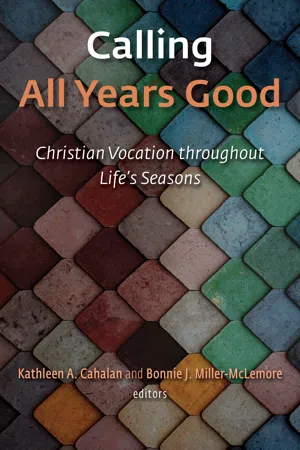
A uniquely comprehensive discussion of vocation from infancy to old age Do infants have a vocation? Do Alzheimer's patients? In popular culture, vocation is often reduced to adult work or church ministry. Rarely do we consider childhood or old age as crucial times for commencing or culminating a life of faith in response to God's calling. This book addresses that gap by showing how vocation emerges and evolves over the course of an entire lifetime. The authors cover six of life's distinct seasons, weaving together personal narrative, developmental theory, case studies, and spiritual practices. Calling All Years Good grounds the discussion of vocation in concrete realities and builds a cohesive framework for understanding calling throughout all of life.
eBook - ePub
Calling All Years Good
Christian Vocation throughout Life's Seasons
- 244 pages
- English
- ePUB (mobile friendly)
- Available on iOS & Android
eBook - ePub
Calling All Years Good
Christian Vocation throughout Life's Seasons
About this book
Information
Topic
Theology & ReligionSubtopic
Religion1
Introduction
Finding Life’s Purposes in God’s Purposes
KATHLEEN A. CAHALAN
Do older persons with dementia have a calling? Or newborns? Can children before they walk and talk have a sense of vocation or teenagers as puberty disrupts their bodies, relationships, and sense of self? When I began working on a theology of vocation in 2010 through the Collegeville Institute Seminars, these questions did not occur to me. In fact, I thought I might plan a seminar focused on young adults, particularly as they left college and entered the workforce. But after listening to theologians, pastors, and social scientists—all experts on vocation (and some on young adults) during the first summer of the project—I changed my mind. In fact, retirement emerged as one of the central vocational moments in adult life. As I began to consider the questions and issues that emerge when we leave full-time paid employment, I began to think about the elderly, children, and teens. Where were they in the vocation literature? Clearly young adulthood is pivotal to vocation, but by focusing on this one time of life our research would fail to capture vocation as a lifelong question and experience.1 Furthermore, it would make the issues of young adulthood central to vocation and thereby obscure the challenges that arise during retirement, childhood, and other life phases. So I decided to launch a seminar devoted to this question: What would a lifelong perspective do to our understanding of vocation?
This volume attempts, then, to offer a perspective quite unique in the literature on vocation as well as in the literature on lifecycle development by examining callings over the span of human life. What does it mean to talk about God’s callings in relationship to the duration of our lives, from birth to old age? What difference does it make to understand Christian vocation not only from the experiences of young adulthood but also from the play of children, the transition into assisted living in late adulthood, and the middle years of multiple callings? We have found that engaging vocation across the span of our lives demands a more nuanced theology than previous interpretations of calling offered in the Christian tradition, especially when we consider it outside the framework of speech, rationality, and choice, as with a newborn or a person with dementia. In addition, the pursuit of meaning and purpose in life, which is central to Christian understandings of vocation, is integral to human personhood but is often missing in current social science theories on the lifespan. We believe that a theological understanding of calling, broadly understood as discerning one’s life purpose in relationship to God’s purposes, has something to offer both theology and lifespan theory.
A Theology of Calling: Lost but Found
At the outset of the Seminars’ work on vocation, we decided that rather than reframing the idea of vocation and teaching it to people2 we would first attempt to understand how people, primarily those in churches, understand their life as a calling.3 What operative notions of vocation exist in the Christian community? Is vocation a meaningful way that people interpret their lives, or is it trapped in outmoded notions from the past? What would be most helpful to people if we invited them to reframe their understanding of vocation, drawing insights from the tradition as well as engaging new frameworks? Or is the idea or very term “vocation” beyond repair and too corrupted by historical interpretations to be of much use to us today?
Over the past five years, under the direction of the Seminars’ research associate Laura Kelly Fanucci, we have gathered hundreds of people—Protestants and Catholics—in small groups, primarily in congregations, and asked them to reflect on a series of questions: What is my sense of God’s callings in my life? How can I learn to listen to God’s call? How do I live out multiple callings in service to others? How have challenges and struggles shaped my callings? How is my vocation changing over my lifetime?4
What we heard from these participants shaped our work in profound ways. First, most people in our small groups had limited, mostly nonexistent, experiences and conceptions of God as Caller. Remember, these were people from various churches who volunteered to participate in a six-week program to think about their life as vocation. For example, Jay described his life in terms of multiple commitments and joys: marriage, children, and extended family. He described his skills as a financial analyst and his ability to help others make difficult decisions. He spoke of how he found God in others, especially as a father, husband, leader, and little league coach. Jay felt gratitude for his life, and he wanted to give back to the community. But at the end of our first discussion he concluded: “But I don’t know that I’ve ever been given a calling.”5
Second, when asked about vocation most people tend to refer to the major commitments clustered in the young adult years pertaining to work and partnering, as I initially did. When we engaged college students they expressed anxiety and fear that they might miss God’s one call. They assumed that there is a single answer to the question of vocation and once they find it, discerning callings is mostly over. But framing vocation as decisions made in young adulthood left most other adults, especially as they get older, feeling that figuring out callings did not have much to do with them.
Third, those people who could recount stories of having a sense of calling as a child or a teen tended to discount their religious experiences or lacked a way to talk about or interpret the experience. Operatively, their notion of a calling that comes from God remains rather calculating, too easily imaging God as having a definite plan or will for them. Discernment constituted figuring out this deeply held secret or having direct access to God’s wishes. Experiences of hearing or seeing, having a dream, being grasped or drawn to an activity or a place, giving extensively to community or religious organizations, identifying and utilizing particular gifts, or being invited by another to share those gifts—these common experiences were not framed as calling experiences.
If people examine their lives through the lens of calling, they do it primarily through what psychologist and contributor to this volume Matt Bloom calls “retrospective sense-making,” looking back and creating a narrative to make sense of their lives and discovering God’s hand at work in the past.6 Few people we talked to either looked inward or forward to consider how God might be calling them now and in the future.
Fourth, most communities are not places of calling—that is, communities whose vocation it is to draw forth each person’s callings as well as the vocation of the whole community. We found that congregations, schools, and campus ministries generally do not engage people in the practices of vocation. For instance, many people reported that their small group was the first time they had been asked such questions. In relationship to work, for example, a majority said their pastors and congregations had rarely asked them about their job or profession, what they did, why they did it, what they loved, and what they were good at. Those who were retiring had little opportunity to explore the new horizon of callings in the next part of life. Generally, the key practices of vocation—discernment, prayer, and storytelling—are not fostered in congregations, the most obvious places where one might expect such activities to occur. Religious education, sermons, and sacraments or other celebrations seldom address vocation or foster vocational conversation, especially across the lifespan. We also found that most people did not pray about their callings or seek guidance and direction from the Spirit or from others, especially when they were younger and deciding what to do, where to do it, and for whom. The majority of people did not have a listening practice to hear God’s guidance, such as regular prayer with scripture or a silent meditation practice. Most significantly, they had not learned to foster a relationship with God who is understood as the “Caller.”
Finally, the language of vocation was not compelling for most people. When we began we suspected that we would find outmoded Protestant and Catholic theologies—that vocation is equated with work (Protestants) or has to do with states of life (Catholics) or with a call to ministry (both)—and we did to some extent. But what we mostly found is that people had no idea what the word “vocation” means. The term almost always fell flat: people did not know what it referred to in greater depth. As a central doctrine and vocabulary of the Christian faith, vocation is nearly gone.
However, when we heard people’s stories we began to see that what traditionally would be referred to as the “language of callings” was everywhere: meaningful relationships; powerful experiences of being given something to do; purposeful work, skills, and abilities experienced as gifts; confirmation about who one is; a sense of gratitude; struggles through transitions and painful loss; aspirations to serve others; and a desire to give themselves to God’s people for God’s purposes. In fact, people have a deep sense of calling in their lives but they often lack ways to make sense of it.
Recovering the Language of Vocation
What, then, happened to the language of vocation, a language that was once rich in the Christian vocabulary? In modernity, many Christians held narrow views of divine power and purpose that portrayed a provident all-powerful deity who makes blueprints for human lives. Such an image proved untenable, and by the twentieth century many had tossed it into the dustbin of useless religious concepts. Furthermore, vocation became a doctrine to be believed in rather than a lived practice. It functioned primarily as a noun—what is my vocation?—rather than as a relationship, a process, or a creative endeavor. The language of calling became static and fixed rather than dynamic and fluid, something church and academic theologians might talk about but not something everyday people needed to consider.
And yet the language of calling is everywhere. What Christians have largely lost, others have discovered. The titles of several books about “calling” demonstrate the way in which it has become the language of the secular age: Callings: Finding and Following an Authentic Life; Your Personal Renaissance: 12 Steps to Finding Your Life’s True Calling; The Path to Purpose: How Young People Find Their Calling in Life; Let Your Life Speak: Listening for the Voice of Vocation.7 The New York Times featured a series entitled “Vocations” in the business section for a short time; it is now called “What I Love.”8 And the evangelical pastor Rick Warren, whose book The Purpose Driven Life has sold millions of copies, prefers the language of “purpose” over that of “vocation” or “calling,” but he is essentially talking about the same reality.9
The search engine Google Ngram Viewer tabulates the frequency of words, now covering about five million books. Terms such as “purpose” and “meaning” have grown in usage since the 1900s, rising steadily up to today; “calling” also has had steady usage. But the term “vocation,” the least used of the four terms, gained some steam around the 1920s, but dropped considerably by 2000. While not a scientific study, word usage reveals that the language of “purpose” and “meaning” has gained ground as the culture has become more secular. The term “calling” certainly leans more in a nonreligious direction despite the fact that “calling” and “vocation” are nearly synonymous terms.
What secular writers on calling have discovered is that vocation is a deeply human quest. What is the purpose of my life? To what shall I give myself? Whom shall I serve? Such questions are at the same time both frightening and exhilarating. They press for an answer. Terms like “purpose” and “meaning” also seem like they offer a greater avenue than the term “vocation” for considering change and development across the lifespan. However, these secular understandings of calling have deep roots in the Christian tradition’s claim, whether these authors recognize this heritage or not, that each person is made in the image of God, has inherent dignity and worth, and lives with a purpose shaped by divine initiative. Moreover, our culture’s “expressive individualism” prizes the notion that each person has an inner nature, truth, or self that drives toward expression.10 Such common or popular notions of calling in the broader culture are influenced by an unnecessarily singular focus on human well-being at the expense of community, the animal world, and the environment as well as divine life and its purposes. In large part, theological sources for vocation have been severed from its broader cultural meaning today. But as we reframe vocation in this book, we see that the Christian tradition gives us a much broader framework that honors the deeply personal and individual character of calling but claims this human quest as fundamentally communal and divine.
A Practical Theological Consideration of Vocation
Why, then, pursue a theology of vocation? What difference does a practical theological understanding of vocation make? Our approach to vocation across the lifespan takes account of several ways in which theology is rendered as practical.11 First, we begin with the stories and experiences of calling—we listened to people in churches, and when the Seminar participants gathered over the past four years, we told stories of our own callings as children, teens, young adults, and adults. When we were learning about phases of the lifespan we had not yet experienced, such as older adulthood, we interviewed people in our families and communities, and we relied significantly on social science literature that includes empirical study of people’s lives.
Vocation, we contend, is inherently narrative. Its first language is story. According to personality psychologist Dan McAdams, author of The Stories We Live By, “If you want to know me, then you must know my story, for my story defines who I am. And if I want to know myself, to gain insight into the meaning of my own life, then I, too, must come to know my own story . . . a story I continue to revise, and to tell to myself (and sometimes to others) as I go on living.”12 We found McAdams’s claim to be true: telling stories about our lives helps each of us to reframe our identity and purposes. But beyond self-insight, we found that telling stories about our callings forged strong bonds of friendship. Once you hear other people’s stories about their callings, you know them in a more full and integral way and can honor and support their discernments and choices.
In our work with people in congregations and during our Seminar, the practice of storytelling captured the contextual, embodied, and temporal character of callings. Stories reveal most clearly that calling is not one thing. We heard powerful and illuminating stories, in fact, too many to be included here. We especially felt that stories that don’t fit expected patterns helped us qualify our claims about vocation—the grandmother who has to parent small children; the teen who cares for a sick parent; the executive laid off from work. Narrative approaches to vocation are one way that we can invite readers to tell their stories and thereby expand our awareness of the multiplicity of vocation experiences.
Second, in addition to lived experience and narrative, we turn to a variety of sources to help us understand both vocation and the span or course of human lives. In terms of theology, there has recently been important retrieval work done by a Protestant, Douglas Schuurman, and a Catholic, Edward Hahnenberg. Each explores his tradition’s interpretations of biblical narratives as well as the doctrines of creation, providence, and salvation as they...
Table of contents
- Title Page
- Copyright
- Contents
- 1. Introduction: Finding Life’s Purposes in God’s Purposes (KATHLEEN A. CAHALAN)
- 2. Callings over a Lifetime: In Relationship, through the Body, over Time, and for Community (KATHLEEN A. CAHALAN)
- Introducing Biblical Interludes: Vocation in the Family of God (JANE PATTERSON)
- Childhood: One Such Child (JANE PATTERSON)
- 3. Childhood: The (Often Hidden yet Lively) Vocational Life of Children (BONNIE J. MILLER-MCLEMORE)
- Siblings: Am I My Brother’s Keeper? (JANE PATTERSON)
- Adolescence: God Looks on the Heart (JANE PATTERSON)
- 4. Adolescence: Vocation in Performance, Passion, and Possibility (KATHERINE TURPIN)
- Younger Adulthood: A Voice from Within (JANE PATTERSON)
- 5. Younger Adulthood: Exploring Callings in the Midst of Uncertainty (KATHERINE TURPIN)
- Points of Decision in Adulthood (JANE PATTERSON)
- 6. Middle Adulthood: The Joys and Paradoxes of Vocation (MATT BLOOM)
- Elders: Ultimate Values (JANE PATTERSON)
- 7. Late Adulthood: Seeking Vocation Once Again (KATHLEEN A. CAHALAN)
- Blessing the Next Generation (JANE PATTERSON)
- 8. Older Adulthood: Vocation at Life’s End (JOYCE ANN MERCER)
- Resurrection and God’s Vindication (JANE PATTERSON)
- Notes
- Contributors
- Index
Trusted by 375,005 students
Access to over 1.5 million titles for a fair monthly price.
Study more efficiently using our study tools.
Frequently asked questions
Yes, you can cancel anytime from the Subscription tab in your account settings on the Perlego website. Your subscription will stay active until the end of your current billing period. Learn how to cancel your subscription
No, books cannot be downloaded as external files, such as PDFs, for use outside of Perlego. However, you can download books within the Perlego app for offline reading on mobile or tablet. Learn how to download books offline
We are an online textbook subscription service, where you can get access to an entire online library for less than the price of a single book per month. With over 1.5 million books across 990+ topics, we’ve got you covered! Learn about our mission
Look out for the read-aloud symbol on your next book to see if you can listen to it. The read-aloud tool reads text aloud for you, highlighting the text as it is being read. You can pause it, speed it up and slow it down. Learn more about Read Aloud
Yes! You can use the Perlego app on both iOS and Android devices to read anytime, anywhere — even offline. Perfect for commutes or when you’re on the go.
Please note we cannot support devices running on iOS 13 and Android 7 or earlier. Learn more about using the app
Please note we cannot support devices running on iOS 13 and Android 7 or earlier. Learn more about using the app
Yes, you can access Calling All Years Good by Kathleen A. Cahalan,Bonnie J. Miller-McLemore in PDF and/or ePUB format, as well as other popular books in Theology & Religion & Religion. We have over 1.5 million books available in our catalogue for you to explore.