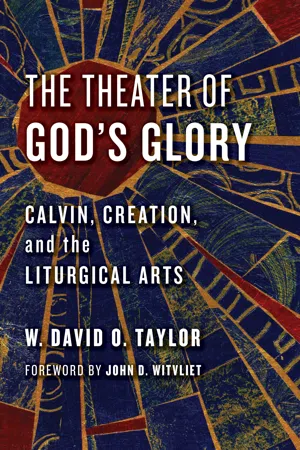
A theological framework for the liturgical arts rooted in John Calvin
Both detractors and supporters of John Calvin have deemed him an enemy of the physical body, a pessimist toward creation, and a negative influence on the liturgical arts. But, says W. David O. Taylor, that only tells half of the story.
Taylor examines Calvin's trinitarian theology as it intersects his doctrine of the physical creation in order to argue for a positive theological account of the liturgical arts. He does so believing that Calvin's theology can serve, perhaps surprisingly, as a rich resource for understanding the theological purposes of the arts in corporate worship.
Drawing on Calvin's
Institutes, biblical commentaries, sermons, catechisms, treatises, and worship orders, this book represents one of the most thorough investigations available of John Calvin's theology of the physical creation—and the promising possibilities it opens up for the formative role of the arts in worship.
- 240 pages
- English
- ePUB (mobile friendly)
- Available on iOS & Android
eBook - ePub
About this book
Information
Topic
Theology & ReligionSubtopic
Christian Rituals & PracticeCHAPTER 1
Musical Instruments in Calvin
[Calvin’s] exemplary liturgy will be simplex, pura and spiritualis, “plain,” “unadorned” and “spiritual.”
Peter Auksi, “Simplicity and Silence”
I have no doubt that playing upon cymbals, touching the harp and the viol, and all that kind of music, which is so frequently mentioned in the Psalms, was a part of the education; that is to say, the puerile instruction of the law.
Calvin, Comm. Psalms
Calvin’s appreciation for both music and the psalms is well known by those who count themselves his liturgical heirs. In his Epistle to the Reader, his foreword to the very popular Genevan Psalter, he writes: “Now among the other things which are appropriate for recreating people and giving them pleasure, music is either the first or one of the principal, and we must value it as a gift of God deputed to that use.”1
The singing of psalms, Calvin remarks in 1537, “can incite us to lift up our hearts to God and move us to an ardor in invoking and exalting with praises the glory of his Name.”2 It is estimated that, on average, Genevan Christians would have sung at any given service between sixteen and thirty psalm stanzas, which, according to Paul Jones, amounts to “the equivalent of five hymns of up to 6 stanzas each.”3 In the tradition that followed Calvin, the singing of metrical psalms would become one of the singular distinguishing features of Calvinists of the sixteenth and seventeenth centuries.4 How Calvin viewed musical instruments, however, is a mixed bag. While he envisions a legitimate place for their use “at home” and “in the fields,” he does not regard them as appropriate to corporate worship. Typical of his thinking is this observation: “For even now, if believers choose to cheer themselves with musical instruments, they should, I think, make it their object not to dissever their cheerfulness from the praises of God. But when they frequent their sacred assemblies, musical instruments in celebrating the praises of God would be no more suitable than the burning of incense, the lighting up of lamps, and the restoration of the other shadows of the law.”5
If scholars take notice of Calvin’s ideas about instruments, it will be to observe that he locates them under the era of “figures and shadows.” More often, the matter is left altogether untreated. In the case of Charles Garside’s seminal essay “The Origins of Calvin’s Theology of Music: 1536–1543,” for example, the focus remains exclusively on music as a general topic.6 H. P. Clive’s treatment does more than most, for he rightly situates Calvin’s concerns about instruments within a wider historical context and thus brings to light the kind of historical “pressures” that may account for the Reformer’s conclusions in a way that exegetical or theological scrutiny alone cannot.7 The aim of this chapter is to press the topic in a more thoroughgoing manner and to suggest that Calvin’s thinking on musical instruments in public worship is far more complicated and interesting than commentators have often allowed.
Song and Instruments
Calvin and Congregational Song
In order to put Calvin’s ideas about musical instruments in context, it will be helpful to summarize his view of congregational song:
- Singing obtains not only a possible place in the liturgy but a positive place, for it intensifies our capacity to worship God.
- Not just any singing will do. We must sing rightly, which involves a consideration for both the mind and the heart, for both understanding and affection.
- The kind of singing that pleases God most is the kind that is done commonly (i.e., in unison), as if with “the same mouth.”
- Because our worship must accord with God’s holy Word, God has provided us with good, fitting words—namely, the psalms of David; when these are sung well, they lead to maximal edification and to right moral formation.
- Because not any melody will do for corporate worship but only that which befits congregational song, God has provided us with skilled musicians to compose melodies suitable to corporate worship.
Whereas the 1559 Institutes, the “Articles” (1537), and the Epistle to the Reader omit mention of musical instruments, Calvin directly addresses their use in his commentaries on the Psalms. The context he presumes in these commentaries is public worship, while the aim is, as always, “pure worship.” Calvin makes two kinds of statements about musical instruments: positive and negative. I take each in turn.
Positive Comments on Musical Instruments
Positively, musical instruments perform a double benefit for Israel’s worship. On the one hand, they incite the heart to exuberant praise: they express ardent affection for God,8 they stimulate increased devotion to God, stirring the worshiper “up more actively to the celebration of the praise of God with the heart,”9 and they indicate that even the “most ardent attempts” to celebrate God’s mighty deeds will fall “short of the riches of the grace of God.”10 In his comments on Psalm 150, Calvin regards the enumeration of instruments as a kind of metaphor for corporate singing. Even as the sound of one instrument piles on top of that of another, producing an exuberant sound, so our individual praise piled on top of the praises of others, producing a kind of exuberant praise, cannot capture the full measure of adoration that God deserves. For the Jews, however, instruments attained that kind of vibrant adoration.
On the other hand, musical instruments serve as deterrents to an “unruly flesh” and therefore performed a crucial moral function in Jewish life. They protect the worshiper not only from a “cold faith” but also from the possibility of sliding into error.11 God commands a multiplicity of songs, Calvin explains in his commentary on Psalm 150:3, in order that “he might lead men away from those vain and corrupt pleasures to which they are excessively addicted, to a holy and profitable joy. Our corrupt nature indulges in extraordinary liberties, many devising methods of gratification which are preposterous, while their highest satisfaction lies in suppressing all thoughts of God. This perverse disposition could only be corrected in the way of God’s retaining a weak and ignorant people under many restraints, and constant exercises.”12
Negative Comments on Musical Instruments
On the negative side, Calvin’s argument against instruments in a new-covenantal liturgy involves four contentions. First, he stresses that instruments belong to the era of figures and shadows. For Calvin, instruments represent the “infancy of the Church,”13 forming a “part of the training of the Law”14 “under the legal economy,”15 and correspond to the “dispensation of shadows and figures,” which characterized Jewish believers. When the Israelites used harp and lyre, it was done because of the “generally prevailing custom of that time.”16 Christians are not to insist on their continuation, for to do so is to perpetuate “the ceremonies of the law.”17 God commanded timbrels and trumpets to “train his people, while they were as yet tender and like children, by such rudiments, until the coming of Christ”;18 the Jews, “who were yet under age,” required the use of “such childish elements.” In one sense, Calvin says, instruments were not in themselves necessary; they were only “useful” as elementary aids to the people of God. Now that the church has “reached full age,” instruments can be set aside.19
Second, Calvin insists that the reintroduction of instruments into public worship leads people to cling to “earthly” things when God has expressly commanded that they worship him in spiritual fashion.20 He comments: “We are to remember that the worship of God was never understood to consist in such outward services, which were only necessary to help forward a people, as yet weak and rude in knowledge, in the spiritual worship of God.”21 He elaborates on this point in a sermon on 2 Samuel, arguing that to reinsert such external elements “would be nothing but a silly performance now, which would obscure the spiritual worship spoken of in the fourth chapter of St. John. For there our Lord Jesus Christ declares to us how we must no longer govern ourselves by the Law.”22
In this light, musical instruments risk contaminating the true praise of God. As Selderhuis observes, Calvin “fears that, by using musical instruments, the correct balance would be disturbed between the joy caused by music and the joy due to the praise of God.”23 Calvin asks: “Does anyone object, that music is very useful for awakening the minds of men and moving their hearts? I own it; but we should always take care that no corruption creep in, which might both defile the pure worship of God and involve men in superstition.”24 The use of instruments in public prayers, in short, defiles such worship.
Third, Calvin insists that God is more pleased with simple worship. This idea functions as a kind of corollary to the first, where the opposite of “shadowy” worship is “simple” worship. Likewise, the opposite of a ceremonially and materially extravagant worship is a ceremonially and materially simple worship. Papists “ape” Israel in their employment of instruments. They do so, Calvin maintains, in “a senseless and absurd manner,” “exhibiting a silly delight in that worship of the Old Testament which was figurative, and terminat...
Table of contents
- Title Page
- Copyright
- Contents
- Foreword, by John D. Witvliet
- Acknowledgments
- Abbreviations
- Introduction
- 1. Musical Instruments in Calvin
- 2. The Work of the Material Creation
- 3. The Work of the Material Symbols of Worship
- 4. The Twin Problem of Materiality and Mediation
- 5. The Double Movement of Creation in Worship
- 6. Calvin’s Theology of the Physical Body
- 7. A Trinitarian Theology of the Physical Body
- 8. The “Simple” Worship of God
- 9. The Trinitarian Space of Worship
- Conclusion
- Select Bibliography
- Index
Trusted by 375,005 students
Access to over 1.5 million titles for a fair monthly price.
Study more efficiently using our study tools.
Frequently asked questions
Yes, you can cancel anytime from the Subscription tab in your account settings on the Perlego website. Your subscription will stay active until the end of your current billing period. Learn how to cancel your subscription
No, books cannot be downloaded as external files, such as PDFs, for use outside of Perlego. However, you can download books within the Perlego app for offline reading on mobile or tablet. Learn how to download books offline
Perlego offers two plans: Essential and Complete
- Essential is ideal for learners and professionals who enjoy exploring a wide range of subjects. Access the Essential Library with 800,000+ trusted titles and best-sellers across business, personal growth, and the humanities. Includes unlimited reading time and Standard Read Aloud voice.
- Complete: Perfect for advanced learners and researchers needing full, unrestricted access. Unlock 1.5M+ books across hundreds of subjects, including academic and specialized titles. The Complete Plan also includes advanced features like Premium Read Aloud and Research Assistant.
We are an online textbook subscription service, where you can get access to an entire online library for less than the price of a single book per month. With over 1.5 million books across 990+ topics, we’ve got you covered! Learn about our mission
Look out for the read-aloud symbol on your next book to see if you can listen to it. The read-aloud tool reads text aloud for you, highlighting the text as it is being read. You can pause it, speed it up and slow it down. Learn more about Read Aloud
Yes! You can use the Perlego app on both iOS and Android devices to read anytime, anywhere — even offline. Perfect for commutes or when you’re on the go.
Please note we cannot support devices running on iOS 13 and Android 7 or earlier. Learn more about using the app
Please note we cannot support devices running on iOS 13 and Android 7 or earlier. Learn more about using the app
Yes, you can access The Theater of God's Glory by W. David O. Taylor in PDF and/or ePUB format, as well as other popular books in Theology & Religion & Christian Rituals & Practice. We have over 1.5 million books available in our catalogue for you to explore.