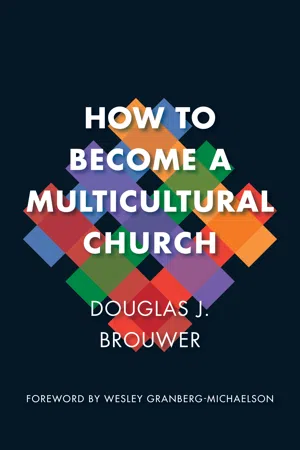
Many churches aspire to be more culturally diverse-but they find that they have no idea how to approach that goal practically. This book addresses that problem with ten ways churches can truly engage and welcome other cultures.
In 2014 Douglas Brouwer, a seasoned American pastor, took on the unique challenge of serving a multiethnic, multiracial, multicultural church in one of Europe's largest cities. In this book Brouwer distills the lessons he has learned from that experience into timely wisdom on issues every multicultural church faces, including language barriers, theological differences, and cultural stereotypes. Honestly recounting his own questions and challenges in multicultural ministry, Brouwer shows how churches everywhere can adjust their attitudes and practices to embrace racial, ethnic, and cultural diversity.
- 189 pages
- English
- ePUB (mobile friendly)
- Available on iOS & Android
eBook - ePub
How to Become a Multicultural Church
About this book
Information
Topic
Theology & ReligionSubtopic
Christian ChurchCHAPTER ONE
Rediscover the Meaning of Home
I always thought the “Where is home?” question was innocent enough, and until I served an international, multicultural congregation, I asked it often and without a second thought.
“Where are you from?” Hey, just being friendly!
If you ask me where my home is, I’ll say, “Michigan.” I think of Michigan as home. My mother lives there, as do my sisters and their husbands and some extended family. Beyond that, I vacation there just about every summer, and I even have plans to retire there.
So, yes, “Michigan is where I’m from,” I say, holding up my right hand to indicate that my home state is shaped like a mitten with its own thumb. I might even point to the fleshy part of my palm and say, “Right there. That’s where I’m from.” (This can be a puzzling gesture for those who do not call Michigan home.)
The German language has a word for this relationship between a person and a place. It’s Heimat, and like several other German words it doesn’t have an exact counterpart in English. German-speaking Swiss, the people I live with, often say Heimatort, which essentially means the same thing. Though Heimat and Heimatort have mostly positive connotations, they are emotionally charged words and can elicit a range of responses. Swiss passports list Heimat rather than a place of birth, even if it has been a few generations since someone has lived there, because, well, Heimat tells you more about a person. If you ask a German-speaking person where Heimat or Heimatort is, you’ll need to set aside time for the answer and have plenty of tissues nearby.
For a growing number of people around the world, and for a growing number of people in our churches, the honest answer to the “Where is home?” question would be, “It’s complicated.” It’s like Heimat. Often it takes time.
The answer to the “Where is home?” question is so complicated, in fact, and occasionally so emotionally fraught, that I have very nearly stopped asking the question altogether. Never mind that one of the first sentences that beginning German students learn is, “Woher bist du?” (Or, more formally, “Woher kommen Sie?”)
Where are you from?
Michigan
If you know where I’m from, then you know just about all there is to know about me. I say that Michigan is my home not so much because I live there (I don’t), but because Michigan reminds me of who I am. Michigan has become for me shorthand for describing all of my essential characteristics—Midwesterner, descendant of Dutch immigrants, reserved, shy, thrifty, modest, not given to much spontaneity, but rather sober, serious, and dependable.
And of course Christian.
I suppose you could say that Michigan, more than anything, is my spiritual home. Over the years I have come to think of it that way.
Maya Angelou, the late American poet, once wrote (in the fifth installment of her autobiographical series All God’s Children Need Traveling Shoes) that “the ache for home lives in all of us, the safe place where we can go as we are and not be questioned.” I like that, and I agree that the “ache for home” exists in all of us. I feel it myself most days. And I believe that it is, more than anything, a spiritual ache.
Recognizing this powerful longing for home, the Roman Catholic Church in the U.S. developed a “come home for Christmas” marketing campaign a few years ago that I thought was especially moving. I felt a sudden rush of tears each time I saw the ad. At its heart the campaign was an invitation—or maybe a plea—to those who had drifted away from the church to return, to come home, to be reunited once again with their core identity.
I have no idea how successful that campaign was, but at the time I thought it was exactly the right idea. I’m not even Catholic, but that year I felt as though I wanted to go home, to join the great company of exiles who would be returning home for Christmas.
Coming home promises something more than coming to the place where there is a roof over our head. Coming home, as Maya Angelou points out, means coming to a “safe place.” What that means, as she expresses it, is a place we can go and “not be questioned.”
Maybe it’s just me, and my own spiritual ache, but I hear in those words a no-matter-what quality, a kind of unconditional acceptance. Home is where you can have any crackpot idea you want to have—and not be questioned about it. Or more realistically, where you can be loved in spite of your crackpot idea.
Home is where you find love in spite of a lot of things. But home, as it turns out, has a few other connotations as well.
It’s complicated
The teenagers in my church’s youth group look and sound as though they have come from all over the world—India, China, Africa, even the Caribbean. But if you ask them where they’re from—a question with which they seem to have a love-hate, though mostly hate, relationship—most of them will say that they’re from Switzerland.
They were born in Switzerland, after all, and they have Swiss passports. Most of them attend Swiss schools. And among themselves, often to the consternation of their parents and sometimes their youth group leaders, they prefer to speak Swiss German. So, they may look as though they have come from many different places, but their home is Switzerland, every bit as much as home for me is Michigan.
It’s the follow-up question that sometimes triggers a complicated reaction. If you say, “No, really, where are you from?” you are likely to receive a puzzled and possibly a pained look.
Pico Iyer, a British-born essayist and novelist of Indian descent, likes to say (as he did in a 2013 TED Talk about where home is) that, when people ask him where he’s from, they “are always expecting me to say India, and they’re absolutely right insofar as 100 percent of my blood and ancestry does come from India. Except that I’ve never lived a day of my life there. I can’t even speak one word of its more than 22,000 dialects.” Iyer left England as soon as he completed his undergraduate education, and after a few years in Japan has now lived much of his life in the U.S.
Where is he from? He would say, truthfully, that he’s from the U.S., but everything about him suggests that the answer is just a tiny bit more complicated than that.
I am tempted to acknowledge that of course Pico Iyer is an extreme example, but my experience tells me that he’s not. In my work, not just here in Switzerland, but in the U.S. too, I meet people like him often. His experience is actually becoming far more common than we might think, not only here, but also in the U.S.
And the “Where is home?” or “Where are you from?” question needs to be carefully considered, not least of all in our churches.
In 2015 there were 244 million people—or 3.3 percent of the world’s population—living outside their country of origin (United Nations Population Fund, http://www.unfpa.org/migration), and the number is increasing rapidly. This number does not include those who have been internally displaced—in other words, many people are refugees within their own country. The majority of the 244 million cross borders (legally) in search of better economic and social opportunities. Others are forced to flee wars and persecution. About half of them are women of, as the report puts it, “reproductive age.”
And some of these people, perhaps more than we realize, are even finding their way into our churches. Or they might find their way into our churches, if they knew that they would find a welcome there, a home.
A roof over my head
As it turns out, there are many ways to ask (and answer) the “Where are you from?” question. A more polite form of the question, depending on the context, might be, “Where were you born and educated?” A more direct question might be, “What passport do you hold?” And curiously, a few people at my church are always eager to ask, “Where do you pay taxes?” as though that might be the defining characteristic of home.
At a men’s gathering soon after my arrival in Europe, and before I learned to be a bit more careful with the question, I asked the men to introduce themselves by telling me their names and where they were from.
When we came to one man, he said, “Home is wherever there is a roof over my head.” I noticed that a few other men nodded in response, as though this was what men at their best should say. Practical and unsentimental. Home, according to this point of view, is wherever you happen to be at any particular moment.
But something about that answer troubled me at the time, as it does now, because it’s much too glib. Frankly, it doesn’t line up with what I have experienced in my own life, and more than that, it doesn’t line up with what I believe. Home may well be the place where there is a roof over my head, but home has always suggested a great deal more to me than that.
Home, I think, refers to our identity—in other words, who we are at our deepest levels.
One time I asked a church member where home was, and suddenly her eyes filled with tears. She said, “In heaven.” And at first I felt embarrassed for having asked the question, as I probably should have been, but then I realized that she was actually trying her best to give her pastor an honest answer, that she was grasping for an important truth.
Right now, she said, “I’m just passing through.”
Which, I suppose, is true for all of us. At least some of us live with the vague feeling that we are in transit, not permanently settled, strangers in a strange land, ready to move on if we have to, or if the right offer were to come along.
A threatening question
One reason I no longer ask the “Where are you from?” question—or try my best not to—is that it can often sound hostile or even threatening.
I like the story that Barbara Brown Taylor, the American preacher, tells. She was walking one time near her home in the backwoods of rural north Georgia, when a man who was clearly not happy to see her, planted himself in her path and asked, “And who would your people be?”
She writes that she understood the question to be shorthand for “Why don’t you get back in your foreign car and go back to wherever you came from?”
I wonder if the questions we sometimes ask of newcomers don’t also sound threatening. Not as threatening as the person in this story, maybe, but threatening nonetheless, even when we think we’re just being friendly and curious.
Too often, not always, “Where are you from?” sounds like “You don’t belong here.” And if people are looking for home, a spiritual home, then the last question they want to hear from their church is, “And who would your people be?”
An article appeared in a recent Atlantic (July 2014) with the title “Is It Racist to Ask People Where They’re From?” The title, of course, was deliberately provocative. The article makes the case that in certain contexts the “Where are you from?” question can be more than threatening. Perhaps without intending it, we can—simply by asking the question—point out another person’s “otherness.”
What we might intend as an innocent question, as the article puts it, often has a way of hitting the ear at an odd angle.
A woman named Lorena from San Diego is quoted in the article as saying, “I’m multiracial and live in a very ethnically diverse city, but I was still asked this [“Where are you from?”] question SO. MANY. TIMES. while growing up. I never realized how ignorant and rude of a question it was until I became an adult. I can only hope no one asks my son this question. Because, really, the answer is simple: here.”
Teresa from West Des Moines, Iowa, is quoted in that same article: “I am a Korean adoptee, raised in central Nebraska. I do not have an accent. I had a Swedish last name growing up and now have a Czech last name. I often get asked, ‘Where are you from?’ I say, ‘Nebraska.’ Then I get, ‘Really, where are you from?’ I have never self-identified as Korean-American and find it puzzling that people need to know this information. I do not know my biological family. I have a Korean adopted brother and growing up, we were often asked if we were REAL brother and sister (we are not biologically related). Is ‘real’ and ‘biological’ the same? Isn’t family more than just blood relations?”
The day and the hour
I have always wanted church to be home. I have always wanted the church to be home for me. I wanted it to be more than that, of course, but I wanted it to be at least that. I have always thought the church at its best should be the place where we felt wanted and accepted, in spite of our shortcomings and deficits, in spite of how different we are from each other.
In the first church I served—I had not even graduated from seminary at the time—I had an overwhelming experience of unconditional love and acceptance—in other words, for me, of the church as home.
It was so overwhelming, in fact, that when people ask me “the day and the hour” when I was “saved,” I usually point to that experience, even though there was never really a time in my life when I did not know that I was a child of God.
The people in that church loved each other in spite of everything and—this may sound odd—in spite of the ugliness and meanness and cruelty which seem to be present in every church, including that one.
And astonishingly—I wanted this, but never expected it—they loved me too.
I had no idea at the time that such a thing was possible, that such love within a church could be real. I had certainly never experienced it in the church of my childhood—or any other church, for that matter. Not to be critical of the church of my childhood, which after all introduced me to the electronic map, but by the time I reached adulthood I figured that it wasn’t possible, that no church could demonstrate love like that.
And though the congregation I served during my seminary years could hardly be called “multicultural”—in the sense I am using the word here—it was certainly diverse, as diverse as any church I had known until that time. Sitting side by side in the pews were world-class surgeons and farmers, first-rate scholars and Amway distributors. It was a Big Ten university town, so there was bound to be at least a little diversity in that church, and there was.
Learning to speak meaningfully into this diversity wasn’t actually as difficult as I imagined it to be at the time, but I still felt awed by the challenge of it. No, that doesn’t begin to describe my feelings at the time. I was as scared as I have ever been.
The first time I preached in that church I visibly trembled on my way to the pulpit, c...
Table of contents
- Title Page
- Copyright
- Contents
- Foreword, by Wesley Granberg-Michaelson
- Introduction
- 1. Rediscover the Meaning of Home
- 2. Reconsider the Church’s Name
- 3. Learn to Lead (Differently)
- 4. Be Theologically Generous
- 5. Seek to Understand— as Well as to Be Understood
- 6. Learn the Language
- 7. Move Beyond Cultural Stereotypes
- 8. Consider What the Flag Might Mean
- 9. It’s Not the Music (or the Worship Style)
- 10. It’s the Meal (Where Strangers Become Friends)
- Afterword, by Richard A. Davis
- Acknowledgments
Trusted by 375,005 students
Access to over 1.5 million titles for a fair monthly price.
Study more efficiently using our study tools.
Frequently asked questions
Yes, you can cancel anytime from the Subscription tab in your account settings on the Perlego website. Your subscription will stay active until the end of your current billing period. Learn how to cancel your subscription
No, books cannot be downloaded as external files, such as PDFs, for use outside of Perlego. However, you can download books within the Perlego app for offline reading on mobile or tablet. Learn how to download books offline
Perlego offers two plans: Essential and Complete
- Essential is ideal for learners and professionals who enjoy exploring a wide range of subjects. Access the Essential Library with 800,000+ trusted titles and best-sellers across business, personal growth, and the humanities. Includes unlimited reading time and Standard Read Aloud voice.
- Complete: Perfect for advanced learners and researchers needing full, unrestricted access. Unlock 1.5M+ books across hundreds of subjects, including academic and specialized titles. The Complete Plan also includes advanced features like Premium Read Aloud and Research Assistant.
We are an online textbook subscription service, where you can get access to an entire online library for less than the price of a single book per month. With over 1.5 million books across 990+ topics, we’ve got you covered! Learn about our mission
Look out for the read-aloud symbol on your next book to see if you can listen to it. The read-aloud tool reads text aloud for you, highlighting the text as it is being read. You can pause it, speed it up and slow it down. Learn more about Read Aloud
Yes! You can use the Perlego app on both iOS and Android devices to read anytime, anywhere — even offline. Perfect for commutes or when you’re on the go.
Please note we cannot support devices running on iOS 13 and Android 7 or earlier. Learn more about using the app
Please note we cannot support devices running on iOS 13 and Android 7 or earlier. Learn more about using the app
Yes, you can access How to Become a Multicultural Church by Douglas J. Brouwer in PDF and/or ePUB format, as well as other popular books in Theology & Religion & Christian Church. We have over 1.5 million books available in our catalogue for you to explore.