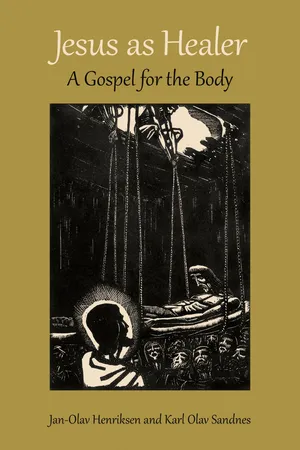
Healings and miracles play a prominent role in the New Testament accounts of Jesus' life and ministry. In the Western Christian tradition, however, Jesus' works of healing tend to be downplayed and understood as little more than a demonstration of his divine power.
In this book Jan-Olav Henriksen and Karl Olav Sandnes draw on both contemporary systematic theology and New Testament scholarship to challenge and investigate the reasons for that oversight. They constructively consider what it can mean for Christian theology today to understand Jesus as a healer, to embrace fully the embodied character of the Christian faith, and to recognize the many ways in which God can still be seen to have a healing presence in the world.
- 272 pages
- English
- ePUB (mobile friendly)
- Available on iOS & Android
eBook - ePub
About this book
Information
Topic
Theology & ReligionSubtopic
Biblical StudiesPart I
Remembering Jesus as Healer:
Perspectives from New Testament Scholarship
Perspectives from New Testament Scholarship
Karl Olav Sandnes
Introductory Remarks to the New Testament Part
We start this part of the book by stating a fact: Jesus was remembered as a healer. This remembrance is to be found almost exclusively in stories. Jesus’ healings were recounted and passed on. Storytelling always serves the present in one way or the other. From the very outset we can therefore point out that Jesus was remembered as a healer in a way relevant for posterity. Outside the narrative genre, Jesus as healer is a topic that plays no significant role in early Christianity. It is, for example, entirely absent in the Apostles’ Creed, as well as in creed-like texts in the New Testament, which are building blocks towards later formulations of what Christian faith is about (Rom 1:3–4; Phil 2:6–11; Col 1:15–20; 1 Tim 3:16; Heb 1:2–4). In a way that became formative for the church, these texts encapsulate the pivotal elements in the ministry of Jesus. Strikingly, the wonder traditions1 are absent. This is, however, not the case in the book of Acts (see later), and it is also worth noticing that Justin Martyr (c. 160 CE) at times includes Jesus’ healings and exorcisms in his creedal statements on the life of Jesus: “In these books, then, of the prophets we found Jesus our Christ foretold as coming, born of a virgin, growing up to man’s estate, and healing every disease and every sickness, and raising the dead, and being hated, and unrecognized, and crucified, and dying, and rising again, and ascending into heaven, and being called the Son of God” (1 Apology 31, cf. 48). To Justin, Jesus’ healing sickness is a fulfillment of prophecy; it is part of his proof-from-prophecy argument. The Christians did tell and pass on stories about Jesus as healer, and also about his disciples who continued this ministry, albeit more randomly.
As Craig S. Keener points out, “Miracle stories compose nearly one-third of Mark’s Gospel.”2 The evidence for Jesus as a wonderworker is overwhelming in the relevant sources. It is found explicitly in Q, Mark, Matthew, Luke, John, Acts, as well as polemically in Jewish as well as pagan sources. The latter sources, for example, rabbinic texts and Celsus, make sense of this activity of Jesus’ differently from how the Gospels present it. They say that Jesus owed his healing power to sorcery, a hostile interpretation echoed also in Mark 3:22 and parallels and some other passages. The polemics make no attempt, however, to deny that Jesus really performed wonders. It is the explanations that differ, and greatly so, not the fact that Jesus performed healings.
Apparently the first-century Jewish historian Josephus attests that Jesus was seen as a wonderworker. In his so-called Testimonium Flavianum (Ant. 18.63), he says that Jesus was a wise man who “worked startling deeds” (paradoxa erga). The Greek adjective paradoxos refers to something contrary to all expectations, or what is incredible;3 it refers to things perceived as miraculous. The fact that the wonders are labeled ta paradoxa is worth noticing, since it gives reason to question the commonly held view that people in the ancient world were exceedingly credulous.4 We need to be reminded that a common reaction to Jesus’ healings was the following: “We have never seen anything like this” (Mark 2:12 par.).5 However, the reliability of this piece of information in Josephus is debatable. No doubt, the testimony has been shaped by Christians; but whether it is a Christian addition throughout or only partly remains an issue. It is probable that Josephus included some information about Jesus of Nazareth at this point in his story, and that Christians then expanded on it, but also shaped what might have been there already. To be sure, some of the concepts conveyed about Jesus in this passage find little compliance with how Christians commonly talked about Jesus, thus suggesting that it is not a Christian invention throughout.6 Furthermore, the fact that Josephus mentions “the brother of Jesus” (Ant. 20.200) assumes that the readers have already been introduced to Jesus; most likely this is where the Testimonium Flavianium is now found. If the Testimonium Flavianum is removed, this piece of information about “the brother of Jesus” is left hanging in the air. Hence, it seems justified to assume that the wonders of Jesus had already been mentioned by Josephus.7 The Greek magical papyri (PGM) give witness to the fact that even outsiders considered the name of Jesus to be able to perform miraculous things.8 Although this is worth noticing, PGM attest to the repute of Jesus only.
This source-critical situation complies with the principle of multiple attestation in historical Jesus research. Again, in the words of Craig S. Keener: “The evidence is stronger for this claim than for most other historical claims that we could make about Jesus or earliest Christianity.”9 This means that the general picture is authentic, but it can nevertheless not be applied to every single instance. What matters in the present context is to point out that Jesus was clearly and broadly remembered as a healer. It is the memories of this activity, not a secured minimum of historically authentic material, that eventually come into play for present-day theology.
It is here worth rehearsing briefly what Chris Keith has called “the Jesus-memory approach” in historical Jesus research.10 Its point of departure is the fundamental insight of recent memory studies, which has been picked up on in New Testament studies: Remembering is not simply an act of recalling the past, but the past is reconstructed in the light of present needs. In other words, memory is formed or shaped by the present. Applying this to the Gospels and considering them as “receptions of Jesus-memory” has significance not only for historical Jesus research but also for the present project. This way of thinking assumes that both past and present have conditioned the memories about Jesus.
These memories were not made without any basis in what happened; certainly the past provided stories to be told and remembered. However, the past would not be remembe...
Table of contents
- Cover
- Titel
- Cotents
- Acknowledgments
- Abbreviations
- Introduction
- I. Remembering Jesus as Healer: Perspectives from New Testament Scholarship
- II. Jesus as Healer and Contemporary Theology
- Bibliography
- Index of Names
- Index of Subjects
- Index of Scripture and Other Ancient Texts
Trusted by 375,005 students
Access to over 1.5 million titles for a fair monthly price.
Study more efficiently using our study tools.
Frequently asked questions
Yes, you can cancel anytime from the Subscription tab in your account settings on the Perlego website. Your subscription will stay active until the end of your current billing period. Learn how to cancel your subscription
No, books cannot be downloaded as external files, such as PDFs, for use outside of Perlego. However, you can download books within the Perlego app for offline reading on mobile or tablet. Learn how to download books offline
Perlego offers two plans: Essential and Complete
- Essential is ideal for learners and professionals who enjoy exploring a wide range of subjects. Access the Essential Library with 800,000+ trusted titles and best-sellers across business, personal growth, and the humanities. Includes unlimited reading time and Standard Read Aloud voice.
- Complete: Perfect for advanced learners and researchers needing full, unrestricted access. Unlock 1.5M+ books across hundreds of subjects, including academic and specialized titles. The Complete Plan also includes advanced features like Premium Read Aloud and Research Assistant.
We are an online textbook subscription service, where you can get access to an entire online library for less than the price of a single book per month. With over 1.5 million books across 990+ topics, we’ve got you covered! Learn about our mission
Look out for the read-aloud symbol on your next book to see if you can listen to it. The read-aloud tool reads text aloud for you, highlighting the text as it is being read. You can pause it, speed it up and slow it down. Learn more about Read Aloud
Yes! You can use the Perlego app on both iOS and Android devices to read anytime, anywhere — even offline. Perfect for commutes or when you’re on the go.
Please note we cannot support devices running on iOS 13 and Android 7 or earlier. Learn more about using the app
Please note we cannot support devices running on iOS 13 and Android 7 or earlier. Learn more about using the app
Yes, you can access Jesus as Healer by Jan-Olav Henriksen,Karl Olav Sandnes in PDF and/or ePUB format, as well as other popular books in Theology & Religion & Biblical Studies. We have over 1.5 million books available in our catalogue for you to explore.