The thought of Immanuel Kant (1724–1804) is often regarded as having caused a crisis for theology and religion because it sets the limits of knowledge to what can be derived from experience. In
The Intolerable God Christopher Insole challenges that assumption and argues that Kant believed in God but struggled intensely with theological questions.
Drawing on a new wave of Kant research and texts from all periods of Kant's thought — including some texts not previously translated — Insole recounts the drama of Kant's intellectual and theological journey. He focuses on Kant's lifelong concern with God, freedom, and happiness, relating these topics to Kant's theory of knowledge and his shifting views about what metaphysics can achieve.
Though Kant was, in the end, unable to accept central claims of the Christian faith, Insole here shows that he earnestly wrestled with issues that are still deeply unsettling for believers and doubters alike.
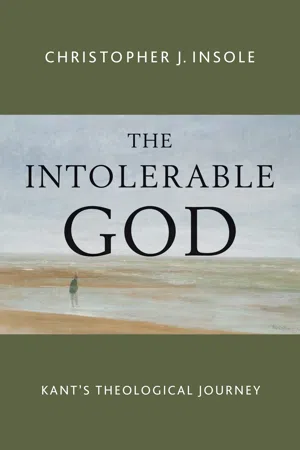
- 186 pages
- English
- ePUB (mobile friendly)
- Available on iOS & Android
eBook - ePub
About this book
Information
Topic
Theology & ReligionSubtopic
Christian TheologyChapter One
Introduction
This book is written for people who have an interest in theology and who have encountered the figure of Immanuel Kant, and who want to know more about his thought and significance.
It is difficult to know more about Immanuel Kant, for a number of reasons. His texts are difficult. Reading Kant can be initially confusing and demoralizing rather than illuminating. This problem is compounded by the fact that Kant’s thought is a system with many facets. Simply reading one text in isolation can lead to a distorted impression of what is going on, even in that text itself. The literature on Kant is also difficult, as well as being vast, and rapidly expanding, with seemingly irreconcilable fundamental perspectives on Kant’s intentions, significance, and meaning. Excellent introductions to Kant’s general philosophy do exist.1 There are also commendable introductions to Kant’s philosophy of religion.2 But these treatments do not have as a central focus Kant’s lifelong concern with God, freedom, and happiness, from his earliest thought to his dying days. These themes are likely to be of the greatest interest to the theologically engaged. Furthermore, I relate these topics to Kant’s theory of knowledge, and to his shifting views about what metaphysics can achieve. In the course of doing this, I draw deeply, but with a light touch, upon a new wave of more historically sensitive, theologically open-minded, and holistic Kant interpretation, to which I have contributed.3 These new developments in Kant scholarship have identified much more continuity between his earlier theological and metaphysical thought, and his later “critical” philosophy. Kant’s mature philosophy has standardly been received by theologians as attempting a straightforward refutation of the possibility of theological discourse.4 The picture of Kant emerging from recent scholarship is quite different, and much more textured about how Kant might relate to theology.
From years of teaching Kant to students whose main interest in Kant is theological, I am convinced that there is no single book available that really brings out what might be of central interest to students of theology, who do not have the time or inclination to dedicate years of their lives to the specialist and technical study of Kant and the secondary literature. By “student of theology” I mean someone who engages thoughtfully with the intellectual tradition, whether that be through a formal course of study or not. My hope is that students of theology will be delighted, surprised, and challenged by what they can learn from an engagement with Kant. Some of these lessons are more positive, with Kant remembering deep strands of the tradition, and applying them in the context of the rise of modern science. Other lessons are more negative, showing where some of the deep fault lines in modern thought really lie. These fault lines are not where one might initially have thought.
This book began its life as a series of public addresses, given as the 2013 McDonald Lectures in Theology, Ethics & Public Life at the University of Oxford. I have extensively reworked the lectures for publication as a book, making the text more appropriate for a different genre, and responding to feedback. Two important features of the lectures, though, I have retained. First of all, I do not presuppose any prior study of philosophy, or of Kant. This is not to say that the text will be easy reading for those with no philosophical or Kantian background. But I do believe it will be possible and rewarding reading, with enough repeated and clear explanations, alongside a glossary of terms, and the use of vivid images and analogies. Second, I have retained several literary devices. These literary devices come in two forms. First of all, there is my use of the notion of conceptual rooms in chapters two and three, where Kant’s background assumptions are visualized in terms of architecture, ornamentation, and artifacts. Second, chapters four to eight dramatize the unfolding of Kant’s philosophical and theological understanding in terms of Dante’s imagined journey, in the Divine Comedy, up the mountain of purgatory.
The book is ambitious in its scope and depth, tracking central features of Kant’s whole intellectual journey with respect to God, knowledge, freedom, causation, belief, and happiness. It does this by relating Kant to a range of debates and influences. Such ambition, I found, is assisted by imagery and metaphor. For example, by picturing a conceptual room, I am able to depict and specify complex, filigreed, and nuanced degrees and aspects of influence, in a way that would have taken many more thousands of words, qualifications, and hesitations: Newton can be invited into the room as a guest; statues of Plato and Aquinas can be present, but not overbearingly or anachronistically celebrated; people can be present in the room, but without their thought being exhaustively captured by every intellectual commitment that the room is intended to communicate. To take another example, I describe an imagined campfire in chapter four. This image makes it possible to picture historical thinkers sitting close to, or farther away from, a circle of committed followers, nodding at some things, but demurring from others. In ordinary descriptive prose, this would entail an unmemorable business of categorizing positions, without the necessary context to make it appropriately fascinating. But enough content can be conveyed, for our purposes, through the more palatable medium of a visualized scene. In this way, complex arguments and lines of intellectual development can be conveyed in a way that is vivid, memorable, and relatively accessible to those without specialist training, and without writing a book that is twice as long and difficult.
Phases in Kant’s intellectual development are related by imagining steps up the mountain of purgatory, where key influences at each stage of Kant’s thought are depicted by a cast of influential thinkers and provocations. The imagery of steps, I have found, avoids unhelpful reification or multiplication of “phases” of Kant’s thought, easily combining different strands of continuity, gradual development, and rupture, especially as I exploit the idea of a spiral, rather than a linear, ascent. In my choice of a journey metaphor running throughout the book, there is a mirroring of form and content. The narrative content of the book circles around the pressures, opportunities, eclipses, and shifts that occur across an intellectual lifetime. The literary form of a journey is intended to carry such material limpidly and gracefully. Kant’s thought unfurls across a developmental temporal arc, with deep spiritual convictions and intellectual treasures tested through crises and resolutions.
Claims that I make throughout are defended with reference to primary texts, and with some reference to my position in relation to the secondary literature. It would not be appropriate in this type of book to engage in extensive wrangling in the field of Kant studies, but nonetheless, I take care when setting out a controversial interpretation of Kant to announce this, and to explain why I think other interpretations are wrong, but also how they have come about, and how some of them have become mainstream. In the chapters themselves, I only include explicit discussion of the secondary literature where I am making a significant and controversial move. The reader needs to be so apprised in order to emerge from the book having learned not only how I interpret Kant, but also something reliable about the current state of Kant studies on key topics of relevance to theologians. More detailed suggestions for further reading, in relation to each chapter, are included at the back of the book.
In the next chapter I begin the substantive treatment of Kant, and set out a map for the argument of the book. In this introduction, I want to summarize not specific claims made by Kant, but dimensions to Kant’s thinking that might amaze, delight, illuminate, and even shock the student of theology, when reflecting on the drama of Kant’s engagement with the themes of God, freedom, and happiness. There are five strands that emerge at numerous points in the book. At times, I will draw attention to the strands, but more often, their presence will be easily felt without my drawing explicit attention to them.
(1) The tradition of philosophical theology that Kant was immersed in is known as “theological rationalism,” and was the dominant intellectual paradigm for thinking theologically in eighteenth-century Germany, and thus for German Enlightenment thought. This school is now deeply unfashionable, and is barely understood or studied at all by non-specialists. Where it is treated, it is presented as a rather arid reduction of religion to a set of formulas and principles. By engaging with Kant’s early and mature philosophy, I hope to show that whatever one thinks of it, there is a theological integrity, energy, beauty, and sincerity to theological rationalism, which has genuine and profound strains from medieval and classical theology. There is even what we might call a living and lived spirituality to it. If this is true, we should find out about it, as it restores to us a forgotten theological texture and dimension to much philosophy from the German Enlightenment.
(2) As well as being immersed in a tradition of philosophical theology, Kant’s conception of philosophy itself is rooted in a classical tradition, where philosophy is ordered not only toward the true, but also to the good, and so toward a capacious understand...
Table of contents
- Acknowledgments
- Method of Citation
- 1. Introduction
- 2. “I Am from Eternity to Eternity”: God in Kant’s Early Thought
- 3. “Whence Then Am I?”: God in Kant’s Later Thought
- 4. Kant’s “Only Unsolvable Metaphysical Difficulty”: Created Freedom
- 5. Creating Freedom: Kant’s Theological Solution
- 6. Interpreting Kant: Three Objections
- 7. The Dancer and the Dance: Divine Action, Human Freedom
- 8. Becoming Divine: Autonomy and the Beatific Vision
- Further Reading
- Glossary of Terms
- Index
Trusted by 375,005 students
Access to over 1.5 million titles for a fair monthly price.
Study more efficiently using our study tools.
Frequently asked questions
Yes, you can cancel anytime from the Subscription tab in your account settings on the Perlego website. Your subscription will stay active until the end of your current billing period. Learn how to cancel your subscription
No, books cannot be downloaded as external files, such as PDFs, for use outside of Perlego. However, you can download books within the Perlego app for offline reading on mobile or tablet. Learn how to download books offline
Perlego offers two plans: Essential and Complete
- Essential is ideal for learners and professionals who enjoy exploring a wide range of subjects. Access the Essential Library with 800,000+ trusted titles and best-sellers across business, personal growth, and the humanities. Includes unlimited reading time and Standard Read Aloud voice.
- Complete: Perfect for advanced learners and researchers needing full, unrestricted access. Unlock 1.5M+ books across hundreds of subjects, including academic and specialized titles. The Complete Plan also includes advanced features like Premium Read Aloud and Research Assistant.
We are an online textbook subscription service, where you can get access to an entire online library for less than the price of a single book per month. With over 1.5 million books across 990+ topics, we’ve got you covered! Learn about our mission
Look out for the read-aloud symbol on your next book to see if you can listen to it. The read-aloud tool reads text aloud for you, highlighting the text as it is being read. You can pause it, speed it up and slow it down. Learn more about Read Aloud
Yes! You can use the Perlego app on both iOS and Android devices to read anytime, anywhere — even offline. Perfect for commutes or when you’re on the go.
Please note we cannot support devices running on iOS 13 and Android 7 or earlier. Learn more about using the app
Please note we cannot support devices running on iOS 13 and Android 7 or earlier. Learn more about using the app
Yes, you can access The Intolerable God by Christopher J. Insole in PDF and/or ePUB format, as well as other popular books in Theology & Religion & Christian Theology. We have over 1.5 million books available in our catalogue for you to explore.