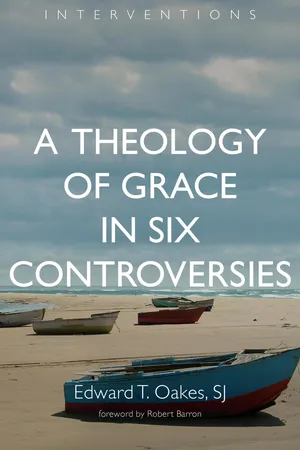
Few topics in theology are as complex and multifaceted as grace: over the course of centuries, many seemingly arbitrary distinctions and arcane debates have arisen around it. Edward Oakes, however, argues that all of these distinctions and debates are ultimately motivated by one central question:
What are God's
intentions for the world?
In
A Theology of Grace in Six Controversies Oakes examines issues relating to grace and points them back to that central question, illuminating and explaining what is really at stake in these debates. Maintaining that controversies clarify issues, especially those as convoluted as that of grace, Oakes works through six central debates on the topic, including sin and justification, evolution and original sin, and free will and predestination.
- 288 pages
- English
- ePUB (mobile friendly)
- Available on iOS & Android
eBook - ePub
A Theology of Grace in Six Controversies
About this book
Information
Topic
Teología y religiónSubtopic
Denominaciones cristianasChapter 1
Nature and Grace
The creature is darkness insofar as it comes out of nothing. But in as much as it has its origin from God, it participates in his image; and this leads to likeness to him.
St. Thomas Aquinas, De veritate q. 18, a. 2, ad 5
The words nature and grace have a wide range of meanings, both inside and outside theology. One way to begin to understand that range would be to start simply with etymology. Nature comes from the Latin natura, itself a noun formed from the Latin deponent intransitive verb nascor, nasci, natus sum, meaning “to be born” which gives to English, among a host of other words, terms like nativity, nation (which originally meant the land where one was born), and innate, meaning “inborn” or “inherent,” which in turn implies the concept of something essential to the make-up or constitution of a particular entity. What is natural, then, can, in certain contexts, refer to what is essential to something’s identity.1 Thus, expressions like “It’s only human nature” assert (or at least imply) that a particular “natural” behavior or trait is inherent to a human being. Correlatively, when a behavior is described as “unnatural,” the implication is not that such behavior is impossible to perform (like pigs flying, which is certainly unnatural in the absolute sense) but deplorable.2
Grace, on the other hand, comes from the Latin noun gratia, a word with another wide range of semantic content; one Latin dictionary lists these meanings (as determined by the context where they occur): “agreeableness,” “esteem,” “favor” (in the sense of a service done outside of one’s ordinary duties), “indulgence,” and finally, in a very common idiom, “thanks” or “gratitude.” As with natura, gratia too is a nominal form derived from a Latin deponent verb, here grator, gratari, gratus sum, meaning “to give thanks to” or “to congratulate,” from which the adjective gratus came to mean “pleasing.” In all of these usages the semantic range stresses what is not essential, that is, what is gratuitous, to the entity in question but comes to it as something extra, unexpected, or not required for a nature to be a nature.3
Thus we speak of someone’s gracious manners, the graceful turn of a ballet dancer, a king’s gracious pardon, or a gracious gesture like holding open a door for someone overloaded with packages. All of which has been usefully summarized by the French theologian Jean Daujat in this way:
The word “grace” is a literal translation of the Latin gratia, equivalent to the Greek charis and derived from the Latin adjective gratus, meaning “pleasing.” Thence is derived the sense of something granted to someone, as being pleasing to him without its being strictly his due, a gratuitous favor granted to an individual without its being an obligation, and finally a “pardon,” a free remission of a penalty incurred. The word also has an important use in aesthetics, so that La Fontaine says it means “something still more than beauty,” and another French writer remarks that the word suggests something that charms us because it expresses or symbolizes something supremely lovable and attractive, such as trust, tenderness, etc. Thus there is a sense in which grace stands for moral qualities. On a last analysis, love is the essence of grace. What we admire in a smile, in gracious manners, in beautiful speech is really the goodness which lies behind them.4
This passage begins to hint at the paradox of grace. For if love is the essence of grace, then something peculiar enters the picture here: we all need love, but love is not love if it has been coerced out of the supposed lover. We all have heard stories of children raised in wealthy homes whose parents give them every material blessing but deprive them of love, thereby warping them (Victorian fiction is filled with such stories). Yet, in a sense, love is not due anyone. What is the value of love if it is not freely given? Thus the paradox: we need love but cannot demand it. Love is love precisely because it is a gift freely—that is, gratuitously—given:
The fundamental meaning of the word “grace” is bound up with love. What pleases us, what we find agreeable, is what we love; but from the first form of love, which is an attraction to the loved object, we pass on to a higher form of love which is a “giving” to the [one] being loved. The lover seeks what is pleasing to the beloved. Real love is always expressed by a giving and, above all, by a giving of one’s self. The gift that comes from love, all that is generosity prompted by love, such is the deepest meaning of the word “grace.” From this comes the idea of all that is given without its being the due of the recipient: of all that is purely a gift, of which a pardon, or remission of a punishment, is only one particular and derived sense. So also we have the words “gratuitous,” “gratuity,” “gratuitously.” What is gratuitous is pleasing because it is something given, and it is love that gives. The same meaning is to be found in the expression to be—or not—in someone’s “good graces.”5
Something analogous to that paradox—a requirement than can only be fulfilled by a free gift—can be seen at work in the centuries-long debate on nature and grace in Christian theology. On the one hand, God did not have to create the world, and so in that sense creation is “gratuitous.”6 On the other hand, once God creates, he has created natures, that is, creatures with their own inherent identity and specific goals, the fulfillment of which is required for them to maintain those natures.
Christian doctrine has consistently maintained what is technically known as God’s aseity, his full self-sufficiency. God is not needy and so did not create the world out of any inherent desperation, the way a lonely child makes a toy and invents a personality to go along with it in order to create an imaginary friend to assuage the pain of isolation. Moreover, Scripture asserts that the act of creation is intimately bound up with Christ’s own incarnation—a gratuitous act on God’s part if ever there was one. For as St. Paul says: “All things were created through him [Christ] and for him” (Col. 1:16b). That word for especially indicates the ultimate purpose of creation: to be united with Christ when all of creation will dwell in God, “who put everything under Christ; [and] when he has done this, then the Son himself will be made subject to him who put everything under him, so that God may be all in all” (1 Cor. 15:27c–28). For Christian revelation, nothing is obviously more gratuitous than the incarnation; but creation itself, as Paul teaches, was created through and for Christ so that all natures will be suffused with the divine presence.
In this perspective, nature becomes not just an analogue, a symbol, or an indicator of grace, a mere pointer to grace, but a true exemplification and instantiation of grace: For the entire universe has been gratuitously created in Christ and is destined for union at the end with that same Christ through whom and for whom creation was aboriginally made, and separation from whom would thus seem to entail a violation of one’s very created nature. In this way, God’s aseity confirms the gracious character of creation, as Daujat rightly stresses:
It remains to see why God created, seeing that he is perfectly self-sufficing in his infinite perfection to which nothing is wanting. He is in no way obliged to create, for creation adds nothing to him who needs nothing. God, who is infinite freedom, is absolutely free to create or not to create. Hence creation, which brings nothing to him, is on his part purely gratuitous, pure generosity, a pure gift to the creature of everything that it has within it. Being, good, perfection, and therefore creation is a pure act of love, purely the overflow or superabundance of love. God creates in order to give, because he is infinite generosity and love.7
Despite the obvious truth of this passage, and despite even more the christological hymns in Colossians, one line from which was cited above, the truth expressed by them must be paired with others that contrast grace over against nature. For insoluble problems arise when the grace of creation is seen as seamlessly segueing into the grace of redemption. Indeed, other passages from Scripture stress how completely unmerited and unexpected grace is when it encounters the unsuspecting sinner, who is by nature a child of wrath (the added italics stress this special gratuity):
As for you, you were dead in your transgressions and sins, in which you used to live when you followed in the ways of this world and of the ruler of the kingdom of the air, the spirit who is now at work in those who are disobedient. All of us also lived among them at one time in the passions of our flesh, gratifying the cravings of flesh and senses, and we were by nature children of wrath, like everyone else. But God who is rich in mercy, out of his great love for us, made us alive in Christ even when we were dead in our transgressions—it is by grace that you have been saved—and raised us up wit...
Table of contents
- Contents
- Foreword
- Acknowledgments
- Introduction
- 1. Nature and Grace
- 2. Sin and Justification
- 3. Evolution and Original Sin
- 4. Free Will and Predestination
- 5. Experience and Divinization
- 6. Mary, Mediatrix of Graces
- Glossary of Terms
Trusted by 375,005 students
Access to over 1.5 million titles for a fair monthly price.
Study more efficiently using our study tools.
Frequently asked questions
Yes, you can cancel anytime from the Subscription tab in your account settings on the Perlego website. Your subscription will stay active until the end of your current billing period. Learn how to cancel your subscription
No, books cannot be downloaded as external files, such as PDFs, for use outside of Perlego. However, you can download books within the Perlego app for offline reading on mobile or tablet. Learn how to download books offline
Perlego offers two plans: Essential and Complete
- Essential is ideal for learners and professionals who enjoy exploring a wide range of subjects. Access the Essential Library with 800,000+ trusted titles and best-sellers across business, personal growth, and the humanities. Includes unlimited reading time and Standard Read Aloud voice.
- Complete: Perfect for advanced learners and researchers needing full, unrestricted access. Unlock 1.5M+ books across hundreds of subjects, including academic and specialized titles. The Complete Plan also includes advanced features like Premium Read Aloud and Research Assistant.
We are an online textbook subscription service, where you can get access to an entire online library for less than the price of a single book per month. With over 1.5 million books across 990+ topics, we’ve got you covered! Learn about our mission
Look out for the read-aloud symbol on your next book to see if you can listen to it. The read-aloud tool reads text aloud for you, highlighting the text as it is being read. You can pause it, speed it up and slow it down. Learn more about Read Aloud
Yes! You can use the Perlego app on both iOS and Android devices to read anytime, anywhere — even offline. Perfect for commutes or when you’re on the go.
Please note we cannot support devices running on iOS 13 and Android 7 or earlier. Learn more about using the app
Please note we cannot support devices running on iOS 13 and Android 7 or earlier. Learn more about using the app
Yes, you can access A Theology of Grace in Six Controversies by Edward T. Oakes in PDF and/or ePUB format, as well as other popular books in Teología y religión & Denominaciones cristianas. We have over 1.5 million books available in our catalogue for you to explore.