Pope John Paul II and Joseph Ratzinger (now Pope Emeritus Benedict XVI) both held Hans Urs von Balthasar in high regard. Many assume that their praise of Balthasar indicates approval of his controversial theology of Holy Saturday, but this book by Lyra Pitstick shows that conclusion to be far from accurate.
Pitstick looks at what John Paul II, Ratzinger, and Balthasar have in fact said regarding the creedal affirmation that Christ "descended into hell," and she shows that there are radical differences in their views. She then addresses a number of important questions that follow from these differences.
This careful, concise exploration of what three of the twentieth century's most famous Catholic theologians had to say about Christ's descent into hell provides an accessible take on a difficult point of theological debate.
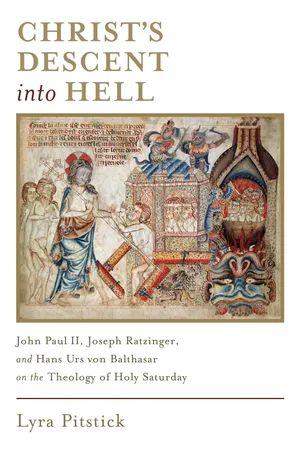
eBook - ePub
Christ's Descent into Hell
John Paul II, Joseph Ratzinger, and Hans Urs von Balthasar on the Theology of Holy Saturday
- 144 pages
- English
- ePUB (mobile friendly)
- Available on iOS & Android
eBook - ePub
Christ's Descent into Hell
John Paul II, Joseph Ratzinger, and Hans Urs von Balthasar on the Theology of Holy Saturday
About this book
Information
Topic
Theology & ReligionSubtopic
Christian Denominations1
Balthasar on the Descent
According to Balthasar, Christ’s descent into hell is the pinnacle of the Trinity’s self-revelation in salvation history. In this event, God’s love remains unscathed by His descent into — and real union with — what is most not Himself, sin and the abandonment by God that is its punishment. The sovereign freedom necessary to punish sin and embrace this justice in love for the world’s redemption will manifest God’s trinitarian divinity.
Christ’s Descent, Not His Cross, Completes the Redemption
Four specific details can help fill out this summary of Balthasar’s theology of Christ’s descent into hell (or descensus, which is Latin for descent and still sometimes used as a technical term to refer to this event). First, in Balthasar’s view, the reconciliation of God with the world is not complete with Christ’s death on the cross, but only with the Son’s descent into hell. For, he says, “it is possible to distinguish between sin and the sinner.”1 He uses distinguish here in the sense of a real separation. Balthasar writes, “because of the energy that man has invested in it, sin is a reality, it is not ‘nothing.’ ”2 In other words, sin is not merely a defect in an action, or an action that lacks some good it ought to have; rather, sin has a kind of real being itself.3 As such a reality, sin may be taken from the sinner and loaded upon another,4 not just as a figure of speech or in idea, but in actuality. The transfer of sin to Christ begins in Gethsemane and is completed upon the cross.5 Mankind is thus freed from the guilt of sin even before Christ’s death. However, the separate reality of the sins themselves remains to be expiated. Balthasar insists that expiation occurs in the descent: Christ’s death on the cross provides Him entrance to the state of being dead, which “constituted the term and aim of the Incarnation. . . . [For] only what has been endured is healed and saved.”6
Christ’s Suffering Increases in His Descent
Balthasar’s principle that “only what has been endured is healed” resembles but significantly changes the patristic maxim, “What is not assumed is not healed.” The Church Fathers were arguing that Christ was truly human, that the Son of God took upon Himself (“assumed”) a whole human nature, both body and soul, and not a body only. In contrast, as we will shortly see confirmed, Balthasar’s version concerns not nature, but punishment: Christ expiates (“heals”) sin by undergoing (“enduring”) the punishment for sin. Balthasar’s principle is his premise for a second detail about his position: because Christ must bear all punishment for sin, His suffering intensifies after His death on the cross. “God has redeemed us,” Balthasar reminds his reader, from “nothing less than hell, the eternal exclusion from the presence of God.”7 Our Savior is “conformed to his brethren even in this”;8 thus He descends “into ultimate perdition” and the “estrangement from God of hell” such that “he experiences the complete godlessness of lost man.”9
Balthasar is explicit. “The interior death of sin . . . is the terminus a quo of the common Resurrection,”10 that is, the extreme from which both Christ and sinners rise. Because physical death entered the world through the spiritual death that is sin (par. Rom 5:12), Balthasar thinks both spiritual death and physical death should be understood in texts such as Rom 14:9: “For to this end Christ died and lived again, that he might be Lord both of the dead and the living.”11 Thus the scars in Christ’s risen body will reveal His “unique experience of death that is both spiritual and bodily.”12 “The reality of the poena damni [the pain of the loss of God in hell] is spiritual and can be experienced only spiritually.”13 Balthasar calls the pre-redeemed afterlife where Christ experiences spiritual death Sheol. (In my text here, I will capitalize Sheol wherever it is used in Balthasar’s sense.) Parallel to St. Thomas Aquinas’s statement that God unites Himself to the human intellect in the beatific vision,14 Balthasar says,
[Christ in Sheol] can and must be one with the object of his vision: the second death which, itself, is one with sheer sin as such, no longer sin as attaching to a particular human being . . . but abstracted from that individuation, contemplated in its bare reality as such.15
And as St. Thomas calls the beatific vision the visio Dei (the vision of God), Balthasar calls this infernal vision the visio mortis (the vision of death). This passage and similar ones confirm that Balthasar’s language of separation, loading, and the like are not merely metaphorical, as some claim. Instead, Balthasar treats sin as a real substance, one that always retains its essence of culpability des...
Table of contents
- List of Tables
- Acknowledgments
- Note to Reader
- Introduction
- 1. Balthasar on the Descent
- 2. Ratzinger on the Descent
- 3. Ratzinger on the Descent after His Election as Benedict XVI
- 4. John Paul II on the Descent
- 5. A Significant Sidenote on Schönborn
- 6. The Crux of the Problem: Who Is Right?
- 7. The Crux, Continued:John Paul II’s and Ratzinger/Benedict XVI’s Praise of Balthasar
- Benedictus Deus’ Definition
- Roman Catechism (Catechism of the Council of Trent)on Christ’s Descent
- Catechism of the Catholic Church on Christ’s Descent
- Pope John Paul II’s Catechesis on Christ’s Descent
- The Passion and Triumph of Eternal Spring
- Bibliography
Trusted by 375,005 students
Access to over 1.5 million titles for a fair monthly price.
Study more efficiently using our study tools.
Frequently asked questions
Yes, you can cancel anytime from the Subscription tab in your account settings on the Perlego website. Your subscription will stay active until the end of your current billing period. Learn how to cancel your subscription
No, books cannot be downloaded as external files, such as PDFs, for use outside of Perlego. However, you can download books within the Perlego app for offline reading on mobile or tablet. Learn how to download books offline
Perlego offers two plans: Essential and Complete
- Essential is ideal for learners and professionals who enjoy exploring a wide range of subjects. Access the Essential Library with 800,000+ trusted titles and best-sellers across business, personal growth, and the humanities. Includes unlimited reading time and Standard Read Aloud voice.
- Complete: Perfect for advanced learners and researchers needing full, unrestricted access. Unlock 1.5M+ books across hundreds of subjects, including academic and specialized titles. The Complete Plan also includes advanced features like Premium Read Aloud and Research Assistant.
We are an online textbook subscription service, where you can get access to an entire online library for less than the price of a single book per month. With over 1.5 million books across 990+ topics, we’ve got you covered! Learn about our mission
Look out for the read-aloud symbol on your next book to see if you can listen to it. The read-aloud tool reads text aloud for you, highlighting the text as it is being read. You can pause it, speed it up and slow it down. Learn more about Read Aloud
Yes! You can use the Perlego app on both iOS and Android devices to read anytime, anywhere — even offline. Perfect for commutes or when you’re on the go.
Please note we cannot support devices running on iOS 13 and Android 7 or earlier. Learn more about using the app
Please note we cannot support devices running on iOS 13 and Android 7 or earlier. Learn more about using the app
Yes, you can access Christ's Descent into Hell by Lyra Pitstick in PDF and/or ePUB format, as well as other popular books in Theology & Religion & Christian Denominations. We have over 1.5 million books available in our catalogue for you to explore.